

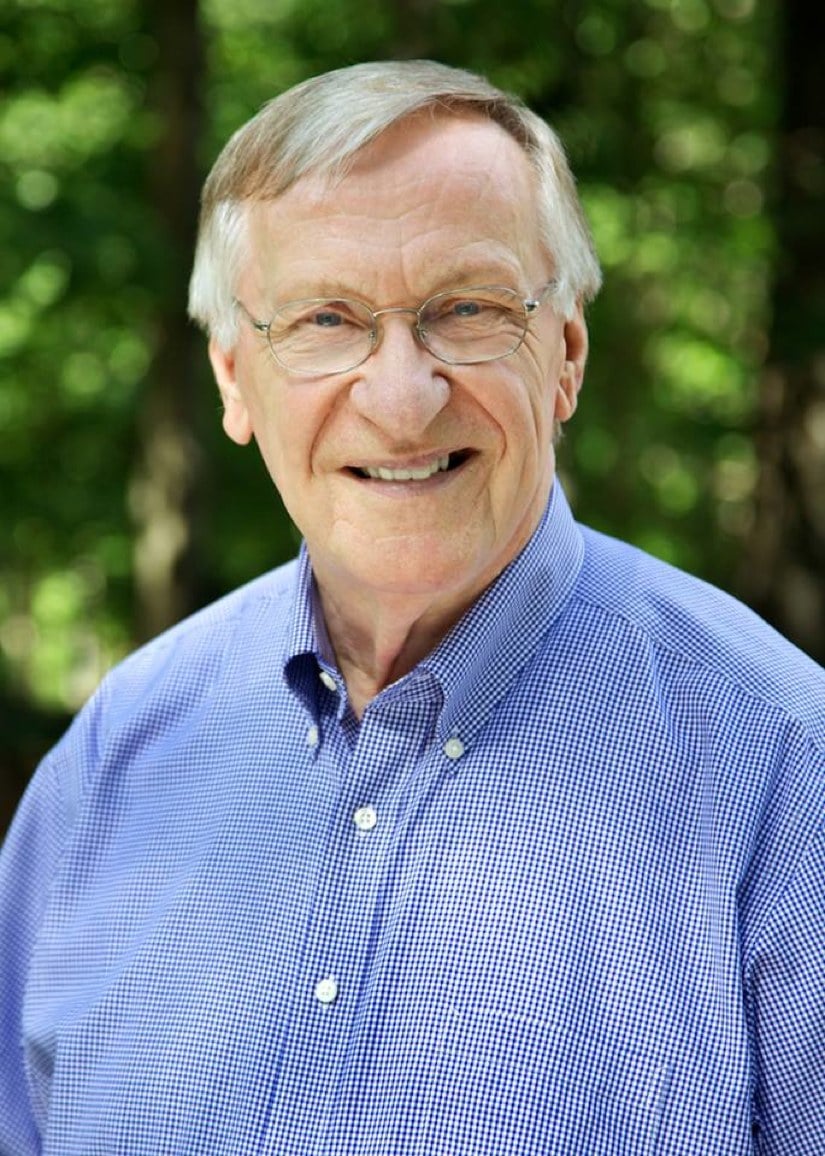
 This is a commentary from Del. Ken Plum (D), who represents Reston in Virginia’s House of Delegates. It does not reflect the opinion of Reston Now.
I am currently the longest serving member of the Virginia House of Delegates. My license plate that has only “1” on it is the subject of many stares and the occasional “How did you get that number?” I have been in office continuously since 1980. I served one term prior to that time, but seniority is counted by continuous service.
I was a candidate for office twice before I was elected. I first ran for the House of Delegates in 1973 and again in 1975. Both times I came close, but close does not count in elections.
I ran in what was the 18th legislative district which encompassed half of Fairfax County, Fairfax City and the Towns of Herndon and Vienna, which were represented by five at-large delegates.
When the Commonwealth of Virginia was forced by the federal government to reapportion the legislature to conform to the “one-man, one-vote” principle, Fairfax had a population equivalent to ten legislative districts. Rather than dividing up the county into individual districts, the legislature drew a line down the center of the county creating two districts with five at-large delegates each. Read More
This is a commentary by Del. Ken Plum (D), who represents Reston in Virginia’s House of Delegates. It does not reflect the opinion of Reston Now.
Voters in the 36th legislative district, which I represent, will receive my annual voting guide in their mailboxes this week. I hope you will find it useful. You can also view the guide online at www.kenplum.com.
Of course individuals make their own choices in voting, but many people ask me for my advice. That is why I started sending out a guide many years ago. In addition to sharing my election picks, the guide provides voters with advanced notice of what is on the ballot in addition to high-profile races.
For example, in addition to voting for the next president this year, voters in my district will elect their member of the House of Representatives, and they may vote on a referendum on a tax, two state constitutional amendments, and a bond referendum.
I enthusiastically recommend a vote for the electors for Hillary Clinton for president and Tim Kaine for vice-president. My endorsement of Hillary Clinton is not because of her political party, her being a woman or her being “the lesser of two evils” as some people are saying. I support her because she is the best-qualified and most experienced person with the clearest agenda of any person I have ever supported in my lifetime — and that goes back to John Kennedy. Read More
This is a commentary from Del. Ken Plum (D), who represents Reston in Virginia’s House of Delegates. It does not reflect the opinion of Reston Now.
Since 1947, the Code of Virginia has provided that any agreement or combination between an employer and a labor union or labor organization whereby (i) nonmembers of the union or organization can be denied employment, (ii) membership in the union or organization is made a condition of employment or continuation of employment by the employer, or (iii) the union or organization acquires an employment monopoly in any such enterprise is against public policy and illegal.
On the ballot in Virginia on Nov. 8 is a constitutional amendment question, one that would put this provision of law into the constitution. There are 26 states, including Virginia, that have such a provision in their constitution or in their laws. Why would Virginia need to have these provisions in its constitution as well as in the Code?
The answer is a political one. The conservative Tea Party members of the legislature are seeking one more opportunity to demonstrate to their base just how anti-labor union they are. While they term this amendment “right to work,” its effect on workers is anything but a right. It gives employers more opportunity to deny workers access to a union or professional organization like a teacher’s or firefighter’s association. It allows some workers to gain the benefits of the work of the union or organization without contributing to it as the members do. Read More
This is a commentary by Ken Plum, who represents Reston in Virginia’s House of Delegates. It does not reflect the opinion of Reston Now.
October is National Cybersecurity Awareness Month as designated by the U.S. Department of Homeland Security. The purpose of the month is “to engage and educate public and private partners through events and initiatives to raise awareness about cybersecurity, provide them with tools and resources needed to stay safe online, and increase the resiliency of the Nation in the event of a cyber incident.”
Certainly the news of cyber attacks and hacking almost daily have made the public more aware of the reality of cybersecurity. One campaign — Stop.Think.Connect.– sponsored by the Department of Homeland Security, is designed to promote safe online behavior and practices by members of the public.
This is a commentary by Del. Ken Plum (D), who represents Reston in Virginia’s House of Delegates. It does not reflect the opinion of Reston Now.
Native Virginian and long-time advocate August Wallmeyer is providing a real service to the people of the Commonwealth and its public policy with his forthcoming book The Extremes of Virginia.
Recently, the Richmond Times-Dispatch included a four-part series from it available at www.richmond.com. The extremes to which he refers are the Southwest, Southside and the Eastern Shore parts of Virginia that are geographically on the outer bounds of the state but more importantly are largely unknown to many including policy makers. They are “separated by distance, culture and economics, and unequal in opportunity and education.”
The evidence of the extremes of these regions is overwhelming. As he explains, the people in these extreme regions earn about two-thirds of what Virginians statewide do and are poorer with an average poverty rate 67 percent higher than the rest of the state.
This is a commentary by Del. Ken Plum (D), who represents Reston in Virginia’s House of Delegates. It does not reflect the opinion of Reston Now.
When Captain John Smith and other Englishmen made their way to the new land of Virginia in 1607, they found a richness of natural beauty and resources unmatched in any place else they had been.
John Smith’s visit around the natural estuary that we now call the Chesapeake Bay highlighted the wealth of forests, wildlife and sea life the new land offered. Little wonder that it became such an inviting place to settle and establish cities and factories. Fast forward to the turn of this century and the Chesapeake Bay had in many places become a dead zone without the ability to sustain life in its waters. Most of its riches had been stripped away.
Fortunately, citizens concerned about environmental issues rallied together mostly under the auspices of the Chesapeake Bay Foundation to work and lobby for the kind of actions necessary to save and restore the Bay. In 2010, the six Bay states, along with the federal government and the District of Columbia, began a renewed effort to restore the health of the Bay and the rivers and streams that flow into it through a Chesapeake Clean Water Blueprint. Read More
This is a commentary by Del. Ken Plum, who represents Reston in Virginia’s House of Delegates. It does not reflect the opinion of Reston Now.
My parents knew of my interest in politics and government from the time I started school. I do not remember their specific reaction in the early 1970s when I told them I was going beyond working for other candidates and was going to run for the state legislature myself.
I do quite clearly remember my mother’s question after the 1972 break-in at Democratic Headquarters in the Watergate and the ensuing scandal that led to President Nixon’s resignation. She asked if I was sure that I wanted to be in politics, a profession that was not too highly regarded.
My answer was straightforward: now more than ever! I explained to her my belief that if honest people did not want to get involved in politics then the running of government would be left to the scoundrels and crooks. I did not want that to happen.
She would probably ask me the same question today and for good reason. While some will dismiss my views as partisan, I want to make clear that my concern here is with Donald Trump, an individual who was able to bully his way to the Republican nomination for President. Read More
This is an opinion column by Del. Ken Plum (D), who represents Reston in Virginia’s House of Delegates. It does not reflect the opinion of Reston Now.
A brief trip to the Shenandoah National Park and the Skyline Drive which Jane and I took recently with two of our grandchildren brought back a flood of memories.
Our stay-over was at Skyland Lodge, where in the summer of 1959 I was cashier at the dining room and in the summer of 1960 I was room clerk. We spent the night in a unit that was next door to the Canyon unit, where my Mother was maid for both those summers. Employees who lived as we did in the Shenandoah Valley stayed in employee housing for our six-day work week since the distance home was too great to commute daily.
My second summer there I shared a room in Trout Cabin with the student minister who worked as a regular employee during the week and conducted a worship service on Sunday.
Living atop the Blue Ridge Mountains was a treat for me. For one thing it was a lot cooler, and we did not have air conditioning at home. Being there daily allowed me to appreciate the mountain in all its moods from cloud shrouded to clear views of the Valley below. But my most lasting memory came from my conversations and debates with my roommate. Read More
This is a commentary by Del. Ken Plum (D), who represents Reston in Virginia’s House of Delegates. It does not reflect the opinion of Reston Now.
In the week that I was in Chicago for the annual Legislative Summit of the National Conference of State Legislatures (NCSL), there was a record 100 people shot in the city in less than a week. According to data kept by the Chicago Tribune, there had been by that time 2,514 shooting victims–about 800 more than at the same time last year.
Between the Friday afternoon after I had arrived and the next Thursday morning, at least 99 people were shot in the city — 24 of them fatally. Among the wounded was a 10-year-old boy who was shot in the back.
Although I was in the city, I had no direct or personal knowledge of what was going on. I was downtown in the McCormick Convention Center part of the city, and I saw no violence and heard no police sirens. What I knew came from reading the newspaper. The experience reminded me that although most of us fortunately live outside areas of violence, we can never be sure of when our sense of safety can be shattered and the next instance of gun violence can happen in or near our community.
Who would have thought that a record for mass murders would be set in Virginia in 2007 when 32 people were killed and 17 wounded on a college campus? That record was broken in 2016 in an Orlando, Florida, nightclub when a gunman killed 49 people and wounded 53. Mass murders that for most of our history did not take place are becoming too frequent. But beyond the mass murders there are more than 33,000 gun deaths and more than 130,000 people shot per year in this country.
According to the organization Americans for Responsible Solutions, Americans are 25 times more likely to be murdered with a gun than people in other developed countries like ours. They report that from 2005-2015 71 Americans were killed by terrorist attacks on U.S. soil while 301,797 were killed by gun violence during the same period. Their shocking statistics show that since the Sandy Hook tragedy in 2012 a child under 12 has been killed by intentional or accidental gunfire every other day. More than 50 gun suicides occur on average every day in our country making guns the most common and lethal means of suicide.
We cannot let these numbers become the norm for our country nor can we let ourselves become desensitized to the public health menace that gun violence has become. That is why I and others participate in an End Gun Violence Vigil at the headquarters of the National Rifle Association (NRA) on the 14th of every month to keep in the public mind the role that gun manufacturers and others play with their campaign contributions and lobbying in defeating commonsense gun safety laws.
I hope that gun violence becomes a major issue in the current presidential and congressional campaigns. I will be introducing a universal background check bill in the next session of the General Assembly.
This is a commentary by Del. Ken Plum (D), who represents Reston in Virginia’s House of Delegates. It does not reflect the opinion of reston Now.
“Our Nation is at risk,” thus began a report on schools given to President Ronald Reagan in 1983. “…We report to the American people that while we can take justifiable pride in what our schools and colleges have historically accomplished and contributed to the United States and the well-being of its people, the educational foundations of our society are presently being eroded by a rising tide of mediocrity that threatens our very future as a Nation and a people.
“What was unimaginable a generation ago has begun to occur–others are matching and surpassing our educational attainments.” (A Nation at Risk, U.S. Department of Education, 1983)
At a meeting of the National Conference of State Legislatures (NCSL) two weeks ago, I heard a similar report from its Study Group on International Comparisons in Education: “The bad news is most state education systems are falling dangerously behind the world in a number of international comparisons and on our own National Assessment of Educational Progress, leaving the United States overwhelmingly underprepared to succeed in the 21st century economy.” (No Time to Lose: How to Build a World-Class System State by State, NCSL, August, 2016)
The Nation at Risk report led to numerous reforms, from high stakes standardized testing, charter schools, standards of learning, common core and others, many of which have themselves already been reformed. I question the accuracy of another report that predicts doom for our public schools.
That there is an unacceptable level of disparity in achievement among groups of students is undeniable. That our goals for our students may be greater than they can sometimes achieve may be true. That our schools do an incredibly wonderful job for most students has been my experience.
What I hope will not happen with this most recent report is that legislators will not jump in with both feet with the latest and greatest ideas they have about reforming schools, lay down unrealistic and inflexible regulations, or assume somehow that the private sector can do a better job than public schools.
Instead, I hope that citizens, advocates, and business representatives will make clear our expectations for our schools and give educators the responsibility to meet those goals with full accountability. Read More
This is a commentary from Del. Ken Plum (D), who represents Reston in Virginia’s House of Delegates. It does not reflect the opinion of Reston Now.
Ratification of the Equal Rights Amendment (ERA) was already being hotly debated in the Virginia General Assembly when I became a member of the House of Delegates in 1978.
A hearing on ratification ended with twelve of twenty members of the committee voting against ratification; they were dubbed “the dirty dozen” by the primarily women supporters of the amendment. The vote caused such a rowdy protest by advocates that the police actually carried some of the women from the room.
As a new member of the House of Delegates who ran on a platform supporting ratification of the ERA, I decided to take a new approach. I wanted to show that the ERA was in keeping with Virginia’s history. If I could show that Thomas Jefferson would support it if he were alive today, the Assembly would likely ratify it or so I reasoned. I wrote to Professor Dumas Malone, author of the six-volume definitive biography of Thomas Jefferson, and asked him if Jefferson were alive in today’s modern society is it not the case that he would support the ERA.
Professor Malone did not take the bait; he refused as a historian to speculate on the future. My plan failed, and Virginia has still not ratified the ERA, despite our repeated attempts to have it do so.
While Virginia is home to the greatest spokespersons for human rights with George Mason’s Declaration of Rights, Thomas Jefferson’s Statute for Religious Freedom and James Madison’s Bill of Rights, the Commonwealth has been among the slowest of the states in embracing any expansion of the scope of human rights beyond their limited 18th century definition. Read More
This is a commentary by Del. Ken Plum (D), who represents Reston in Virginia’s House of Delegates. It does not reflect the opinion of Reston Now.
At the same time that the nation is moving forward with a major political party nominating a woman as candidate for the presidency of the United States, Virginia institutions are clinging to past traditions that should have been abandoned decades ago.
The Supreme Court of Virginia ruled that Governor Terry McAuliffe exceeded his authority in a blanket restoration of the voting rights of 206,000 felons who have completed their sentences. There are a number of serious concerns about the Court’s 4-3 decision.
While the Chief Justice who wrote the opinion did not dispute the fact that the Governor clearly has the authority to restore voting rights — as Professor A. E. Dick Howard, the chief drafter of the current Virginia Constitution, and other experts testified — he quibbled with the method the Governor chose in restoring the rights.
The majority of the Court found that the restoration of rights needed to be an individual action and not a class action although there is no provision in the Constitution requiring it.
This is an opinion piece by Del. Ken Plum (D), who represents Reston in Virginia’s House of Delegates.
For a short time when I was in college, I sold Fuller brushes and home cleaning products door to door to make money to pay my bills.
I could make several-fold more per hour selling door to door with flexible hours than I could with any other part-time job. I was trained by a mentor salesman who made a good living selling the well-known brushes and cleaners.
One practice of his that I never adopted was to knock on doors that had a “no solicitation” sign. He explained that while he may encounter a grumpy person or two behind those doors he mostly found people with a low resistance to sales pitches who used the signs as their first level of defense to keep from buying something.
More recently, I have been seeing a different sign, “Don’t Tread on Me,” not on homes but on vehicle license plates. The original yellow flag with a coiled snake and the slogan on it was the flag of the early navy in our country. Today it is the flag of the Tea Party.
Each time I see the yellow license plate I wonder what message it is intended to convey. Is it at all like the “no solicitation” signs on homes that proved to be a not-very-effective defense from the salesman and the outside world? Or is it a proclamation of self-importance that one should be able to live in the world without being bothered by others?
Since the flag has been adopted politically by the Tea Party-ites, its meaning no doubt is aimed at laws, regulations, or government actions that are viewed as “treading” on someone.
Government actions do affect us. We have a system of national security that gets in our way especially when we want to board an airplane or enter a government building. We may feel tread upon by the number of traffic rules we have to abide by or by the health and safety regulations affecting our homes and businesses. Certainly there have been cries of protest at any attempts to tread on someone’s ability to buy and carry any size gun whenever or wherever they want.
Living in a civilized society means that we sometimes are inconvenienced by the necessity to compromise some of what we are doing for the greater community’s health and safety. There simply has never been a government devised that allows everyone to live a life unfettered without any thought of the needs of others. There is no constitutional right to live a life trampling on others in order that you are not tread upon.
While certainly not intended by most, the admonition to not tread on me can be interpreted as selfishness. You view your needs as greater than others; your rights trump (sorry for the pun) others’ rights. Certainly there are mixed messages that can be interpreted from such a simple phrase. I prefer the simpler and easier to understand bumper stickers like “live simply so that others can simply live” or “coexist.”
What does “don’t tread on me” mean to you? Positive or negative. Let me know at [email protected].
This is a sponsored post by Del. Ken Plum (D), who represents Reston in Virginia’s House of Delegates.
In a few days, I will be driving about six hours from my home in Reston to Wise County in Southwest Virginia to volunteer at the Remote Area Medical (RAM) Health Clinic at the county fairgrounds.
About 5,000 patients are expected to show up at this three-day health event for their once-a-year opportunity for professional health care. The RAM clinics were founded by television star Stan Brock to provide health care for indigent patients in under-developed nations. He soon learned that the same kind of care and services were needed in the Appalachian region of Virginia and Tennessee.
Organizing the health care days in Wise County is the Health Wagon, a mobile health clinic, that provides services throughout the year for a four-county region that is the poorest in the state. In addition to its clinic on wheels, the Health Wagon also has two stationary health clinics in Wise and Clintwood counties. The typical patient is 38 years old with an annual income of less than $20,000. These people cannot afford regular health care insurance, and since the Virginia General Assembly has refused to close the coverage gap they make too much money to qualify for Medicaid.
Read More
This is a commentary by Del. Ken Plum (D), who represents Reston in Virginia’s House of Delegates. It does not reflect the opinion of Reston Now.
Each week during the General Assembly session and several times monthly during the remainder of the year, I travel the Dulles Toll Road to the Beltway to I-95 South to Richmond.
Since I travel south early in the mornings and return late in the day, I can generally make the trip in two hours. Mine is a reverse commute, but I witness in the lanes going in the other direction the bumper-to-bumper, slow-moving traffic experienced by commuters daily. Express lanes on the Beltway–I-495–along with its widening have helped relieve congestion with the exception of the American Legion Bridge that is like a parking lot much of the time. I-95 is its own parking lot during commuting times.
Fortunately, relief is on the way, but the size of the transportation projects requires years for completion. Widening with express lanes and using traffic management technology will bring some relief to the I-66 corridor.
The most promising congestion relief for the region was announced recently with Virginia receiving a $165 million federal FASTLANE grant that will be leveraged to fund $1.4 billion in multimodal transportation projects in the congested I-95 corridor. The entire undertaking is being called the Atlantic Gateway Project.
For the highway commuters I see stuck in traffic on my trips to Richmond, the project will fund the extension of Interstate 395 express lanes about 7 miles north to the Potomac River and I-95 express lanes about 10 miles south towards Fredericksburg. A new I-95 bridge will be built across the Rappahannock River. For rail commuters and rail freight the project includes the construction of 14 miles of new track along the CSX rail corridor crossing the Potomac River to enhance freight, commuter and passenger rail routes. Mass transit options will be expanded with 1,000 new parking spaces for commuters along I-95 and I-395.
The federal money coming from the United States Department of Transportation competitive grant program, FASTLANE, is part of a $4.6 billion, 5-year program that was passed in Congress in 2015 after years of delay and inaction.
The project in Virginia has national significance in that it will help unlock the most congested part of I-95 on the East Coast. Not only will Virginia commuters realize relief, but it will be shared by travelers from New York to Florida. Likewise, commerce will be enhanced with the railway and highway improvements.
Added to the $165 million in federal money will be $565 million in private investment by Transurban and CSX Transportation through public-private partnership agreements and $710 million in state transportation funds. Construction on some parts of the project will begin as early as 2017.
The approach being used in this corridor establishes a significant precedent that must be followed to successfully unlock other areas of Northern Virginia from some of the worst traffic congestion in the country.
