

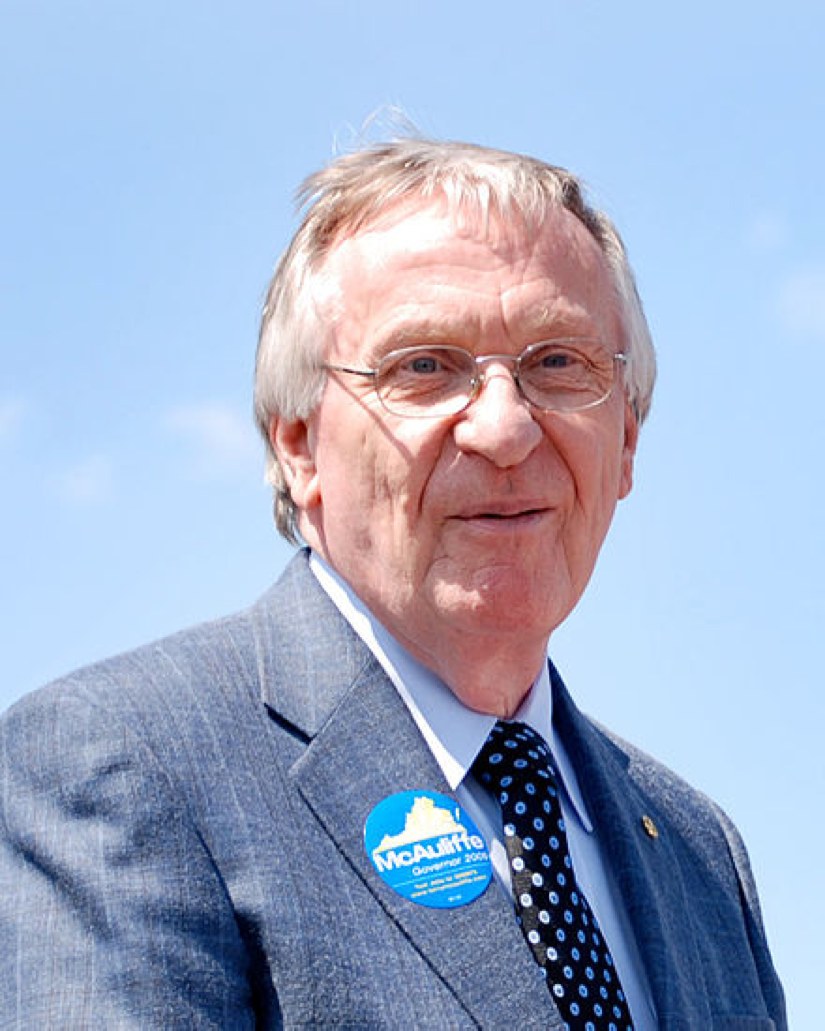
 Governor-elect Terry McAuliffe hit the ground running when the day after his election he announced his transition team and a webpage at which he solicits ideas and suggestions and invites resumes from those who want to work in his administration.
His approach of assembling a bipartisan transitional team, moving quickly and seeking input are crucial for Virginia at an important transitional time. Last week, I talked about many of the issues like Medicaid expansion that were debated during the campaign and need immediate attention. There are many other issues that do not get as bright a spotlight but deserve serious attention. One is the natural landscape of Virginia and the quality of its air and water.
More than a month ago, VIRGINIAforever, a coalition of concerned businesses, environmental organizations and outdoor enthusiasts, presented to the gubernatorial candidates a five-year plan, “Investing in the Commonwealth’s Land and Water.” As the report points out, Virginia’s population has doubled in the last 50 years putting great stress on our land and water.
The Commonwealth has a constitutional requirement unique among the states “to protect its atmosphere, lands and water from pollution, impairment, or destruction, for the benefit, enjoyment and general welfare of the people of the Commonwealth.” Virginia currently spends just over one percent of its budget on land conservation and water quality improvements. As the title of the report suggests, it will be necessary to “invest” more greatly if the goals of the report are to be met. But investing also suggests that there is an expected return.
Part of the changing landscape of Virginia is the loss of farmland. Since 1997 nearly 150,000 acres of farmland have been converted to other uses. A drive through the Shenandoah Valley can provide immediate visual evidence of the change. While the new use is justified in economic terms, it needs to be recognized that farming and forestry has nearly a $100 billion impact on Virginia’s economy.
The report calls for Virginia to protect 120,000 acres of farmland over the next five years through the use of tax credits. And, in order to meet the growing demand for state parks at a recommended level of 10 acres of park per 1,000 Virginians it will be necessary to conserve an additional 18,000 acres by 2020.
Only about one-third of Virginia’s 52,255 miles of rivers have been assessed for impairment, and of those assessed waters 71 percent are impaired for one or more uses as are over 80 percent of Virginia’s lakes and the Chesapeake Bay, according to the VIRGINIAforever report.
One of the most important statements in the report is that “concerns about cleaning up our polluted waters often fall back on predictions of negative consequences for the economy. Experience has not just disproven the concern that environmental restoration threatens economic prosperity, it has demonstrated just the opposite—economies cannot thrive in a world of depleted and degraded natural resources, and in fact, innovation, investment, and competition have spurred job growth in new sectors just when traditional sectors were faltering.”
The nature of Virginia must be a priority of the new administration!
Ken Plum (D-36th) represents Reston in Virginia’s House of Delegates. He writes a weekly column for Reston now. He can be reached at [email protected].
Results of the election are not known to me as I write this column, but polling suggests that there will be a shift towards the middle of the political spectrum in the Old Dominion this year. Seldom have the choices been clearer on political philosophy among the statewide and House of Delegates candidates as they were in this election.
Virginia faces some serious challenges that the new governor and the General Assembly must take on. Regardless of the claims that the state has had a budget surplus the last four years, the Commonwealth has experienced slow growth during this period that has produced small ending balances as a result of conservatively estimated revenues. When measured against the unmet needs in many areas of the budget, state coffers are empty.
Transportation needs will take some dollars from a general fund that is already inadequate to address education, mental health and other pressing issues. Fairfax County Public Schools are facing a $140 million deficit in part because of the declining per student support from the state.
The outgoing governor will propose a budget for the next biennium, but the priorities of that budget will need close scrutiny by the new governor and General Assembly. The slow erosion of support for public education at all levels needs to be reversed. With all the data that support the value of preschool programs, the state’s investment in these programs needs to increase. Mental health programs are grossly underfunded with as many as a third of local jail populations being persons in need of mental health treatment.
Although legislation is in place to allow Virginia to move into an expanded Medicaid program, there seems to be reluctance on the part of the commission appointed to bring about certain reforms to take the last step of expanding Medicaid even though the reforms have been accomplished. The new governor should ask the General Assembly to act right away to extend insurance to 400,000 Virginians and to pay for it by receiving federal dollars paid by Virginians. There is no good reason for those dollars to go to residents of another state when there are over a million Virginians without health insurance.
As the location of one of the greatest incidents of gun violence — Virginia Tech — the state needs to enact important gun safety measures that will expand background checks to all gun sales and to expand its background database to include persons with violent mental health illnesses. We need also to recognize that the world has passed us by, and we need to repeal the marriage amendment to allow people who are in love to marry regardless of their sexual orientation. Likewise we need to pass laws against discrimination based on sexual orientation.
That is the beginning of the list of work for the legislature to do. I always invite your recommendations on legislation; email me at [email protected].
Reston resident Ken Plum, re-elected by Reston voters on Nov. 5, has represented Virginia’s 36th District in the Virginia House of Delegates since 1982. Plum’s campaign is Reston Now advertiser.
By Delegate Kenneth R. “Ken” Plum
Recently, I was asked to participate in a workshop for a group of leaders who were planning a future for their organization. Specifically, I was asked to discuss the characteristics of our community of Reston. While I try to stay on top of trends and am out in the community on a daily basis, I learned a lot preparing for the presentation at the workshop.
While the 400 square miles of Fairfax County are about average size for a county in Virginia, there is little else average about us in the state or in the nation for that matter. Virginia is the 12th-largest state in population among the 50 states, but the 1.1 million people in Fairfax County is larger in population than any other jurisdiction in Virginia. Richmond has just over 200,000 people; Washington, D.C. just over 600,000.
Virginia is the eighth-wealthiest state in household income, but the Northern Virginia jurisdictions of Fairfax, Loudoun, and Arlington have the highest level of household income in the nation. In fact, the median household income in Fairfax County is more than twice that of the United States.
That is not to say that everyone in Fairfax County is wealthy. We have the same income gap between the top and bottom incomes as exists throughout the country. While Fairfax County has a seemingly low rate of poverty at six percent, that rate translates into 72,000 individuals; a low rate but a high number! Eight percent of children under eight were below the poverty level compared with four percent of people 65 years and over. Thirteen percent of families with only a female head of household present had incomes below the poverty level.
Just as our county’s population has gone from about 454,000 in 1970 to 1.1 million today with an expected growth to 1.37 million in 2040, the population has become more diverse. Thirty percent of the people living in Fairfax County are foreign born. Of the foreign born, just over half were born in Asia, about 30 percent in Latin America, and the rest from throughout the world.
The diversity of our population by ethnicity and race can best be seen in our schools that are themselves diverse in different ways. Hunters Woods Elementary is 33 percent Asian while nearby Dogwood Elementary is 60 percent Hispanic. Lake Anne Elementary is 37 percent white, 29 percent Hispanic and 21 percent black. Nearby Forest Edge is 40 percent white, 18 percent Asian, 20 percent black and 15 percent Hispanic. Demographic information is available on each public school’s website.
The population of Fairfax County is among the best educated in the country. Of persons age 25 and older, 28 percent have advanced degrees beyond the bachelor’s, 30 percent have bachelor’s degrees, and only about eight percent have less than a high school education.
All these characteristics make our community unique and special. A wonderfully diverse population with very different backgrounds and needs contributes to our special culture. I would not want to live anywhere else in the world.
Reston resident Ken Plum has represented Virginia’s 36th District in the Virginia House of Delegates since 1982. Plum’s campaign is Reston Now advertiser.
