

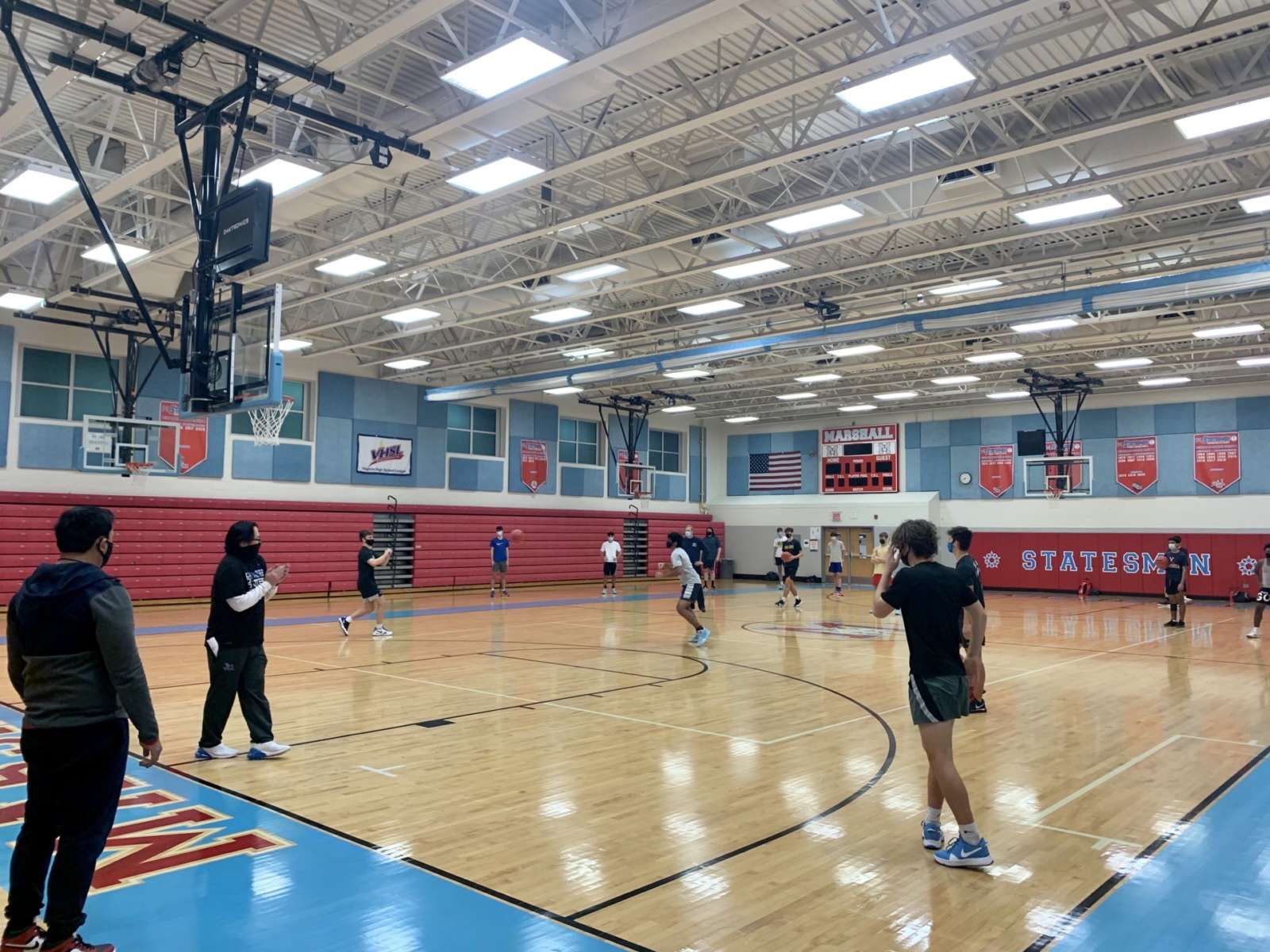
For the first time since Mar. 12, high school athletes in Fairfax County have games to play.
Boys’ and girls’ basketball teams around the county will began yesterday (Monday) to usher in an unusual winter sports season that will unfold in front of largely empty stands, marking students’ return to athletic competition after the COVID-19 pandemic wiped out this year’s spring and fall seasons.
Under Virginia’s current COVID-19 rules, spectators are limited to 25 people per field for indoor sports and two guests per player for outdoor sports. The total number of spectators for any venue is capped at 30% of its occupancy capacity.
Though Gov. Ralph Northam signed an executive order on Oct. 30 permitting school sports to proceed, the Virginia Department of Health says participating in recreational sports that require close contact with others “during times of substantial COVID-19 activity in a community…is not advisable.”
With COVID-19 transmission rates now higher than the spring surge that led schools to shut down, winter sports have been postponed or canceled in Washington, D.C., and nearly all of Maryland. The City of Alexandria announced in November that its schools would opt out of the season.
Most of Virginia, though, appears to be forging ahead with the Virginia High School League’s “Championships + 1” schedule, which pushed fall sports to Feb. 2 and spring sports to Apr. 12.
However, Fairfax County Public Schools has put some restrictions in place.
While the VHSL is “strongly” encouraging masks without mandating them, FCPS is requiring nearly all athletes to wear masks even while competing, providing limited exceptions only for swim and dive, wrestling, and cheerleading. Athletes will also not have access to locker rooms this year.
“The expectation will be that kids come to practice/games ready to compete and will leave the facility immediately after the event,” FCPS said in a news bulletin sent to families yesterday.
While fans can’t attend games in-person for now, at least some competitions will be streamed live through the host teams’ websites or social media accounts.
Photo via Marshall High School Athletics/Twitter

Metro will start collecting fares from bus riders again on Jan. 3 as part of its pandemic recovery plan, the Washington Metropolitan Area Transit Authority announced yesterday (Thursday).
The WMATA board of directors authorized a temporary suspension of Metrobus fare collections in March as part of a policy prompted by the COVID-19 pandemic that required riders to board buses through the rear doors in an effort to reduce contact between passengers and drivers.
With fare collections resuming, bus riders should return to entering the vehicles from the front, where the farebox and SmarTrip equipment are located.
WMATA says the change in policy is enabled by the more robust public health procedures that it has put in place now that there is a better understanding of how the novel coronavirus is transmitted.
“With everyone wearing masks, shields for operators on every bus, and enhanced daily cleanings, front-door boarding is safe, expands our capacity for more riders, and helps us resume some normalcy,” Metro General Manager and CEO Paul Wiedefeld said. “We also need to collect fares from every rider to keep essential Metro transit employees working and continue to provide essential service.”
Metrobus costs $2 per trip, which is payable in cash or with a SmarTrip card. Metro also offers a seven-day bus pass for $15 that provides unlimited access to Metrobus and other local bus services, including the Fairfax Connector.
The plan to resume collecting bus fare comes as Metro threatens to make significant service cuts after plummeting ridership during the pandemic contributed to a projected deficit of nearly $500 million for Fiscal Year 2022.
The dilemma facing Metro is shared by other major transit systems around the country, leading local elected leaders and transportation officials to call for the inclusion of public transit funding in a federal coronavirus relief package currently under negotiation in Congress.
Without outside support, WMATA could close 19 stations, drastically reduce rail and bus service hours and routes, and eliminate 2,400 additional jobs. The impact of those cuts is expected to land hardest on low-income residents and other populations that depend on transit.
Metro’s proposed FY 2022 budget will be up for public comment early next year.

All Fairfax County Public Schools students will learn virtually tomorrow (Wednesday) as the Washington, D.C., metropolitan area braces for its potential first snow of the year.
While the heaviest precipitation is expected to fall more toward the western part of Virginia, the National Weather Service issued a winter weather advisory at 4:00 p.m. today for Fairfax County, predicting that the area will see mixed precipitation with about one to three inches of snow and sleet accumulation.
The advisory will be in effect from 10 a.m. on Wednesday to 1 a.m. on Thursday.
“Plan on slippery road conditions,” the NWS says. “The hazardous conditions could impact the morning or evening commute.”
That forecast is a slight downgrade from the agency’s projections on Monday, when it issued a winter storm watch suggesting that Fairfax County could see more than five inches of snow.
Still, FCPS has decided to close all school buildings to students.

Fairfax County Public Schools could start expanding in-person learning to more students again in January.
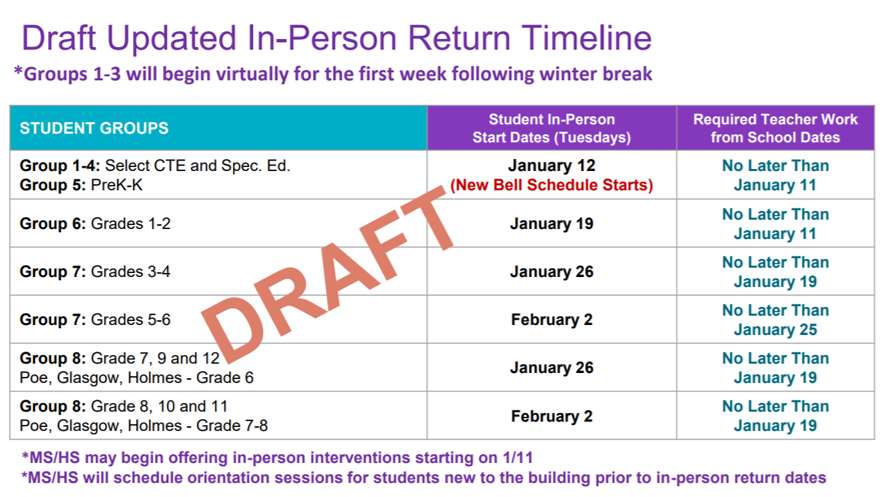
Under a draft timeline that FCPS Superintendent Scott Brabrand presented to the county school board last night (Thursday), all students will learn virtually for the first week after winter break, which lasts from Dec. 21 through Jan. 3.
Students who opt for hybrid in-person/virtual learning would then begin returning to school buildings on Jan. 12, starting with five cohorts that encompass pre-K and kindergarten students, as well as students in special education, English learners, and other specialized programs.
Elementary school students will be phased in, two grades at a time, between Jan. 19 and Feb. 2. Middle and high school students have been split in two groups, with seventh, ninth, and 12th graders returning on Jan. 26, and eighth, 10th, and 11th graders returning on Feb. 2.
“This plan is contingent on health and operational metrics being met,” Brabrand emphasized. “We’ll provide the board an update on this plan on Jan. 5 at our next monthly return-to-school work session and as needed as we get closer to the target dates for the groups.”
During the school board work session, Brabrand also laid out plans for a revised bell schedule to accommodate the increased time and reduced capacity needed to transport students to school by bus, a change that he acknowledged will present challenges for some families and employees.
“However, it is the only way we can return all of our grade levels back to in-person following health and safety guidance,” he said.
To address concerns about students falling behind academically while learning online, FCPS will loosen its grading policies and implement a system of interventions to give more individualized support to students who are struggling. English learners and special education students will also receive targeted support, including teacher-family conferences and regular check-ins.
Brabrand’s Dec. 10 presentation represents represent FCPS’s first concrete effort to resume a process that began on Oct. 5 but was suspended on Nov. 16 after Fairfax County’s COVID-19 caseload exceeded established thresholds for phasing students back into in-person learning.
Whether the new Return to School plan will actually come to fruition as proposed remains to be seen, as the Fairfax Health District continues to report record levels of COVID-19 transmission.
Brabrand alerted the school board that about 4,100 students are on track to revert back to all-virtual learning on Dec. 14, because tomorrow could mark the seventh day in a row where the county averages more than 200 new cases per 100,000 people and has more than 10% COVID-19 tests come back positive over a two-week span.
The superintendent said that FCPS has already sent letters to families whose students will be affected letting them know that a return to virtual learning could happen, though it will be confirmed on Saturday.
School officials have stressed the importance of mitigation strategies, such as social distancing and face mask requirements, to reduce the risk of COVID-19 spread and avoid the need to return all students to distance learning. FCPS announced earlier this week that it is assembling safety teams to monitor adherence to public health protocols at schools that have reopened.
However, the Fairfax County Federation of Teachers reported yesterday that it had recorded 72 safety violations since Oct. 23 through an online safety violation tracker. Members also reported in a survey conducted by the labor union that they have not seen consistent use of masks, social distancing, respiratory etiquette, and proper cleaning and disinfecting practices.
Since Sept. 8, FCPS has recorded 454 COVID-19 cases out of 12,104 in-person students and staff, a more than 3% positivity rate.
The FCFT argues that FCPS should transition all students and staff to virtual instruction until Fairfax County’s COVID-19 positivity rate drops below 5% and all of its standards for a safe reopening are met.
“FCPS’ introduction of a ‘mitigation strategies’ metric is important, but should not be prioritized over community spread of COVID-19,” FCFT President Tina Williams said in a statement. “…Our schools are part of our community and if COVID is spreading in our community, that means it is spreading in our schools.”
It has barely been 10 days since Fairfax County launched its annual Hypothermia Prevention Program, and it’s already clear that this winter will be unlike any other that Abby Dunner has experienced in her nearly decade-long work with the initiative.
Now the manager of the Fairfax County Office to Prevent and End Homelessness, Dunner has been involved with the hypothermia prevention program since she was employed as a case manager and assistant by the nonprofit FACETS in 2012.
The COVID-19 pandemic, however, forced Dunner and the other county and nonprofit officials who run the program to completely reengineer their operations, which were well-honed after 15 years of providing shelter for people in need during the coldest months of the year.
This year’s hypothermia prevention program, which started on Dec. 1 and runs through Apr. 1, 2021, must contend not only with the public health risks and social distancing protocols created by COVID-19, but also the looming threat of a surge in homelessness if emergency assistance measures end.
“We recognize the challenges and kind of the unique situation that we’re in, but everybody is also very much on board with understanding that the program has to continue,” Dunner said. “We have to still be able to shelter people who are experiencing homelessness.”
County officials and the nonprofit contractors that operate the hypothermia prevention shelters realized early on that they would have to make major changes to the program to make it viable this year.
Dunner says the Office to Prevent and End Homelessness collaborated extensively with the Fairfax County Health Department throughout the planning process. Health officials walked through each site and recommended ways to implement social distancing as much as possible.
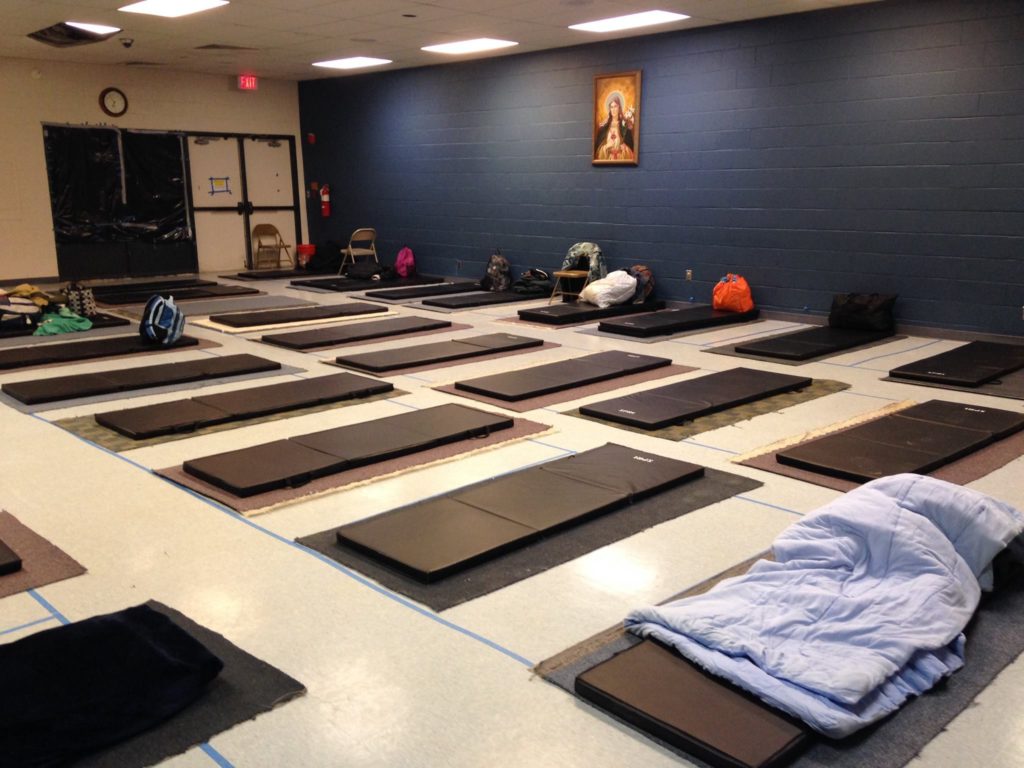
Typically, the county relies on faith communities and nonprofits to host the actual shelters, which rotate between different locations every week, but the churches and other buildings usually utilized were too small to allow for the approximately 100 square feet of space sought per guest.
This time, the county turned to its own facilities, ultimately identifying seven sites that were sufficiently spacious, centrally located, and accessible by public transportation.
Dunner says the hypothermia prevention program generally serves about 1,200 people across its four months of operation, and roughly 215 people utilize the shelters each night.
Though only a handful of people stayed at the Container Store site for the first couple of nights, the shelter averaged about 26 guests over the program’s first seven days, reaching 40 people on Dec. 7 with numbers expected to continue rising, according to Dykes.
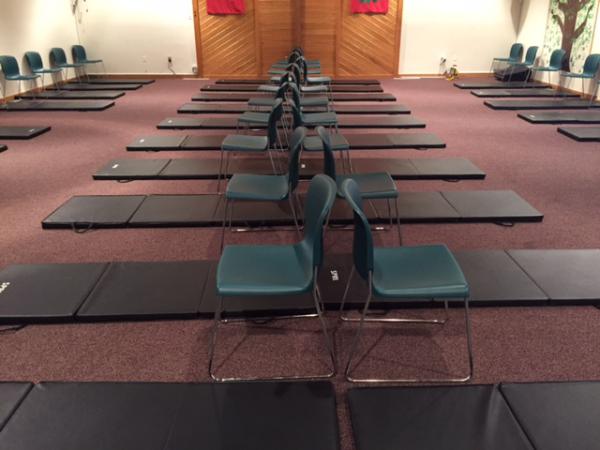
Individuals are given 100 square-foot spaces marked off by tape, and they are required to wear masks except when eating and sleeping in their space.
Shelter staff, who also must wear face coverings, administer temperature checks and wellness questionnaires when guests arrive. If someone records a high temperature or reports COVID-19 symptoms, they are directed to one of the Quarantine, Protection, Isolation and Decompression sites that Fairfax County has set up in local hotels, where they can be monitored and tested.

As of Dec. 9, the county has 445 rooms at six hotels for QPID shelter. 360 of them are occupied by 477 guests, only seven of whom were not experiencing homelessness upon admission, Fairfax County Health and Human Services reported.
In addition to housing people who are unable to isolate or quarantine safely in their own home, the QPID rooms could serve as overflow shelter if the county’s emergency shelters and hypothermia prevention sites run out of capacity.
FACETS Senior Director of Programs Carole Huell says Fairfax County could also revisit sites that were previously considered for the hypothermia prevention program, but a second location would require hiring more staff, something that was already a challenge.
The volunteers that the program normally relies on to staff the shelters are not involved this year, since they tend to be older and, therefore, at higher risk of contracting COVID-19 if exposed.
“There is a back-up plan [if shelters exceed capacity],” Huell said. “It’s just we hope we don’t have to get to that, because each agency that needs additional space for a facility will have to man that space, and that’s additional resources and funding necessary.”
According to Dunner, Fairfax County is already seeing evidence of the pandemic’s economic fallout, as new people enter an increasingly strained social safety system that had glaring deficiencies even before a deadly contagion entered the picture.
Dunner says the county is “very concerned” about the ripple effects of the U.S. Centers for Disease Control and Prevention’s eviction moratorium ending on Dec. 31, but even with the ban in place, evictions have not wholly stopped.
Still, both county and nonprofit workers believe they have prepared adequately for the season. They have also gotten support from partners in various faith communities, who are contributing food, clothing, and other donations in lieu of being able to serve as hosts and volunteers.
“We’re hoping that, based on the spaces that we’ve chosen and the way that we planned the program, we’ll be able to accommodate anyone who’s in need of shelter,” Dunner said.
Image via Fairfax County Office to Prevent and End Homelessness
As a tumultuous year of school closures and virtual learning inches toward a close, students in Fairfax County Public Schools say they are exhausted and feel forgotten by the administration and school board.
Their frustrations bubbled over during a school board meeting on Dec. 3. Two students took issue with recent headlines about upticks in failing grades and the board’s focus on how to resume in-person classes over how to improve the distance-learning experience.
John R. Lewis High School student Kimberly Boateng, who previously served as the school board’s student representative, chastised the board, saying its members have not demonstrated that they have turned the comments and criticisms she has submitted by letter, email and tweet into action.
She urged the county to do better, saying that she is tired of “aspirational goals” and wants the board and FCPS administrators to take concrete actions.
“I’m tired of the ‘we see you’ emails, the ‘we hear you’ tweets,” she said. “…Students are surrounded by so much grief, trauma, and death, and we are expected to continue on as if this is normal. This is not normal.”
As the board’s current student representative, South County High School student Nathan Onibudo said he is caught between knowing the extent of the county’s efforts to address the challenges caused by COVID-19 and experiencing the reality of student life.
“I see what’s possible and I see the hard work being put in,” he said. “[Many students] feel like somehow, they’re being forgotten even though all the conversations are about them.”
He told the school board that, for many students, the debate over whether they should learn virtually or in-person has become secondary to the struggle to survive each day.
“Students are simply suffering,” he said.
Boateng echoed that sentiment, saying that she feels unable to take a mental health day because it would bury her deeper under tasks.
“Students are sitting in front of their computer screens wondering when they’re going to catch a break, and the break never comes,” she said.
During an open comment period later in the school board meeting, FCPS Superintendent Scott Brabrand and a handful of board members promised to take action.
“Nathan, I heard you. Our leadership team heard you, our principals heard you, our staff heard you,” Brabrand said. “Kimberly, I sat with you here last year. I heard you. We want your voice and your input as we continue through this year, and we will use your recommendations to make the changes necessary to be sure students are heard, listened to, respected, valued.”
Mount Vernon District Representative Karen Corbett Sanders noted the board is also hearing about the impact of the pandemic on the county’s school children from parents, parent-teacher associations, neighbors, and relatives.
Springfield District School Board Member Laura Jane Cohen told the students that the board is “trying to get better answers.”
“I know sometimes it rings hollow, but please, hang in there and just know that we’re trying to make things better right now,” Cohen said.

People whose employment has been affected by the COVID-19 pandemic may now be eligible to receive free job training from the Fairfax County Department of Family Services.
According to a news release published on Nov. 19, DFS will cover up to $1,000 in training costs for individuals who are looking to gain new skills in the high-demand industries of healthcare, information technology, skilled trades, public safety, and early childhood education.
Anyone who lost a job due to the impact of COVID-19 and received unemployment benefits on or after Aug. 1 is eligible to apply, along with anyone who was laid off from a full-time job due to COVID-19 and now earns less than $15 per hour working part-time.
The offer of job training support comes as part of a Re-Employing Virginians (REV) initiative launched by Virginia Gov. Ralph Northam’s office on Oct. 30.
Funded by $30 million from the federal CARES Act, the REV initiative aims to mitigate the long-term economic impact of the COVID-19 pandemic by providing one-time $3,000 scholarships for workforce training.
The funds are being administered by the Virginia Community College System and localities in Northern Virginia and Hampton Roads, which, combined, represented nearly 50 percent of all unemployment claims in the state as of the end of October, according to the governor’s office.
“Investing in programs that help people develop skills in high-demand fields is a win for workers, employers, and our economy,” Northam said. “As we focus on recovering from the impacts of the global pandemic, the new REV initiative will give Virginians the resources they need to get back on their feet and help ensure that our Commonwealth emerges from this public health crisis even stronger than we were before.”
The application deadline for the DFS program is Dec. 8, and training must be completed by Dec. 29.
People interested in applying should contact DFS REV Intake Specialist Ziyoda Crew at 571-536-1979 or email the department at [email protected].
Individuals can also apply for short-term training or certification programs at Northern Virginia Community College by certifying their eligibility for the REV initiative and registering for a training voucher by Dec. 14.
Photo via Bruce Mars/Unsplash
COVID-19 is now more widespread in Fairfax County than it was when the pandemic’s first wave hit in the spring.
Reporting 262 new cases just today (Monday), the Fairfax Health District has recorded a total of 31,388 COVID-19 cases since the novel coronavirus first arrived in March. 2,561 people have been hospitalized, and 638 people have died from the disease.
Fairfax County officially surpassed the spring peak on Nov. 24 when it reported 308.3 cases on average over the previous seven days. The highest seven-day average recorded in the spring was 303 cases on May 31.
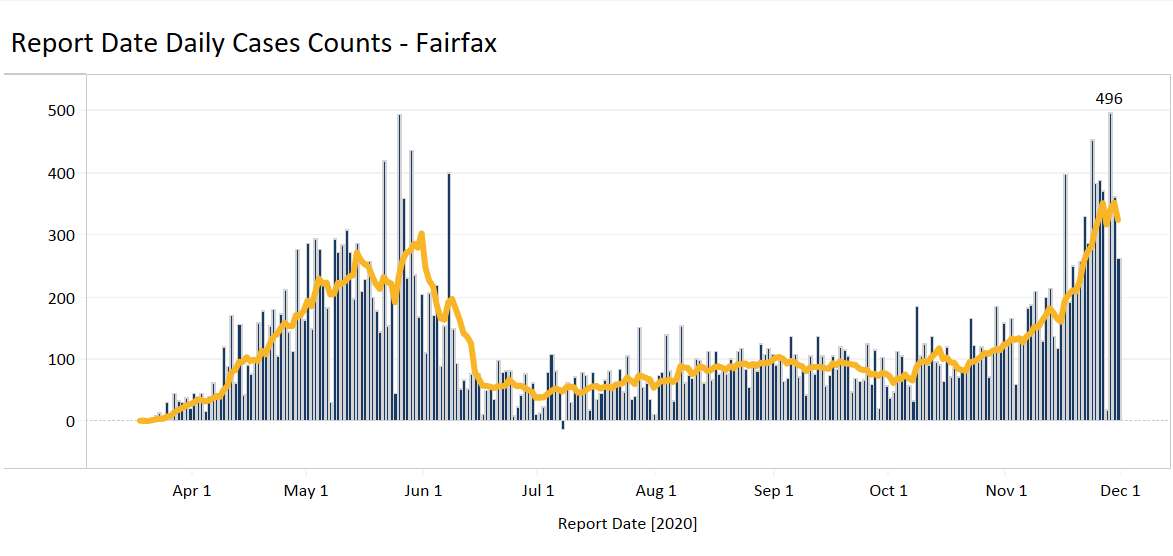
The weekly average caseload then hit an all-time high of 352.3 cases on Sunday (Nov. 29) before dipping down to a seven-day average of 324.9 cases today, according to Virginia Department of Health data.
Fairfax County also recorded its highest single-day case count of the pandemic this past weekend when it saw 496 new cases on Nov. 28. The previous record was 493 cases on May 25.
However, Fairfax County’s hospitalization and death rates remain well below where they were in the spring.
Currently, Fairfax County is averaging 7.86 hospitalizations over the past seven days, compared to the peak of 35.57 hospitalizations over seven days recorded on May 4. The county is seeing a seven-day average of 1.29 deaths right now, but the seven-day average was 14 deaths on May 4 after there was a single-day record of 31 deaths on May 3.
The surge in COVID-19 cases that Fairfax County is witnessing right now falls in line with the overall trend for Northern Virginia as a region, which recorded its highest seven-day moving average of 815.7 cases on Nov. 29.
By comparison, the pandemic’s spring surge peaked at a seven-day regional moving average of 685.3 cases on May 31.
The continued upward trajectory of COVID-19’s spread in Fairfax County comes after health officials warned that the traveling, intimate family gatherings, and in-person holiday shopping typically associated with Thanksgiving weekend could exacerbate the pandemic.
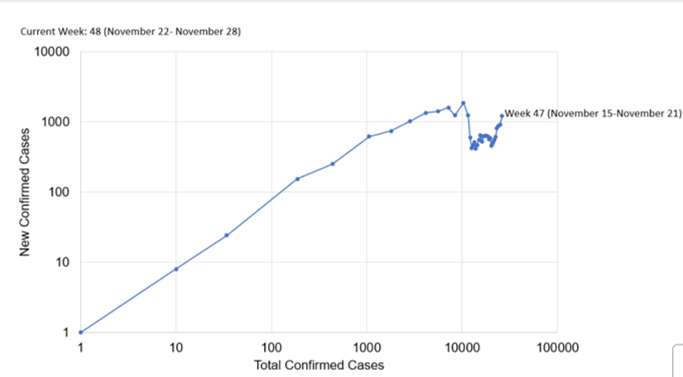
Given the lag time between when someone is exposed to the coronavirus and when a new case is actually reported, Fairfax County’s current COVID-19 data suggests the worst may still be on the horizon.
Images via CDC on Unsplash; graphs via Virginia Department of Health, Fairfax County Health Department
An ongoing local surge in COVID-19 cases has forced some Fairfax County Public Schools students to revert to online learning for the first time since FCPS started phasing in-person learning back in on Oct. 5.
FCPS announced on Monday (Nov. 23) that administrators had notified families that students in Group 4 would return to all-virtual instruction that day after Fairfax County’s health metrics surpassed the threshold that determines whether they should continue learning in person.
“The health metrics that guide our return to school in person reached a threshold yesterday that indicated we must dial back our Group 4 cohort in order to comply with the metrics we had stated to our community,” FCPS Director of News and Information Lucy Caldwell said in a statement.
Group 4 consists of 2,900 students, including elementary students at Burke School and students in specialized high school career preparatory programs. Affected classes range from culinary arts and musical theater to robotics, veterinary sciences, and the Junior Reserve Officers’ Training Corps (JROTC).
These students had been permitted to learn either virtually or through a hybrid model with two days of in-person instruction and two days of online instruction since Oct. 26.
Based on metrics recommended by the U.S. Centers for Disease Control and Prevention, FCPS determined that Group 4 could continue in-person learning as long as Fairfax County’s COVID-19 caseload did not exceed 200 cases per 100,000 people for seven consecutive days.
The county’s positivity rate for novel coronavirus testing also had to stay at or under 10%.
Fairfax County officially passed the 200-case threshold on Sunday (Nov. 22). At 289.8 cases per 100,000 people, Monday marked eight consecutive days of the county exceeding that limit.
The county’s cases-per-100,000-people and testing positivity rates must both fall under the established thresholds for seven consecutive days for students to resume in-person learning.
“As soon as these metrics indicate that it is safe to return to in-person instruction, Group 4 students will be phased back into schools,” FCPS said on Monday.
This is the second consecutive week that Fairfax County’s COVID-19 spread has required FCPS to revise its Return to School timeline.
Superintendent Scott Brabrand announced on Nov. 16 that FCPS would pause plans to welcome back an additional 6,800 kindergarten, preschool, and special education students that had been scheduled to return to classrooms on Nov. 17.
FCPS has set Dec. 1 as a possible new day for those students to start in-person learning, but with health experts anticipating the pandemic to worsen over Thanksgiving break, that date looks extremely tentative.
“As far as Group 5, we had indicated we would be communicating their in-person return closer to the December 1 date,” Caldwell said. “The numbers right now have not decreased as we have been hoping.”
With FCPS closed for the week starting on Wednesday, Caldwell says the school system will share more information on what Group 5 students can expect either today (Tuesday) or at the end of the break on Nov. 30.
Roughly 5,500 FCPS students are still attending in-person classes. Most of them are in special education, English Learners, career preparation, and other specialized programs.
Though their established thresholds are looser, those cohorts could potentially join Group 4 students in transitioning back to learning exclusively online.
“Given the COVID-19 infection rates in our community, we do anticipate that it may be necessary to dial up and dial back our in-person cohorts,” Caldwell said.
Photo via FCPS
Though the U.S. Centers for Disease Control and Prevention issued an eviction moratorium on Sept. 4, the ability to keep up with rent payments has been one of the most urgent challenges of the COVID-19 pandemic for Fairfax County residents, along with food insecurity.
As of Nov. 16, Fairfax County Coordinated Services Planning, which connects individuals to social services, has received 4,693 requests for rental assistance so far this year, according to Fairfax County Health and Human Services.
The county generally gets around 5,000 housing payment assistance requests every fiscal year.
“The pandemic has exacerbated the situation of our most vulnerable residents,” HHS public information officer Shweta Adyanthaya told Tysons Reporter in an email. “The system has seen a significant increase [of] over 3,000 new households, requesting all basic needs – housing, utility, food assistance – during the pandemic response.”
Adayanthaya says that, while requests have come in from all parts of the county, the areas with the highest levels of need now are the same areas that struggled most prior to COVID-19.
To help provide resources to tenants at risk of losing their homes, Fairfax County formed an eviction prevention task forcewith representatives from various county agencies, the county sheriff’s office, and the nonprofit law firm Legal Services of Northern Virginia.
The task force has also been charged with collecting and analyzing data on the eviction situation in Fairfax County, which will then be used to help direct resources and guide recommendations for future actions.
According to HHS, it is currently unknown how many Fairfax County residents have been evicted or become homeless since COVID-19 arrived in Virginia this past spring.
However, Adayanthaya says the county is “taking a proactive approach” to contact residents who get pulled into the legal system for evictions, and it has expanded outreach efforts to connect vulnerable and hard-to-reach populations with essential resources.
The county has also started outreach efforts to landlords that will expand in the new year.
“Communication is a key ingredient in communicating with tenants who are at risk of eviction as well as landlords,” Adayanthaya said. “We have been working hard to provide as much current information to prevent unwarranted eviction and to help educate the community.”
Currently set to expire on Dec. 31, the CDC’s temporary moratorium bars landlords from issuing evictions from residential properties for nonpayment of rent by individuals with incomes lower than $99,000 and married couples with joint incomes of less than $198,000.
Tenants in those categories will be covered by the moratorium if they are unable to pay rent due to income loss or extraordinary out-of-pocket medical expenses and would become homeless if evicted. They must present a declaration to their landlord.
The Fairfax County Redevelopment and Housing Authority has suspended evictions for rent nonpayment and associated charges or fees for residents of its properties. Late rent penalties also have been waived until further notice for renters at county-owned and managed properties.
Adayanthaya says the impact of eviction moratoriums on landlords, particularly small and family owners, has raised concerns in Fairfax County about the potential loss of affordable housing, but such measures are critical right now from a public health standpoint as well as a socioeconomic one.
“Eviction moratoria – like quarantine, isolation and social distancing – are effective public health measures to prevent the spread of COVID-19,” Adayanthaya said. “Housing stability helps protect public health as homelessness increases the likelihood of individuals moving into congregate settings, such as homeless shelters, which puts individuals at higher risk for COVID-19.”
According to HHS, the Fairfax County Office to Prevent and End Homelessness has secured 445 rooms at six hotels as of Nov. 12 to provide shelter for people experiencing homelessness and individuals who are unable to isolate or quarantine safely in their homes.
358 of those rooms are currently occupied by 462 guests for an 80% occupancy rate. 90% of the individuals residing in the hotels were referred by homeless services providers. Only two of the guests were not homeless upon admission.
“Since the hotels opened, 132 people who were experiencing homelessness at admission moved to permanent housing situations,” HHS says.
Additional housing assistance information and a guide to tenant-landlord rights can be found on the Fairfax County emergency information website.
Photo via Fairfax County Office to Prevent and End Homelessness/Facebook
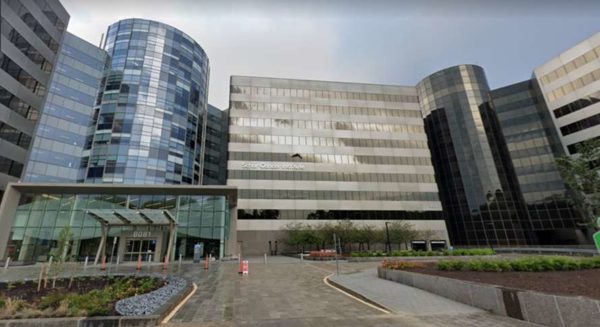
Inova Health System will open a new cancer screening and prevention center on its Center for Personalized Health campus in Merrifield, thanks to a $20 million donation from Reston couple Paul and Linda Saville.
Paul Saville is the president and CEO of the Reston-based home construction company NVR, Inc.
Announced on Nov. 10, the new 24,000 square-foot cancer screening center will be an expansion of the Inova Schar Cancer Institute, which opened in May 2019 and bears the name of NVR founder and Chairman Dwight Schar and his wife Martha after they donated $50 million to build it, according to the Washington Business Journal.
“We’ve all been impacted by cancer, and many of us know someone who has died from cancer due to a late diagnosis,” Paul Saville said. “We hope that many more people will have access to early detection and treatment and avoid serious disease.”
Inova says the new center made possible by the Savilles’ donation will be the first of its kind in Northern Virginia, which currently lacks a “comprehensive, multidisciplinary, organized cancer screening and prevention program.”
Expected to open in fall 2021, the center will provide screenings to detect breast, lung, prostate, bladder, pancreatic, colorectal, head and neck, skin, cervical, uterine, ovarian, and other cancers.
Preventative resources for patients who may be at high risk of developing cancer will include genetic testing, opportunities for clinical trials, and education on nutrition and exercise.
“The Savilles’ commitment to help us create a state-of-the-art early detection and prevention center is bringing us a giant step closer to becoming the leading cancer institute in our region,” Inova Health System President and CEO J. Stephen Jones said.
The U.S. Centers for Disease Control and Prevention currently list cancer as the second most frequent cause of death in the U.S. after heart disease, but that appears to be based on data from 2018.
According to Inova, cancer surpassed cardiovascular disease as the leading cause of death in America this year.
“By providing members of our community accessible, multidisciplinary screening and prevention services in a ‘one-stop-shop’ approach, we hope to cure more cancers by catching them early,” Schar Cancer Institute President John Deeken said. “And through programs such as smoking cessation, as well as dietary and exercise interventions, we hope to prevent more and more cancers in the years ahead.”
Photo via Google Maps
Fairfax County Public Schools will no longer bring additional students back into the classroom this week for in-person learning, FCPS Superintendent Scott Brabrand announced today (Monday).
6,800 kindergarten, preschool, and special education students had been set to resume in-person instruction tomorrow under the timeline that FCPS established with its Return to School plan, which gives students the option to remain virtual or to enter a hybrid model that combines in-person and virtual learning.
However, the Virginia Department of Health reported today that Fairfax County has recorded 211.2 COVID-19 cases per 100,000 people within the past 14 days, exceeding the 200-case threshold that FCPS set as a metric for determining whether a new group of students can begin in-person instruction.
At 7.4%, Fairfax County’s current seven-day positivity rate for PCR-RT tests remains below the 8% limit required by FCPS to start in-person instruction.
The students who were scheduled to go back into the classroom on Nov. 17 will now remain all virtual until at least Nov. 30, and all new concurrent learning pilot programs that were supposed to start then have been put on hold.
“We made this decision as soon as new health metrics were released and are communicating it to you immediately as promised,” Brabrand said in a letter to the FCPS community. “We always anticipated the need to potentially adjust our return to school plans as necessary during this ongoing pandemic.”
The 8,000-plus students that have already returned to physical classrooms since students started getting phased in on Oct. 5 will continue with hybrid learning, though that could change in the future if COVID-19 cases continue to rise in the county.
The Fairfax County Federation of Teachers called FCPS’s decision to pause its return-to-school plans “a good step in the right direction” but expressed concern that the school system has moved the possible resumption date to Nov. 30, immediately after the Thanksgiving holidays.
“Experts have said this period will be a hot bed for new cases because of expected small group gatherings,” FCFT President Tina Williams said. “We need real metrics from FCPS. We urge FCPS to transition all students and staff to virtual learning immediately until there is controlled community spread of COVID-19.”
The Fairfax Education Association joined other teachers’ unions in Northern Virginia for a press conference this morning to urge Virginia Gov. Ralph Northam to dial the entire Commonwealth back to Phase Two of his reopening strategy and recommend that public schools return to virtual learning.
Northam tightened restrictions on social gatherings, mask-wearing, and alcohol service in restaurants starting Nov. 15, but educational settings were explicitly exempted from the new 25-person limit on gatherings.
FEA President Kimberly Adams says the union was “very happy” to see FCPS pause its return-to-school plans in accordance with its established metrics, but the association will continue pushing for Virginia to issue stronger restrictions and provide additional support for school districts that return to all-virtual learning.
Adams says the FEA is still hearing from staff members who say they have not received the personal protective equipment that they need to work in-person, but district-level administrators have stepped in to address many concerns, including ensuring that face shields are available at a school where the principal had initially declined to provide them.
Of the 214 COVID-19 cases that FCPS has recorded since Sept. 8 based on self-reporting, 177 of the people infected have been employees.
“Educators want to be with their students,” Adams said. “Right now, they’re very torn between wanting to be there for their kids but having to protect their own health and that of their families. This unfortunately is setting us up for a clash between those two feelings.”
Fairfax County recorded a massive jump of 400 COVID-19 cases today (Monday), up from 174 yesterday, due to a backlog in data reporting on the part of the Virginia Department of Health.
The Fairfax Health District added 1,366 cases over the past week for a seven-day average of 195.1 cases, the highest rate since the district saw an average of 197.7 cases over seven days on June 8.
Fairfax County also reported three deaths from COVID-19 over the past week, raising the county’s death toll to 625 people. The county has now reported 27,095 total cases, and 2,440 people have been hospitalized since the Fairfax Health District identified its first presumptive positive case in early March.
The Fairfax Health District currently has a total testing positivity rate of 8.3% out of 392,064 testing encounters, according to the VDH.
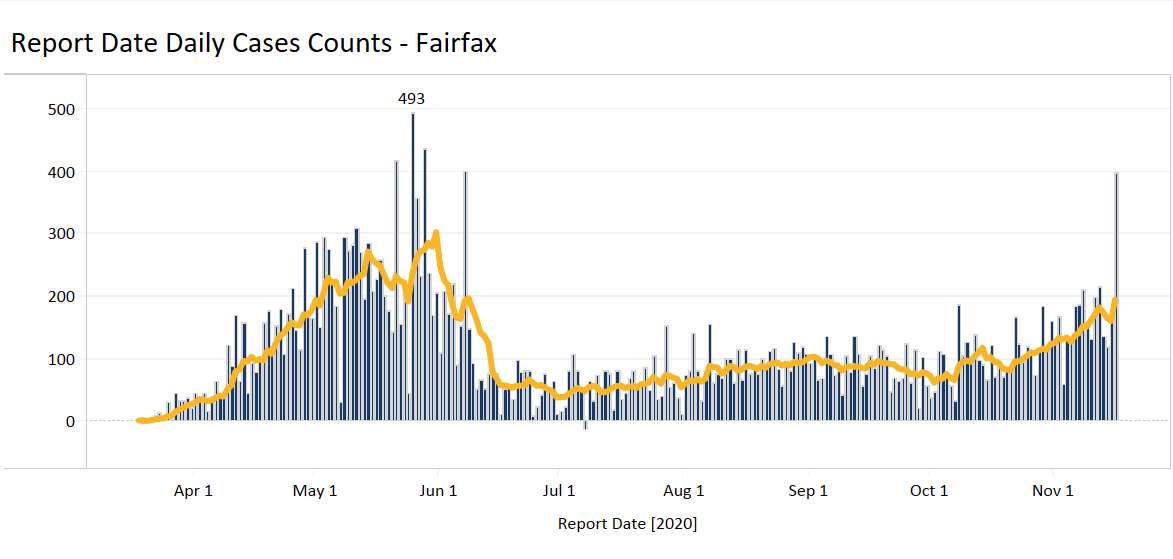
Because of the data reporting backlog, the 2,677 cases that the VDH reported today statewide are the most that Virginia has recorded in a single day at any point during the pandemic.
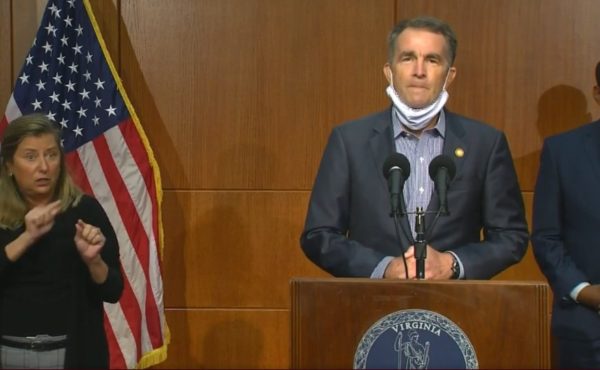
While Virginia’s COVID-19 infection rate remains one of the lowest in the U.S., the clear upward trend in cases that the state has seen over the past 90 days led Gov. Ralph Northam to tighten restrictions on social gatherings and businesses in an effort to mitigate the spread of the novel coronavirus.
“While cases are not rising in Virginia as rapidly as in some other states, I do not intend to wait until they are,” Northam said when announcing the new measures on Nov. 13. “We are acting now to prevent this health crisis from getting worse.”
Effective as of midnight on Sunday (Nov. 15), the cap on public and private in-person gatherings has dropped from 250 people to 25. The revised executive order defines gatherings as indoor and outdoor parties, celebrations, and other social events, but the limit does not apply to educational settings.
Religious services can also have more than 25 people in attendance if they adhere to health and social distancing protocols, including having at least six feet of separation between individuals and practicing routine cleaning and disinfection of frequently-contacted surfaces.
A mask mandate requiring all individuals 10 and older to wear face coverings in indoor public settings that has been in place since May 29 has been expanded to include all individuals aged 5 and over.
Northam has also prohibited the on-site sale, consumption, and possession of alcohol after 10 p.m. in any restaurant, bar, or other food and beverage service establishment.
Finally, violations of social distancing, mask-wearing, and cleaning guidelines by essential retail businesses, including grocery stores and pharmacies, are now punishable by the state health department as Class One misdemeanors.
Photo via Governor of Virginia/Facebook, Virginia Department of Health
Fairfax County Public Schools administrators reaffirmed their commitment to bringing more students back for in-person learning during a Fairfax County School Board work session last night (Thursday), despite increasing levels of COVID-19 transmission in Northern Virginia.
After introducing more than 8,000 students to hybrid learning – which consists of two days of in-person instruction and two days of virtual instruction – over the past month, FCPS is preparing to welcome an additional 6,800 students back into classrooms on Nov. 17, Superintendent Scott Brabrand told the school board.
Under a newly revised timeline, another cohort of approximately 13,500 students, including first and second-graders as well as students with disabilities, will start hybrid learning on Dec. 8, a week later than previously proposed.
Students in grades three to six will now be phased in on Jan. 12 instead of Jan. 4. Middle and high school students are still scheduled to return on Jan. 26.
“As we make preparations for additional students and staff to return, we are very mindful of the national, state, and local COVID trends,” Brabrand said. “COVID remains a fluid situation, and I want to emphasize these are my recommendations as of today, this evening.”
For now, FCPS will forge ahead with its Return to School plan even as COVID-19 cases rise in Fairfax County at a rate not seen since early June and the public school system reports its first outbreaks of the pandemic.
According to FCPS, Justice High School in Falls Church and Woodson High School in Fairfax had outbreaks on Nov. 10 that involved staff members, but no students. An outbreak is defined as more than two cases of COVID-19 that are epidemiologically linked.
FCPS sent out letters reporting the outbreaks to the affected school communities and is working with the Fairfax County Health Department to support its contact tracing investigations.
“Those outbreaks are concerning to us, and we take that seriously,” FCPS Department of Special Services Assistant Superintendent Michelle Boyd said. “We’re following up on what may have contributed to the transmission in our schools.”
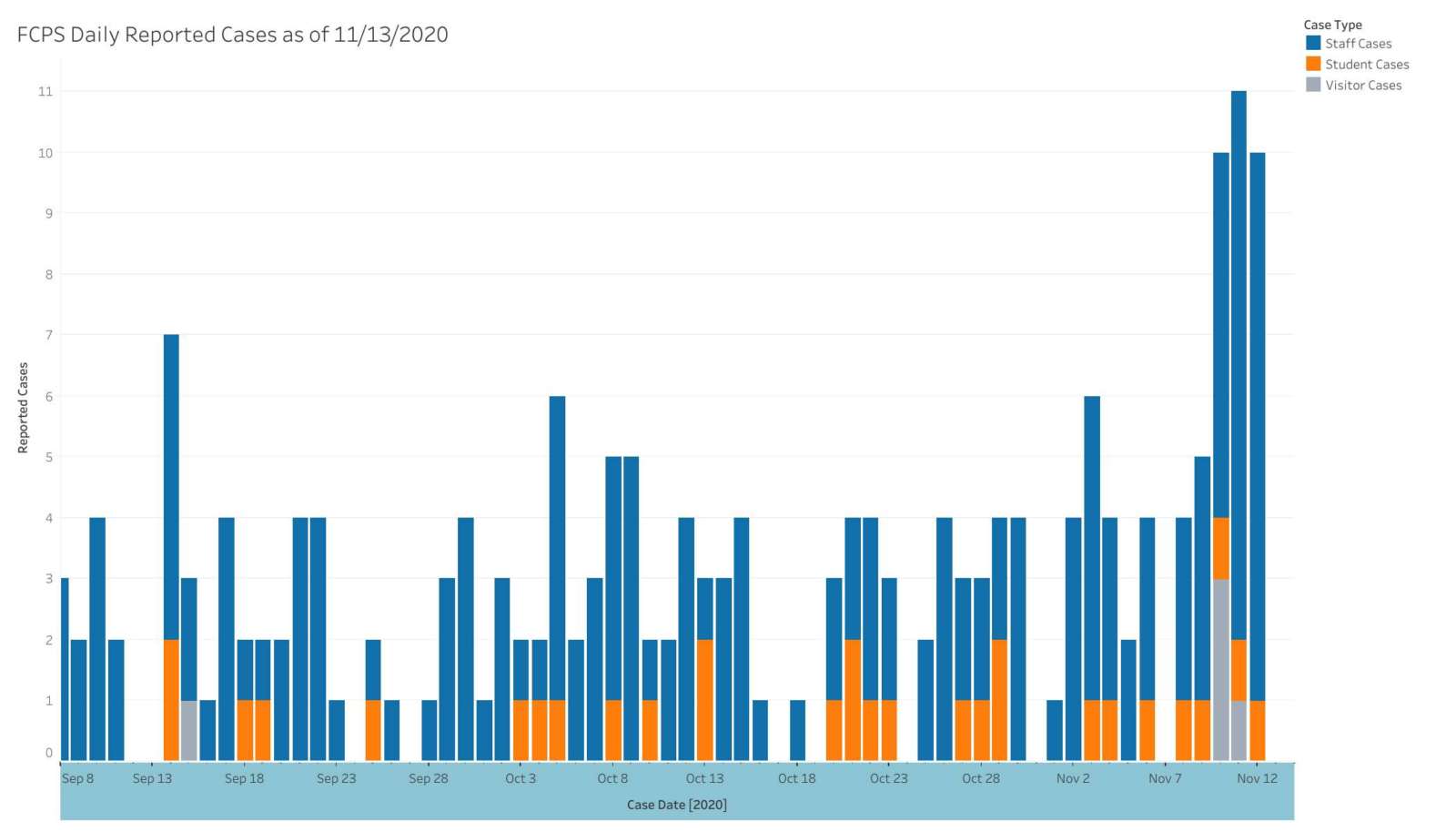
As of this morning, FCPS has recorded 192 COVID-19 cases since Sept. 8, including 28 cases involving students, though the vast majority of infected individuals have been employees. 40 cases have been reported just this week starting on Nov. 8.
The unions that represent FCPS educators have argued that the school system should halt its plans for bringing in more students.
“We do not believe we should continue to send our most vulnerable students into the buildings,” the Fairfax Education Association board of directors said in a statement. “…It is unacceptable for FCPS to disregard the advice of scientists and medical professionals during a global pandemic, thereby placing our students, staff, and families at risk.”
FCPS is using metrics from the U.S. Centers for Disease Control and Prevention to guide its reopening strategy. The established thresholds that Fairfax County must meet for the next cohort of students to begin in-person instruction are 200 or fewer cases per 100,000 people and less than 8% test positivity for seven consecutive calendar days.
As of Nov. 13, Fairfax County had 190.8 new cases per 100,000 people within the past 14 days and a 6.4% positivity rate for COVID-19 tests, putting it just barely within those thresholds, according to the Virginia Department of Health.
While resuming in-person instruction raises public health risks, FCPS is also grappling with the consequences of limiting students to virtual learning.
Brabrand confirmed on Thursday that more students than usual received D and F grades in the 2020-2021 academic year’s first quarter, which ended on Nov. 2. A formal analysis of the impact of distance learning on students’ grades is still being conducted.
“I do think that in-person is much easier for us to assess student progress and engagement and be able to evaluate student progress,” Bush Hill Elementary School Principal Mary Duffy told the school board.
Whether hybrid learning will impart the same academic benefits as full-time in-person learning remains to be seen, however, as families and some employees remain skeptical of the concurrent learning model that FCPS has been piloting since October.
A Fairfax County Federation of Teachers survey of 475 FCPS employees found that 92.4% of the respondents participating in the pilot program feel virtual and in-person students are not receiving an equitable education, and 76.9% say they can provide higher quality instruction through full distance learning.
FCPS Director of News and Information Lucy Caldwell says the school system is doing its best to balance the needs of students and instructional staff, stating that many teachers have said they want to return to the classroom.
“Our return-to-school plan, in which gradually certain cohorts of students and their teachers return to in-person instruction, prioritizes the safety of students and staff,” Caldwell said. “We have protocols in place, robust health and safety metrics, a transparent dashboard, and a phased-in approach that will allow us to closely monitor conditions and to make any necessary adjustments.”

Like everywhere else in the U.S., the COVID-19 pandemic and ensuing economic fallout have hit Fairfax County hardest in its most disadvantaged communities, consultants confirmed in a presentation to the Fairfax County Board of Supervisors on Tuesday (Nov. 10).
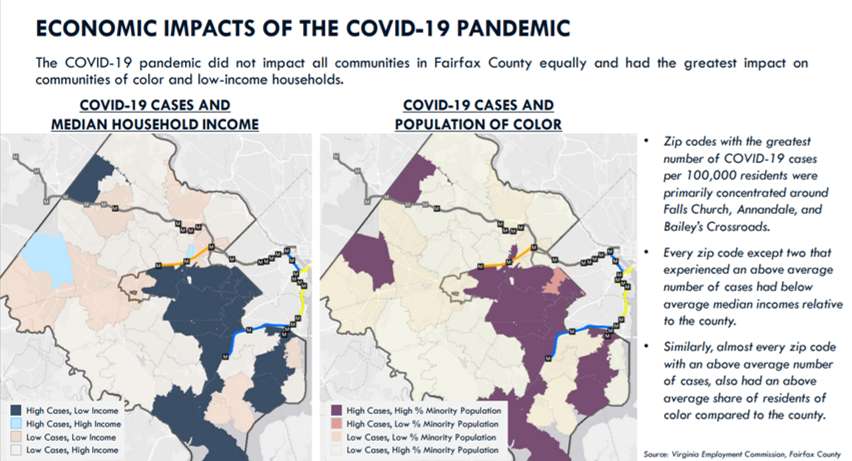
With the exception of just two zip codes, the areas in Fairfax County with more COVID-19 cases also have more residents of color and lower average median incomes than the county as a whole, according to HR&A project manager Olivia Moss.
The zip codes with the most COVID-19 cases per 100,000 residents are concentrated primarily around Falls Church, Annandale, and Herndon.
On top of that, low-income residents and people of color have been most affected by the national economic downturn that started this spring, when businesses and public spaces temporarily closed in an effort to control the spread of the novel coronavirus.
90% of all job losses in Fairfax County this year have occurred in industries like retail and food services, where average wages are less than 80% of the county’s area median income. 63% of the county’s job losses were in industries where the majority of workers are people of color.
“We know across the country, the pandemic and the resulting economic crisis has not been distributed equally across everyone and every business sector,” HR&A partner Jeff Hebert said. “So, really trying to understand what’s happening in Fairfax and how you can be part of creating a more just recovery in Fairfax is going to be really important to the community that will result after this pandemic is over.”
Fairfax County hired HR&A this summer to develop an economic recovery framework to guide the county’s response to the economic challenges presented by COVID-19.
To create a “new normal” that addresses the socioeconomic inequities exposed and deepened by the ongoing pandemic, Fairfax County needs recovery strategies targeted to different industries and populations based on their specific needs, Hebert and Moss say.
For instance, the county could assist the hardest-hit industries – led by the hospitality and food services sectors, which have shed 12,420 jobs or 26% of their entire workforce – by helping them reduce costs, evaluating regulatory requirements, and supporting programs to rebuild consumer confidence.
Initiatives like the RISE COVID-19 Small Business and Nonprofit Relief Grant Fund that the Board of Supervisors approved in May will be critical too. Through RISE, Fairfax County has awarded $52.5 million to 4,804 businesses so far, 72% of them owned by women, minorities, or veterans.
Lee District Supervisor Rodney Lusk says Fairfax County should adapt its recovery strategies to specific geographic areas as well as industries, noting that the pandemic’s economic impact in his district has been especially acute in the Richmond Highway corridor.
“Certain parts of Fairfax County are going to have different needs and issues,” Lusk said. “Tysons, Reston, Herndon are in a very different position than Bailey’s, Richmond Highway, and parts further south.”
Workforce development will also be essential to help people whose jobs may never return.
While 40,300 of the approximately 48,200 jobs lost during the pandemic are projected to be recovered by the end of the year, Fairfax County’s labor force has contracted by about 22,000 workers. Women in particular have been driven out by issues like inadequate or uncertain access to childcare, Hebert says.
“The reskilling piece is probably the important thing in here, from my standpoint. Not only if you’re going to help those most vulnerable in the community, you’re going to do that by making sure they have a skill set to take advantage of our future economy,” Board Chairman Jeff McKay said, suggesting the green economy as one industry with a lot of potential for growth.
HR&A will continue analyzing the impact of COVID-19 on Fairfax County before delivering a report with recommendations for recovery strategies and programs in January 2021.
Staff Photo by Jay Westcott
