

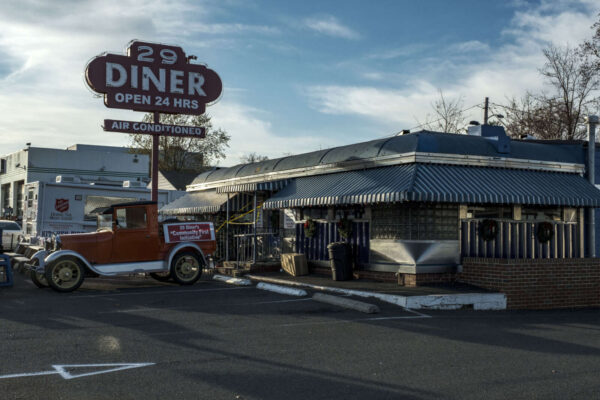
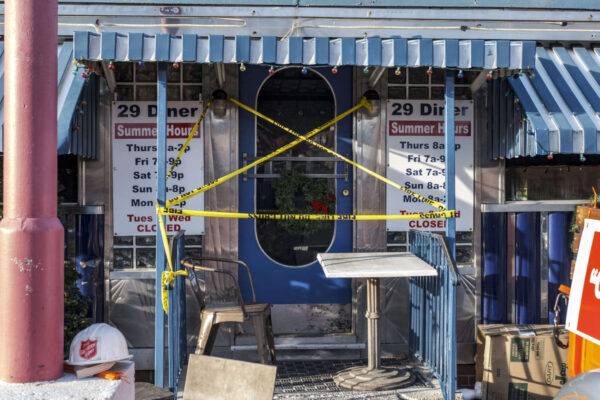


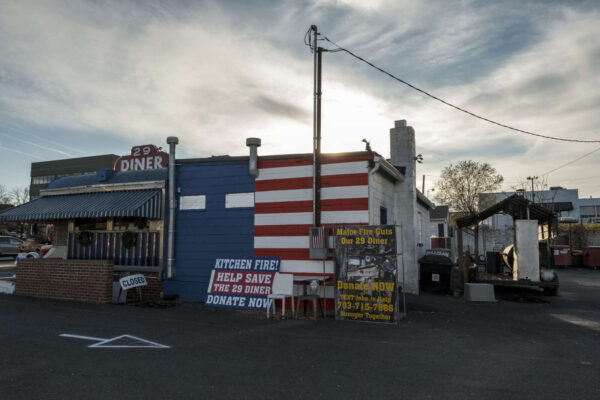
Two days before Thanksgiving, the 29 Diner was decimated by a fire. The next day, owner John K. Wood got back to work.
“It was a total loss,” Wood told FFXnow of the damage to the iconic, 74-year-old Fairfax City eatery. “But there’s nothing to be sorry about. It’s time to celebrate what this diner means to the community. I’m going to be here every day that I can — rain, sleet, snow — to watch the rebirth of the 29 Diner.”
Firefighters got a call around 6 p.m. on Nov. 23 about an explosion in the back of the building, WJLA reported. When crews arrived, a fire had spread from a storage room where chemicals were being stored to the kitchen across the way.
“It was a chemical fire that reached about 700 degrees,” said Wood, a Robinson High School graduate who has owned the diner since 2014.
Thankfully, no one was in the building at the time, but the fire rendered the kitchen completely unusable. Wood estimates it could take six months for the kitchen to be restored so the diner can reopen.
He’s already getting significant help from the community to do just that. A GoFundMe campaign set up to help Wood rebuild and support the employees that have lost their jobs has amassed over $54,000 in just a week’s time.
“I’m on the wings of the community and I feel the love,” Wood said.
A cozy spot to get a short stack and two eggs over easy, 29 Diner is also a historic landmark. In 1992, it was placed on the National Register of Historic Places for being a “uniquely American form of roadside architecture.”
The pre-assembled metal, glass, and double-wide diner was considered the “Cadillac of diners,” Wood says, when it emerged in 1947. The building was manufactured in New Jersey and purchased by original owner D.T. “Bill” Glascock, who placed it along Fairfax Boulevard, which was called Lee Highway then, like Route 29 still is (for now) in Fairfax County.
Wood reveals a little-known secret about the restaurant: a 1,500 square-foot basement, the dimensions of a good-sized townhouse, runs the entire length of the diner.
29 Diner grew with the region, becoming a hub of community in Fairfax. It did go through several owners, including Fredy and Virginia Guevara, who was a server there in the 1960s. When the couple retired, Wood took over.
“You step into that diner, and it just takes you back to when you were 9 years old and you got your first milkshake,” Wood told The Washington Post when he became the owner in 2014.
Wood has been a proud steward ever since. Open 24 hours, six days a week, the diner has become a headquarters of sorts for a number of charitable endeavors, raising money for causes from feeding those in need to supporting families with cancer and veteran suicide prevention.
Not even a destructive fire can dim Wood’s perpetual optimism and commitment to giving back.
“This is going to give us a chance to remodel, in the way the Lord wanted us to have,” he said.”We are going to set up a more inclusive kitchen, [better] wheelchair access, and help disabled veterans.”
Wood is planning a number of events in the coming weeks to help raise money, including runs and a motorcycle rally.
He says a big chunk of donations will also go toward providing for his employees and their families while they wait for the diner to reopen.
Rich Berkwitz, who set up the GoFundMe campaign, appreciates everything Wood has done for the diner and community. A teacher at Mark Twain Middle School in Alexandria and an assistant wrestling coach at John Lewis High School, he says he eats at 29 Diner “pretty much every week” because “it feels like home.”
“I’m so happy that the community is backing him as much as he’s back to the community,” he said. “He’s just so giving.”
It’s unlikely that 29 Diner will reopen prior to June 2022, but Wood has faith in the future.
“It’s going to come back better than it was,” he said. “That wasn’t a fire. That was the Lord paying a visit to the 29 Diner.”
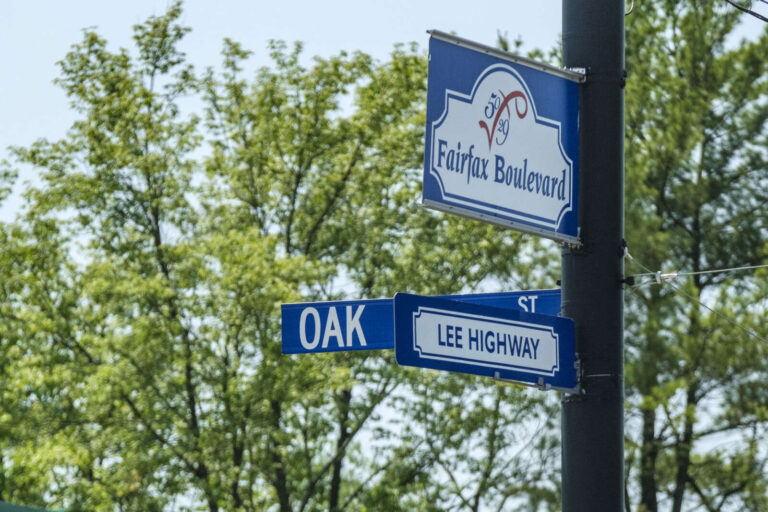
A task force of nearly 30 people has recommended renaming two highways in Fairfax County, following concerns that their invocation of the Confederacy runs counter to the county’s goal of creating an inclusive environment.
After months of meetings and debate, the Confederate Names Task Force voted 20-6 yesterday (Tuesday) in favor of a change for Lee Highway (also known as Route 29) and 19-6 for Lee-Jackson Memorial Highway (Route 50), with at-large member Tim Thompson abstaining.
The recommendation is just one step in the renaming process. It came after the task force gathered public input with a series of listening sessions and an online survey.
The Fairfax County Board of Supervisors and state’s Commonwealth Transportation Board would have to sign off on any name changes.
Some committee members argued that renaming the highways would “erase history.” Jenee Lindner, one of four Springfield District representatives, said doing so was wrong.
“If we’re going to move forward, let’s eradicate that term, ‘erasing history.’ It’s not true. Personally, we’re erasing stupidity and injustice and immorality,” Pastor Paul Sheppard from Providence District countered.
Dranesville District representative Barbara Glakas, a retired teacher from Fairfax County Public Schools, said if Confederate leaders had their way, the U.S. might look more like Europe, with fragmented countries, and slavery might have continued for much longer.
The task force’s votes diverged from the results of the public survey, where 23,500 respondents said they support keeping the names as they are, and 16,265 called for changing them.
“We can’t just ignore that opinion, whether you agree with it or not,” said Braddock District’s Robert Floyd, who voted against the recommendations and was one of a handful of people who tuned into the meeting remotely.
The survey was more designed to be a pulse check than as a poll that met scientific sampling standards and could be representative of the entire population. It had a mechanism to prevent people from taking it repeatedly, but it only blocked Internet Protocol (IP) addresses, meaning people could still participate multiple times, skewing results.
For respondents who wanted the highways to be renamed, many people proposed using Route 29 and Route 50, which are already used on maps.
Sully District committee member Marvin Powell said society renames things all the time and the county needs to think of the citizens of today and tomorrow.
The committee also discussed how families’ properties were taken by eminent domain for the roads in question. Sheppard said his family was affected and joked one road could have originally been named after his family.
The Board of Supervisors appointed the task force in July after the Fairfax County History Commission compiled an inventory of streets, monuments, and public places with names tied to the Confederacy. It found “approximately 157 assets, including parks, within the County that bear confirmed Confederate associated names,” the December 2020 report said.
Michael Champness, an at-large member of the Confederate Names Task Force, said before the votes that changing the two highway names sends an important message, but the county doesn’t necessarily need to rename all of those landmarks.
“We might be in a good position to maybe call a truce after this,” he said, before voting “yes” on each motion. “I think it’s very important to change these names because it’s important to be heard. It’s important for action to take place…but I don’t think we need to try and change every street name.”
The task force is scheduled to vote on Dec. 13 on alternative names to recommend to the Board of Supervisors, which could schedule a public hearing and act on the recommendations in early 2022.
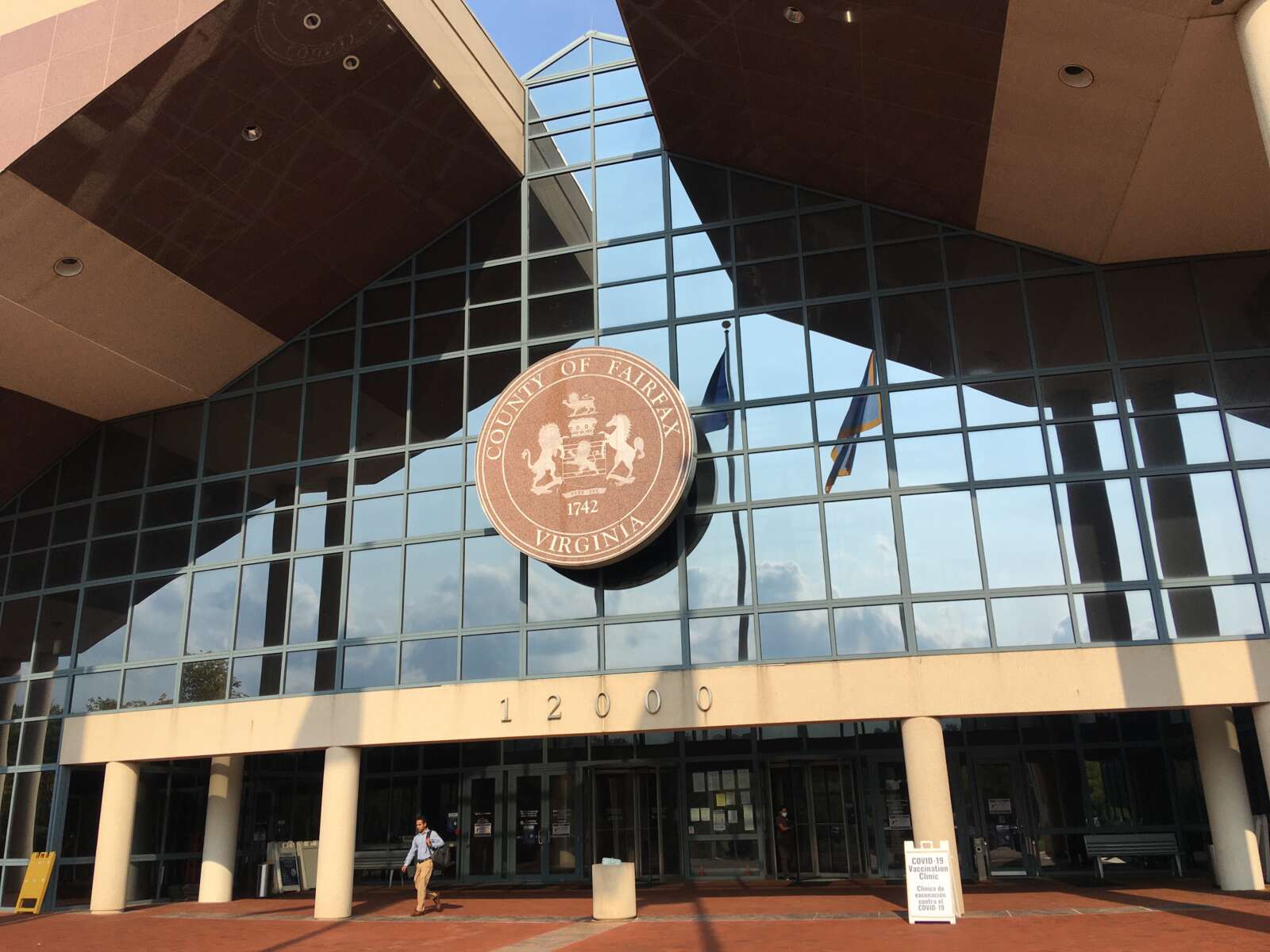
Fairfax County housing officials want to assist religious congregations interested in using their existing buildings or land to help create affordable housing.
The Fairfax County Board of Supervisors talked about the idea at its housing committee meeting last Tuesday (Nov. 23). While in the preliminary stages of discussion, the proposed collaboration could help religious groups that need to sell vacant property to address struggling finances, officials suggested.
“A lot of these congregations are, especially the older ones, are facing economic and financial pressures, and they’re looking for a lifeline out of that,” Braddock District Supervisor James Walkinshaw said. “We’re in a little bit of a race against time here.”
He shared that developers are asking to buy excess land from religious groups and build million-dollar-plus homes on those parcels, thereby giving faith organizations revenue that would help them continue providing services to their congregations.
Senior Facility Could Serve as Model
Faith organizations have a model for one way to approach redeveloping their land through Chesterbrook Residences, an assisted living facility with a capacity for 109 residents that opened at 2030 Westmoreland St. in McLean in 2007.
The project used land donated by the Chesterbrook Presbyterian Church, which sought to create an assisted living facility for low-income seniors when it dissolved in 2000, according to a history provided by Chesterbrook Residences.
The $13.5 million project also involved a partnership with the Lewinsville and Immanuel Presbyterian churches and Temple Rodef Shalom. Local and federal grants provided $12 million, and the religious groups raised the remainder, Rabbi Amy Schwartzman said in a blog post.
“The National Capital Presbytery donated the land for this project. Without this gift, the cost would likely have been too burdensome,” Schwartzman wrote.
Other Options for Religious Groups
Places of worship could also pursue other strategies, such as retrofitting part of a building, while still maintaining a worship space.
They could demolish an existing structure to build a new one with both housing and worship space, according to Judith Cabelli, director of the county’s Affordable Housing Development Division.
“There might be a…parking lot on site that is much larger than the house of worship needs, and a multifamily building could be built on that parking lot, and then parking could be reconfigured,” she said.
But the complex and sometimes lengthy permitting approval process can create barriers.
Chairman Jeff McKay noted that congregations could also face development challenges, from stormwater management to zoning. Their buildings may be located in environmentally sensitive areas that limit development.
To address those concerns, county leaders are looking for ways to streamline the approval process, possibly working with an initial batch of congregations to help their projects succeed. If that route is pursued, the initial group could later be expanded to more congregations, McKay suggested.
Next Steps
County staff proposed providing a handout, a video, or another resource to help religious groups. Cabelli said the county envisions having community educational meetings and adding a “Faith in Housing” section to the Department of Housing and Community Development’s website.
An informational video could be launched in early 2022 with meetings to follow throughout the year.
Housing and Community Development Director Tom Fleetwood said he plans to continue examining possible approaches to bring back to the housing committee.

In many ways, this past Thanksgiving weekend looked much more normal than last year’s isolated celebrations.
COVID-19 vaccines enabled many people to gather again with family and friends. Black Friday shoppers returned in droves to local malls, and air travel reached a pandemic high of 2.3 million air travelers the day before Thanksgiving (Nov. 24) — only for that to be topped by 2.4 million travelers yesterday (Sunday), according to the Transportation Security Administration.
However, like a crotchety relative who overstays their welcome, the coronavirus still proved difficult to ignore, as reports emerged of a new variant of concern dubbed Omicron that was first identified in South Africa last week but has since been detected in at least a dozen countries, including Canada.
While no cases have been reported in the U.S. yet, and it’s unclear exactly what kind of threat Omicron poses, news of a new, potentially more transmissible variant comes as Fairfax County grapples with already climbing infection rates.
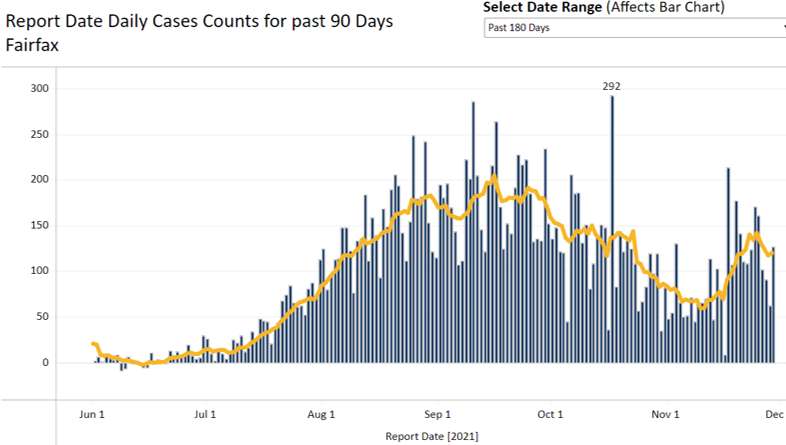
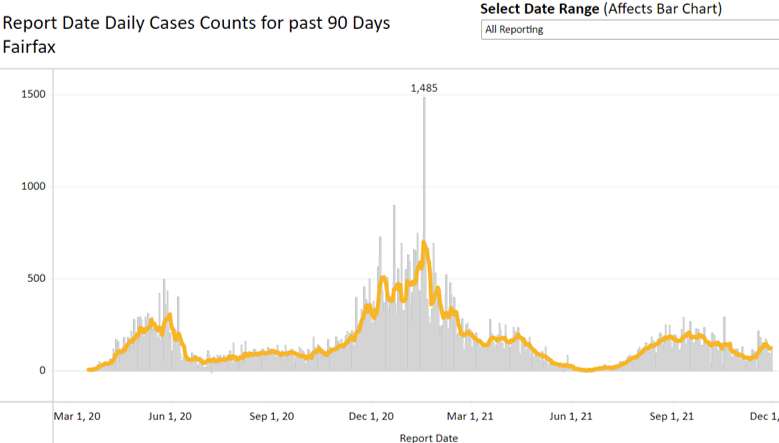
The county’s seven-day average hit a high for November on last Thursday (Nov. 25) with 141.6 cases — the highest weekly average since there were 143.4 new cases per day on Oct. 23, just before the late-summer Delta variant surge waned.
After a slight dip over the weekend, the addition of 149 cases today (Monday) has the weekly average sitting at 119.6 cases.
The Fairfax Health District, including the cities of Fairfax and Falls Church, has recorded a total of 96,651 COVID-19 cases during the pandemic. 4,189 residents have been hospitalized, and 1,226 residents have died, with one death reported in the past week.
Citing an increased demand for testing amid the recent COVID-19 surge, the Fairfax County Health Department announced this morning that the county’s public library branches will soon serve as distribution sites for at-home test kits as part of a state-led pilot program.
Quantities are expected to be limited, but the BinaxNOW COVID-19 Antigen Card Home Test kits will be available for free at all 13 of Fairfax County Public Library’s community branches and its eight regional branches starting on Friday (Dec. 3).
The tests are conducted online through eMed. The results are reported within 15 minutes and automatically shared with the Virginia Department of Health.
“Libraries are trusted community hubs, and we are pleased to support public health initiatives like this partnership with the Virginia Department of Health,” FCPL Director Jessica Hudson said in a statement.
The Fairfax Health District averaged 3,861 testing encounters a day for the past week as of Nov. 25. The current seven-day positivity rate for all tests, including rapid antigen tests, is 4.2%.
“For people who have a hard time finding a test kit at a pharmacy or who can’t afford a kit, the new library program provides another opportunity to receive a test kit,” FCHD spokesperson Lucy Caldwell said.
COVID-19 testing is also still available from health care providers and clinics, and those who are exhibiting symptoms or have had contact with someone who tested positive can visit FCHD sites.
At the same time, vaccination rates continue to increase, with 883,825 district residents — 74.7% of the total population — having now received at least one dose. That includes 85.1% of people aged 18 and older and nearly 30% of children aged 5-11, according to the Fairfax County Health Department.
775,361 residents — 77.5% of adults and 65.5% of the population overall — are fully vaccinated.
65-74 year olds and 75-84 year olds lead the way in terms of vaccinations, with over 99% of both those age groups getting at least one vaccine dose. 51.3% of 75-84 year olds have gotten a booster shot, the highest rate of any age group, though more doses have been administered to younger residents.
Photo via CDC/Unsplash
Fairfax County housing officials are looking at ways to make affordable homes more of a reality for residents, as the value of land continues to jump.
The Board of Supervisors discussed last Tuesday (Nov. 23) how local government could help with not just affordability, but also wealth-building through homeownership, Dranesville District Supervisor John Foust said at the housing committee meeting.
“We’re seeing this imbalance of more expensive properties and more need in the community,” Mason District Supervisor Penny Gross said.
Exacerbating the problem of affordable housing is a disparity among different ethnicities in Fairfax County. County data found that, for one period, 44% of Black people and 48% of Hispanic/Latino residents owned homes, compared to 67% for Asians and Pacific Islanders and 76% for whites.
On top of that, two-thirds of the homes in Fairfax County that low and moderate-income residents could afford are occupied by residents making about 80% of the area median income and above, according to a county presentation.
Community Land Trusts Proposed
Now, the county government could pursue a new strategy that mirrors what communities across the country have done: community land trusts, where a nonprofit owns the land and maintains housing as affordable into perpetuity.
Under a potential pilot program, the land could be held by the county’s housing authority, which would reduce the price of homes by taking out land costs, Department of Housing and Community Development Director Tom Fleetwood said.
The county identified a property adjacent to the James Lee Community Center in West Falls Church as one possible site but stressed that no final decision has been made. The presentation acted as an initial brainstorming session to further refine proposals.
The board requested more information from county staff, including how such a proposal would affect property taxes, how other communities have fared with such initiatives, and what would be the best resale formula allowing homeowners to sell while maintaining the properties’ affordability.
Currently, the county has an array of affordable housing programs that involve rental units as well as for-sale properties, which come with conditions like limits on the sales price.
However, housing prices continue to climb, and 67% of low-income households in Northern Virginia have to spend more than half their income on housing costs — the highest rate of any large metropolitan area in the country, according to the Community Foundation for Northern Virginia.
Gross said it seems like the region is fighting a losing battle, where it’s common for someone to pay $500,000 more than the assessed value of a property.
Board Expresses Interest in Idea
The county has touted the potential of using its available land for affordable housing efforts, but there’s still room to grow.
Fairfax County owns at least $50 million worth of assessed properties for over 100 parcels that could be used for commercial, residential, or other uses, not including properties in floodplains and land already in use.
At least $10 million in assessed property is listed as vacant but nonbuildable. It wasn’t clear if other restrictions, such as environmental issues, setbacks, and prior plans, limited the use of those properties.
Lee District Supervisor Rodney Lusk wondered if the county could quantify available parcels for the community land trust-like initiative.
“It’s a very large number of sites. I can’t quantify it for you, but only a small percentage may be appropriate for this,” Fleetwood said.
Chairman Jeff McKay said he thought the proposal presented was an excellent idea to see how it would work and examine how the county could tweak it in the future.
County leaders also noted that while new housing stock is important, they’re also looking for ways to improve existing homes.
Lusk suggested reexamining the threshold for the county’s existing affordable housing initiatives. Its first-time homebuyer program, for instance, is currently limited to people making up to 70% of the area median income.

Students and staff in the LGBTQIA+ community expressed relief yesterday (Tuesday) after Fairfax County Public Schools announced that it will return a pair of challenged, queer-centered books to library shelves.
“Gender Queer: A Memoir” by nonbinary author Maia Kobabe and Jonathan Evison’s “Lawn Boy” — a coming-of-age story about a Mexican American man that deals with race, class, and sexual identity — were pulled from circulation in late September after parents complained that they contained graphic sexual content unsuitable for children.
Two committees convened to review the books determined the complaints were without merit and that the books have literary merit in line with FCPS’ goal of supporting a diverse student body, including through its library materials, the school system said.
The Pride Liberation Project, a student-led LGBTQIA+ advocacy group, praised the decision as an affirmation of its argument that the books are “valuable sources of support” for vulnerable students, not pornography or pedophelia as alleged by the complaints.
“I am relieved that our libraries will continue to have books that depict people like me,” a Westfield High School student said in a news release. “It is isolating when LGBTQIA+ students are singled out and already limited Queer representation is taken away.”
FCPS Pride, an LGBTQIA+ advocacy group for employees, said its members were pleased that “Gender Queer” and “Lawn Boy” will be returned to circulation.
Kobabe’s memoir will be reinstated at the 12 high schools that currently own it, and Evison’s novel will be available at seven high schools, according to FCPS.
“Having read the the books and knowing that FCPS has a commitment to including and welcoming all students, we had faith that the process would be followed and literature that allows LGBTQIA+ students to see themselves, and which allows their peers to see that they exist, would be returned to circulation,” FCPS Pride said in a statement.
With book challenges cropping up across the country in recent months, many of them targeting books about gender and sexual identity or race, FCPS Pride co-president Robert Rigby Jr. tied the complaints against “Gender Queer” and “Lawn Boy” to a larger political backlash to LGBTQIA+ inclusion, pointing to a blog post accusing teachers of using Gay-Straight Alliances to “recruit” children that was shared by the Fairfax County Republican Committee as an example.
FCPS Assistant Superintendent of Instructional Services Department Noel Klimenko confirmed to FFXnow that formal complaints were filed against the two books, but the issue gained attention when conservative-leaning media outlets and advocates shared mother Stacy Langton’s remarks from a contentious school board meeting on Sept. 23.
“LGBTQ students and their peaceful existence in classes and schools have become ‘collateral damage,’ with uncaring people exploiting their existence for other purposes,” Rigby said.
Langton wrote in an opinion piece for the Washington Examiner that her complaint stemmed from concern about pornographic materials in schools, not as an objection to LGBTQ characters, stating that she’s aware of the discrimination that community faces because her mother was lesbian.
Klimenko, who made the final decision to reinstate “Gender Queer” and “Lawn Boy,” says book challenges tend to get politicized since they deal with free speech issues and people’s subjective opinions about what constitutes objectionable art.
The publicity around Langton’s complaint and claims that the books depicted pedophelia, which turned out to be unfounded, prompted FCPS to remove the books from circulation — a departure from past practices, as the school system has historically left books on shelves while they’re under review.
“We decided we needed to have an abundance of caution and go ahead and remove those books,” Klimenko said. “But now that this decision has been made, the books will be returned to the libraries that had them prior to the challenge.”
FCPS’ regulation on handling book challenges doesn’t explicitly state whether books should remain available while being reviewed.
Klimenko says staff will consult with school board members and other stakeholders to see if there were any concerns with how the two-month-long process played out, but overall, FCPS upheld its established policies, which had not been tested since the last library material challenge in 2015.
“I think it’s really important that Fairfax County Public Schools has a procedure for both identifying books to put in our libraries and also for challenging them,” she said. “I feel like we’ve taken great care and deliberation with this decision.”
Fairfax County School Board Chair Stella Pekarsky, who represents Sully District, says there have not been any conversations so far about reexamining the challenged materials regulation, which was last updated on Feb. 16.
She expressed support for parents playing “a robust and active role in their children’s education.”
Langton told the Washington Examiner earlier this month that she was barred from the Fairfax High School library after visiting with her son to check out a book.
FCPS doesn’t accommodate unscheduled visits to school libraries or other instructional spaces during class hours, but it allows pre-arranged visits before and after the school day. Its library catalogs can also be viewed online.
“I encourage parents to be involved in conversations with their students about all aspects of their school experience, including their literary choices,” Pekarsky said in a statement. “I continue to trust the professionalism of our school librarians and appreciate the time and care they devote to procuring collections that will serve a diverse student body.”
Photo via Sharon McCutcheon/Unsplash
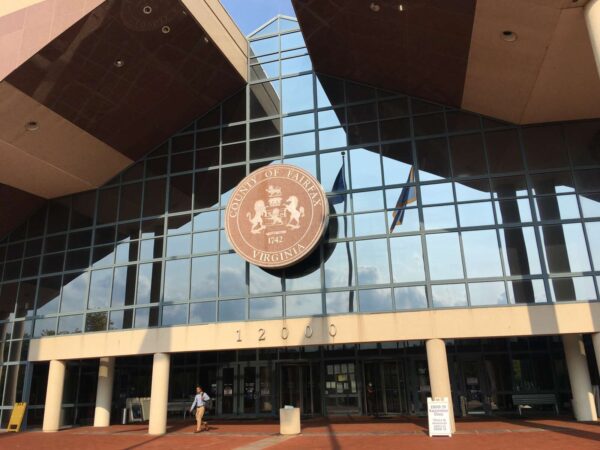
With Thanksgiving on the horizon, many local entities and organizations will be closed.
Fairfax County government offices and Fairfax County Public Schools will be closed for Thanksgiving (Thursday, Nov. 25) and Black Friday (Nov. 26). County libraries are also closed both days.
Fairfax County Circuit Court, General District Court, and Juvenile and Domestic Relations District Court close at noon today (Wednesday) through Friday.
The Fairfax County Animal Shelter is open for services by appointment only. For emergencies, contact Animal Protection Police at 703-691-2131.
All Department of Motor Vehicle service centers will be closed from Nov. 25 through Nov. 27.
While the Fairfax Connector has regular service today, riders can expect Sunday service on Thursday and holiday weekday service on Friday. More details on specific routes are available online.
Metrorail and Metrobus will also operate on a Sunday school tomorrow and offer week day service on Friday.
All recreation centers will open Thursday from 5 a.m. to noon with the exception of George Washington Recreation Center. All centers reopen on Friday.
The Fairfax County Government Center and South County Government Center vaccine clinic and the Tysons Community Vaccination center will be closed Thursday through Sunday for Thanksgiving. More locations are available online.
For trash and recycling collection, residents should contact their trash and recycling collector directly for any schedule changes due to the holiday.
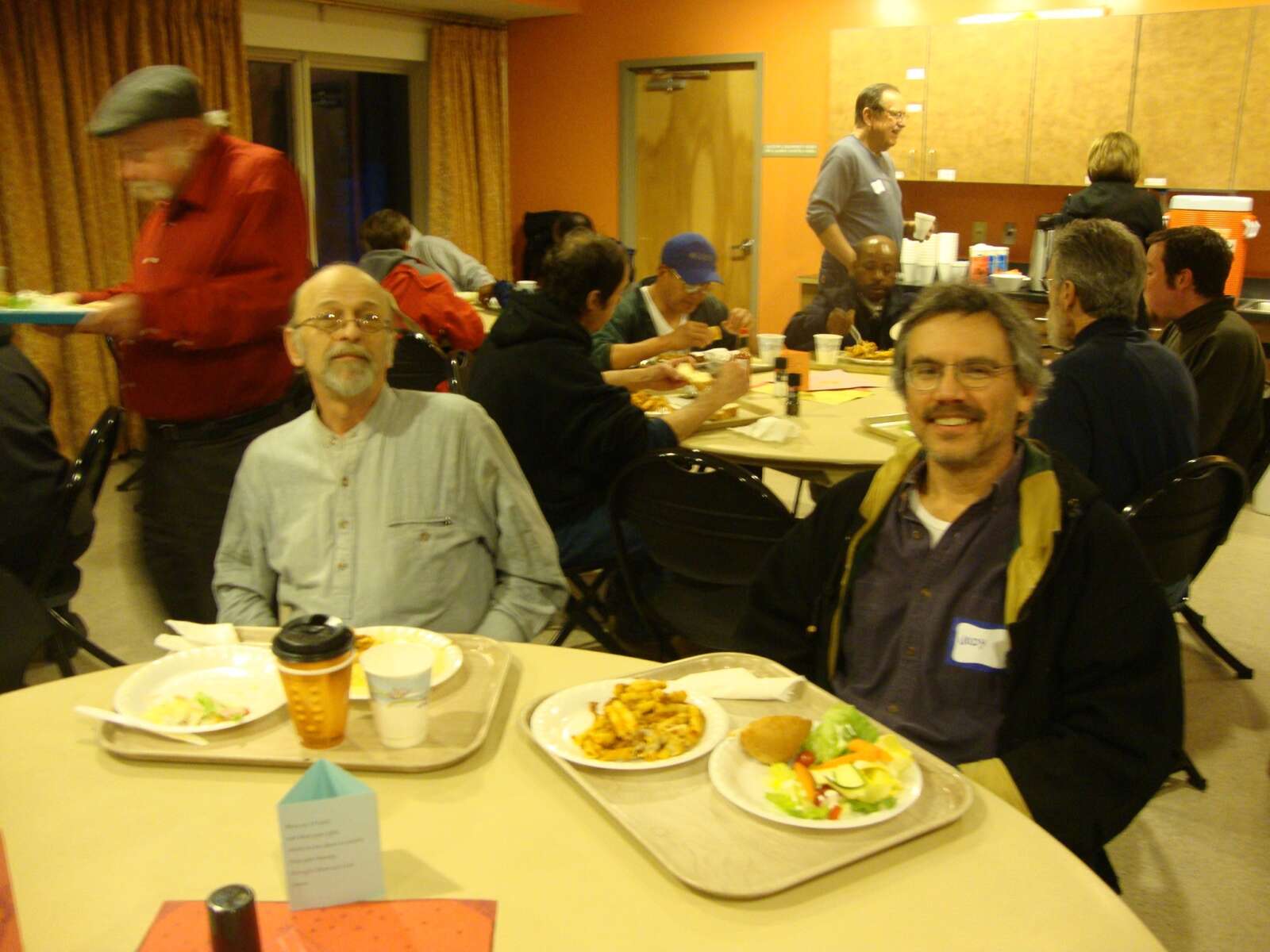
Faith communities are once again opening their doors to Fairfax County’s homeless population this winter after a year-long hiatus due to the COVID-19 pandemic.
The county’s Hypothermia Prevention Program, which began in 2005, will run from Nov. 28 through April.
As in past years, the service will be operated by FACETS, a nonprofit organization that helps individuals affected by poverty, hunger and homelessness. The program serves people in across the county and the City of Falls Church in partnership with the local government and more than 40 faith communities.
FACETS Executive Director Joe Fay notes that the move was inspired by faith partners who felt more comfortable opening their doors due to the state’s high vaccination levels.
“The pandemic continues to create greater need and complicates efforts to help meet those needs,” Fay acknowledged, adding that safety measures will remain in effect to protect staff, volunteers and guests.
The COVID-19 pandemic forced the county to adapt the program last year, as space limitations and the age of many volunteers made the churches and other buildings used in the past less viable.
The county instead set up its own sites and used hotels, which provided a good alternative to congregate settings because they allowed for social distancing, reducing transmission of the virus, Tom Barnett, the director of the county’s Office to Prevent and End Homelessness told FFXnow.
“While most of us were told to stay home to avoid the virus, people experiencing homelessness did not have that option. Older adults and people with pre-existing health conditions were especially vulnerable,” Barnett said. “Fairfax County expanded shelter capacity with hotels through the pandemic to accommodate the increased demand for shelter.”
As the focus shifts back to congregate settings, nonprofit organizations have been able to hire more staff to sustain operations at their shelters.
Barnett says faith communities returning to the hypothermia prevention program is a “tremendous resource.”
After a brief dip to moderate transmission levels, COVID-19 cases appear to have returned to August levels. The county’s level of community transmission has returned to substantial.
Barnett noted that the program will attempt to increase social distancing, require masks for guests and staff, and increase the frequency of facility cleaning. Hotels will remain open through the winter in order to isolate, quarantine, and protect individuals and to reduce overcrowding in other shelters.
The program is open to any adult in need of immediate shelter.
Existing shelters that serve single adults and auxiliary programs through faith community partners run the program, which offers warm shelter, food, and other supportive services. FACETS will also offer case management for guests who wish to move into safe and stable housing.
The number of people who are homeless and unvaccinated remains a challenge, FACETS spokesperson Shawn Flaherty says. The organization plans to focus on vaccine availability and health education this year, especially as economic anxiety and food insecurity appear to be on the rise.
“The pandemic has created more economic strain which is impacting the county’s homeless population. Also, they struggle to get personal protective equipment, and it [has] been harder for them to connect with resources and basic needs,” Flaherty said.
COVID-19 vaccines will be available for all guests.
The organization plans to continue operating a shelter out of a hotel in Alexandria for individuals impacted by the pandemic.
Despite the constraints, the Hypothermia Prevention Program was able to serve an average of 215 guests per night last year.
Barnett does not expect increased demand this year due to the pandemic.
“We are confident that we have the resources and connections in place to serve our unsheltered neighbors this winter,” he said.
Photo courtesy FACETS
Fairfax County Public Schools has reinstated two books that were recently pulled from library shelves after some parents took issue with their sexual content.
“Gender Queer: A Memoir” by Maia Kobabe and “Lawn Boy” by Jonathan Evison — both books that center on LGBTQIA+ individuals exploring their identities — will be returned to shelves based on recommendations from committees formed to review the materials, FCPS announced today (Monday).
“The decision reaffirms FCPS’ ongoing commitment to provide diverse reading materials that reflect our student population, allowing every child an opportunity to see themselves reflected in literary characters,” the school system said in a news release. “Both reviews concluded that the books were valuable in their potential to reach marginalized youth who may struggle to find relatable literary characters that reflect their personal journeys.”
FCPS pulled the two books from circulation in late September after local mother Stacy Langston complained at a school board meeting that they contained graphic sexual content akin to pornography, including depictions of pedophelia.
Langston said her complaint was inspired by similar protests at a school board meeting in Texas. Since then, protests of books have proliferated across the country, with a nearly decade-old challenge of Toni Morrison’s “Beloved” in Fairfax County even figuring into Virginia’s recent gubernatorial race.
Langston’s challenge prompted FCPS to form two committees to review the books, led by its library services coordinator.
According to FCPS, each committee consisted of two teachers, two parents, a school-based administrator, a member of its Equity and Cultural Responsiveness team, and two high school students.
The committees were formed by FCPS Assistant Superintendent of Instructional Services Department Noel Klimenko, who randomly selected members from “a pool of stakeholder representatives” submitted by schools.
FCPS says both committees determined that the pedophelia claims were unfounded and that they both have literary value that justifies keeping them in schools.
Klimenko made the final decision to reinstate the books after receiving the committees’ recommendations, in accordinace with the school system’s regulation for handling challenges of school materials.
“I am satisfied that the books were selected according to FCPS regulations and are appropriate to include in libraries that serve high school students,” Klimenko said. “Both books have value beyond their pages for students who may struggle to find relatable stories.”
Booster COVID-19 shots are now available to all adults in the U.S. — just in time for what promises to be a busy holiday season.
The Centers for Disease Control and Prevention expanded eligibility for a third dose of the Pfizer-BioNTech and Moderna vaccines to everyone 18 and older early Friday night (Nov. 19), encouraging people to get the added protection before they gather for Thanksgiving and the winter holidays.
People 65 and older and those at higher risk of infection due to their job or other factors have been able to get boosters since September. The CDC’s move adds approximately 2.2 million Virginians to that pool of eligibility, according to the Virginia Department of Health.
“These vaccines are incredibly safe and effective, but no vaccine prevents 100 percent of illness,” Virginia State Vaccination Liaison Dr. Danny Avula said in a statement. “All vaccines’ effectiveness wanes over time, and the data show a tangible benefit to people when they receive a vaccine booster.”
In Fairfax County, all vaccines, including booster shots, are available by appointment at the local health department, the Tysons Community Vaccination Center, and various community sites, which can be located through vaccines.gov.
The Fairfax County Health Department notes that Pfizer and Moderna’s boosters should be administered at least six months after the main two-dose regimen, and people don’t have to get the same brand as their original vaccination.
Coupled with the recent rollout of pediatric vaccines, the push for more booster shots comes at a critical time as the weather cools, and millions of Americans plan to travel for Thanksgiving on Thursday (Nov. 25), spurring the busiest travel period of the pandemic.
While the availability of vaccinations suggest COVID-19 infections are unlikely to reach the heights seen last winter, cases have already started to rise again in Fairfax County after more than a month of decline.
“As more people spend time indoors and as people get together for the holidays, the risk of spreading COVID-19 is higher,” Fairfax County Director of Epidemiology and Population Health Dr. Ben Schwartz said. “Rates of COVID-19 infection in Fairfax County have actually increased again during the past two weeks emphasizing the importance of vaccination, booster doses, and maintaining other measures to prevent infection.”
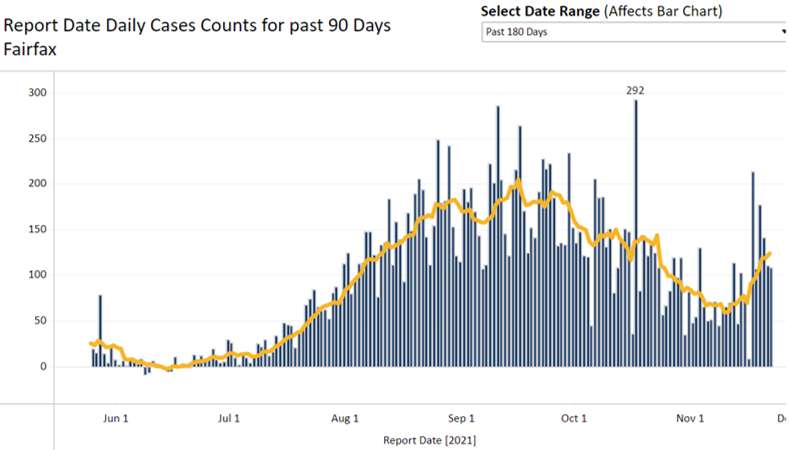
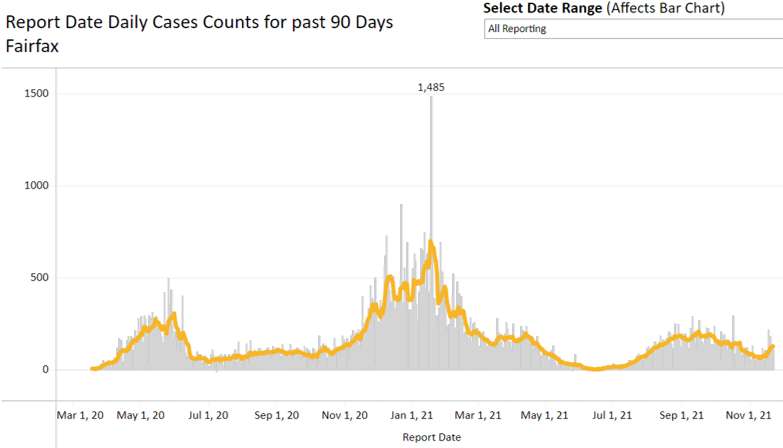
With 115 cases added today (Monday), the county now has a weekly average of 123.4 new daily cases, just shy of the 125.1 cases it was averaging on Aug. 11 in the middle of the Delta variant surge. For comparison, though, the county had a weekly average of 273.3 cases on Nov. 22, 2020.
The level of community transmission has returned to substantial after dropping to moderate just two weeks ago, according to VDH data. The county saw 72 new cases per 100,000 people and a testing positivity rate of 3.3% for the week of Nov. 14-20.
In total, the Fairfax Health District, including the cities of Fairfax and Falls Church, has reported 95,798 COVID-19 cases, 4,385 hospitalizations, and 1,225 deaths, including six in the past week.
While COVID-19 cases are trending upwards, so too are vaccinations in the Fairfax Health District, which has seen 1.7 million doses of vaccine administered, FCHD data shows.
867,103 residents — 73.3% of the district’s population — have received at least one dose, including 84.3% of people 18 and older, 86.7% of adolescents aged 12-17, and 21.6% of children between the ages of 5 and 11.
769,721 residents, or 65% of the population, are fully vaccinated, having gotten two Pfizer or Moderna doses or the one-shot Johnson & Johnson vaccine. That includes 77.1% of adults.
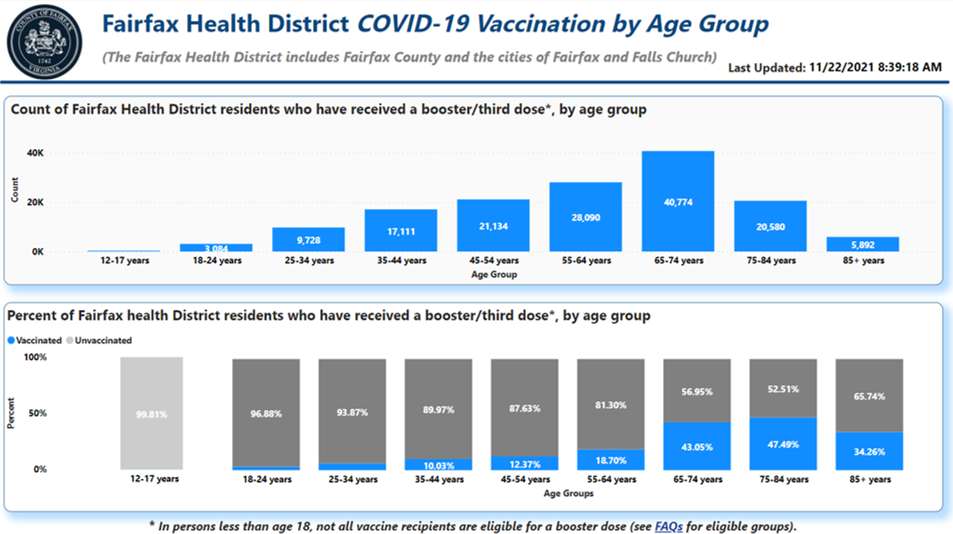
The popularity of booster shots generally increases with age, with more than 40,000 doses going to people in the 65-74 age group. In terms of percentages, the lead goes to people who are 75 to 84 years old, nearly 47.5% of whom have gotten a booster shot.
In addition to recommending that parents get their children vaccinated, Schwartz urged all community members “to remain vigilant and keep up health and safety measures,” such as wearing masks in public indoor spaces, washing their hands, and staying home when sick.
Photo via CDC/Unsplash
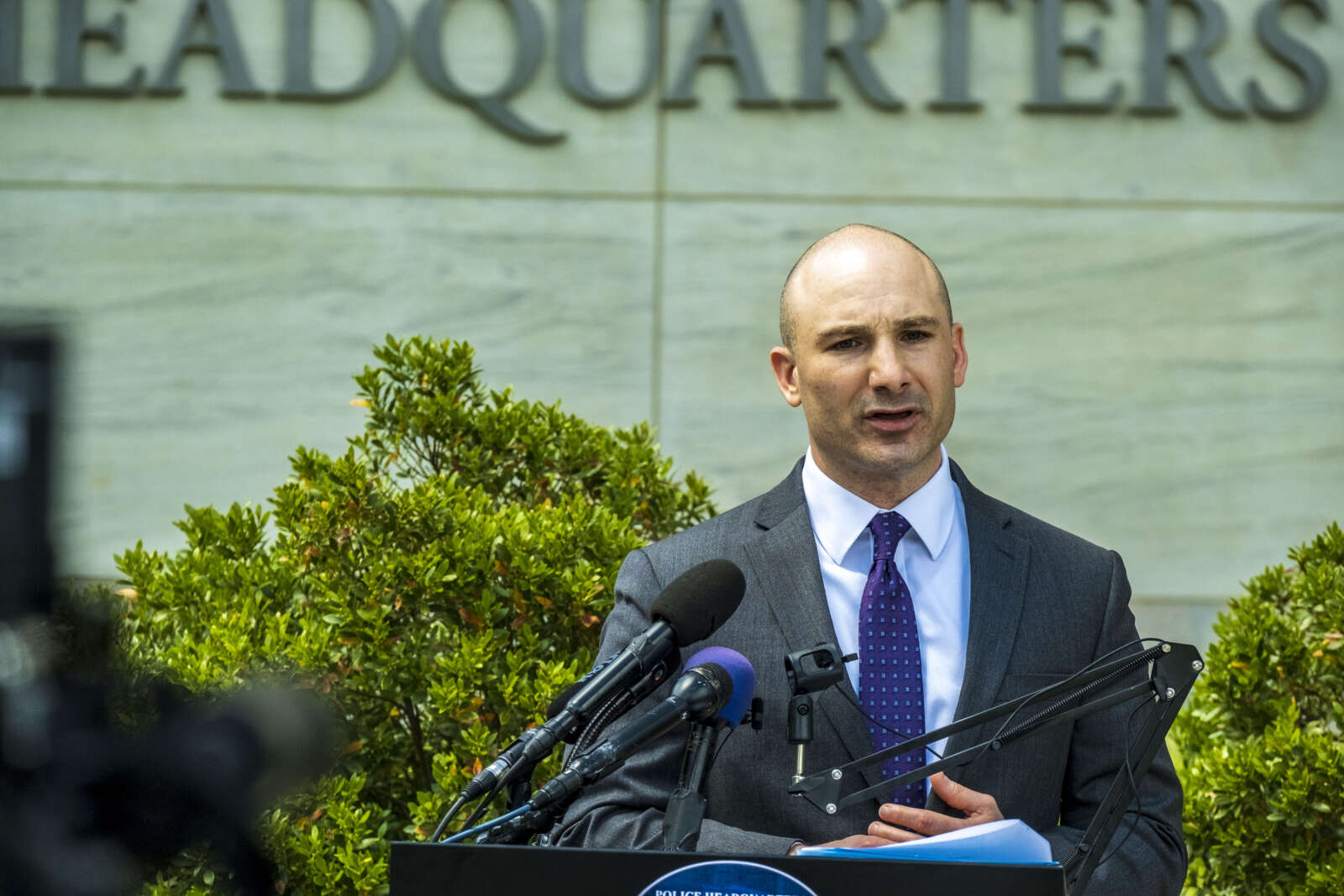
The results of Virginia’s 2021 general election could have significant ramifications for local efforts to seek alternatives to jail and other criminal justice reforms, Fairfax County Commonwealth’s Attorney Steve Descano says.
Descano, a Democrat, addressed expectations that his agenda will clash with that of Republican Attorney General-elect Jason Miyares in an online event on Tuesday (Nov. 16) hosted by the McLean chapter of the American Association of University Women, which seeks to promote equity and education for women and girls.
A day after defeating incumbent Mark Herring, who was seeking a third consecutive term as Virginia’s top legal officer, Miyares told reporters on Nov. 3 that he plans to introduce a bill that would let the state intervene in local cases.
“This legislation was inspired by a child rape case in Fairfax County, where a defendant was charged with repeatedly raping and molesting a 5-year-old child and was eligible for a life sentence,” Miyares said in a statement to FFXnow, pointing to a case involving Oscar R. Zaldivar, 53, who received a 17-year sentence through a plea deal.
Despite objections from the families involved, Descano’s office defended the sentence in statements to media after the September hearing as longer than what 75% of defendants in Virginia face for the same offenses.
Prosecutors typically get discretion to determine when to pursue a case based on whether the available evidence is sufficient and other factors. Descano said Miyares’s proposal would turn the legal system on its head.
“He wants the police to be able to sideline a prosecutor who’s inconvenient for them at anytime,” Descano said, adding that Fairfax County is fortunate to have a professionalized police force.
Miyares countered that he would get guidance from Commonwealth’s Attorneys to advocate for a bill that would “invite” the attorney general to prosecute child rape or violent crime cases “when the local prosecutor refuses to prosecute.”
The clash between Descano and Miyares presages the uphill battle that Fairfax County’s mostly Democratic elected officials will likely face over the next few years in trying to work with the n0w-Republican-led state government.
The county started a veterans court in 2015 to provide support systems for service members faced with charges. It then launched a Diversion First initiative in 2016 that offers rehabilitation over incarceration for certain nonviolent offenses. Since then, the county has also created specialized court dockets focused on the needs of people with drug addiction and mental health issues.
According to Census data compiled by the nonprofit The Marshall Project, Fairfax County’s jail population has declined significantly over the past two decades, from 3,749 people in 2000 to 1,207 people in 2010 and 667 people in 2020.
Elected in 2019 amid a progressive surge in Northern Virginia, Descano has implemented many of his pledged reforms, including eliminating cash bail, not holding suspects on nonviolent charges when they aren’t deemed a danger to the community, and enabling prosecutors to take “community values” into account instead of deferring to judges.
He said on Tuesday that the changes are intended to improve fairness in prosecutions.
The Office of the Commonwealth’s Attorney also has a data director who is working with researchers from American University and other partners to create a public dashboard with information on how it handles different cases.
Descano says the data will allow for analysis of prosecutors’ decisions, which will help avoid problems, such as unfair treatment based on gender or race.
When asked about the data effort by Aroona Borpujari, a statistician who watched the event, Descano replied that his office will release the data when they have enough of a sample size.
“It’s our pledge that we’re going to be transparent,” he said, describing the office as previously being in the Stone Age.

If you’ve ever lost precious minutes circling a parking lot for an available spot or questioned the amount of space devoted to parking in a new development, the time to voice those concerns has come.
Fairfax County kicked off a month-long series of town halls last week for the public to weigh in on its first comprehensive parking in decades, inviting stakeholders from business interests and nonprofits to tenants and religious groups to provide feedback.
Any recommended changes are expected to go to the Planning Commission and Board of Supervisors for votes in late 2022.
“We have lots and lots of privately owned parking, and sometimes it seems we have more than enough parking, and sometimes, we don’t have enough,” Hunter Mill District Supervisor Walter Alcorn said during an online town hall meeting on Nov. 10.
Dubbed Parking Reimagined, the county’s initiative focuses on off-street parking. It began last month and could run for 12-18 months. County rules regulate current parking as well as what future developments must build, though exceptions can be made.
The county is partnering with a consultant team, Clarion-Nelson\Nygaard, to study the matter, but a principal with Nelson\Nygaard, Iain Banks, noted that they’re looking at data from 2019 and earlier due to the pandemic’s effects on remote work, the use of transit, and other factors.
“Transportation is changing rapidly, not only as a result of COVID and the subsequent recovery from COVID but also into a future where perhaps traffic peak periods are going to change throughout the day,” Banks said. “It’s not going to be that typical morning and evening rush hour perhaps; it’s going to be more spread out throughout the day as flexible schedules perhaps become the norm.”
Residents expressed the need for parking and observed that parking costs money in the form of taxes, a parking permit, or a parking meter, though Fairfax County currently doesn’t operate any meters for off-street parking.
Michael Davis, parking program manager with the county’s Land Development Services department, said at the town hall last week that the initiative could help people think of parking as a resource.
He said they’re looking at “right sizing” parking, where the supply is appropriate for the demand. He noted that times of high and low demand can change by the hour and season, and there can even be times when cars are unnecessary, such as for nearby commutes.
Davis also raised the idea of shared parking. Instead of requiring a minimum number of parking spots, such as for a site with apartments, offices, and retail, a smaller parking area can be built that provides enough parking for all based on hourly demand.
County officials emphasized their interest in hearing from people at the town hall, which also turned into a brainstorming session of sorts.
Alcorn wondered if there was a way to track the progress of parking availability at developments. Davis noted that technology is already at Reston Town Center and Tysons Corner Center, which have electronic signs in their garages that show how many parking spots are available in real time.
But the changes in behaviors driven by the pandemic are leading officials to cautiously approach how to gather current data.
Information about upcoming meetings and other updates can be found on the county’s website for the project.

Flooding, power outages, and other impacts from storms are among the top climate change-related concerns for Fairfax County residents, the recently released results of a county survey suggest.
606 community members participated in the survey that the Fairfax County Office of Environmental and Energy Coordination (OEEC) conducted between June 8 and July 2 as part of its Resilient Fairfax initiative, which will produce a plan for how the county can withstand and adapt to the threats introduced by a warming planet.
81% of respondents cited severe storms as a concern, followed by changing temperatures (79%) and flooding (60%), according to the survey results report published on Nov. 8.
55% of respondents said they’re concerned about drought, 40% about fire risks, and 19% listed other climate hazards, including air quality and pollution, health effects, and the impact on plants and animals.
While the survey drew responses from just a fraction of the 1.1 million people who live in Fairfax County, the results still offer insight into the community’s awareness of the risks posed by climate change — and how they are already affecting people’s lives, county staff say.
“It helps us gather information that’s not available through quantitative data that we have,” OEEC Senior Planner Allison Homer said. “People’s opinions or people’s concerns, that’s not something we have access to without asking.”
Flooding
24.6% of the Fairfax County residents who answered the survey said their neighborhood has flooded within the past five years, with 9.8% of residents saying it has affected their home.
Of the respondents who work in the county, 24.8% said they have experienced flooding at their place of employment. 67.1% of respondents said they have witnessed flooding in the county outside their home or work, such as on roads.
The survey identifies Hunter Mill Road, Richmond Highway, George Washington Memorial Parkway, Prosperity Avenue, Huntington Avenue, and Little River Turnpike among the areas most vulnerable to flooding, though Homer says the evenly distributed flood map in the report doesn’t fully align with the county’s data.
“I think it’s sort of biased towards the areas where people lived that are taking the survey,” she said. “Our most flood-prone roads in reality are mostly concentrated towards the eastern part of the county.”
Flood risks tend to be higher in areas with older infrastructure, according to OEEC Division Manager Matt Meyers, citing the Great Falls area as an example.
“Those were country road when they were first built, but now, they’re surrounded by urban development, so those road culverts were not designed to today’s standards,” Meyers said. “They’re already inadequate, and then, when we have these intense rainfalls, they’re just overwhelmed.”
Power Outages
A sizable 80.7% of survey respondents reported experiencing storm damage other than flooding — such as power outages, damage to infrastructure and buildings, and downed trees — in their neighborhood within the past five years.
In particular, 94% of respondents said they have lost power in that time frame. While 46% said they were not significantly affected by a power outage, many reported notable ramifications:
- Loss of ability to communicate by phone or online (57%)
- Spoiled food (28%)
- Unable to stay inside because their home became too hot or cold (28%)
- Loss of refrigerated medications (2%)
- Operational issues with a life-supporting medical device (2%)
- Other impacts, mostly related to using a generator for power (7%)
Many of the areas cited as vulnerable were the same ones seen as susceptible to flooding, including Richmond Highway, Hunter Mill Road, Lawyers Road, Old Dominion Drive, and Prosperity Avenue.
The fragility of the power grid is an issue nationwide, as illustrated by extreme weather from a winter storm in Texas to this summer’s Pacific Northwest heat wave.
Homer says the county government can help reinforce Fairfax County’s power system by investing in backup generators, for example, but many changes, like moving power lines underground, will require cooperation from the state and utilty companies, which are involved in Reslient Fairfax as part of its Infrastructure Advisory Group.
“Renewable energy like solar installations can help enhance resilience if they’re paired with storage,” Homer said. “…But there are some limitations in Virginia as far as [how] we can use that solar plus storage, so we’re trying to see how much we can do that’s within our power to do.”
The Climate Adaptation and Resilience Plan
The survey is just one part of the Climate Adaptation and Resilience Plan that OEEC expects to finalize for the Fairfax County Board of Supervisors’ approval in June 2022.
In the coming months, county staff will release a climate projections report forecasting temperatures, precipitation levels, and other future conditions. They’re also developing a vulnerability and risk assessment that will incorporate feedback from the survey and an audit of the county’s existing policies and programs to determine where updates might be needed.
The final piece of the initiative will be a roadmap for how the county can implement its strategies for climate resilience.
Since launching in April, Resilient Fairfax has held two public meetings, and Homer says another community survey is planned for January. There will be a public comment period after a draft of the resilience plan is released in April.
The initiative works with the Community-wide Energy and Climate Action Plan that the Board of Supervisors adopted in September, which recommends steps for reducing greenhouse gas emissions.
One of the Resilient Fairfax team’s goals is to identify strategies that can address both the causes and effects of climate change.
“Resilient Fairfax is acknowledging that we’re already facing impacts from climate change,” Homer said. “We’re already facing more severe storms and flooding and heat, so while we’re all working to reduce our emissions, we also need to make sure that we’re prepared for the impacts at the same time.”
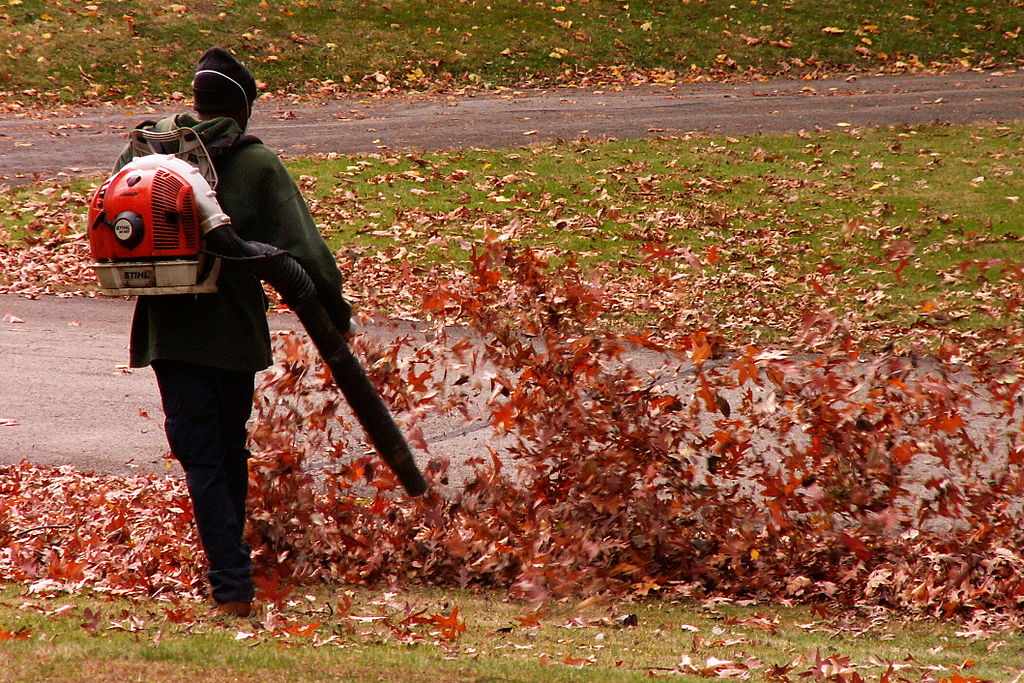
Fairfax County will phase out the use of gas-powered leaf blowers in county operations.
Gas-powered leaf blowers are too noisy, dirty, and do not adhere to the newly-adopted Community-wide Energy and Climate Action Plan, according to several county supervisors. Instead, officials are recommending the use of electric equipment, along with leaf and grasscycling.
Braddock District Supervisor James Walkinshaw presented a joint board matter directing county staff to develop a plan for ending gas-powered leaf blower purchases at last week’s Board of Supervisors meeting. The board approved the matter by a vote of 9-1 with Springfield District Supervisor Pat Herrity dissenting.
“The use of gas-powered leaf blowers presents a number of problems,” said Walkinshaw at the meeting. “Most prominently, their extreme and pentertraing noise levels and the highly toxic emissions from the out of date two stroke engines.”
Walkinshaw noted that the blowers operate at a noise level that could potentially cause hearing damage. He also mentioned that they are inefficient in terms of its output and emit 23 times the amount of carbon dioxide as a Ford pickup truck.
The board matter additionally calls for contractors that work for the county to begin transitioning away from this type of equipment, encouraged by incentives from the county.
“By taking an incentive-based approach to our procurement policies, we can jumpstart the transition from dirty and noisy gas-powered blowers,” wrote Walkinshaw in a statement. “This initiative sends a strong signal to landscaping contractors that now is the time to invest in cleaner equipment.”
However, specific incentives were not discussed and will be established “when staff reports back,” a spokesperson from Walkinshaw’s office wrote to FFXnow in an email.
As of yet, there’s no deadline established for the phase out.
During the meeting, Hunter Mill District Supervisor Walter Alcorn noted that the county currently owns 133 gas-powered leaf blowers.
However, that number doesn’t include ones used by contractors who work for the county, a spokesperson from Walkinshaw’s office confirmed.
Alcron said he still hoped that this idea of banning gas blowers would be also adopted by the Virginia General Assembly, but stated that the county’s adoption was “clearly a step in the right direction.”
McKay acknowledged converting to an entirely electric fleet of blowers could be very expensive for some contractors, but hopes that the county phasing out this type of equipment is “leading by example.”
A cost estimate for phasing out this equipment isn’t available yet, but it’s expected to be minimal, according to Walkinshaw’s office.
Photo via Cbaile19/Wikimedia Commons
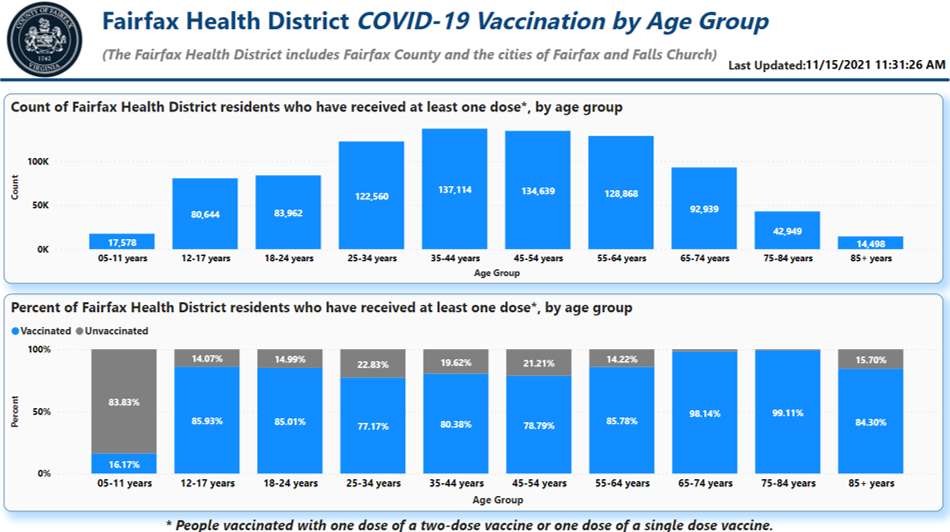
More than 16% of children in the Fairfax Health District have gotten a COVID-19 vaccine dose since the shots became available to them on Nov. 3.
As of today (Monday), 17,578 of the district’s over 108,000 residents between the ages of 5 and 11 have received their first dose of the two-dose Pfizer-BioNTech regimen, according to the Fairfax County Health Department’s vaccine data dashboard.
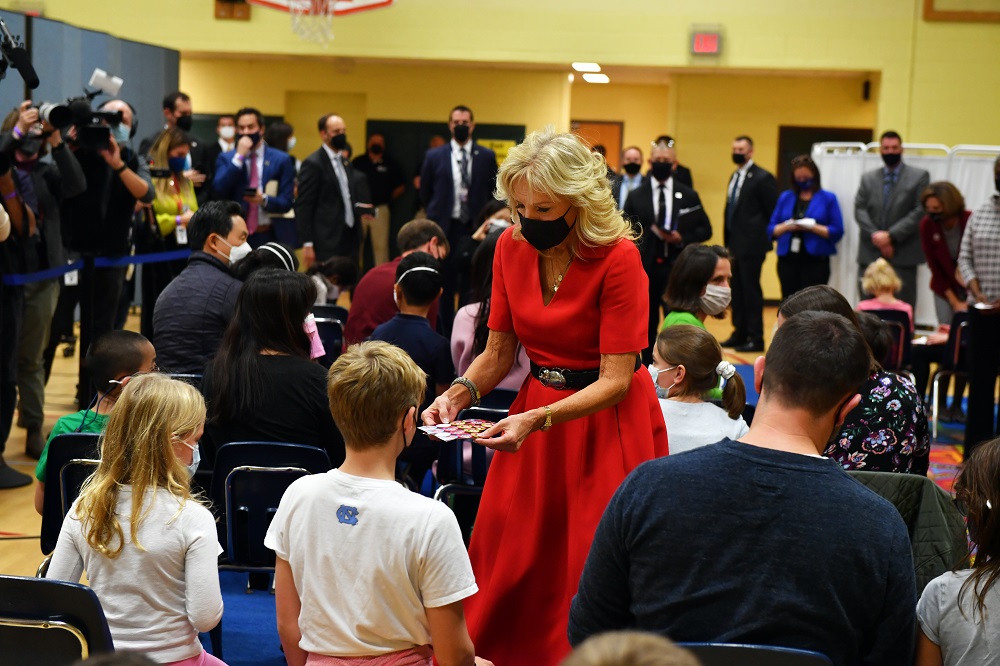
After formally kicking off its pediatric vaccine rollout with first lady Jill Biden last week, FCHD announced on Thursday (Nov. 11) that it will host a series of vaccine clinics specifically for this age group at nine public elementary schools starting tomorrow (Tuesday).
According to the county health department, it is working on the 19 scheduled school-based clinics with Fairfax County Public Schools, the Virginia Department of Health, Giant Pharmacy, and Ashbritt/IEM, the same contractor partnership that operates the mass vaccination site at Tysons Corner Center.
“Capacity at each clinic is expected to be 150 doses,” FCHD spokesperson Lucy Caldwell said by email. “In the event supply is exhausted at a particular event, our staff will assist families onsite to make an appointment at a nearby vaccine provider.”
For now, the clinics will all take place after school hours or on the weekend, though FCPS officials have said they plan to eventually make vaccinations available when students are in school as well, likely after their winter break.
Unlike at the county’s mass vaccination sites, which have temporarily suspended walk-ins, appointments are not needed for the school clinics, but children must be accompanied by a parent or guardian.
According to Caldwell, the schools that will host the clinics were chosen by FCPS and county health department staff based on data showing areas with “higher rates of COVID-19 illness but less access to sites offering vaccine for children ages 5-11.”
However, every clinic is open to all children regardless of whether they attend that particular school.
Vaccinations for all ages can still be scheduled at health department sites, Inova, private healthcare providers, and various community sites like grocery stores and pharmacies through vaccines.gov.
Overall, at least one COVID-19 vaccine dose has been administered to 855,751 residents of the Fairfax Health District, which includes the cities of Fairfax and Falls Church. That amounts to 72.3% of all residents, including 83.7% of people aged 18 and older.
762,954 residents, or 64.5% of the population, are now fully vaccinated, including 76.4% of adults.
While vaccinations have helped reduce the pandemic’s threat, they haven’t extinguished it entirely.
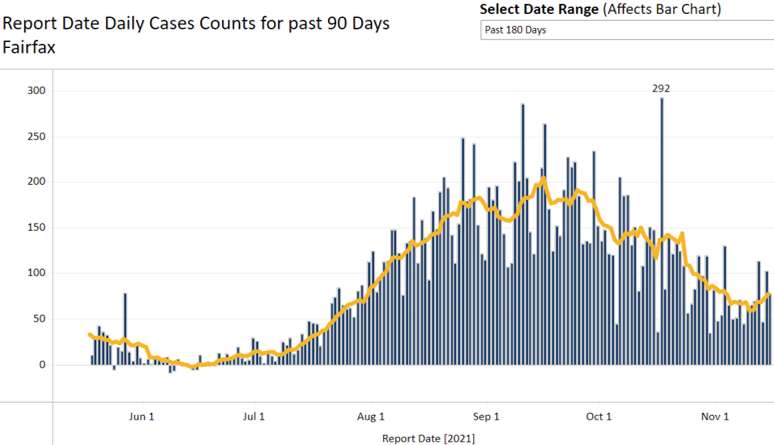
After dropping to 58.7 cases last Wednesday (Nov. 10), the lowest point since July 24, when the Delta variant first took hold, Fairfax County’s weekly average has ticked up over the past few days and now sits at 77.1 cases per day, according to VDH data.
With 93 new cases today, the Fairfax Health District has reported 94,770 COVID-19 cases total. 4,390 residents have been hospitalized by the novel coronavirus, and 1,219 people have died.
While it’s too soon to tell whether the rise in cases is a blip or the start of another surge, past patterns and a resurgence of the virus in Europe have health experts reiterating the need to vaccinate as many people as possible, with the winter holidays and cold weather approaching.

