

 This is an opinion column by Del. Ken Plum (D), who represents Reston in Virginia’s House of Delegates. It does not reflect the opinion of Reston Now.
According to the General Assembly’s own watchdogs, the Joint Legislative Audit and Review Commission (JLARC), Virginia’s local school divisions shoulder the highest share of total K-12 spending in the Southeast region.
The finding is hardly news to school superintendents, school boards, and local governments as the recession took its toll on the economy and tax revenues at all levels, student enrollment increased and the state share of education spending declined.
In FY2014, the average Virginia school division spent 7 percent less to educate each student than it did in FY2005, according to JLARC. Also not news to teachers is the JLARC finding that “divisions reduced per-student spending on instruction through a combination of employing fewer teachers per student, limiting teacher salary growth, and requiring teachers to pay a higher percentage of health insurance and retirement benefit costs.” Parents also are keenly aware that their children are sitting in classrooms with many more students.
Fairfax County Board Chairman Sharon Bulova captured the details of the declining state revenue for K-12 education in a letter to the Governor recently. She wrote that “though the Commonwealth’s budget shortfall was the 20th largest in the nation, the state funding cut to localities was third highest among the states. In fact, since FY2009, structural budget cuts to K-12 have cost localities more than $1.7 billion per biennium statewide. State K-12 funding in FY2016 remains below the FY2009 level.”
She observed that “a state that is in the top ten in income should not be in the bottom ten for state education funding, but that is where Virginia finds itself at present.”
A recent report based on a survey by the Virginia Association of School Superintendents found that 92 percent of school districts in the Commonwealth have cut staff, eliminating more than 10,000 jobs, more than half of which have been teaching positions. Increased class sizes have been reported in 71 percent of school districts. Programs such as fine arts, foreign language, physical education and career and technical education have been reduced at more than half of school districts, and nearly a third of districts have reduced extra-curricular activities such as academic clubs, student clubs, and athletics.
As the president of the Association said, “School divisions simply don’t have the finances or human resources to make the changes we want and need in order to prepare our students effectively for higher education and careers.”
An analysis of the JLARC report by the Commonwealth Institute for Fiscal Analysis concluded that “supporting our schools at a level far below what it takes to meet growing needs, we put our children and our future workforce in a precarious position. Continuing to pretend that teachers and schools can do more with less, year after year, is not sustainable. It’s time to rebuild the damage done to education funding during the recession and invest in our children.”
Governor McAuliffe has said that he will be giving priority to education funding in the budget that he is preparing for the next biennium. The 2016 session of the General Assembly must adopt the same priority.
This is an opinion column by Del. Ken Plum. who represents Reston in Virginia’s House of Delegates. It does not reflect the opinion of Reston Now.
It is not easy to admit that you are not up to a challenge that hundreds of your constituents face each day, but that’s what happened to me last week.
ProgressVA sponsored the “Live the Wage Challenge” asking elected officials, community leaders, advocates, and everyday citizens to walk in the shoes of a minimum wage worker by living on a minimum wage budget for one week. The point of the activity was to help others understand what life is like for low-wage workers and why raising the wage is important to working families and to the economy.
Directions for the simulation provided each participant with a weekly budget of $77, which represents the weekly wages of a full-time worker making the federal minimum wage of $7.25 per hour (minus average taxes and average housing expenses).
Even that budget is generous for the Northern Virginia region, where housing expenses alone would wipe out the entire paycheck. For the activity, I needed only to figure out how to pay for my meals, groceries, transportation, and recreational spending. The rules were very generous in not requiring me to cover the expenses of family members or work travel. The rules however did require me to eat only those items of groceries or eating out paid for within the budget. I was required to record my expenses to see how I made it through the week.
The fact of the matter is that I did not make it through the first day. It was clear to me from the beginning that I was not going to be able to make ends meet. Yet people in my community and throughout Virginia have to face these challenges every day. The simulation included a day when a child in your household gets sick. What do you do? You cannot stay home for you need to work every day to get the income. You cannot afford a baby sitter or a visit to a medical clinic.
I have been conscious of the plight of low-income people, but this activity brought home to me once again how tough life is for some people. Several years ago, I was paired with a woman living in subsidized housing along with her young daughter who had multiple handicaps. I tried to live on the budget of public assistance that she had. I failed that challenge as well. And I grew up in a home with limited income. I admire the resourcefulness of persons in these situations and their ability to live without many of the things we consider basic.
Last legislative session, I introduced a bill to raise the minimum wage in Virginia. It was supported by interfaith, religious, and labor groups. It was unfortunately opposed by business groups including the Virginia Chamber of Commerce and much to my disappointment the Fairfax and Reston Chambers of Commerce. I will introduce the bill again in 2016.
For those who have opposed the bill in the past, I hope you will go to #LiveTheWageVA and tell me and others how you would meet the challenge!
One of the early rites of passage for me and those of my generation was to get a driver’s license. I was pleased to run errands for the family, and my parents were generous in allowing me to use the family car for school and social events.
Now I understand that about a fourth of millennials are not even bothering to get a driver’s license. And when you consider how many communities are developing by transit oriented development (TOD) principles, there is less of a need to own or lease an automobile. These shifts in living patterns have significant public policy implications.
With the opening of the Silver Line to Wiehle-Reston East, I have another alternative for my travels. Within a year residents in the new apartments under construction by Comstock at Reston Station will be able to take the elevator down to the plaza to the bus to Dulles on the Silver Line to points east as well as Maryland.
For weekend travel, a Zipcar or other hourly rentals are available, and a bicycle provides good healthy exercise. A new hourly car rental system allows you to leave the car at your destination without the need to return it to where you picked it up. Some suggest that the driverless vehicle is not that far in the distant future, and with the rapid advances I have seen in recent times, I believe them.
The traditional taxi system got a jolt with the introduction of Uber and other companies that use drivers and their own automobiles to transport passengers. The Virginia General Assembly passed legislation this year to establish a legal framework under which the companies can provide service to consumers in a safe and legal way. I would guess that there is likely to be a melding of these two businesses in the future to provide more convenient car ridesharing.
In the short run, I understand the interests of persons dependent upon automobile travel that our roadway surfaces be repaired and that traffic congestion be reduced.
We suffer from more than a decade of refusal on the part of the legislature to provide adequate funding for highway construction and repair. During that time I co-sponsored and voted for many bills only to see them defeated. Technological advances are helping to reduce congestion with better traffic light systems and with regulated traffic systems as has just been introduced on I-66.
These improvements must take into account the bigger picture of transportation. Road improvements must include bicycle travel lanes. Mass transit will need subsidy just as our roads are subsidized. Public and private incentives need to be offered for car-pooling, and the use of transit. TOD must be given priority.
Our public policy on transportation must recognize that there are many different ways to go.
I don’t know why I was surprised at Reston founder Bob Simon’s passing. After all, he was 101 years old. Few people reach that age, and fewer still live beyond it. Yet Bob was such a prominent figure in his namesake community that unconsciously those of us who were surprised by his death may have thought he would always be there. His passing was so noteworthy that it received coverage in all the major news outlets.
He will be greatly missed by those who knew him and by those whose lives were touched by him: by the little children who huddled around the pedicab when he was brought to the Founder’s Day Program or to the Bike-to-School program at Lake Anne Elementary; by the children at a day care center named for him; by residents and visitors alike as he ambled around Lake Anne; by everyone who saw him in the annual Holiday Parade at Town Center; and by politicians at all levels of government with whom he shared the podium at numerous public events in his town and who witnessed his popularity and couldn’t help but be a bit envious.
Surprise and sadness at the passing of Bob Simon are quickly replaced by overwhelming joy at having known him. Few times in life do we get to know a visionary: a person who can see beyond the immediate to a better society. That sizable chunk of Virginia countryside in which Bob Simon invested in the 1960s could have easily been turned into a subdivision for quick profit, but for Bob and his vision it represented an opportunity to create a better place for people where they could live, work and play.
Better than anyone I know, Bob Simon knew and appreciated community. His plan for Reston did not start with designing a government structure. Some land use laws had to be changed to accommodate his plan, but the governance of that place he named Reston was left to the community.
While there have been healthy debates about issues over the years, there has been a recognition that local neighborhood citizen organizations and nonprofits formed by the residents could resolve those issues without the need for another layer of government or partisan involvement.
While it is difficult to discern the elements that create the sense of community in Reston, it is undeniable that it is there and that it was nurtured by its founder Bob Simon. The basic principles he outlined in the beginning for his new town give us the best insight into what he envisioned. The most radical notion at the time and place of Reston’s founding that people of all races could live together in harmony has become a societal norm.
Robert E. Simon, Jr., our immediate surprise and sadness at your passing have quickly turned to joy at having known you. Rest in peace, inspirational leader, wise counselor and good friend — you made a wonderful difference for all!
Ken Plum represents Reston in Virginia’s House of Delegates. His opinion does not represent Reston Now.
This is a column by Ken Plum, who represents Reston in Virginia’s House of Delegates. It does not reflect the opinion of Reston Now.
A federal court found Virginia’s congressional redistricting to be unconstitutional because it diluted the strength of minorities in elections. Essentially, the redistricting of 2011 packed black voters from Richmond to Norfolk in a single congressional district ensuring the probable election of one black representative while reducing the likelihood of another one being elected.
The court ruled on the fairness of districts related to their being numerically equal in size and in their treatment of classes of voters, but it does not take into account partisan advantages or disadvantages.
The federal court set a Sept. 1 deadline for new district lines to be drawn by the General Assembly. The Assembly was unwilling or unable to draw new lines, at least in part because any new map is likely to increase the Democrats’ chances of winning more than the 3 of 11 congressional seats they currently hold.
A special session called by Governor Terry McAuliffe to take up the issue concluded without taking action. A proposal drawn up by the Democratic minority to address the issue of fair racial representation in the Tidewater and Northern Virginia areas was not considered by the House or Senate. Based on prior voting behavior by the people in these new districts, there would likely have been five Republican, five Democrat, and one swing district. Such an outcome is reflective of how the state has been voting in statewide contests.
This is not the first time Virginia has run afoul of federal courts on the issue of redistricting. As the state grows in size with developing metropolitan areas, those who controlled the legislature have been reluctant to give up their power to the newly emerging suburban and urban areas. Virginia was one of the states in the 1964 Baker v Carr decision establishing the principle of one man, one vote. After the 1981 census, the Supreme Court threw out the redistricting three times before the legislature got it right. With the changing of district lines, I had to run for office in 1981, 1982, and 1983. The same thing could happen again this year.
The same rationale that makes the congressional districts unfair applies to the House of Delegates districts that are now being challenged in federal court. House members could have to run three years in a row just as in the early 80s if the case is successful. House of Delegates elections in 2016 in particular could be interesting as this is a presidential election year with greater voter participation.
It is human nature that political parties in power try to maintain their majorities through gerrymandering districts to their advantage. I first introduced a bill in 1982 that would have given the task over to an independent commission. Neither Democratic nor Republican majorities have been willing to pass it. Several states have such a commission, and I have continued to re-introduce the bill.
I believe it is the only way to get fair, nonpartisan redistricting done. I support OneVirginia, a group that is working for this kind of reform that needs to be put into place right away.
This is commentary by Del. Ken Plum (D), who represents Reston in Virginia’s House of Delegates. It does not reflect the opinion of Reston Now.
Virginia made history last week — not for the kind of event for which we would like to be remembered, but one nonetheless that took place on our soil and will be talked about around the globe.
Virginia is home of the first on-camera televised and social media-exposed double murder. A disgruntled television worker shot a reporter and her guest and the cameraman while the show was being televised and then publicized his deed on Facebook and Twitter before shooting himself.
In the 2009 Virginia Tech massacre, 32 students and professors were killed in the deadliest shooting incident by a single gunman in this country. In the future, Smith Mountain Lake — which has been known as a wonderful place to have a lakeside home for weekend or retirement living — will also be known for the live murders on television, just as the excellent university that Virginia Tech is always will be remembered in part for the massacre that occurred there.
Aurora, Colo., Newtown, Conn., and other places are getting the same kind of blight on their names as the epidemic of mass murders accelerates at an alarming pace.
As astounding as what seems to be a growing tolerance in this country for mass murders occurring in school houses, on college campuses, in theaters and now on television is, the paralysis of elected officials to do anything about it is truly baffling.
The Founding Fathers certainly had none of the present carnage in mind when they wrote the Second Amendment about a standing militia. Certainly the current state of affairs does not promote life, liberty or the pursuit of happiness among the citizenry.
Shocking also is the ability of gun manufacturers and their advocates to turn these situations into opportunities to promote more gun sales and to propose arming of school teachers, college students, citizens, and now I suppose television reporters. Rather than gun safety measures being put into place, there has been a steady erosion of such laws in Virginia and throughout the country.
Part of the solution is expanded mental health services to respond to the needs of individuals who may become violent. Virginia expanded funding for mental health programs after the Virginia Tech massacre but reduced it again soon thereafter. It took a violent attack on a member of the legislature, Creigh Deeds, by his own son to get the money restored. Laws need to be strengthened to ensure thorough background checks so that those whose mental illness causes violence do not get access to guns.
We are past time to act. I trust that voters will look at incumbents’ records on gun safety legislation and will vote accordingly. I will continue to introduce and work hard to pass expanded background checks for gun purchasers. Let’s turn this around and make history again by making Virginia one of the strongest states to take decisive action to prevent gun violence.
This is an opinion piece by Ken Plum, who represents Reston in Virginia’s House of Delegates. It does not reflect the opinion of Reston Now.
Recently, a place of worship in the community asked me to be a speaker in their summer worship series. After getting past the frightening idea that I was to preach a sermon, I started to focus on the fact that I live my life on both sides of the wall that separates church and state.
As an historian, I know that the Virginia General Assembly in 1786 passed one of the most revolutionary laws ever enacted by it or any other legislative body: the Virginia Statute for Religious Freedom. Not only did it end an established state church supported by taxpayers, but it put into law the idea of freedom of conscience. As Jefferson expressed it in the Statute, “no man…shall otherwise suffer on account of his religious opinions or belief, but that all men shall be free to profess, and by argument to maintain, their opinion in matters of religion, and that the same shall in no wise diminish, enlarge or affect their civil capacities.”
Earlier, of course, Jefferson had penned the Declaration of Independence with the pronouncement that “all men are created equal and are endowed by their creator with certain inalienable rights that among these are life, liberty and the pursuit of happiness.” Note that Jefferson never claimed that those rights that could not be taken away came from his god, but rather they came from “their (humankind’s) creator” suggesting that different persons could believe in different creators or gods.
These ideas that defined the wall between church and state made their way into the Virginia Declaration of Rights and the U.S. Constitution’s Bill of Rights. For the first time in history there were to be no state established churches; individuals were left to choose and believe as their conscience dictated.
There continues to be a debate as to whether we are a Christian nation. Patrick Henry wanted the Virginia Statute to guarantee Christian religion, but his arguments failed. We are one nation “under God” only because a law in 1954 added those words to the Pledge of Allegiance. There are Christians of many denominations in our country as there are many Jews, Muslims, people of other religions and of no religion. None have legal sanction or supremacy over the others.
I live my life on both sides of the wall. Privately, I am a person of faith. My religious beliefs support my moral beliefs. I believe I should love my neighbor as myself regardless of their race, creed, color, national origin, gender, or sexual orientation. And I believe that loving others requires me to do all I can to ensure their life, liberty and pursuit of happiness.
On the public side of the wall as an elected official I continue to hold my religious beliefs; they motivate me to vote for legislation to protect all citizens’ rights to vote, to get an education and to live a life free of discrimination. My moral compass is under-girded by my faith, but that does not mean I think my particular beliefs should be the law of the land.
The wall between church and state is intended to protect each person’s right to their own beliefs–to protect my freedom of conscience. .. not my freedom from conscience. I feel I must use my moral compass on both sides of the wall.
Del. Ken Plum represents Reston in Virginia’s General Assembly. It does not represent the opinion of Reston Now.
Shifting from a relaxing vacation back to work is always challenging, but my return this past week from the mountains, streams and lakes of Glacier National Park to a special session of the General Assembly has been a particularly stark contrast.
The special session of the General Assembly called by Governor Terry McAuliffe that started on Monday of this week was to deal with court-ordered redistricting, but before we got to the Capitol in Richmond an additional issue arose that makes the special session particularly contentious.
A federal court found that Virginia’s congressional redistricting was unconstitutional, and that decision was upheld twice by appeal courts. While the districts were numerically about even, district lines were drawn in such a way as to pack minorities into the 3rd Congressional District ensuring the likelihood of the election of a minority member and at the same time reducing the possibility of electing more than one.
Federal courts have thrown out redistricting in other states that had the same effect. The majority party that drew the lines in the first place has been trying to delay responding to the court’s order apparently hoping that a higher court would change the decision that has a Sept. 1 deadline. Changing the lines may give a racial minority a greater opportunity to elect another member of Congress, and at the same time it may give the minority political party the chance to elect another member.
The majority party that controls both the House and Senate in Virginia refused requests from the minority party to work together with the Governor to come up with a new plan in a transparent way that would meet the court’s equal protection requirement choosing instead to develop a plan of their own in secret.
Adding to the friction of the situation is the majority party leadership announcement that they will reject the appointment by Governor McAuliffe of a Supreme Court justice. Governor McAuliffe made an interim appointment of a justice when a vacancy occurred as he is authorized by the Constitution to do.
That appointment is subject to General Assembly confirmation when it meets. Such confirmation is generally routine except in this case the majority leadership says it was not consulted and will not confirm the appointment of a woman who everyone agrees is superbly qualified. The contention of not being consulted is dubious when it was a ranking member of the majority party who chairs the committee that reviews judicial appointments that brought her to the attention of the Governor and who spoke on behalf of her appointment when the Governor announced it.
Behavior in the State Capitol in Richmond is getting to be too much like the United States Congress. I have not made reference to specific parties in expressing my concern about what is happening because it is not about Republicans or Democrats; it is about doing the people’s business without pettiness or arrogance.
What is going on now is wrong whether done by Democrats or Republicans. The concern is not about party; it is about misbehavior that is not worthy of the public trust.
With the federal Clean Air Act requiring higher air quality standards, many fossil-fuel power plants will be closing or converting to other fuel sources.
On trips to the western part of our country and abroad, especially to Germany, I am reminded of the significant role that wind plays in being used to generate clean and sustainable electricity. In 2014, wind power added significantly more new electricity for consumers than any other source in the United States, according to the U.S. Department of Energy.
According to an American Wind Energy Association announcement last year, the United States has more wind energy supplying its grid than any other country, enough to power 15.5 million American homes. Wind is the fifth-largest electricity source in the U.S., generating 4.4 percent of all the electricity in this country.
In Denmark, wind-produced electricity provides just under 40 percent of the nation’s power. Scotland has enough wind-produced electricity to supply all its homes. Wind power is the leading source of Spain’s electricity and is the largest component of Germany’s renewable sources that now constitute a quarter of its power. China leads the world in investments in wind power.
Among the states Texas, Iowa, California, and Oklahoma, each generated enough electricity from wind to power more than a million homes. Other states with significant wind capacity include Kansas, Illinois, Minnesota, Oregon, Colorado, and Washington.
Virginia and other eastern states do not make the list because they do not have as significant a wind resource. For Virginia, only off-shore and in the mountains mostly in the southwest is there wind sufficient to site a wind turbine farm.
Dominion, the largest power provider in the Commonwealth, has invested in wind-powered electricity generation in West Virginia, Indiana, Illinois, and in Virginia where it holds a lease from the federal government for off-shore wind development.
The success of wind-produced electricity in Europe has been realized from a feed-in tariff system that has effectively subsidized investments. In the United States, the Production Tax Credit has been the primary federal tax incentive for wind energy. As all countries look for ways to save money these incentives are in danger at a time when wind energy is beginning to demonstrate its value.
Virginia is the first state to secure a wind energy research lease to build and operate turbines in federal waters. Dominion’s plan to build a pair of 6-megawatt test turbines about 24 nautical miles off-shore from Virginia Beach seems to be in trouble as bids to build the turbines are about twice that projected. The expectation has been that eventually there would be 300 turbines in the off-shore area. Stakeholders are currently at work to identify options to salvage the project.
Wind energy needs to be a part of the renewable mix of energy sources in Virginia and the nation. Congress needs to extend the federal tax credit that keeps our development of wind energy competitive with the rest of the world. Consumers need to be open to buying wind and other renewable energies even if there is a cost premium. Our air quality depends on it.
Del. Ken Plum represents Reston in Virginia’s House of Delegates. His opinion does not represent Reston Now.
While I am far from a world traveler, I find the trips I take to other countries to be relaxing, fun and educational. I agree with those who stress the value of traveling abroad to a complete education. An increasing number of colleges and universities have made study in other countries available and sometimes required of their students.
I seem to be happiest when I am learning, and a couple of weeks immersed in another land and culture brings new discoveries, challenges to my own paradigms, and the excitement of seeing and doing.
The recent vacation Jane and I took to the Netherlands, Belgium, and the Mosel Valley in Germany was no exception. While it can be questionable to draw too many conclusions after being in a place for only hours or days, curiosity can be aroused that can be verified with some research when you get home.
I always pay close attention to how other countries deal with their transportation needs. Never have I seen as many bicycles as there are in Amsterdam. Multiple levels of covered parking for bicycles at the airport and train station accommodate thousands of bicycles. Most every lamp post, park bench, and railing had bicycles chained to it.
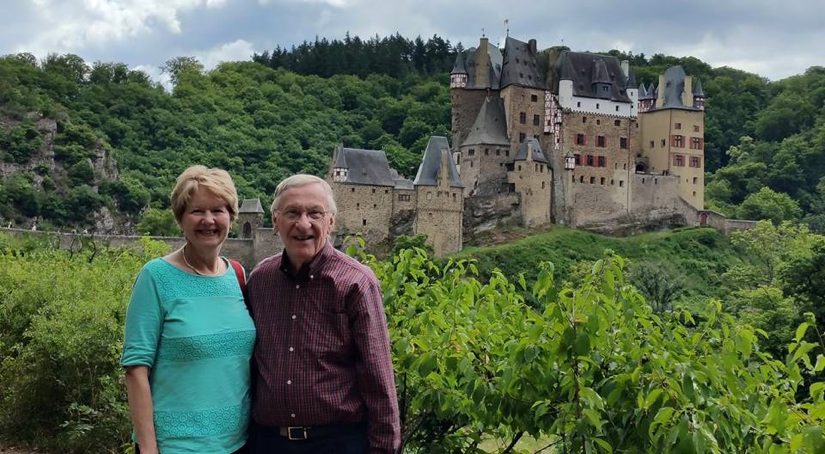 Checking on my observations when I returned home I found that Amsterdam and other Dutch cities are the most bicycle-friendly in the world. There are more than 22,000 miles of bicycle lanes in the Netherlands with more than a quarter of all trips made by bicycle. That number is 38 percent in Amsterdam, a city of about a million people, and in the university city of Groningen 59 percent of all trips are by bicycle.
A typical street scape in Amsterdam would include a narrow lane for automobiles, bicycle lanes in both directions, trolley rails, and a sidewalk for pedestrians. Men and women dressed for work were among those on bicycles as were many seniors. Spending a couple of days there makes it obvious why it is considered one of the best cities in the world in which to live.
Brussels is likewise a beautiful city to visit, but I think it is especially noteworthy as the center for the cooperative efforts that are going on in Europe with the European Union and the European Parliament. At a time when there is so much strife among countries, it is reassuring to see the progress being made in mutual support and cooperation in Europe even if it is slow given the strong sense of nationalism and history that exists among the countries.
Of course I pay attention to things that relate to issues I deal with as a delegate, but do not let me mislead you about our vacations. I also give equal or more time to enjoying the flowers and foliage of the region, the local foods, and the people we meet. That’s what is great about traveling abroad: you learn a lot while you are relaxing and having a good time.
Ken Plum represents Reston in Virginia’s House of Delegates. His opinion does not represent Reston Now.
The recent tension between the Fairfax County Board of Supervisors and the School Board over approval of the budget for the public schools left one big factor out of the equation for funding schools — the role of state government in financing public education in the Commonwealth.
Public education as defined in the state constitution is a partnership between state and local governments. For some years, the state funded on average statewide more than half the cost of public education. In recent years there has been steady slippage in state support, and local governments have had to pick up the difference.
Virginia Issues and Answers, an excellent publication of the Virginia Tech School of Public and International Affairs, took a look at the issue of financing K-12 education in Virginia in its spring 2015 issue. While the national average of state funding for public education has been around 50 percent, “Virginia, however, has provided a smaller fraction of funding with its contributions typically 10 percentage points below the national average.”
With the Great Recession, funding for education dropped nationally while in Virginia in 2010 it dropped to 37 percent to be in the lowest quartile among the states.
As would be expected, in a look at local funding the opposite is true. In Virginia, localities have been asked to pick up a greater share of education costs. The study found that on average local governments in Virginia have to put in about ten percent more for education than their counterparts in other states.
“Whereas most other states rely more heavily on state revenue to fund their schools, Virginia relies more heavily on local revenues from local property and sales taxes,” the report stated.
Federal funds typically provide 10 percent or less to the revenues of schools in the states. Interestingly, in 2009 the federal share of funding schools in Virginia increased by four percent as Virginia accepted without fanfare or objection American Recovery and Reinvestment Act monies that otherwise Virginia politicians like to rage against. The Virginia Tech study found that during the Great Recession other states cut their per pupil spending less than cuts in Virginia.
The funding for schools is complicated by the necessity under the federal Constitution to ensure that children throughout the state are equally protected to have access to public education. The equalization aspect of the state funding formula for schools results in a higher percentage of state dollars going to the poorest communities over the more prosperous ones. While the success of the formula is open to debate on equalizing access to education, reductions in the amount of dollars available disadvantage all school divisions.
Local governments in Virginia can pass only those taxes that are permitted by state government. Fairfax County cannot pass a meals tax, for example, without state authorization and approval in a local referendum.
Fairfax County residents expect the best schools and under current laws and practices have to shoulder most costs through the property tax. As the debate goes on in Fairfax City about funding our schools, we need to have a discussion about the state’s shrinking role.
I continue to celebrate the human rights victories we have had recently in marriage equality, health care and housing.
I voted against Virginia’s marriage amendment defining marriage as being between a man and a woman when it came before the General Assembly and campaigned against it in the referendum; voters in my district voted against it. Now it is history! All Virginians can marry. Now we need to work against LGBT discrimination in other parts of our society.
With the Affordable Care Act being found constitutional, we need to move forward in fully implementing it in Virginia by expanding Medicaid coverage to the working poor. A key benefit of accepting federal Medicaid dollars is that it would free up state funds for programs we currently are unable to fund adequately like mental health and education. As many as 400,000 Virginians could be helped as we accept back into the state tax monies Virginians have paid into the system.
The Supreme Court’s ruling interpreting the Fair Housing Act of 1968 that housing discrimination doesn’t have to be intentional to be illegal protects vulnerable populations. These advances remind us that we need to stay the course on other issues like gun violence and the Second Amendment.
A study recently released by the Harvard School of Public Health found that between 1982 and late 2011 mass shootings occurred about every 200 days. After Sept. 2011, however, the rate of mass shootings increased to one every 64 days.
Prior to the 1980s mass murders had rarely occurred. Since Columbine and Virginia Tech, the rate of terrorism by mass murderers using guns has accelerated.
A timeline in a recent issue of Mother Jones dramatically shows the increased frequency of mass shootings. (Mass Shootings) Since the shootings at Virginia Tech in 2007, there have been more than two dozen slaughters using guns. I join President Obama in wondering what kind of nation we have become and when we are going to insist that political leaders do something about gun violence.
Recent Supreme Court rulings in other areas convince me that commonsense gun safety measures can be enacted into law and pass any constitutional challenge. As Thomas Jefferson once wrote in words that are inscribed on the Jefferson Memorial, “institutions must advance also to keep pace with the time.” A militia of armed citizens is not required for our times.
Trying to enact legislation to keep guns out of the hands of violent or mentally ill people is not an attack on the Second Amendment rights of law-abiding gun owners. Bills are being introduced in the Congress and in the General Assembly that would put the Second Amendment freedom in perspective with the public’s safety.
I will continue introducing bills for universal background checks. Insist that your elected representatives support these bills. If there are those who would want to take the resulting laws to the Supreme Court, let’s go. Our recent victories call for another!
Ken Plum represents Reston in Virginia’s House of Delegates. His opinion does not represent Reston Now.
Virginia voters in areas with contested primaries went to the polls last week to select their candidates for the Nov. 3 general election, when all seats in the General Assembly are up for election as are many local offices.
Primary elections attract mostly party faithfuls in small numbers and are not clear barometers of the mood of voters generally on issues. Some of the results in General Assembly primaries merit attention.
In the Republican-dominated Shenandoah Valley, senior Sen. Emmett Hanger, one of the three Republicans in the General Assembly who supported Medicaid expansion, had two more conservative challengers who made Medicaid expansion an issue in the primary with both of them opposing expansion. Hanger won easily.
In Hampton Roads, the lone Democratic incumbent who opposed Medicaid expansion lost to his primary challenger who supported it.
Before jumping to the conclusion that Medicaid expansion has suddenly become popular in the Commonwealth, there is the primary involving the William Howell, Speaker of the House of Delegates.
The Speaker was reported as campaigning in part on his being able to keep Virginia from expanding Medicaid. Of course, his Tea Party opponent opposed Medicaid and suggested that the Speaker’s opposition had not been strong enough. After campaigning hard and out-spending his challenger, the Howell won easily.
Across the state, a senate incumbent and a delegate incumbent, both Republican who opposed Medicaid expansion, beat their challengers who also opposed Medicaid expansion.
The election results do not give a clear indication of the outcome of what will be a critically important issue for the 2016 General Assembly session. The Governor remains committed to Medicaid expansion, but his having any chance of success is dependent upon the outcome of the Senate races.
There will be several key contests in the November state senate races. At a 21-19 advantage for Republicans, Democrats need to pick up at least one seat to give Democratic Lt. Gov. Ralph Northam the opportunity to break ties.
The seats being vacated by the two other moderate Republicans who supported Medicaid expansion offer hope for Democrats, but Democrats need also to hang on to the seat vacated with the retirement of Democratic State Sen. Chuck Colgan, the only Democratic state senator in western Virginia is in a three-way race.
If elections were based purely on facts, Medicaid expansion would be a sure winner. The White House Council of Economic Advisors issued a report recently that said expansion would reach an additional 179,000 Virginia residents with lifesaving care. The report also said Virginia will miss out on $1.24 billion in federal funding in 2016 by not expanding Medicaid. That is billions of Virginia taxpayer dollars that could come back to the Commonwealth, freeing up state funds for crucial under-funded programs.
Go to the polls this November, and in the meantime, let friends and family members know the importance of Medicaid expansion and that their votes will matter in making it happen.
Ken Plum represents Reston in Virginia’s House of Delegates. His opinion does not reflect that of Reston Now.
I am an elected public official by career choice. I can continue to serve in my professional occupation only with the concurrence of the voters every two years.
Most people refer to me as a “politician” for short. The word politician brings with it negative connotations, and I understand why. I would never defend the actions of some in my chosen profession. I just hope that we will not throw out the whole bushel because of some rotten apples. Some of the most honest and decent people I have known have been dedicated public servants in elective office.
Recently, the public perception by some of our political system was brought clearly to my attention. I was invited to George Mason University by a group of students concerned about corruption in government who had organized themselves as part of a national group, Represent.Us.
I was impressed by the sincerity of the group and their desire to make a positive difference. Initially I was taken back by the headline on their handout: “Uniting to Fix Our Corrupt Political System.” It sounded as if they thought everyone involved was corrupt, but then I realized they were talking about the system as a whole.
As explained in their literature, “The system has been corrupted by money. Instead of solving our nation’s problems, our politicians raise money for reelection; instead of listening to the American people, they listen to lobbyists and big donors. Citizens who can’t afford to buy access are cut out of the democratic process.”
The strategy of these GMU students and Represent.Us is to pass a new anti-corruption law that would impose strict lobbying and conflict of interest laws and end secret political money by mandating full transparency and disclosure of all political money and “bundlers” who gather contributions for politicians. A copy of the model bill is available for review or download at AntiCorruptionAct.org.
While the ultimate goal is to pass a federal law, the immediate strategy is to pass anti-corruption laws at the city/county and state levels first to build momentum for federal action.
Too many activities the bill would outlaw have unfortunately become the way of doing business in legislative halls. Overturning the decision in Citizens United would be an important first step. In Virginia, filling in the cracks in the recently passed ethics law is important. The obvious loophole of gifts simply becoming campaign contributions must be closed. Auditing of legislative and campaign accounts is critical.
I have met with a couple of the students a second time. It is refreshing to be around young people who have a strong sense of right and wrong and who want to make a difference. To call them idealistic would be to miss the importance of what they are doing. I have agreed to work with them to help fix the system that allows corruption to flourish in my chosen profession.
Ken Plum represents Reston in Virginia’s House of Delegates. His opinion does not represent Reston Now.
A couple of weeks ago, I dropped off my Prius for service at a dealership near the Spring Hill Station on the Silver Line and caught the Metro for a one-stop trip to the Greensboro Station.
At the conference center there, I participated in an exciting forum sponsored by the Northern Virginia Transportation Commission (NVTC) about transit and its importance to business. Released at the forum were the results of a new study by the Center for Regional Analysis at George Mason University that concluded that “if Northern Virginia is going to be able to effectively compete for non-government related, private sector business development, it must have a state-of-the-art, effective, financially sustainable, and efficient multimodal public transit system.”
It was particularly appropriate that the meeting that attracted more than 140 business, community, and political leaders was held at Tysons Corner.
Tysons is already undergoing a transformation with the Silver Line and other transportation improvements. There is no stronger proof of the impact of what mass transit can do than to get off at the Tysons Station on the Silver Line and walk directly from the station to the new plaza with a new hotel, restaurants, and office buildings. Already a commercial success, the area now has a great sense of place and community.
Former businessman and now Virginia Secretary of Transportation Aubrey Lane spoke at the conference about the linkage of transit and business development.
As quoted in the May 2015 issue of NOVA Transit News he said: “Phase One is helping to facilitate the transformation of the Tysons area into an urban, walkable center with 200,000 jobs and 100,000 residents. At the Wiehle-Reston East station alone, close to one billion in private investment has been stimulated by the Silver Line. This project is a huge economic driver for the Commonwealth because it connects people to opportunity, stimulates localized economic growth, and provides businesses with a wider pool of consumers who can access their goods and services.”
While the forum was recognition of the success that has been realized in making the region more pedestrian and bicycle friendly and transit supported, it was also a clear call for help in order for more progress to be realized. Federal and state officials need to come up with the funding necessary-especially for Metro. Local governments need to consider transportation issues in making land use decisions and in planning more connectivity with the Metro system. The Northern Virginia Transportation Commission is eagerly seeking suggestions from citizens; go to the website at www.novatransit.org.
The Dulles Corridor Rail Association (DCRA), whose board I chair, will give special recognition at its spring event to the transformation that is occurring at Tysons Corner with the work of the Tysons Partnership. In addition, retiring Del. Tom Rust (R-Herndon) will be honored for his contributions to transportation in our region.
DCRA’s spring meeting and reception will be held on the concourse of Tysons Corner Center on June 2, 6:00 to 8:00 p.m.More information is available by contacting [email protected].
Ken Plum represents Reston in Virginia’s House of Delegates. His opinion is not necessarily that of Reston Now.
