

By Wayne M. Zell, Esq., of Zell Law, PLLC, an estate and business planning law firm located in Northern Virginia that focuses on helping clients realize their dreams of wealth and freedom.
We recently published an update on the tax-related provisions in the Coronavirus Aid, Relief and Economic Security (CARES) Act that impact individuals.
This article summarizes the most important small business-related provisions of the Act. For more details, please visit our website.
Employee Retention Credit for Employers
Eligible employers can qualify for a refundable credit against, generally, the employer’s 6.2% portion of the Social Security (OASDI) payroll tax (or against the Railroad Retirement tax) for 50% of certain wages (below) paid to employees during the COVID-19 crisis.
For employers with more than 100 employees in 2019, the eligible wages are wages of employees who aren’t providing services because of the business suspension or reduction in gross receipts described above. For employers with 100 or fewer full-time employees in 2019, all employee wages are eligible, even if employees haven’t been prevented from providing services.
The credit is provided for wages and compensation, including health benefits, and is provided for the first $10,000 in eligible wages and compensation paid by the employer to an employee. Thus, the credit is a maximum $5,000 per employee. Various exclusions from “wages” apply, so please consult our blog for more details.
Delayed Payment of Employer Payroll Taxes
Taxpayers (including self-employed) will be able to defer paying the employer portion of certain payroll taxes through the end of 2020, with all 2020 deferred amounts due in two equal installments, one at the end of 2021, the other at the end of 2022.
Taxes that can be deferred include the 6.2% employer portion of the Social Security (OASDI) payroll tax and the employer and employee representative portion of Railroad Retirement taxes (that are attributable to the employer 6.2% Social Security (OASDI) rate). The relief isn’t available if the taxpayer has had debt forgiveness under the CARES Act for certain loans under the Small Business Act as modified by the CARES Act (see below). For the self-employed, the deferral applies to 50% of the Self-Employment Contributions Act tax liability (including any related estimated tax liability).
Net Operating Loss Liberalizations
The 2017 Tax Cuts and Jobs Act (TCJA) limited NOLs arising after 2017 to 80% of taxable income and eliminated the ability to carry NOLs back to prior tax years. For NOLs arising in tax years beginning before 2021, the CARES Act allows taxpayers to carryback 100% of NOLs to the prior five tax years, effectively delaying for carrybacks the 80% taxable income limitation and carryback prohibition until 2021. The Act also temporarily liberalizes the treatment of NOL carryforwards.
Deferral of Non Corporate Taxpayer Loss Limits
The CARES Act retroactively turns off the excess active business loss limitation rule of the TCJA in Code Sec. 461(l) by deferring its effective date to tax years beginning after December 31, 2020 (rather than December 31, 2017). Under the rule, active net business losses in excess of $250,000 ($500,000 for joint filers) are disallowed by the 2017 Tax Law and were treated as NOL carry forwards in the following tax year.
The CARES Act clarifies, in a technical amendment that is retroactive, that an excess loss is treated as part of any net operating loss for the year, but isn’t automatically carried forward to the next year. Another technical amendment clarifies that excess business losses do not include any deduction under Code Sec. 172 (NOL deduction) or Code Sec. 199A (qualified business income deduction).

Meet Avona, a black and white Tuxedo female available for adoption locally.
Here is what her friends at Little Buddies Adoption and Humane Society have to say about her:
Avona is a very sweet, friendly older kitten that loves lots of affection.
Purrs even when she’s sleeping.
Are you and Avona a match?

This is a sponsored post from Eve Thompson of Reston Real Estate. For a more complete picture of home sales in your neighborhood, contact her on Reston Real Estate.
Like all businesses, real estate has been knocked back on its heels by COVID-19.
While many might see real estate transactions as being non-essential there are life situations that force people to move. Death, divorce, employment changes — things that are beyond an individual’s control that require them to sell or buy property.
So far the impacts of COVID-19 have been on behaviors around real estate processes. Masks, gloves, booties and hand sanitizers at showings and agents wiping down door knobs, light switches and hand rails after showings. Sellers are only allowing their homes to be shown by appointment and only to potential buyers –adults only no kids — that have been well vetted by a reputable lender and are pre-qualified to buy. Open Houses are no longer allowed.
Conventional wisdom would say that sales should be down; but in the Reston market things so far are holding steading. Our current housing inventory is 148 properties which includes 14 coming soon. 51 houses went pending in the last 14 days and more than half of those went pending in the last 7 days.
These numbers are consistent with what our rates of sales have been over the past 12 month period. So for those with no choice about selling or buying, the picture isn’t too bad — for buyers there is inventory and for sellers there are buyers.
Here are few of the properties that sold this week.

1298 Stamford Way
6 BD/4.5 BA
List Price: $1,099,000
Sold Price: $1,080,000

1355 Garden Wall Circle #712
2 BD/1 BA
List Price: $277,500
Sold Price: $277,500

11475 Washington Plaza W
3 BD/3 BA
List Price: $700,000
Sold Price: $700,000

1520 Moorings Drive #1B
2 BD/1.5 BA
List Price: $259,000
Sold Price: $265,000

11305 Traffail Court
4 BD/3.5 BA
List Price: $750,000
Sold Price: $795,000

2122 Cartwright Place
4 BD/2.5 BA
List Price: $374,900
Sold Price: $385,000
By Wayne M. Zell, Esq., of Zell Law, PLLC, an estate and business planning law firm located in Northern Virginia that focuses on helping clients realize their dreams of wealth and freedom.
We hope that you are keeping yourself, your loved ones and your community safe from COVID-19 (commonly referred to as the Coronavirus). Along with those paramount health concerns, you may be wondering about some of the recent tax changes meant to help everyone coping with the Coronavirus fallout.
This article updates you on the tax-related provisions in the Coronavirus Aid, Relief and Economic Security (CARES) Act, Congress’s gigantic economic stimulus package that the President signed into law on March 27, 2020. This month’s installment summarizes provisions that impact individuals. The next installment will discuss business-related provisions.
Recovery Rebates for Individuals
To help individuals stay afloat during this time of economic uncertainty, the government will send up to $1,200 payments to eligible taxpayers and $2,400 for married couples filing joints returns. An additional $500 additional payment will be sent to taxpayers for each qualifying child dependent under age 17 (using the qualification rules under the Child Tax Credit).
Rebates are gradually phased out, at a rate of 5% of the individual’s adjusted gross income over $75,000 (singles or marrieds filing separately), $122,500 (head of household) and $150,000 (joint).
Waiver of 10% Early Distribution Penalty
The additional 10% tax on early distributions from IRAs and defined contribution plans (such as 401(k) plans) is waived for distributions made between January 1 and December 31, 2020 by a person who (or whose family) is infected with the Coronavirus or who is economically harmed by the Coronavirus (a qualified individual).
Penalty-free distributions are limited to $100,000, and may, subject to guidelines, be re-contributed to the plan or IRA. Income arising from the distributions is spread out over three years unless the employee elects to turn down the spread out. Employers may amend defined contribution plans to provide for these distributions. Additionally, defined contribution plans are permitted additional flexibility in the amount and repayment terms of loans to employees who are qualified individuals.
Waiver of Required Distribution Rules
Required minimum distributions that otherwise would have to be made in 2020 from defined contribution plans (such as 401(k) plans) and IRAs are waived. This includes distributions that would have been required by April 1, 2020, due to the account owner’s having turned age 70 1/2 in 2019.
Charitable Deduction Liberalizations
The CARES Act makes various significant liberalizations to the rules governing charitable deductions, detailed in the full version of the blog on our website.
Other provisions
- The CARES Act expands the definition of expenses qualifying for the exclusion to include employer payments of student loan debt made before January 1, 2021.
- For amounts paid after December 31, 2019, the CARES Act allows amounts paid from Health Savings Accounts and Archer Medical Savings Accounts to be treated as paid for medical care even if they aren’t paid under a prescription.

For more details on these and other tax-related provisions in the CARES Act, please visit our website.
Meet Oreo, a male Cocker Spaniel mix available for adoption locally.
Here is what his friends at Lost Dog & Cat Rescue Foundation have to say about him:
Oreo is a laid back, low-maintenance guy who loves to be with people. He really enjoys walks to keep up with his fitness routine! Among the perks of being a grown-up dog is that he is housebroken and only chews on toys that are meant for him. (And boy does he love his chew toys!)
Oreo also gets along with other dogs in a home. He clearly likes having the company of four-legged friends as well as humans!
Are you and Oreo a match?

This is a sponsored column by attorneys John Berry and Kimberly Berry of Berry & Berry, PLLC, an employment and labor law firm located in Northern Virginia that specializes in federal employee, security clearance, retirement and private sector employee matters.
By John V. Berry, Esq.
Virginia employees, if House Bill 123 is signed by Governor Ralph Northam or not otherwise acted upon by April 6, 2020, will have new rights to wages that are unlawfully unpaid.
Virginia House Bill 123 has been passed by both the Virginia House and Senate. The new legislation would create a private right of action for collecting unpaid wages in Virginia. House Bill 123 allows employees that have not been paid to sue an employer to recover their pay, in addition to damages.
Details of Employer Damages and Penalties
House Bill 123 permits Virginia employees to bring claims against employers that fail to pay wages and allows them to recover the wages owed, plus 8% interest from the date that the wages were due. Employees can also be awarded triple damages (3 times the amount of unpaid wages), their attorney’s fees and other costs if a court finds that the employer knowingly failed to pay the wages.
In our experience, most employers are aware that they did not pay wages owed to an employee. There is also a $1,000 civil penalty against the employe for a violation.
Example: Under the law, for example, if an employer fails to pay an employee $1,000 that they earned, they could be liable for that amount, plus 8%, potentially 3 times the wages that were not paid, along with attorney’s fees incurred by the employee, and a civil penalty.
The $1,000 that was unpaid could easily become a judgment against the employer for $5,000 to $8,000 by the time damages and fees are included. Then the civil penalty would also need to be added. If a court finds that there is a genuine dispute between an employer and employee, the employer would not be required to pay triple damages.
Criminal Penalties for Employer Apply
There are also criminal law penalties in the new law. Employers could be found guilty of a misdemeanor, punishable by up to 12 months in jail, if the wages owed are less than $10,000. Employers are to be considered guilty of a felony, punishable by a prison term of up to five years, if the value of wages owed is at least $10,000 or if the employer previously had been convicted of such a violation.
Criminal liability now only applies if the nonpayment of wages was willful with the intent to defraud. If signed by the Governor or allowed to become law, the legislation would take effect July 1, 2020.
Contact Us
If you are in need of employment law representation or advice, please contact our office at 703-668-0070 or through our contact page to schedule a consultation. Please also visit and like us on Facebook or Twitter.

In today’s digital environment, organizations must collect vast volumes of data, analyze that data to retain high-value customers, predict trends, identify emerging markets, mitigate risk, drive innovation and more.
This means IT leaders must know how to gather and store information, combine data into meaningful clusters, mine it for compelling insights, and present it in a way that can help the business.
“Nowadays every company needs data-literate IT leaders who understand how to manipulate data, hear the voice of data, and translate insights into a competitive advantage for the business,” says Barbara Hoopes, Associate Professor of Business Information Technology at Virginia Tech.
For those companies or individuals looking to deepen their data analytics skill set, Virginia Tech’s online Master of Information Technology (VT-MIT) program provides an excellent foundation.
Not everyone has the time or financial resources to commit to a full master’s degree program, however. Some may already have a master’s and are just looking for a narrow update on a current skillset. For these reasons, the VT-MIT program also offers IT professionals the option to earn a graduate certificate in six specialized IT subject areas, including Business Analytics and Data Mining.
“IT leaders can find a certificate that speaks exactly to their professional needs without having to commit several years to pursuing a master’s degree,” says Hoopes. In fact, students can earn a certificate in as little as 12 months.
Whether looking to enhance existing skills or prepare for a major career transition, VT-MIT students can expect:
- Enhanced marketability as they develop skills where a current dearth of talent is driving competitive salaries and prime opportunities for career advancement.
- Greater convenience through exclusively online courses and a flexible schedule that allow for VT-MIT students to stay in the workforce while they earn a credential, shift their course loads at busier times for their business, and benefit from the experience of peers from across the globe.
- Rapid upskilling in high-demand areas through focused graduate certificate options. Employers often provide tuition reimbursement “to contribute to the skill sets and the knowledge base of employees without having to release them to earn a degree as a full-time student,” says Hoopes.
Data analytics can provide organizations with invaluable insights — but only if IT leaders know how to parlay data into insights that drive informed business decisions.
Learn more about Virginia Tech’s 100% online Master of Information Technology and graduate certificate options at vtmit.vt.edu.
Meet Dottie, a brown and white female Pointer mix available for adoption locally.
Here is what her friends at Lost Dog & Cat Rescue Foundation have to say about her:
Dottie can’t wait to meet you! She loves people of all sizes and ages, as long as they give her pets and ear scratches!
Dottie is good on the leash, but being a high-energy pointer means that she is on the go and eager to go faster. (Age is just a number!) She is very polite when meeting other dogs and happy to say hello. If other dogs bark at her, she just walks on by and doesn’t react at all. Not much fazes her! That’s why she’s great with kids, too.
Whatever it is, Dottie is always up for the next adventure in the great outdoors! Make this special girl a part of your family today!
Are you and Dottie a match? If so, let us know and our sponsor, Becky’s Pet Care, will send you some treats and prizes.
Want your pet to be considered for the Reston Pet of the Week?
Email [email protected] with a 2-3 paragraph bio and at least 3-4 horizontally-oriented photos of your pet. Each week’s winner receives a sample of dog or cat treats from our sponsor, Becky’s Pet Care, along with $100 in Becky’s Bucks.
Becky’s Pet Care, the winner of eight Angie’s List Super Service Awards and the National Association of Professional Pet Sitters’ 2013 Business of the Year, provides professional dog walking and pet sitting services in Reston and Northern Virginia

If you want to achieve your most cherished goals, you have to make your money work hard for you — and that means putting together a systematic and attainable plan and Baird can help.
According to many financial experts, the success of a long-range savings and investment plan is predicated not on the rate of return, but on the use of a systematic plan.
A financial plan, a central component to any comprehensive investment process, can help you avoid expensive financial mistakes that can seriously damage your financial health, including taking on too much debt, not saving enough, and placing too much of your financial assets in investments with a high level of risk.
A Comprehensive Investment Process
In developing a comprehensive investment plan, you need to start by gathering information. By taking a careful look at your assets and liabilities, insurance coverage, how long you have to save for retirement and the tax status of your various accounts, you can better prepare for your future.
As you are reviewing your current financial situation, you will want to identify issues and opportunities. Depending on where you are in your financial life cycle, you may have specific short and long term goals to consider.
- During the Wealth Accumulation phase, as you are gathering and building assets, you may also be establishing your career and family, planning for your children’s education and saving for retirement.
- During the Wealth Distribution phase, when you have built a strong portfolio of assets, you may be considering retirement, purchasing a second home, helping your children financially and developing an estate plan.
- The Wealth Transfer phase represents the culmination of a successful strategy as you prepare to transfer your wealth to your heirs and favorite charities in a tax-advantaged way, both during your life and at death.
All of this information should be factored into your financial plan. A Financial Advisor can evaluate where you are financially and help you plan for the future.
Next, you and your Financial Advisor need to develop an investment strategy to put your financial plan into action. This strategy should consider risk vs. reward, proper asset allocation and portfolio diversification. Together, you and your Financial Advisor can develop a plan designed to minimize risk and maximize opportunities that can help you reach your goals.
Once your plan is designed, you need to implement it. Your Financial Advisor will help you choose quality investments to put your strategies to work.
Regular reviews of your investment plan help ensure that your asset allocation and investment strategies continue to meet your changing needs.
Contact Matthew Cash of Baird.

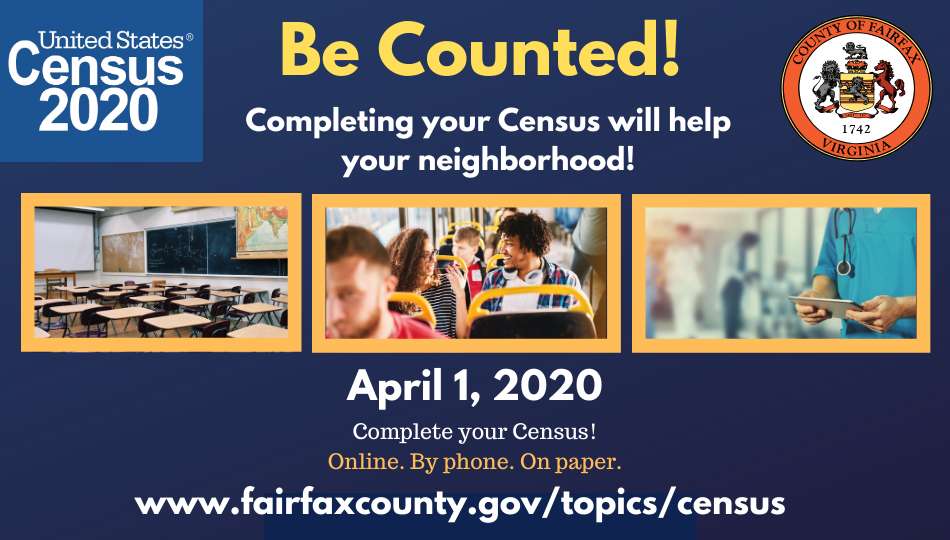
The U.S. Census count is underway, the enormous effort happens once every 10 years to count every person living in the United States regardless of age or immigration status.
The census helps determine how much funding Fairfax County receives from money allocated by the federal government to improve transportation, provide education, healthcare, affordable housing and prepare for emergencies. It also determines how many representatives are sent to Richmond and Washington D.C to advocate for the county.
According to the Community Foundation of Northern Virginia, Fairfax County could lose $12,000 in potential funding over the course of a decade for each person who does not respond to the census.
In March, the U.S. Census Bureau began mailing every household an invitation to complete a simple questionnaire about who lives at their address on April 1. People can respond to the census online, by phone, or by mail.
The census will ask for names, age, sex, race and the relation of everyone living in each household. Federal law keeps those responses safe, secure and confidential.
Everyone should be counted to ensure Fairfax County receives its fair share of federal funds and representation.
Learn more at https://www.fairfaxcounty.gov/topics/census.

Meet Muppet, a male Domestic Long Hair available for adoption locally.
Here is what his friends at Little Buddies Adoption and Humane Society have to say about him:
Muppet is a big love! Not to mention super gorgeous, too.
He loves being pet, cuddled, brushed. Muppet gets along well with other cats. He is easy going and enjoys playing with toys.
Are you and Muppet a match? If so, let us know and our sponsor, Becky’s Pet Care, will send you some treats and prizes.
Want your pet to be considered for the Reston Pet of the Week?
Email [email protected] with a 2-3 paragraph bio and at least 3-4 horizontally-oriented photos of your pet. Each week’s winner receives a sample of dog or cat treats from our sponsor, Becky’s Pet Care, along with $100 in Becky’s Bucks.
Becky’s Pet Care, the winner of eight Angie’s List Super Service Awards and the National Association of Professional Pet Sitters’ 2013 Business of the Year, provides professional dog walking and pet sitting services in Reston and Northern Virginia
This is a sponsored column by attorneys John Berry and Kimberly Berry of Berry & Berry, PLLC, an employment and labor law firm located in Northern Virginia that specializes in federal employee, security clearance, retirement and private sector employee matters.
By Kimberly Berry
Our law firm handles many different types of federal retirement issues in our representation of federal employees.
One of the more common types of retirement cases that we often handle involves the representation of federal employees in the disability retirement process before various federal agencies and the Office of Personnel Management.
Federal employees filing for disability retirement are typically covered under the Federal Employees Retirement System or the Civil Service Retirement System.
Federal employees should consider the following questions before they pursue OPM disability retirement:
How serious are the federal employee’s medical issues and are they linked to the federal employee’s position description duties?
When making a disability retirement decision, keep in mind that OPM evaluates your continued ability to work with your medical condition in the context of the duties described in your position description. If the medical disability is not deemed serious enough, or not fully supported by medical documentation and evidence, and is not sufficiently linked to your inability to “usefully and efficiently” carry out your job duties, then OPM may deny the disability retirement application.
How long is the medical disability realistically expected to last?
OPM requires that a medical disability be expected to last at least one year in duration. When considering whether to file for disability retirement, it is important for you to consider the expected duration of your medical disability. Disabilities with known shorter duration could be problematic for you in the application process.
Can a federal employee survive on a reduced annuity?
If you are considering filing for OPM disability retirement, understand that this type of retirement usually provides you with a lower monthly retirement annuity in comparison to full retirement. As a result, we recommend that you obtain benefit estimates from your human resources representative and consult with a financial advisor about the impact of a potential reduced annuity prior to filing for disability retirement.
Are there modifications to a federal employee’s current position that can be made to allow the federal employee to continue to work?
Oftentimes a federal agency will work with you to provide you with a reasonable accommodation (i.e., change in duties, hours, telework or other adjustments) that can make your current position and medical condition workable. This can often be the best solution, even if it is only a short-term solution.
As a part of the disability retirement process, the federal agency is required to certify that it is unable to accommodate your disabling medical condition in your present position. The agency must also certify that it has considered you “for any vacant position in the same agency, at the same grade or pay level, and within the same commuting area, for which [you] qualified for reassignment.”
Do your medical professionals believe that you should not continue in your current position?
This is an important consideration when filing for disability retirement. In most cases, physicians will be open with their patients about whether it is a good idea to keep working in their current federal employment position.
There are at least two reasons to discuss a possible filing for OPM disability retirement with your treating medical provider(s). First, your health should be of primary importance and a consideration when determining whether continuing in a job hinders or impedes your recovery. Second, physicians and their medical opinions are necessary and, in fact, crucial in the disability retirement application process with OPM.
OPM will require a physician’s statement about your medical issues, and the physician’s statement can either make or break the outcome of your disability retirement application.
When considering OPM disability retirement, it is important to obtain the advice and representation of legal counsel. You can contact our law firm through www.retirementlaw.com, www.berrylegal.com, or by telephone at (703) 668-0070, to schedule a consultation to discuss your individual federal employment retirement matter. Please also visit and like us on Facebook or Twitter.
Meet Tilley, a young Dilute Tortoiseshell female available for adoption locally.
Here is what her friends at The Feline Foundation of Greater Washington Inc have to say about her:
Tilley is a sweet and gentle dilute calico girl that was dumped at the shelter by her owner.
She’s as sweet as she can be, not holding any grudges against humans for doing this to her. The owner now has a dog and decided that even though Tilley likes dogs, she needed to go. FFGW was happy to get Tilley into a foster home where she’s already happy to enjoy the Foster Mom sharing her bed with her!
Tilley is in great health and has no issues other than being dealt a hand by no fault of her own. The only reason Tilley might look like she’s giving us the “eye” in her photos is because we were trying to get pictures for her bio, and she was just getting ready to go to sleep! Who can blame her? No one wants woken up before bedtime!
Are you and Tilley a match? If so, let us know and our sponsor, Becky’s Pet Care, will send you some treats and prizes.
Want your pet to be considered for the Reston Pet of the Week?
Email [email protected] with a 2-3 paragraph bio and at least 3-4 horizontally-oriented photos of your pet. Each week’s winner receives a sample of dog or cat treats from our sponsor, Becky’s Pet Care, along with $100 in Becky’s Bucks.
Becky’s Pet Care, the winner of eight Angie’s List Super Service Awards and the National Association of Professional Pet Sitters’ 2013 Business of the Year, provides professional dog walking and pet sitting services in Reston and Northern Virginia
Meet Kobe, a black Labrador Retriever mix available for adoption locally.
Here is what his friends at Lost Dog & Cat Rescue Foundation have to say about him:
Kobe is a sweet dog who came from Mayaguez, Puerto Rico and is here looking for a new forever home!
Kobe has a chill island vibe about him. He loves to sit and cuddle. And he’s always up for long walks and jogs to stay fit with you. He knows simple commands and appears to be house trained. He is a fast learner and very treat motivated.
He may miss Puerto Rico but he’s excited to start a new chapter in a home with you!
Are you and Kobe a match? If so, let us know and our sponsor, Becky’s Pet Care, will send you some treats and prizes.
Want your pet to be considered for the Reston Pet of the Week?
Email [email protected] with a 2-3 paragraph bio and at least 3-4 horizontally-oriented photos of your pet. Each week’s winner receives a sample of dog or cat treats from our sponsor, Becky’s Pet Care, along with $100 in Becky’s Bucks.
Becky’s Pet Care, the winner of eight Angie’s List Super Service Awards and the National Association of Professional Pet Sitters’ 2013 Business of the Year, provides professional dog walking and pet sitting services in Reston and Northern Virginia
By Nicola Caul Shelley, Synergy Design & Construction
It’s quickly become the go-to kitchen design style in recent years, with many homeowners opting for it over contemporary, traditional or farmhouse kitchens. It’s also a phrase that’s often used in design magazines and reality T.V. home remodeling shows, but what does ‘transitional kitchen’ mean?
Simply put, transitional design blends styles in a fuss-free way with clean lines and a fresh, modern flair. If you aren’t a fan of either ultra contemporary kitchens on the one hand or traditional kitchens on the other, a transitional kitchen may be the look that is right for you.
What’s great about transitional design is it balances design elements, so it can feel modern and more contemporary without going too overboard on edgy finishes as well as artfully incorporating more traditional elements. If the rest of your home is more traditional, it is a great way to update your look without making your kitchen feel out of step with the rest of your home.
Thinking of selling? Another benefit of a transitional kitchen is that it’s more likely to appeal to a broader range of potential buyers than ornate traditional or urban-vibe contemporary kitchens (for example) will in the future.
The key is to simplify the look and keep the lines clean. The #1 request we receive from homeowners is to make a kitchen feel “more open”. This usually means spaces flow into one another and open up into a family (or other) room. The design goal of a transitional kitchen is to create a light, open and airy feel that complements the rest of the first floor.
So how is this look achieved? We show you in this month’s featured remodel which is a transitional first floor remodel in Leesburg. The overall footprint on the first floor was too closed-in. With only one small window and a small doorway from the main living areas, the kitchen felt cut off from the rest of the house.
Planning to stay in her home for the longer term, our client was ready to lighten up the kitchen to create a better flow throughout the entire first floor with tons of room for entertaining. Synergy incorporated traditional elements into a transitional design that reflects our client’s French country/farmhouse design aesthetic. The result? A stunning first floor that is chic, warm and welcoming!
At Synergy Design & Construction, we provide a full design-build kitchen remodeling service. That means we partner with you to design your perfect kitchen that takes into consideration how you use your space and reflects your personal design aesthetic. There’s nothing cookie cutter about any of the projects we work on!
We work with you all the way through construction and professionally project manage your home remodel along the way so you have a turn-key home renovation experience. One point of accountability, one team. All you have to do is sit back and enjoy a hassle-free remodel! See more of our remodels here.
If you are looking for a design thoughtful kitchen remodel, first floor or whole home remodel, we’re happy to discuss your needs. Get in touch!