

By Personal Injury Attorney Davis Haines of Haines Law, P.C.
To questions of “are we there yet?” regarding highway safety, Cathy Chase, President of Advocates for Highway and Auto Safety (AHAS), says no.
Tens of thousands of people are killed in car accidents each year. That amounts to approximately 100 deaths each day, and nearly 7,500 personal injuries. AHAS and Chase have made it their mission to put an end to these injuries and fatalities by pressing state legislatures to take action and improve their highway safety laws.
AHAS recently released its 2020 Roadmap of State Highway Safety Laws which includes within it Safe Roads Report Cards that grade each state, as well as the District of Columbia (D.C.), on the quality of their automobile safety laws. The timing of the release intentionally coincides with the start of many state legislative sessions. It is meant to prompt a discussion of what each respective jurisdiction can do to improve its road safety laws.
The roadmap says that in 2019, 10 jurisdictions (9 states and D.C.) passed 12 laws into effect, improving road safety in the areas of texting and cell phone bans, child seating safety requirements, and drunk driving regulations. Nevertheless, the roadmap argues, much remains to be done.
The report cards issued grades according to color: green (good), yellow (caution), and red (danger). Just eight jurisdictions (7 states and D.C.) received a green grade, while 31 were labeled as yellow. AHAS determined that the remaining 12 were in a red predicament, wherein they had enacted few meaningful road safety laws.
To give some perspective, the state of Rhode Island has enacted 13 AHAS “approved” laws, the most of any state in the nation. South Dakota, on the other hand, has enacted just two laws, the least of any jurisdiction.
These personal injuries, deemed preventable, continue to happen on a large scale. Roughly half of all car accident fatalities occur because a motorist is improperly buckled into their seat. However, according to AHAS, 31 states lack sufficient laws to address this problem.
AHAS is especially worried about inadequate legislation concerning placing children in size and age-appropriate car seats, the issuance of graduated drivers licenses for teen and novice drivers, as well as an across-the-board ban on texting while driving.
The roadmap acknowledges that vehicle technology can play a role in this, and that some measures – such as automatic emergency braking, blind-spot detectors, and lane departure warnings – can be effective at minimizing the frequency of car crashes. However, AHAS cautions that these innovations are often priced out of reach for many consumers.
Furthermore, they state that they can, at times, be confusing, thus creating their own dangers for motorists across the country.

This is a sponsored column by attorneys John Berry and Kimberly Berry of Berry & Berry, PLLC, an employment and labor law firm located in Northern Virginia that specializes in federal employee, security clearance, retirement and private sector employee matters.
By John V. Berry, Esq.
We thought that an article on whistleblowing would be timely given the recent news involving the whistleblower complaint involving Ukraine. A whistleblower is simply an individual who learns of illegal or unethical activity (or waste, fraud and abuse) and reports it.
Most whistleblowers do not end up famous, but they often play a critical role in holding employers and the government accountable for engaging in illegal activities. Too often illegal activities are ignored by an employee for fear of retaliation. Some employees, however, take a stand at great risk to themselves. As a result, many whistleblower laws have developed over the years to protect these individuals.
Whistleblower Laws in the United States and Virginia
The United States has had whistleblower laws in effect since 1863 during the time of President Abraham Lincoln, who wanted to encourage individuals to report rampant fraud against the federal government in response to purchases during the Civil War. As a result, the False Claims Act (FCA) became law and encouraged private citizens to bring lawsuits against individuals and companies who were defrauding the government.
As an incentive, the whistleblower could receive a percentage of whatever the government recovered from the disclosure. The FCA is still in effect today, though numerous other federal and state laws cover different types of whistleblowers.
In 1989, the Whistleblower Protection Act (WPA) was enacted to protect federal employees who disclosed illegal actions by the federal government and waste, fraud and abuse. The WPA sought to protect federal employee whistleblowers who suffered retaliation for reporting these illegal activities. There are numerous other whistleblower laws at the federal and state levels that protect individuals who disclose different types of illegal activities, such as the Clean Air Act, the Sarbanes-Oxley Act, the Toxic Substances Control Act, and the Occupational Safety and Health Act (OSHA).
These are just some of the existing whistleblower laws that can protect individuals that make disclosures. Additionally, many states allow employees, either by statute or common law, the ability to challenge retaliation related to whistleblowing activities.
In Virginia, because the state has not yet enacted general state whistleblower protections for employees, the courts have allowed employees to bring whistleblower claims through common law. These are known as Bowman claims, after the case of Bowman v. State Bank of Keysville, 331 S.E.2d 797 (Va. 1985).
General Test to Qualify for Whistleblower Protection
The importance of being a whistleblower is that certain protections can then come into play after the disclosures are made. Generally, once a disclosure is made, an employer finds out who disclosed the illegal activity and are very unhappy with the employee. This often causes employer retaliation against the whistleblower.
Whistleblower protection laws usually follow the same 3-part test to determine if an employee can prevail on a retaliation claim. In general, this requires:
- That the individual had a good faith belief that their employer was engaging in illegal activities or waste, fraud and abuse and they reported it
- That the individual’s employer knew that the individual made such disclosures
- That the whistleblower suffered retaliation due to the disclosures
Depending on the statute involved, a whistleblower can receive legal protection from retaliation (the most common retaliatory action involves termination from employment), damages, back pay and attorney fees. Each statute is different so individuals should consult with an attorney if they believe that they may need whistleblower protection.
Conclusion
If you need assistance with whistleblower representation or other employment issues, please contact our office at (703) 668-0070 or at www.berrylegal.com to schedule a consultation. Please also visit and like us on Facebook.
By Personal Injury Attorney Tim Miley of The Miley Legal Group
The U.S. Consumer Product Safety Commission has been under review by the U.S. Senate Committee on Commerce, Science, and Transportation. While issuing recalls involving products of Britax and Fisher-Price, the way in which these recalls played out came under question and, as a result, into the hands of the Senate Review Committee.
What is the U.S. Consumer Product Safety Commission? Formed under the Consumer Product Safety Act, the U.S. Consumer Product Safety Commission is a regulatory agency that has the purposes of:
- Protecting the public against unreasonable risk of injury related to consumer products
- Assisting consumers in evaluating the safety of products
- Developing uniform safety standards for products and minimizing conflicts between State and local regulations
- Promoting research and investigation into the causes of product-related injuries, illnesses and deaths, and the prevention of harm due to consumer products
The Safety Commission administers five acts, which include the Consumer Product Safety Act, the Poison Prevention Packaging Act, the Flammable Fabrics Act, the Federal Hazardous Substances Act, and the Refrigerator Safety Act. The Commission offers the public a hotline for recall inquiries and also makes product recall information available to the public through its website.
The current review of the Safety Commission’s conduct pertains primarily to its administering of the Consumer Product Safety Act. In its report, the Senate Review Committee expressed concern that the Safety Commission handled recalls to allow companies to benefit from future sales. By offering relief in the form of discount coupons, for example, consumers purchased new products and the companies reaped additional revenue as a result of the recall.
Additionally, the timeliness of recalls by the Safety Commission came into question by the Review Committee. One such instance under review involved the Fisher-Price’s Rock ‘n Play infant sleeper, a product that was related to more than 30 infant deaths. The infant sleeper was not recalled when the number of deaths reported at ten; instead, a warning was issued, and a recall was not released until the reported deaths reached over 30 and at the American Academy of Pediatrics’ urging for an immediate recall.
The recent scrutiny under which the Safety Commission has fallen is a reason for consumers to pause and address what products have been subject to recall and what remedies are available.
Meet Chase, a male Chihuahua mix available for adoption locally.
Here is what Chase from Safe Haven Puppy Rescue has to say:
I am a sweet boy and I love being in the house with the people!
I love snuggling, playing and wearing hats! I really like to cuddle my shelter helper Brian too! I am 2 years old and precious boys like me get adopted fast, so please send your application on in pronto so we don’t miss each other!
I am up to date on all shots and dewormings and have been neutered. I am a friendly fella and will try my hardest to make you smile every day.
Are you and Chase a match? If so, let us know and our sponsor, Becky’s Pet Care, will send you some treats and prizes.
Want your pet to be considered for the Reston Pet of the Week?
Email [email protected] with a 2-3 paragraph bio and at least 3-4 horizontally-oriented photos of your pet. Each week’s winner receives a sample of dog or cat treats from our sponsor, Becky’s Pet Care, along with $100 in Becky’s Bucks.
Becky’s Pet Care, the winner of eight Angie’s List Super Service Awards and the National Association of Professional Pet Sitters’ 2013 Business of the Year, provides professional dog walking and pet sitting services in Reston and Northern Virginia.
By Nicola Caul Shelley, Synergy Design & Construction
You might be under the impression condo remodeling can be approached in the same way as any home remodel. Not so!
When it comes to remodeling, a ‘one size fits all’ approach doesn’t work. Condo remodeling brings its own unique challenges and requirements. Luckily for you, we’re here to help you navigate the road to a successful condo renovation project!
Condo Association Rules & Regulations
Remember that Condo Owner Association (COA) binder you received when you bought your place? Dust it off, because it’s going to become your new best friend. Most (if not all) COAs have an approval process in place that must be followed if you are making significant changes to your space, even though it’s just the interior. We’ve seen most approval cycles take a minimum of 45 days, so plan in advance and don’t start work until you have the seal of approval.
Hire the Right Remodeling Partner
As with any home remodel, it’s important to understand exactly who you need to do the work. If it’s just a simple pull and replace of your condo powder room, that’s a much simpler project and completely different to a total redesign and renovation of your condo’s kitchen or master bath.
If you are simply looking to update your powder room or replace your kitchen countertops, there are plenty of General Contractors who could be the perfect match for you. A full service design/build approach is a better fit for a more complex, design thoughtful condominium remodel. If you aren’t sure what you need, read Best Remodelers in Reston & How to Find Them.
Logistics Matter
There are a lot of nuances to consider and things you might find helpful to know before you meet with any remodeling contractor or company to discuss your condo remodel:
- Elevation — Enjoying the beautiful view from the 10th floor? Gorgeous, yes, but if you don’t have a lot of storage space, the time it takes to go up and down from the ground floor with supplies and materials eats into the time the crew can work in your home so projects may take a little longer.
- Visitor Access — Many luxury condo buildings have requirements for pre-approval of guests in the building. Your building management may require you to be the central point of contact for your contractor to ensure they can gain easy, daily access to the building.
- Time Restrictions — Home remodelers tend to be early morning people. Most of our carpenters and crew are usually hard at work by 8 a.m. Many condo buildings, however, put time restrictions on when work can be undertaken in the building. Working around these restrictions is a necessity, but it also means your remodeling partner may have to adjust their schedule accordingly which may add extra time to your project.
- Parking — This can be one of the biggest challenges, especially now in Reston Town Center since — dare we even mention it — paid parking! Your contractor will need approved bay(s) in your building garage to use to keep the project flowing smoothly.
- Dumpsters — It may not be the most glamorous thing to have to think about, but if you need a dumpster for demolition items, your contractor will need approval for a place to put it on condo property.
Ask your prospective condo remodeling company if they have undertaken a remodel in a condo building before. If they have, it’s a good sign they will take all of these things into consideration with the added benefit of having developed relationships with many of the building managers in the area.
Special Considerations
Although you may think of condo remodeling in the same way as residential remodeling, it brings with it special commercial building considerations. There are some things no remodeler may be able to change for you such as sprinkler locations, limitations on what can be done with concrete ceilings or even certain structural changes.
There are also specific requirements in many condo buildings with regards to use of specific flooring to reduce noise or other building materials. The more you plan for this in advance, the smoother the process will be once you begin your condo remodel.
Luxury Condominium Remodeling Right on Your Doorstep!
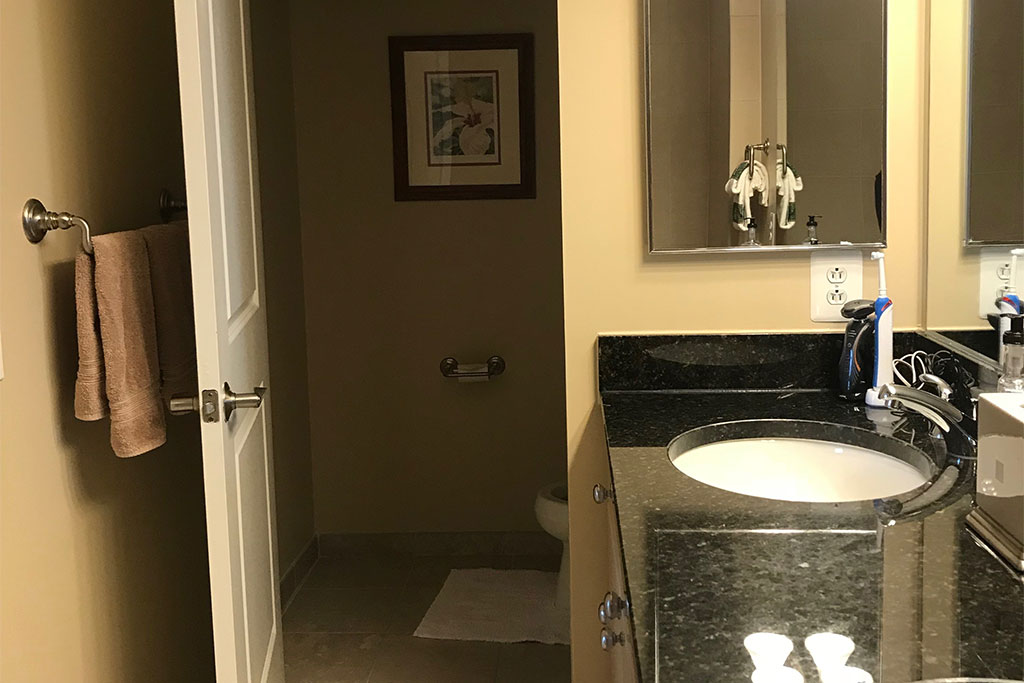
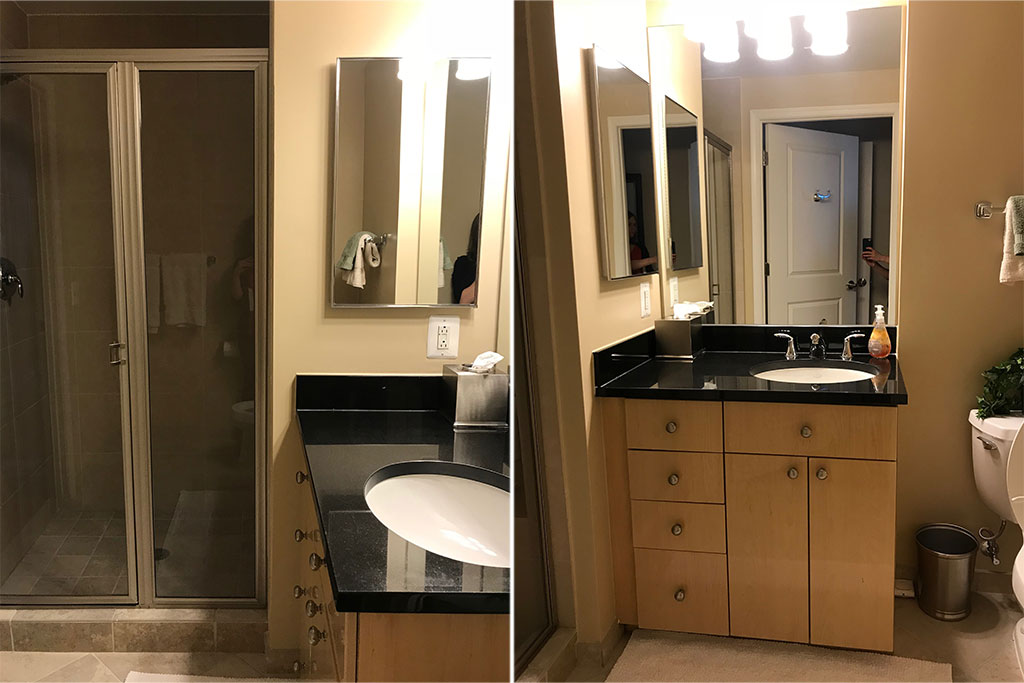
This month’s featured project is a Reston MidTown Condo remodel. This is a gorgeous condo, but the bathrooms were original to the unit and the owner’s were ready to completely remodel all three of them to reflect their personal taste and design aesthetic.
With many condos in the Reston area now well into their second decade, you might be thinking it’s time to remodel yours. We can help! With over 10 years of experience and based right here in Reston, we know a thing or two when it comes to luxury condominium remodeling. We apply our same proven Renovation Roadmap™ methodology to all of our remodels to ensure you renovate happy!
By Personal Injury Attorney William Colarulo of Grungo Colarulo
Historically, members of the military were unable to file a medical malpractice claim against the federal government when they were a victim of negligence. This is largely due to the fact that nearly all governments have immunity from civil lawsuits. More specifically, it has to do with the Feres Doctrine.
The Feres Doctrine is named after three different cases of military medical malpractice heard by the Supreme Court in 1950. Once the case was decided on, it was determined that any service member was barred from filing a medical malpractice claim against the federal government.
Now, however, a new proposal to the 2020 defense budget bill might allow service members or their families to take action by filing a claim with the Secretary of Defense. If accepted, these claims would allow service members to collect compensation for their injuries.
In mid-December, the House of Representatives approved the 2020 National Defense Authorization Act. Under this bill, military members can file a claim for review if they believe they were the victims of medical malpractice. Of course, like any civil action, it does not necessarily mean that they will be successful in their claim. Currently, only medical malpractice claims are included in the National Defense Authorization Act, although that does cover not only medical treatment, but also dental treatment and other related healthcare.
The National Defense Authorization Act also states that an attorney’s fees cannot exceed 20 percent of any compensation awarded. The Department of Defense is also not liable for those fees, meaning that anyone filing a claim would be responsible for paying the associated expenses.
This National Defense Authorization Act might prove to be helpful for service members that are victims of medical malpractice in the future, as well as for any member that was a victim after January, 2017.
By Criminal Defense Attorney Floyd Oliver of Floyd Oliver Attorney at Law
In the world of criminal law, words matter. Cases are often lost and won based on the prevailing interpretation of the relevant statutory and regulatory language. This is also the case for federal firearm enforcement.
For decades, federal prosecutors and regulators at the United States Bureau of Alcohol, Tobacco, Firearms and Explosives (ATF) have relied on what some call an archaic definition of the word “gun.” This agency defines the frame (or receiver) of a firearm as a gun.
However, with AR-15-style weapons, a frame is made of two separate parts: the upper and lower receivers. Neither of these parts could fire a bullet on their own, but ATF and federal prosecutors have treated these individual parts as guns in order to regulate who can obtain them.
A significant part of ATF’s mission is to prevent certain people — those legally prohibited from possessing a gun — from being able to legally obtain the separate parts they could use to make a firearm. However, the discrepancy between the law as it is written and the construction of AR-15-style weapons is starting to cause panic within the federal gun enforcement community.
Defense attorneys are making a “plain reading of the law” argument in efforts to invalidate assertions that their clients are guilty of having possessed or sought to possess a gun. They argue that one part of the receiver does not make a gun and should therefore not be treated as a firearm.
The courts are starting to listen. Since 2016, at least five defendants have seen their cases or charges dropped or have avoided prison. Recently, an Ohio federal judge sided with the defense’s argument that a plain reading of the law necessitated a dismissal and said that the legal definition of the word “gun” is something ATF has a duty to fix.
Meet Pete, a black and white male available for adoption locally.
Here is what Pete from Little Buddies Adoption and Humane Society has to say about himself:
Don’t hate me because I’m handsome. The name is Pete.
I currently reside with some kids, another cat and a dog but I’m looking for the one. You know my furrever home. A place I can use all this magnetic charm and good looks to make you feel wonderful.
One belly rub and you’ll be hooked. I’m also always in a tux so don’t worry, your guests will never be disappointed.
Cuddles anyone?
Are you and Pete a match? If so, let us know and our sponsor, Becky’s Pet Care, will send you some treats and prizes.
Want your pet to be considered for the Reston Pet of the Week?
Email [email protected] with a 2-3 paragraph bio and at least 3-4 horizontally-oriented photos of your pet. Each week’s winner receives a sample of dog or cat treats from our sponsor, Becky’s Pet Care, along with $100 in Becky’s Bucks.
Becky’s Pet Care, the winner of eight Angie’s List Super Service Awards and the National Association of Professional Pet Sitters’ 2013 Business of the Year, provides professional dog walking and pet sitting services in Reston and Northern Virginia.
By Personal Injury Attorney Mac Hester of Mac Hester Law
A recent proposal by the United States Department of Transportation’s Federal Motor Carrier Safety Administration (FMSCA) calls for significant changes to truck driving rules, sparking a debate on whether the changes will benefit all drivers and the safety of the roadways.
According to the Owner-Operator Independent Drivers Association, they believe changes need to be made as the number of truck-involved incidents has increased alongside an increase in the regulations on truck drivers.
Current rules on Hours of Service restrict the amount of time truck drivers spend on the roads, the frequency and length of their breaks, and their sleeping hours while on duty. For example, truck drivers cannot drive for more than eight hours without taking a break. Long-haul drivers cannot drive more than 11 hours in 14 hours of driving time, which must be followed by a ten-hour consecutive off-duty break.
The proposed changes address the consecutive ten-hour sleeping requirement. As opposed to ten consecutive hours, the proposal allows the driver to split up the ten-hour consecutive sleeping requirement into two segments, a seven-hour consecutive segment in the sleeping berth, followed by a period of at least two hours in the sleeping berth or off-duty.
Additionally, the proposed changes speak to challenges that truck drivers face in situations such as lengthy traffic jams, which can account for a considerable amount of on-duty driving time.
For example, with the proposed changes, a truck driver who finds themselves in a traffic jam would be able to take the requisite 30-minute break within an eight-hour driving period, by taking the break while in an on-duty, non-driving status — as opposed to an off-duty status.
A recent North Carolina Department of Transportation report showed an increase of 900 crashes involving tractor-trailers from the year 2017 to 2018. Reports such as these shed light on a need to revisit rules and regulations, as well as other factors affecting safety on the roads.
Where cell phone usage by all drivers is reported as a threat to driver safety in general, officials of NCDOT predict that truck driver fatigue is an underreported factor in truck-related accidents.
Whether the proposed changes will help address the truck driving industry’s concern for safe and efficient transportation, as well as lessen the number of truck-involved incidents, is yet to be seen as the proposed changes are mere proposals at this point.
For the proposed changes to go into effect it will not require the approval of Congress, but, instead only the approval of the FMSCA and the Office of Management and Budget.
This is a sponsored column by attorneys John Berry and Kimberly Berry of Berry & Berry, PLLC, an employment and labor law firm located in Northern Virginia that specializes in federal employee, security clearance, retirement and private sector employee matters.
By John V. Berry, Esq.
An amendment approved by the Governor of Virginia in Virginia Code.
Requirements of the New Virginia Employment Law
Virginia Governor Ralph Northam approved an amendment and re-enactment of Virginia Code § 8.01-413.1. The new amendment requires Virginia employers to produce certain employment documents when they receive a written request from a current/former employee or employee’s attorney.
If the employer doesn’t comply, the Virginia statute awards potential damages to the employee if the employer fails to do so within the allotted timeframe. Since the amendment became effective on July 1, 2019, a number of Virginia employers are seeing an increase in requests for the applicable documents.
The Virginia amendment requires a Virginia employer to furnish employment records reflecting (1) dates of employment, (2) wages or salary, (2) job description and job title, and (4) any injuries sustained during the course of employment within 30 days of the receipt of a written request. An employer is not required to be a party to a suit for the statute to apply. That statute provides that:
Every employer shall, upon receipt of a written request from a current or former employee or employee’s attorney, furnish a copy of all records or papers retained by the employer in any format, reflecting (i) the employee’s dates of employment with the employer; (ii) the employee’s wages or salary during the employment; (iii) the employee’s job description and job title during the employment; and (iv) any injuries sustained by the employee during the course of the employment with the employer. Such records or papers shall be provided within 30 days of receipt of such a written request.
Before the new Virginia statute, employers were not required to produce such documents without a subpoena. If the Virginia employer cannot process the employee’s request within 30 days, the employer must notify them in writing. The Virginia employer will then have an additional 30 days to produce the records.
Pursuant to the Virginia statute, the employer can charge a reasonable fee for the copying of paper records and/or the retrieval of electronic records. Failure to comply with a written request can result in a subpoena and the award of damages against the employer, including the employee’s expenses for obtaining the copies, court costs and attorneys’ fees.
The bottom line is that the new statute in Virginia will help employees obtain copies of their employment records. If the employer does not comply, they will likely be responsible for significant fees.
Conclusion
If you need assistance with Virginia employment law issues, please contact our office at (703) 668-0070 or at www.berrylegal.com to schedule a consultation. Please also visit and like us on Facebook at www.facebook.com/BerryBerryPllc.
By Personal Injury Attorney Gary Christmas of Christmas Injury Lawyers
Each year, approximately 6,000 pedestrian lives are lost to traffic accidents.
These deaths account for 16% of all traffic deaths, and the majority of these accidents happen after dark when visibility is low. Sadly, the number of pedestrian deaths is on the rise.
As a result, automakers have attempted to combat the issue of pedestrian-related crashes by introducing new safety technology, such as an automatic emergency braking system that engages when a sensor detects a pedestrian in front of the car. In theory, this emergency braking system could be extremely helpful for keeping people safe on the road.
Drivers are ultimately responsible for the safe driving of their vehicles, no matter how advanced their safety technology is. Although these safety systems have the potential to significantly reduce vehicle crashes when properly functioning, this technology is only meant to enhance the driver’s awareness, not to take the driver’s place.
Even if a vehicle is equipped with advanced technology to assist a driver in navigating in a safer manner, this technology can never be relied on to take the place of the driver, and ultimately, a driver who causes a traffic accident despite the use of this safety technology is liable and responsible for the damage they have caused.
Unfortunately, according to tests done by AAA, this technology has a long way to go before it is effective. AAA challenged this technology in simulated real-world scenarios and found that this technology was largely ineffective. These tests revealed that the sensors had the highest success rate while the vehicle was traveling slowly at 20 miles per hour during daylight, avoiding collision approximately 40% of the time.
However, when the vehicle speed was increased to 30 miles per hour in the same scenario, the majority of detection systems failed to detect the pedestrian and was unable to avoid the collision.
Additionally, the safety system failed to detect pedestrians during nighttime simulations, illustrating that this technology requires further testing and work to become more effective before it can be relied on to aid drivers in identifying and avoiding pedestrians.
Meet Hueso, a black and white mixed breed available for adoption locally.
Here is what Hueso from Lost Dog & Cat Rescue Foundation has to say about himself:
Hola! My name is Hueso (Spanish for “bone” — yum!). I came to Lost Dog from Puerto Rico with my mom Pink, who was my best pal, but she’s been adopted and now I’d love to have a forever home too.
I’m what you call an “all-purpose” dog — I love a good hike, especially if it means I can splash around in some water — but I’d equally love to curl up on your couch with you and bang out an entire season of Stranger Things in one sitting, with an occasional bathroom break for both of us, of course!
I’m an easy walker and love to stop to roll around in patches of grass… and maybe eat some when you’re not looking. While I love to play with dogs in playgroup, sometimes they make me nervous on walks, so I’d prefer to be your one and only love.
I have a condition called Megaesophagus (I can’t pronounce that, can you?) which means my esophagus doesn’t push food down to my stomach very well. It sounds much worse than it is! It just means I eat from a special bowl and have to wait a little bit for a walk after I eat. But I promise I’m just as happy, healthy and handsome as other dogs!
I’m a pretty perfect dog and I can’t wait for my forever home and lots of adventures filled with hikes, waterfalls, grass and maybe the occasional puppacino!
Are you and Hueso a match? If so, let us know and our sponsor, Becky’s Pet Care, will send you some treats and prizes.
Want your pet to be considered for the Reston Pet of the Week?
Email [email protected] with a 2-3 paragraph bio and at least 3-4 horizontally-oriented photos of your pet. Each week’s winner receives a sample of dog or cat treats from our sponsor, Becky’s Pet Care, along with $100 in Becky’s Bucks.
Becky’s Pet Care, the winner of eight Angie’s List Super Service Awards and the National Association of Professional Pet Sitters’ 2013 Business of the Year, provides professional dog walking and pet sitting services in Reston and Northern Virginia.

We’ve said it before and we’ll say it again: remodeling sucks!
With the holidays right around the corner, there is no better time to start that long-awaited bathroom or kitchen upgrade before holiday stress sets in.
In fact, 75% of remodelmate customers in the Washington D.C. area believe it is important for them to renovate their homes before the holidays, with 75% of them likely to do so.
That’s why we’re bringing back a Reston Now favorite: $500 off our exclusive Concierge service, just before the holidays.
Use code HOLIDAYREST when you build a project (for free!) using our online builder on www.remodelmate.com.
Remodelmate is simply the better way to renovate your home:
- Get free, instant quotes with no in-home consultations
- Book a project with a trusted local pro for just $1
- Use one of our expert virtual Concierges to assist with the design
- Pay as you go using milestone-based credit or debit card payments
- Manage your renovation completely online
- Finish in half the time for half the cost
But don’t take our word for it. Here’s what Reston Now reader Lauren B. had to say:
Stay hands-off and stress-free! Get a remodelmate before your in-laws get to town. 😉
Use code HOLIDAYREST when you book a $1 renovation on www.remodelmate.com.
Minimum project order of $7,500. Expires November 8, 2019 at 11:59 p.m. EST.
Inmates that once had hope for a second chance are now living in fear that they will be sent back to jail.
This is due to the fact that several lawyers at the Department of Justice are trying to overturn the First Step Act, an act that reforms the federal prison system and seeks to reduce recidivism
The First Step Act allows individuals convicted of selling cocaine to serve reduced sentences. It has already allowed 1,100 individuals out of jail after serving just a portion of the time they were sentenced to. The law was a response to the failure of tough-on-crime policies that not only do not work, but also disproportionately affect African Americans. Now, the Justice Department wants to put at least some individuals that have been freed back in prison.
This is not only an injustice, but it is downright cruel. After both sides of the aisle came together to get this Act passed, it is difficult to understand why federal prosecutors now want to take it away.
The Justice Department’s reasoning for this is that these individuals accepted a plea deal when they were first being tried. Within those deals, they agreed to plead guilty in exchange for agreeing that they were caught with a smaller amount than what they actually were.
However, those plea deals are already settled. If those accused had not agreed to them at the time, they may have been found not guilty during trial. That is a chance they no longer have as federal prosecutors continue to come after them.
Fortunately, those prosecutors have been largely unsuccessful so far. They have appealed 81 cases and have lost 73 of those. Prosecutors have stated that they intend to appeal 12 more. If they are successful, it will mean sending people back to jail after they were led to believe they were free.
This is something that has never been done before, which is why it is being met with so much resistance from nearly everyone, except those in the Justice Department.

Virginia Tech’s 100% online Master of Information Technology program has been ranked the No. 1 online graduate degree for cybersecurity nationwide in the 2019 rankings list from CyberDegrees.org, a Washington, D.C. based company.
In addition, the program was named one of the three best online graduate information technology programs nationwide for the seventh consecutive year in the annual rankings from U.S. News & World Report.
Based at Virginia Tech’s Northern Virginia Center in Falls Church, the online program is offered jointly by the Pamplin College of Business and College of Engineering. The interdisciplinary nature of the program allows students to develop a range of skills and focus their studies in a topic that best serves their career goals.
Cybersecurity is one of 11 areas of specialization that students can use to tailor their degree. Other areas include Analytics and Business Intelligence, Big Data, Health Information Technology and Software Development.
The program also offers six graduate certificate options for professionals that are not looking to pursue a full degree.
The program plans to continue adding new courses and graduate certificates that keep up with current trends in tech, particularly as the wider university takes on a central role in the cybersecurity ecosystem.
In 2010, Virginia Tech launched the Hume Center to lead the university’s research and experiential learning programs in national security. The center now has a research facility in Ballston.
In 2018, the Commonwealth of Virginia announced that Virginia Tech will lead its $25 million Commonwealth Cyber Initiative.
For more information about Virginia Tech’s 100% online Master of Information Technology Program, visit vtmit.vt.edu or sign up for an upcoming information session.