
Meet Quincy, a male American Staffordshire Terrier mix available for adoption locally.
Here is what his friends at Fancy Cats Rescue Team have to say about him:
Quincy is a sweet 2 year old American Staffordshire Terrier mix.
He loves going to dog parks where he can exercise those legs. He loves his humans and would do best in a home where he’s the sole recipient of your affection!
Quincy has an average activity level & likes to go on 2-3 walks a day. He’d be a great running & hiking companion. He’d love nothing more than to find his forever home!
Are you and Quincy a match?

By Nicola Caul Shelley, Synergy Design & Construction
Life in Reston sure feels a lot different these days and we hope you and your families are staying healthy and safe. Construction is considered an essential business service here in Virginia, so we’re still open and employing innovative tools to continue to deliver our same excellent customer service and beautiful home remodels, while keeping our team and clients safe.
We’re proud to say the Synergy team continued to work hard on the on-time completion of the home remodeling projects that were mid-way through construction when the lockdown took effect. Fortunately, we had many of the business tools and job site safety practices already in place, so were able to quickly respond and react to the dynamic situation that was (and continues to be) life in the middle of a pandemic.
You might think it’s an odd time to think about a home remodel during a health crisis, but we have been hearing from people working from home and self-isolating who tell us they have started to focus on the things in their home that just don’t work — from the lack of a dedicated home office space to the aging kitchen that is just too cramped. Now is the perfect time to think about the design of your kitchen, even if you aren’t ready to start a remodel.
With that in mind, we got to thinking how we could help. Maybe being at home has you dreaming of a more open concept for your main level or binge watching HGTV home remodeling shows and thinking, “What if I did that in my kitchen…?” If this sounds like you, then join us as one of our resident experts, Emily Bickl, Interior Designer, shares the secrets to creating a more open concept kitchen.
The webinar is FREE. Claim your spot now!


This is a sponsored column by attorneys John Berry and Kimberly Berry of Berry & Berry, PLLC, an employment and labor law firm located in Northern Virginia that specializes in federal employee, security clearance, retirement and private sector employee matters.
By John V. Berry, Esq.
Many Virginians have recently found themselves laid off or otherwise out of work due to the impact of the COVID-19 pandemic. As a result, unemployment compensation benefits are needed like never before. This is a short article on the unemployment claims process in Virginia and benefits in light of new legislation.
Benefits for affected employees can be sought through the Virginia Employment Commission (VEC). Employees who have been laid off, terminated or otherwise had their hours reduced can qualify. Here is a link to the VEC directions for initiating a claim.
Changes to Unemployment Claims Related to COVID-19
On March 12, the U.S. Department of Labor (DOL) also provided additional guidance to state unemployment agencies interpreting unemployment benefits related to the COVID-19 pandemic. The DOL offered states guidance in being flexible in awarding unemployment compensation to those affected.
As of March 15, the Commonwealth of Virginia waived the one-week waiting period for the unemployed to receive unemployment benefits. The effect of this change is that out of work Virginians can receive unemployment compensation benefits sooner.
Another change is that a claimant in Virginia has usually had to show that they were actively seeking new work, but Virginia changed this requirement in light of COVID-19 for obvious reasons.
Lastly, Virginia is in the process of making unemployment compensation benefits available to the self-employed (1099 and Gig Economy workers) pursuant to an order from Governor Northam.
To file for unemployment compensation in Virginia, please apply at www.vec.virginia.gov. It is also recommended to file as soon as possible so that benefits can start as soon as possible.
Contact Us
If you are in need of employment law representation or advice, please contact our office at 703-668-0070 or through our contact page to schedule a consultation. Please also visit and like us on Facebook or Twitter.
Meet Toby, a young Domestic Short Hair male available for adoption locally.
Here is what his friends at The Feline Foundation of Greater Washington, Inc have to say about him:
Ulysses P. Toberson (otherwise known as Toby) is a very sweet boy. He likes to snuggle in cozy spaces and is often quiet, but he isn’t overly shy.
When he wants attention he is out head-butting you and rolling over.
He has rabbit-soft fur and loves being pet and you’ll hear his loud purr when he relaxes. If you’re okay being patient while Toby adjusts to his new home, then Toby may be the one for you!
He was dumped in a colony of semi-feral kitties and the caretaker recognized that he was not part of the group and brought him inside and called us to rescue him.
We think he was a bit traumatized by his early experiences and he does like to have a safe cubby or hiding space available to him.
Are you and Toby a match?
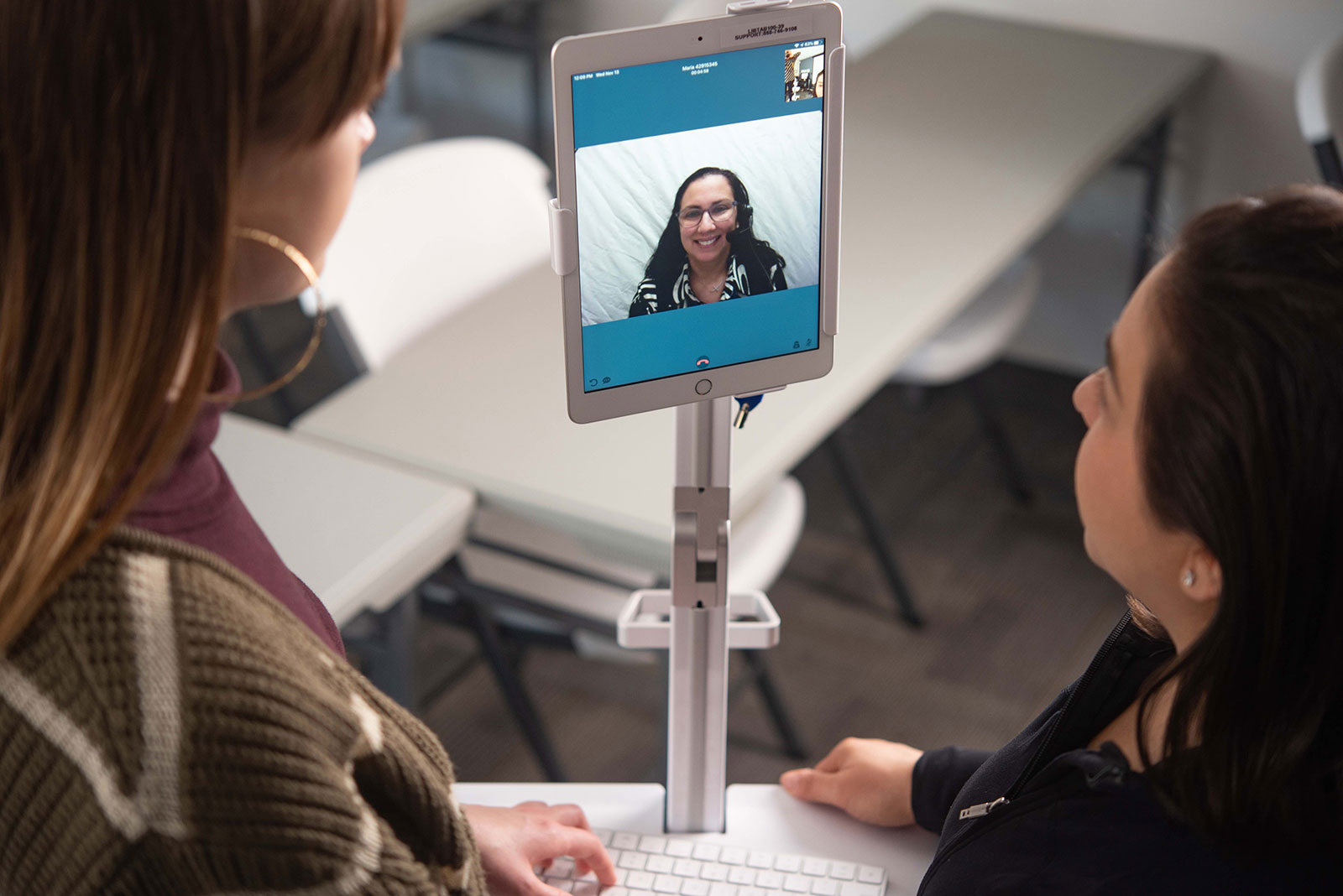
Imagine the fright in coming down with symptoms of coronavirus: fever, cough, tiredness and trouble breathing. Then imagine trying to navigate the health care system with limited English skills, especially when loved ones are barred from medical settings to limit the virus spread.
We’re hearing about the risks facing front line workers including doctors, nurses, emergency personnel and service workers, yet there are also disturbing reports that medical interpreters are not being afforded personal protective equipment and protocols, and of patients experiencing sub-standard, potentially life-threatening barriers to services.
“High quality medical interpretation allows healthcare service providers to effectively communicate and comply with language access laws,” says Silvia Villacampa, Managing Director of Liberty Language Services in Vienna, Virginia.
“Because in-person interpreters risk exposure like all health care workers, video remote and over-the-phone interpreting are excellent ways to reduce risk while providing much needed support to service providers serving limited English-speaking patients in our community,” Villacampa adds.
25 million people in the U.S. speak no or limited English, and the COVID-19 epidemic has intensified longstanding language access issues in health care. Video remote technology, which can be used with any phone, tablet or computer with a webcam, offers the safest solution.
“It’s HIPAA compliant, and our trained and qualified interpreters work in hundreds of languages, as well as American Sign Language,” Villacampa notes.
With years of experience providing on-site medical and legal interpretation services throughout the mid-Atlantic region, Liberty Language Services applies the same careful vetting, training, testing and understanding clients’ needs to Video Remote and Over the Phone Interpreting.
Visit the Liberty Language Services website for more information.
Meet Jade, a female Labrador Retriever and Boxer mix available for adoption locally.
Here is what her friends at Fancy Cats Rescue Team have to say about her:
Jade is approximately three years old and just had a litter of beautiful puppies!
After some R&R, she is now ready for adoption! Jade is SO appreciative of any and all human attention. Be ready to cuddle with this sweet one!
What brings the greatest joy to Jade is falling asleep on your lap. She is mostly house trained and is great with kids and other dogs.
Are you and Jade a match?
This is a sponsored column by attorneys John Berry and Kimberly Berry of Berry & Berry, PLLC, an employment and labor law firm located in Northern Virginia that specializes in federal employee, security clearance, retirement and private sector employee matters.
By John V. Berry, Esq.
Many security clearance holders and future applicants have been affected by the COVID-19/Coronavirus pandemic, most often in connection with their overall financial situation or credit. This article discusses the potential security clearance implications of the Coronavirus/COVID-19 for security clearance holders and applicants.
Financial Issues
The most common security clearance concern for clearance holders, even before the pandemic, involved financial issues. The current COVID-19 crisis will directly impact these types of security concerns. Individuals will likely face potential financial losses, bankruptcy, bad credit or unmanageable debt as a result of the crisis.
These types of issues fall under Guideline F, Financial Considerations pursuant to Security Executive Agent Directive 4 (SEAD 4). SEAD 4 provides the Government’s security clearance guidelines that adjudicators review in evaluating whether or not to grant a security clearance. Financial concerns usually include bad credit, unpaid debts, unpaid taxes and other related financial issues.
It is very likely, due to the existing and future disruptions in business and work that many individuals could be laid off or lose their jobs if the COVID-19 pandemic lasts for an extended period of time. We may very well be entering a recession right now given the number of jobless claims that have recently been filed.
With these recent layoffs, individual finances are clearly going to be negatively impacted. An economic downturn and loss of work can have massive financial implications for many government contractors and other private-sector employees in a relatively short period of time. If individuals are laid off, it is often the case that they find themselves financially underwater within a month. As a result, these individuals are often unable to pay their mortgage, rent, car loans, consumer credit loans or other major bills.
These types of issues affect security clearance holders as debts which result from such a recession are not easily rectified immediately even when new positions requiring clearances become available. We still have clients who lost a majority of their investments during the Great Recession between 2007 and 2009 who still have to address financial issues in connection with their security clearances. In other words, COVID-19 may lead to a downturn which can have a major effect on security clearance holders or applicants for a long period of time.
The COVID-19 Crisis Will Most Certainly Be Viewed as Unique and Mitigating
In terms of security clearances, there is good news for clearance holders, applicants and future applicants. Clearance adjudicators recognize that major shared events, like recessions, are unique in nature which can help to mitigate those security clearance concerns. COVID-19 related financial issues and any downturn would almost certainly fall in this category.
Specifically, SEAD 4, under Guideline F, Financial Considerations, provides mitigation to those facing security concerns related to debts, credit and other financial issues. SEAD 4. Paragraph 20(a) provides as mitigation that “the behavior happened so long ago, was so infrequent, or occurred under such circumstances that it is unlikely to recur…” Furthermore, Paragraph 20(b) states, as a key mitigating factor that “the conditions that resulted in the financial problem were largely beyond the person’s control (e.g., loss of employment, a business downturn, unexpected medical emergency… and the individual acted responsibly under the circumstances.)”
There is no reason to doubt that security clearance adjudicators will give serious consideration to mitigating financial-related security clearance concerns related to debts, bankruptcy and taxes as they have done in the past as it relates to losses occurring as a result of the COVID-19 pandemic.
Our general advice to security clearance holders is for them to keep on top of their finances, work with creditors (even if they are uncooperative) if they are laid off or lose their jobs and keep copies of all documents and their attempts to resolve debts or otherwise appear to act responsibly. Even if a creditor doesn’t act reasonable, copies of records showing that the individual tried to do their best in a difficult financial situation is often very helpful.
Contact Us
If you are in need of security clearance law representation or advice, please contact our office at 703-668-0070 or through our contact page to schedule a consultation. Please also visit and like us on Facebook or Twitter.

By Wayne M. Zell, Esq., of Zell Law, PLLC, an estate and business planning law firm located in Northern Virginia that focuses on helping clients realize their dreams of wealth and freedom.
We recently published an update on the tax-related provisions in the Coronavirus Aid, Relief and Economic Security (CARES) Act that impact individuals.
This article summarizes the most important small business-related provisions of the Act. For more details, please visit our website.
Employee Retention Credit for Employers
Eligible employers can qualify for a refundable credit against, generally, the employer’s 6.2% portion of the Social Security (OASDI) payroll tax (or against the Railroad Retirement tax) for 50% of certain wages (below) paid to employees during the COVID-19 crisis.
For employers with more than 100 employees in 2019, the eligible wages are wages of employees who aren’t providing services because of the business suspension or reduction in gross receipts described above. For employers with 100 or fewer full-time employees in 2019, all employee wages are eligible, even if employees haven’t been prevented from providing services.
The credit is provided for wages and compensation, including health benefits, and is provided for the first $10,000 in eligible wages and compensation paid by the employer to an employee. Thus, the credit is a maximum $5,000 per employee. Various exclusions from “wages” apply, so please consult our blog for more details.
Delayed Payment of Employer Payroll Taxes
Taxpayers (including self-employed) will be able to defer paying the employer portion of certain payroll taxes through the end of 2020, with all 2020 deferred amounts due in two equal installments, one at the end of 2021, the other at the end of 2022.
Taxes that can be deferred include the 6.2% employer portion of the Social Security (OASDI) payroll tax and the employer and employee representative portion of Railroad Retirement taxes (that are attributable to the employer 6.2% Social Security (OASDI) rate). The relief isn’t available if the taxpayer has had debt forgiveness under the CARES Act for certain loans under the Small Business Act as modified by the CARES Act (see below). For the self-employed, the deferral applies to 50% of the Self-Employment Contributions Act tax liability (including any related estimated tax liability).
Net Operating Loss Liberalizations
The 2017 Tax Cuts and Jobs Act (TCJA) limited NOLs arising after 2017 to 80% of taxable income and eliminated the ability to carry NOLs back to prior tax years. For NOLs arising in tax years beginning before 2021, the CARES Act allows taxpayers to carryback 100% of NOLs to the prior five tax years, effectively delaying for carrybacks the 80% taxable income limitation and carryback prohibition until 2021. The Act also temporarily liberalizes the treatment of NOL carryforwards.
Deferral of Non Corporate Taxpayer Loss Limits
The CARES Act retroactively turns off the excess active business loss limitation rule of the TCJA in Code Sec. 461(l) by deferring its effective date to tax years beginning after December 31, 2020 (rather than December 31, 2017). Under the rule, active net business losses in excess of $250,000 ($500,000 for joint filers) are disallowed by the 2017 Tax Law and were treated as NOL carry forwards in the following tax year.
The CARES Act clarifies, in a technical amendment that is retroactive, that an excess loss is treated as part of any net operating loss for the year, but isn’t automatically carried forward to the next year. Another technical amendment clarifies that excess business losses do not include any deduction under Code Sec. 172 (NOL deduction) or Code Sec. 199A (qualified business income deduction).

Meet Avona, a black and white Tuxedo female available for adoption locally.
Here is what her friends at Little Buddies Adoption and Humane Society have to say about her:
Avona is a very sweet, friendly older kitten that loves lots of affection.
Purrs even when she’s sleeping.
Are you and Avona a match?

This is a sponsored post from Eve Thompson of Reston Real Estate. For a more complete picture of home sales in your neighborhood, contact her on Reston Real Estate.
Like all businesses, real estate has been knocked back on its heels by COVID-19.
While many might see real estate transactions as being non-essential there are life situations that force people to move. Death, divorce, employment changes — things that are beyond an individual’s control that require them to sell or buy property.
So far the impacts of COVID-19 have been on behaviors around real estate processes. Masks, gloves, booties and hand sanitizers at showings and agents wiping down door knobs, light switches and hand rails after showings. Sellers are only allowing their homes to be shown by appointment and only to potential buyers –adults only no kids — that have been well vetted by a reputable lender and are pre-qualified to buy. Open Houses are no longer allowed.
Conventional wisdom would say that sales should be down; but in the Reston market things so far are holding steading. Our current housing inventory is 148 properties which includes 14 coming soon. 51 houses went pending in the last 14 days and more than half of those went pending in the last 7 days.
These numbers are consistent with what our rates of sales have been over the past 12 month period. So for those with no choice about selling or buying, the picture isn’t too bad — for buyers there is inventory and for sellers there are buyers.
Here are few of the properties that sold this week.

1298 Stamford Way
6 BD/4.5 BA
List Price: $1,099,000
Sold Price: $1,080,000

1355 Garden Wall Circle #712
2 BD/1 BA
List Price: $277,500
Sold Price: $277,500

11475 Washington Plaza W
3 BD/3 BA
List Price: $700,000
Sold Price: $700,000

1520 Moorings Drive #1B
2 BD/1.5 BA
List Price: $259,000
Sold Price: $265,000

11305 Traffail Court
4 BD/3.5 BA
List Price: $750,000
Sold Price: $795,000

2122 Cartwright Place
4 BD/2.5 BA
List Price: $374,900
Sold Price: $385,000
By Wayne M. Zell, Esq., of Zell Law, PLLC, an estate and business planning law firm located in Northern Virginia that focuses on helping clients realize their dreams of wealth and freedom.
We hope that you are keeping yourself, your loved ones and your community safe from COVID-19 (commonly referred to as the Coronavirus). Along with those paramount health concerns, you may be wondering about some of the recent tax changes meant to help everyone coping with the Coronavirus fallout.
This article updates you on the tax-related provisions in the Coronavirus Aid, Relief and Economic Security (CARES) Act, Congress’s gigantic economic stimulus package that the President signed into law on March 27, 2020. This month’s installment summarizes provisions that impact individuals. The next installment will discuss business-related provisions.
Recovery Rebates for Individuals
To help individuals stay afloat during this time of economic uncertainty, the government will send up to $1,200 payments to eligible taxpayers and $2,400 for married couples filing joints returns. An additional $500 additional payment will be sent to taxpayers for each qualifying child dependent under age 17 (using the qualification rules under the Child Tax Credit).
Rebates are gradually phased out, at a rate of 5% of the individual’s adjusted gross income over $75,000 (singles or marrieds filing separately), $122,500 (head of household) and $150,000 (joint).
Waiver of 10% Early Distribution Penalty
The additional 10% tax on early distributions from IRAs and defined contribution plans (such as 401(k) plans) is waived for distributions made between January 1 and December 31, 2020 by a person who (or whose family) is infected with the Coronavirus or who is economically harmed by the Coronavirus (a qualified individual).
Penalty-free distributions are limited to $100,000, and may, subject to guidelines, be re-contributed to the plan or IRA. Income arising from the distributions is spread out over three years unless the employee elects to turn down the spread out. Employers may amend defined contribution plans to provide for these distributions. Additionally, defined contribution plans are permitted additional flexibility in the amount and repayment terms of loans to employees who are qualified individuals.
Waiver of Required Distribution Rules
Required minimum distributions that otherwise would have to be made in 2020 from defined contribution plans (such as 401(k) plans) and IRAs are waived. This includes distributions that would have been required by April 1, 2020, due to the account owner’s having turned age 70 1/2 in 2019.
Charitable Deduction Liberalizations
The CARES Act makes various significant liberalizations to the rules governing charitable deductions, detailed in the full version of the blog on our website.
Other provisions
- The CARES Act expands the definition of expenses qualifying for the exclusion to include employer payments of student loan debt made before January 1, 2021.
- For amounts paid after December 31, 2019, the CARES Act allows amounts paid from Health Savings Accounts and Archer Medical Savings Accounts to be treated as paid for medical care even if they aren’t paid under a prescription.

For more details on these and other tax-related provisions in the CARES Act, please visit our website.
Meet Oreo, a male Cocker Spaniel mix available for adoption locally.
Here is what his friends at Lost Dog & Cat Rescue Foundation have to say about him:
Oreo is a laid back, low-maintenance guy who loves to be with people. He really enjoys walks to keep up with his fitness routine! Among the perks of being a grown-up dog is that he is housebroken and only chews on toys that are meant for him. (And boy does he love his chew toys!)
Oreo also gets along with other dogs in a home. He clearly likes having the company of four-legged friends as well as humans!
Are you and Oreo a match?
This is a sponsored column by attorneys John Berry and Kimberly Berry of Berry & Berry, PLLC, an employment and labor law firm located in Northern Virginia that specializes in federal employee, security clearance, retirement and private sector employee matters.
By John V. Berry, Esq.
Virginia employees, if House Bill 123 is signed by Governor Ralph Northam or not otherwise acted upon by April 6, 2020, will have new rights to wages that are unlawfully unpaid.
Virginia House Bill 123 has been passed by both the Virginia House and Senate. The new legislation would create a private right of action for collecting unpaid wages in Virginia. House Bill 123 allows employees that have not been paid to sue an employer to recover their pay, in addition to damages.
Details of Employer Damages and Penalties
House Bill 123 permits Virginia employees to bring claims against employers that fail to pay wages and allows them to recover the wages owed, plus 8% interest from the date that the wages were due. Employees can also be awarded triple damages (3 times the amount of unpaid wages), their attorney’s fees and other costs if a court finds that the employer knowingly failed to pay the wages.
In our experience, most employers are aware that they did not pay wages owed to an employee. There is also a $1,000 civil penalty against the employe for a violation.
Example: Under the law, for example, if an employer fails to pay an employee $1,000 that they earned, they could be liable for that amount, plus 8%, potentially 3 times the wages that were not paid, along with attorney’s fees incurred by the employee, and a civil penalty.
The $1,000 that was unpaid could easily become a judgment against the employer for $5,000 to $8,000 by the time damages and fees are included. Then the civil penalty would also need to be added. If a court finds that there is a genuine dispute between an employer and employee, the employer would not be required to pay triple damages.
Criminal Penalties for Employer Apply
There are also criminal law penalties in the new law. Employers could be found guilty of a misdemeanor, punishable by up to 12 months in jail, if the wages owed are less than $10,000. Employers are to be considered guilty of a felony, punishable by a prison term of up to five years, if the value of wages owed is at least $10,000 or if the employer previously had been convicted of such a violation.
Criminal liability now only applies if the nonpayment of wages was willful with the intent to defraud. If signed by the Governor or allowed to become law, the legislation would take effect July 1, 2020.
Contact Us
If you are in need of employment law representation or advice, please contact our office at 703-668-0070 or through our contact page to schedule a consultation. Please also visit and like us on Facebook or Twitter.

In today’s digital environment, organizations must collect vast volumes of data, analyze that data to retain high-value customers, predict trends, identify emerging markets, mitigate risk, drive innovation and more.
This means IT leaders must know how to gather and store information, combine data into meaningful clusters, mine it for compelling insights, and present it in a way that can help the business.
“Nowadays every company needs data-literate IT leaders who understand how to manipulate data, hear the voice of data, and translate insights into a competitive advantage for the business,” says Barbara Hoopes, Associate Professor of Business Information Technology at Virginia Tech.
For those companies or individuals looking to deepen their data analytics skill set, Virginia Tech’s online Master of Information Technology (VT-MIT) program provides an excellent foundation.
Not everyone has the time or financial resources to commit to a full master’s degree program, however. Some may already have a master’s and are just looking for a narrow update on a current skillset. For these reasons, the VT-MIT program also offers IT professionals the option to earn a graduate certificate in six specialized IT subject areas, including Business Analytics and Data Mining.
“IT leaders can find a certificate that speaks exactly to their professional needs without having to commit several years to pursuing a master’s degree,” says Hoopes. In fact, students can earn a certificate in as little as 12 months.
Whether looking to enhance existing skills or prepare for a major career transition, VT-MIT students can expect:
- Enhanced marketability as they develop skills where a current dearth of talent is driving competitive salaries and prime opportunities for career advancement.
- Greater convenience through exclusively online courses and a flexible schedule that allow for VT-MIT students to stay in the workforce while they earn a credential, shift their course loads at busier times for their business, and benefit from the experience of peers from across the globe.
- Rapid upskilling in high-demand areas through focused graduate certificate options. Employers often provide tuition reimbursement “to contribute to the skill sets and the knowledge base of employees without having to release them to earn a degree as a full-time student,” says Hoopes.
Data analytics can provide organizations with invaluable insights — but only if IT leaders know how to parlay data into insights that drive informed business decisions.
Learn more about Virginia Tech’s 100% online Master of Information Technology and graduate certificate options at vtmit.vt.edu.
Meet Dottie, a brown and white female Pointer mix available for adoption locally.
Here is what her friends at Lost Dog & Cat Rescue Foundation have to say about her:
Dottie can’t wait to meet you! She loves people of all sizes and ages, as long as they give her pets and ear scratches!
Dottie is good on the leash, but being a high-energy pointer means that she is on the go and eager to go faster. (Age is just a number!) She is very polite when meeting other dogs and happy to say hello. If other dogs bark at her, she just walks on by and doesn’t react at all. Not much fazes her! That’s why she’s great with kids, too.
Whatever it is, Dottie is always up for the next adventure in the great outdoors! Make this special girl a part of your family today!
Are you and Dottie a match? If so, let us know and our sponsor, Becky’s Pet Care, will send you some treats and prizes.
Want your pet to be considered for the Reston Pet of the Week?
Email [email protected] with a 2-3 paragraph bio and at least 3-4 horizontally-oriented photos of your pet. Each week’s winner receives a sample of dog or cat treats from our sponsor, Becky’s Pet Care, along with $100 in Becky’s Bucks.
Becky’s Pet Care, the winner of eight Angie’s List Super Service Awards and the National Association of Professional Pet Sitters’ 2013 Business of the Year, provides professional dog walking and pet sitting services in Reston and Northern Virginia