

The ever-evolving “security threat landscape” and changes in user behavior and IT infrastructure require IT professionals to keep their knowledge up to date and stay on top of the latest trends and developments.
Earning a 100% online Master of Information Technology with a specialization in cybersecurity from Virginia Tech can help individuals meet these heightened demands in a number of ways.
Ranked the #1 online master’s degree for cybersecurity by Cyberdegrees.org, and one of the top 3 online graduate IT programs nationwide by U.S. News and World Report, Virginia Tech’s VT-MIT program takes a unique approach to specialized education.
Core courses in areas such as information systems design, electronic commerce, software engineering and computer programming help students master technical expertise in a business context. After completing these core courses, degree students can choose to specialize in cybersecurity.
Areas of focus range from cybersecurity management — for those interested in running their own in-house cybersecurity practice — to cybersecurity policy, which explores the legal and ethical concerns triggered by data breaches. This breadth of content allows students to tailor their education around their career ambitions.
Part of Virginia Tech’s core strength is its world-class cybersecurity research, supported by $15 million in research grants and contracts. Students can access six cybersecurity research centers, including the Ballston-based Hume Center for National Security and Technology.
The VT-MIT program’s 100% online format allows students to pursue higher education at their own pace — a flexibility that allows for a longer timeline. Further enriching the student environment is the program’s openness to students with diverse backgrounds and interests, including business line leaders looking to improve their technology capabilities while leveraging their domain expertise.
Combating today’s cyber threats has never been more difficult, nor more critical to business continuity. A Master of Information Technology degree with a specialization in cybersecurity from Virginia Tech can help leaders better understand the systemic nature of these threats, and teach them strategies for dealing with an increasingly complex security landscape.
Learn more about Virginia Tech’s 100% online Master of Information Technology with cybersecurity specializations here.
Meet Oshie, a brown and white Pit Bull mix available for adoption locally.
Here’s what his friends at Lost Dog & Cat Rescue Foundation have to say:
Oshie is smiley, sweet and loves naps!
Oshie loves playing with all kinds of toys and when he’s not playing he’s sleeping. He is such a cuddle bug! He doesn’t like to be surprised, so slow movements are a must. But once he is comfortable he loves all the love he can get.
Oshie likes treats and knows “sit” and “come.” As for exercise, he’s mostly a lazy pup with some spurts of energy. He gets a little excited when he sees birds and squirrels, but is overall good on the leash.
Oshie is crate trained, and can be trusted alone in the home while his family is at work as long as he’s in the crate. He has had no accidents in his foster mom’s house and sleeps through the night in bed with her.
He has been joining doggie playgroups while at Lost Dog and has a great time! He does play rough and it is good to keep a close eye on him. Still, Oshie would likely do best in an adults-only home where he can be the only dog so that his family can give him all the undivided attention he deserves.
Come meet this love bug today!
Are you and Oshie a match? If so, let us know and our sponsor, Becky’s Pet Care, will send you some treats and prizes.
Want your pet to be considered for the Reston Pet of the Week?
Email [email protected] with a 2-3 paragraph bio and at least 3-4 horizontally-oriented photos of your pet. Each week’s winner receives a sample of dog or cat treats from our sponsor, Becky’s Pet Care, along with $100 in Becky’s Bucks.
Becky’s Pet Care, the winner of eight Angie’s List Super Service Awards and the National Association of Professional Pet Sitters’ 2013 Business of the Year, provides professional dog walking and pet sitting services in Reston and Northern Virginia.

In today’s digital age, as technology drives innovation throughout the enterprise, business acumen and technology expertise are emerging as essential skills.
At the same time, traditional functional roles are blurring, creating a blended business environment where IT leaders must embrace more business-oriented responsibilities and line of business leaders must find their way around sophisticated and complex technology systems. Only through education can these professionals gain the necessary skills and expertise to keep pace with this evolving business landscape. But it shouldn’t have to come at the cost of a full-time position.
Virginia Tech’s dual Master’s degree in business administration and information technology (MBA + MIT) is based in the D.C. area and can help professionals gain the experience, expertise and advantages they need to succeed in a blended business environment. Here’s how:
- Career boost: Students receive an MBA while keeping up with changes in the technology industry by adding on a Master of IT. The result: greater marketability in a competitive labor market.
- Economize time and money: The dual-degree program double-counts up to five courses earned in the MBA program toward those also offered in the MIT program or vice versa.
- Work-life balance: Both the MBA and MIT degrees are built for full-time working professionals. Students have the flexibility to set their own pace by choosing the number of courses they will take each semester.
- Variety: Students can select from a wide range of specialization areas including business intelligence, big data, cybersecurity, networking and software engineering.
- Network: An in-person class format for the MBA program encourages students to establish valuable working relationships with classmates, and engage with top-notch faculty. A 100% online format for the MIT degree provides additional flexibility for working professionals and opportunity to work with students from across the country.
The Virginia Tech MBA + MIT dual-degree program offers the flexibility to contribute to business growth, revenue and innovation as a working professional today — and as a substantially more marketable leader tomorrow.
Learn more about the dual degree program here or explore Virginia Tech’s other local MBA options here.

This is a sponsored column by attorneys John Berry and Kimberly Berry of Berry & Berry, PLLC, an employment and labor law firm located in Northern Virginia that specializes in federal employee, security clearance, retirement and private sector employee matters.
By John V. Berry, Esq.
The President recently proposed a new federal rule which will affect the wages of employees who earn tips. The new rule was proposed on October 8, 2019 by the Department of Labor (DOL) and would permit employers to require widespread sharing of tips with other types of co-workers. One of the major industries affected would be the foodservice industry. The newly proposed rule would permit employers to share wait staff tips with food preparation staff and others (e.g. dishwashers, food delivery personnel).
Difficulties With the New Tip-Pooling Rule
A problematic part of the newly proposed rule would give employers newfound flexibility in assigning non-tipped assignments to workers who rely on gratuities for the major portion of their income. The restaurant lobbying industry has sought these types of changes for some time. Former President Obama’s Administration had previously mandated that tips belonged to the workers that received them.
One of the major problems with the new rule, for employees that earn tips is that it takes funds earned by them and transfers them to employees that don’t earn tips. By doing this, restaurant owners are potentially able to compensate food staff (non-tip earners) with lower salaries.
Tipped Employees Wages will be Affected
The DOL, in their proposal, even acknowledges that the new rule will result in tipped employees spending more time on lower-paying duties:
“The removal of the twenty percent time limit may result in tipped workers such as wait staff and bartenders performing more of these non-tipped duties such as ‘cleaning and setting tables, toasting bread, making coffee, and occasionally washing dishes or glasses.’ . . . Tipped workers might lose tipped income by spending more of their time performing duties where they are not earning tips, while still receiving cash wages of less than minimum wage.”
Employers will Gain
Employers will gain from the situation and may be able to provide lower salaries to non-tip earners, offsetting the loss with tip income. The DOL also provides the real rationale for the change in the proposed regulation: “[E]mployers that had been paying the full minimum wage to tipped employees performing related, non-tipped duties could potentially pay the lower direct cash wage for this time and could pass these reduced labor cost savings on to consumers.”
The proposal should become final in about 6 weeks and could have some changes in the final version. However, if a new administration comes in, the tip-pooling policy could potentially change once again.
Conclusion
If you are in need of employment law representation or advice, please contact our office at 703-668-0070 or through our contact page to schedule a consultation. Please also visit and like us on Facebook or Twitter.
Meet Coal and Lacey, a black male Labrador and a female Pit Bull mixed breed available for adoption locally.
Here’s what their friends at Lost Dog & Cat Rescue Foundation have to say:
Coal and his buddy Lacey are like peanut butter and jelly, gin and tonic or Bert and Ernie — you just simply can’t have one without the other!
Coal’s two loves in life are Lacey and tennis balls! He plays fetch like a pro and is a complete gentleman bringing the ball back and dropping it right at your feet. Lacey loves rolling in grass, playing with toys, head scratches and Sunday morning strolls in good company.
Coal and Lacey are well-mannered house guests and good with small children. They get along with some other dogs, but would really prefer to be the only two in the home. Coal and Lacey are great walking companions, travel well in the car and are perfect on the leash.
Coal and Lacey lost their lifetime home when their owner passed away and have not yet found the right fit in a new home. This incredibly special duo and bonded pair are looking for a final, forever home where they can grow old together feeling safe and loved.
Coal and Lacey are so beloved that their adoption will be FREE thanks to a member of the Coal and Lacey fan club who couldn’t keep them in their home, but wanted to help them find their final forever home!
Are you, Coal and Lacey a match? If so, let us know and our sponsor, Becky’s Pet Care, will send you some treats and prizes.
Want your pet to be considered for the Reston Pet of the Week?
Email [email protected] with a 2-3 paragraph bio and at least 3-4 horizontally-oriented photos of your pet. Each week’s winner receives a sample of dog or cat treats from our sponsor, Becky’s Pet Care, along with $100 in Becky’s Bucks.
Becky’s Pet Care, the winner of eight Angie’s List Super Service Awards and the National Association of Professional Pet Sitters’ 2013 Business of the Year, provides professional dog walking and pet sitting services in Reston and Northern Virginia.

This is a sponsored post from Eve Thompson of Reston Real Estate. For a more complete picture of home sales in your neighborhood, contact her on Reston Real Estate.
The real estate market in Reston slowed just a bit over the past few weeks.
Buyers are not in a rush and days-on-market has stretched out a bit to an average of 36 days. Low interest rates and constrained inventory should have the impact of shorter days on market and can drive home prices up; but that’s not what we’re experiencing.
Buyers are taking things slowly and seem to know that if they miss out on one house there will be another around the corner and that is not untrue. What is harder to predict is interest rates; what we can say about them that even with a 1 point bump they’re still incredibly favorable.
Here are a few of the properties that have sold in the past several weeks.

2133 Cabots Point Lane
3 BR/2.5 BA
List Price: $974,900
Sold Price $974,900

1606 Chimney House Road
1 BR/1 BA
List Price: $249,000
Sold Price: $216,900

11719 Blue Smoke Trail
4 BD/2.5 BA
List Price: $849,900
Sold Price: $850,000

2224 Cartwright Place
3 BD/2.5 BA
List Price: $349,000
Sold Price: $349,000

1637 Stowe Road
4 BD/ 4 BA
List Price: $689,000
Sold Price: $675,000
By Personal Injury Attorney Amy Gaiennie of Gaiennie Law Office
The inclusion of high school students in an existing federal safety program is the latest proposal introduced by U.S. Senator Catherine Cortez Masto of Nevada.
The proposed legislation adds to the existing Safe Routes to School Program, which promotes students walking and bicycling to school, and provides safety education, incentives for active school commutes and improved infrastructure.
Unfortunately, commute-related injuries occur daily across the nation. For example, over the past year in Nevada’s Washoe County School District alone, over 20 students have been injured by cars during their commute to school.
Ensuring student safety amongst the nation’s elementary and middle schools — no matter the type of commute — is at the heart of the Safe Routes to School Program. The proposed legislation seeks to offer high school students the same umbrella of protection and benefits offered by the Safe Routes to School Program to elementary, middle, and high schools alike.
As research shows — and common-sense dictates — walking and bicycling to and from school offer students health benefits. Furthermore, offering the added protection of federally-funded safety education and infrastructure improvements to high schools expands not only those health benefits of an active commute, but also a safer commute as well. If approved, high schools would be eligible for funding from the Department of Transportation for pedestrian and bicycle safety projects.
The proposed legislation — the result of bipartisan efforts in the U.S. Senate — takes great strides in promoting safer commutes for all students. While the proposed legislation is pending regarding the inclusion of high schools in the program, safety precautions can be put in place by each individual on the road — adult or child.
For example, it is helpful for drivers who know they will be on the roads during school commute hours to allow a little more time for their own commute. Students walking to school can help practice safety by using sidewalks when available, and if no sidewalks are available, using the edge of the road while facing traffic.
Similarly, using crosswalks, where available, and always being cognizant to stop and look both ways before crossing. Bicyclists can help practice safety by wearing proper safety gear, including helmets, adhering to traffic signs and signals, and cycling in the same direction as the flow of traffic, but utilizing bike lanes where available.
For all, taking the time to be alert and pay attention may help curb the number of incidents during school commute hours — and also encourage growth in a more active commute for school students.
Meet Steffy, a black and chocolate female Jindo available for adoption locally.
Here is what her friends at Two Dog Farms, Inc has to say:
Steffy is a 4 year old female Jindo, weighing around 50 lbs, who we recently rescued from the shelter in Dallas, Texas.
She is a happy little girl, and has a wagging tail and likes treats, (no aggression noted), and appears to get along with other dogs (though as with any dog, regardless of breed, age or gender, we’d recommend caution and patience with introductions).
Steffy was Heartworm Positive, but we have treated her over the past few months since she has been in rescue and she has been declared free of Heartworm.
Are you and Steffy a match? If so, let us know and our sponsor, Becky’s Pet Care, will send you some treats and prizes.
Want your pet to be considered for the Reston Pet of the Week?
Email [email protected] with a 2-3 paragraph bio and at least 3-4 horizontally-oriented photos of your pet. Each week’s winner receives a sample of dog or cat treats from our sponsor, Becky’s Pet Care, along with $100 in Becky’s Bucks.
Becky’s Pet Care, the winner of eight Angie’s List Super Service Awards and the National Association of Professional Pet Sitters’ 2013 Business of the Year, provides professional dog walking and pet sitting services in Reston and Northern Virginia.
By Personal Injury Attorney Davis Haines of Haines Law, P.C.
To questions of “are we there yet?” regarding highway safety, Cathy Chase, President of Advocates for Highway and Auto Safety (AHAS), says no.
Tens of thousands of people are killed in car accidents each year. That amounts to approximately 100 deaths each day, and nearly 7,500 personal injuries. AHAS and Chase have made it their mission to put an end to these injuries and fatalities by pressing state legislatures to take action and improve their highway safety laws.
AHAS recently released its 2020 Roadmap of State Highway Safety Laws which includes within it Safe Roads Report Cards that grade each state, as well as the District of Columbia (D.C.), on the quality of their automobile safety laws. The timing of the release intentionally coincides with the start of many state legislative sessions. It is meant to prompt a discussion of what each respective jurisdiction can do to improve its road safety laws.
The roadmap says that in 2019, 10 jurisdictions (9 states and D.C.) passed 12 laws into effect, improving road safety in the areas of texting and cell phone bans, child seating safety requirements, and drunk driving regulations. Nevertheless, the roadmap argues, much remains to be done.
The report cards issued grades according to color: green (good), yellow (caution), and red (danger). Just eight jurisdictions (7 states and D.C.) received a green grade, while 31 were labeled as yellow. AHAS determined that the remaining 12 were in a red predicament, wherein they had enacted few meaningful road safety laws.
To give some perspective, the state of Rhode Island has enacted 13 AHAS “approved” laws, the most of any state in the nation. South Dakota, on the other hand, has enacted just two laws, the least of any jurisdiction.
These personal injuries, deemed preventable, continue to happen on a large scale. Roughly half of all car accident fatalities occur because a motorist is improperly buckled into their seat. However, according to AHAS, 31 states lack sufficient laws to address this problem.
AHAS is especially worried about inadequate legislation concerning placing children in size and age-appropriate car seats, the issuance of graduated drivers licenses for teen and novice drivers, as well as an across-the-board ban on texting while driving.
The roadmap acknowledges that vehicle technology can play a role in this, and that some measures – such as automatic emergency braking, blind-spot detectors, and lane departure warnings – can be effective at minimizing the frequency of car crashes. However, AHAS cautions that these innovations are often priced out of reach for many consumers.
Furthermore, they state that they can, at times, be confusing, thus creating their own dangers for motorists across the country.
This is a sponsored column by attorneys John Berry and Kimberly Berry of Berry & Berry, PLLC, an employment and labor law firm located in Northern Virginia that specializes in federal employee, security clearance, retirement and private sector employee matters.
By John V. Berry, Esq.
We thought that an article on whistleblowing would be timely given the recent news involving the whistleblower complaint involving Ukraine. A whistleblower is simply an individual who learns of illegal or unethical activity (or waste, fraud and abuse) and reports it.
Most whistleblowers do not end up famous, but they often play a critical role in holding employers and the government accountable for engaging in illegal activities. Too often illegal activities are ignored by an employee for fear of retaliation. Some employees, however, take a stand at great risk to themselves. As a result, many whistleblower laws have developed over the years to protect these individuals.
Whistleblower Laws in the United States and Virginia
The United States has had whistleblower laws in effect since 1863 during the time of President Abraham Lincoln, who wanted to encourage individuals to report rampant fraud against the federal government in response to purchases during the Civil War. As a result, the False Claims Act (FCA) became law and encouraged private citizens to bring lawsuits against individuals and companies who were defrauding the government.
As an incentive, the whistleblower could receive a percentage of whatever the government recovered from the disclosure. The FCA is still in effect today, though numerous other federal and state laws cover different types of whistleblowers.
In 1989, the Whistleblower Protection Act (WPA) was enacted to protect federal employees who disclosed illegal actions by the federal government and waste, fraud and abuse. The WPA sought to protect federal employee whistleblowers who suffered retaliation for reporting these illegal activities. There are numerous other whistleblower laws at the federal and state levels that protect individuals who disclose different types of illegal activities, such as the Clean Air Act, the Sarbanes-Oxley Act, the Toxic Substances Control Act, and the Occupational Safety and Health Act (OSHA).
These are just some of the existing whistleblower laws that can protect individuals that make disclosures. Additionally, many states allow employees, either by statute or common law, the ability to challenge retaliation related to whistleblowing activities.
In Virginia, because the state has not yet enacted general state whistleblower protections for employees, the courts have allowed employees to bring whistleblower claims through common law. These are known as Bowman claims, after the case of Bowman v. State Bank of Keysville, 331 S.E.2d 797 (Va. 1985).
General Test to Qualify for Whistleblower Protection
The importance of being a whistleblower is that certain protections can then come into play after the disclosures are made. Generally, once a disclosure is made, an employer finds out who disclosed the illegal activity and are very unhappy with the employee. This often causes employer retaliation against the whistleblower.
Whistleblower protection laws usually follow the same 3-part test to determine if an employee can prevail on a retaliation claim. In general, this requires:
- That the individual had a good faith belief that their employer was engaging in illegal activities or waste, fraud and abuse and they reported it
- That the individual’s employer knew that the individual made such disclosures
- That the whistleblower suffered retaliation due to the disclosures
Depending on the statute involved, a whistleblower can receive legal protection from retaliation (the most common retaliatory action involves termination from employment), damages, back pay and attorney fees. Each statute is different so individuals should consult with an attorney if they believe that they may need whistleblower protection.
Conclusion
If you need assistance with whistleblower representation or other employment issues, please contact our office at (703) 668-0070 or at www.berrylegal.com to schedule a consultation. Please also visit and like us on Facebook.
By Personal Injury Attorney Tim Miley of The Miley Legal Group
The U.S. Consumer Product Safety Commission has been under review by the U.S. Senate Committee on Commerce, Science, and Transportation. While issuing recalls involving products of Britax and Fisher-Price, the way in which these recalls played out came under question and, as a result, into the hands of the Senate Review Committee.
What is the U.S. Consumer Product Safety Commission? Formed under the Consumer Product Safety Act, the U.S. Consumer Product Safety Commission is a regulatory agency that has the purposes of:
- Protecting the public against unreasonable risk of injury related to consumer products
- Assisting consumers in evaluating the safety of products
- Developing uniform safety standards for products and minimizing conflicts between State and local regulations
- Promoting research and investigation into the causes of product-related injuries, illnesses and deaths, and the prevention of harm due to consumer products
The Safety Commission administers five acts, which include the Consumer Product Safety Act, the Poison Prevention Packaging Act, the Flammable Fabrics Act, the Federal Hazardous Substances Act, and the Refrigerator Safety Act. The Commission offers the public a hotline for recall inquiries and also makes product recall information available to the public through its website.
The current review of the Safety Commission’s conduct pertains primarily to its administering of the Consumer Product Safety Act. In its report, the Senate Review Committee expressed concern that the Safety Commission handled recalls to allow companies to benefit from future sales. By offering relief in the form of discount coupons, for example, consumers purchased new products and the companies reaped additional revenue as a result of the recall.
Additionally, the timeliness of recalls by the Safety Commission came into question by the Review Committee. One such instance under review involved the Fisher-Price’s Rock ‘n Play infant sleeper, a product that was related to more than 30 infant deaths. The infant sleeper was not recalled when the number of deaths reported at ten; instead, a warning was issued, and a recall was not released until the reported deaths reached over 30 and at the American Academy of Pediatrics’ urging for an immediate recall.
The recent scrutiny under which the Safety Commission has fallen is a reason for consumers to pause and address what products have been subject to recall and what remedies are available.
Meet Chase, a male Chihuahua mix available for adoption locally.
Here is what Chase from Safe Haven Puppy Rescue has to say:
I am a sweet boy and I love being in the house with the people!
I love snuggling, playing and wearing hats! I really like to cuddle my shelter helper Brian too! I am 2 years old and precious boys like me get adopted fast, so please send your application on in pronto so we don’t miss each other!
I am up to date on all shots and dewormings and have been neutered. I am a friendly fella and will try my hardest to make you smile every day.
Are you and Chase a match? If so, let us know and our sponsor, Becky’s Pet Care, will send you some treats and prizes.
Want your pet to be considered for the Reston Pet of the Week?
Email [email protected] with a 2-3 paragraph bio and at least 3-4 horizontally-oriented photos of your pet. Each week’s winner receives a sample of dog or cat treats from our sponsor, Becky’s Pet Care, along with $100 in Becky’s Bucks.
Becky’s Pet Care, the winner of eight Angie’s List Super Service Awards and the National Association of Professional Pet Sitters’ 2013 Business of the Year, provides professional dog walking and pet sitting services in Reston and Northern Virginia.
By Nicola Caul Shelley, Synergy Design & Construction
You might be under the impression condo remodeling can be approached in the same way as any home remodel. Not so!
When it comes to remodeling, a ‘one size fits all’ approach doesn’t work. Condo remodeling brings its own unique challenges and requirements. Luckily for you, we’re here to help you navigate the road to a successful condo renovation project!
Condo Association Rules & Regulations
Remember that Condo Owner Association (COA) binder you received when you bought your place? Dust it off, because it’s going to become your new best friend. Most (if not all) COAs have an approval process in place that must be followed if you are making significant changes to your space, even though it’s just the interior. We’ve seen most approval cycles take a minimum of 45 days, so plan in advance and don’t start work until you have the seal of approval.
Hire the Right Remodeling Partner
As with any home remodel, it’s important to understand exactly who you need to do the work. If it’s just a simple pull and replace of your condo powder room, that’s a much simpler project and completely different to a total redesign and renovation of your condo’s kitchen or master bath.
If you are simply looking to update your powder room or replace your kitchen countertops, there are plenty of General Contractors who could be the perfect match for you. A full service design/build approach is a better fit for a more complex, design thoughtful condominium remodel. If you aren’t sure what you need, read Best Remodelers in Reston & How to Find Them.
Logistics Matter
There are a lot of nuances to consider and things you might find helpful to know before you meet with any remodeling contractor or company to discuss your condo remodel:
- Elevation — Enjoying the beautiful view from the 10th floor? Gorgeous, yes, but if you don’t have a lot of storage space, the time it takes to go up and down from the ground floor with supplies and materials eats into the time the crew can work in your home so projects may take a little longer.
- Visitor Access — Many luxury condo buildings have requirements for pre-approval of guests in the building. Your building management may require you to be the central point of contact for your contractor to ensure they can gain easy, daily access to the building.
- Time Restrictions — Home remodelers tend to be early morning people. Most of our carpenters and crew are usually hard at work by 8 a.m. Many condo buildings, however, put time restrictions on when work can be undertaken in the building. Working around these restrictions is a necessity, but it also means your remodeling partner may have to adjust their schedule accordingly which may add extra time to your project.
- Parking — This can be one of the biggest challenges, especially now in Reston Town Center since — dare we even mention it — paid parking! Your contractor will need approved bay(s) in your building garage to use to keep the project flowing smoothly.
- Dumpsters — It may not be the most glamorous thing to have to think about, but if you need a dumpster for demolition items, your contractor will need approval for a place to put it on condo property.
Ask your prospective condo remodeling company if they have undertaken a remodel in a condo building before. If they have, it’s a good sign they will take all of these things into consideration with the added benefit of having developed relationships with many of the building managers in the area.
Special Considerations
Although you may think of condo remodeling in the same way as residential remodeling, it brings with it special commercial building considerations. There are some things no remodeler may be able to change for you such as sprinkler locations, limitations on what can be done with concrete ceilings or even certain structural changes.
There are also specific requirements in many condo buildings with regards to use of specific flooring to reduce noise or other building materials. The more you plan for this in advance, the smoother the process will be once you begin your condo remodel.
Luxury Condominium Remodeling Right on Your Doorstep!
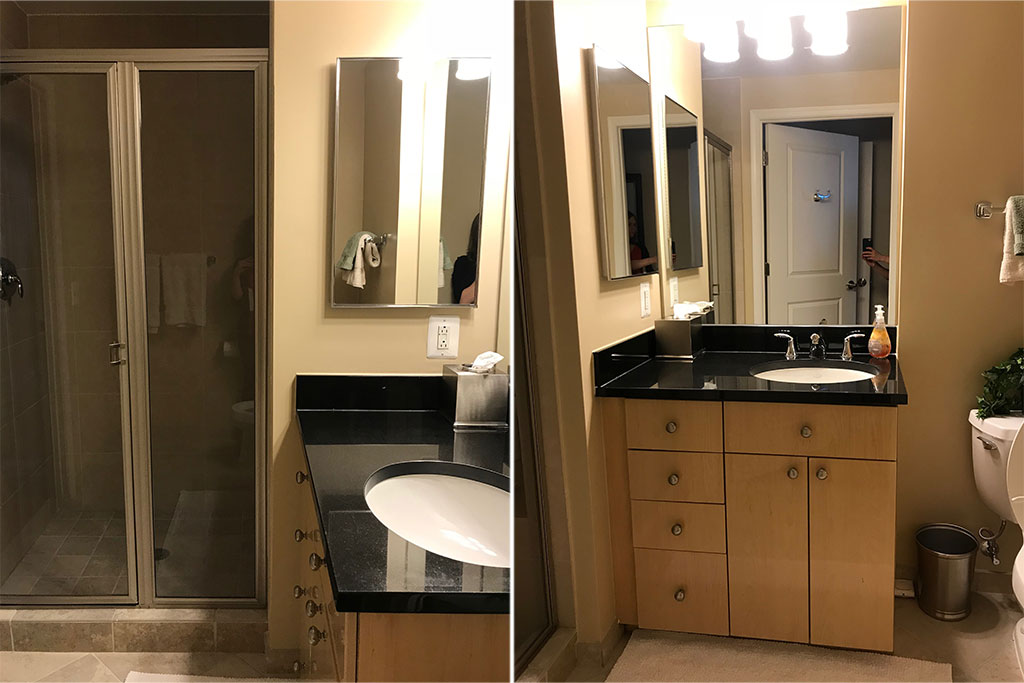
This month’s featured project is a Reston MidTown Condo remodel. This is a gorgeous condo, but the bathrooms were original to the unit and the owner’s were ready to completely remodel all three of them to reflect their personal taste and design aesthetic.
With many condos in the Reston area now well into their second decade, you might be thinking it’s time to remodel yours. We can help! With over 10 years of experience and based right here in Reston, we know a thing or two when it comes to luxury condominium remodeling. We apply our same proven Renovation Roadmap™ methodology to all of our remodels to ensure you renovate happy!
By Personal Injury Attorney William Colarulo of Grungo Colarulo
Historically, members of the military were unable to file a medical malpractice claim against the federal government when they were a victim of negligence. This is largely due to the fact that nearly all governments have immunity from civil lawsuits. More specifically, it has to do with the Feres Doctrine.
The Feres Doctrine is named after three different cases of military medical malpractice heard by the Supreme Court in 1950. Once the case was decided on, it was determined that any service member was barred from filing a medical malpractice claim against the federal government.
Now, however, a new proposal to the 2020 defense budget bill might allow service members or their families to take action by filing a claim with the Secretary of Defense. If accepted, these claims would allow service members to collect compensation for their injuries.
In mid-December, the House of Representatives approved the 2020 National Defense Authorization Act. Under this bill, military members can file a claim for review if they believe they were the victims of medical malpractice. Of course, like any civil action, it does not necessarily mean that they will be successful in their claim. Currently, only medical malpractice claims are included in the National Defense Authorization Act, although that does cover not only medical treatment, but also dental treatment and other related healthcare.
The National Defense Authorization Act also states that an attorney’s fees cannot exceed 20 percent of any compensation awarded. The Department of Defense is also not liable for those fees, meaning that anyone filing a claim would be responsible for paying the associated expenses.
This National Defense Authorization Act might prove to be helpful for service members that are victims of medical malpractice in the future, as well as for any member that was a victim after January, 2017.
By Criminal Defense Attorney Floyd Oliver of Floyd Oliver Attorney at Law
In the world of criminal law, words matter. Cases are often lost and won based on the prevailing interpretation of the relevant statutory and regulatory language. This is also the case for federal firearm enforcement.
For decades, federal prosecutors and regulators at the United States Bureau of Alcohol, Tobacco, Firearms and Explosives (ATF) have relied on what some call an archaic definition of the word “gun.” This agency defines the frame (or receiver) of a firearm as a gun.
However, with AR-15-style weapons, a frame is made of two separate parts: the upper and lower receivers. Neither of these parts could fire a bullet on their own, but ATF and federal prosecutors have treated these individual parts as guns in order to regulate who can obtain them.
A significant part of ATF’s mission is to prevent certain people — those legally prohibited from possessing a gun — from being able to legally obtain the separate parts they could use to make a firearm. However, the discrepancy between the law as it is written and the construction of AR-15-style weapons is starting to cause panic within the federal gun enforcement community.
Defense attorneys are making a “plain reading of the law” argument in efforts to invalidate assertions that their clients are guilty of having possessed or sought to possess a gun. They argue that one part of the receiver does not make a gun and should therefore not be treated as a firearm.
The courts are starting to listen. Since 2016, at least five defendants have seen their cases or charges dropped or have avoided prison. Recently, an Ohio federal judge sided with the defense’s argument that a plain reading of the law necessitated a dismissal and said that the legal definition of the word “gun” is something ATF has a duty to fix.