


The trajectory of COVID-19 cases in Fairfax County continues its upward climb this week.
As of today (Monday), the trailing weekly average of new cases hit 471, with an all-time high reported on Saturday when cases hit a weekly average of 505.
While the county’s caseload continues to break all local records, the acceleration of new cases reported daily seems to slow slightly.
Nonetheless, the county reported the highest number of daily cases — 725 — last week on Dec. 7. Overall, the case trajectory continues to be exponential over the last month, suggesting that community transmission is occurring.
Another measure to determine community spread — the test rate positivity — remained high this week. The county’s rate is 10.6 percent, slightly down from last week’s rate of 11.5 percent. The state’s rate is 10.9 percent.
New statewide restrictions are going into effect today that include a curfew from midnight to 5 a.m., a 10-person cap on social gatherings and an emphasis on a mandatory mask requirement.
Meanwhile, the county is urging residents to celebrate the holidays with the people in their immediate household.
“We must find a way to recognize our traditions without putting ourselves and others at risk,” said Fairfax County Health Director Gloria Addo-Ayensu.
An initial shipment of the Pfizer vaccine was cleared by the Food and Drug Administration last week. Millions of doses will be shipped around the country next week.
In a recent meeting with the Herndon Town Council, town manager Bill Ashton noted that health officials believe the vaccine will be accessible to the general populace in late spring or early summer.
Here are some shopping tips for a healthy, safe and enjoyable holiday 🛍️
Check out our recommendations for family celebrations and entertainment: https://t.co/U2eRplxu3k pic.twitter.com/CpqHqa5TR9
— FairfaxCounty Health (@fairfaxhealth) December 13, 2020
Image via Unsplash

Fairfax County Public Schools could start expanding in-person learning to more students again in January.
Under a draft timeline that FCPS Superintendent Scott Brabrand presented to the county school board last night (Thursday), all students will learn virtually for the first week after winter break, which lasts from Dec. 21 through Jan. 3.
Students who opt for hybrid in-person/virtual learning would then begin returning to school buildings on Jan. 12, starting with five cohorts that encompass pre-K and kindergarten students, as well as students in special education, English learners, and other specialized programs.
Elementary school students will be phased in, two grades at a time, between Jan. 19 and Feb. 2. Middle and high school students have been split in two groups, with seventh, ninth, and 12th graders returning on Jan. 26, and eighth, 10th, and 11th graders returning on Feb. 2.
“This plan is contingent on health and operational metrics being met,” Brabrand emphasized. “We’ll provide the board an update on this plan on Jan. 5 at our next monthly return-to-school work session and as needed as we get closer to the target dates for the groups.”
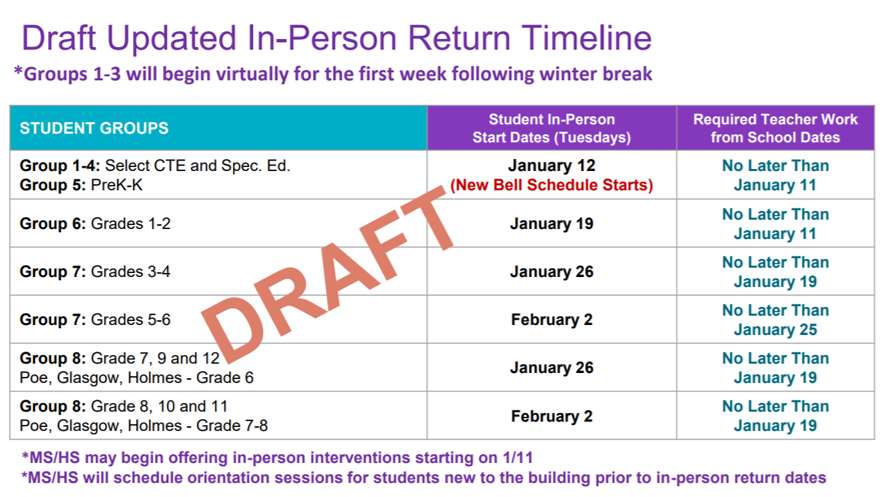
During the school board work session, Brabrand also laid out plans for a revised bell schedule to accommodate the increased time and reduced capacity needed to transport students to school by bus, a change that he acknowledged will present challenges for some families and employees.
“However, it is the only way we can return all of our grade levels back to in-person following health and safety guidance,” he said.
To address concerns about students falling behind academically while learning online, FCPS will loosen its grading policies and implement a system of interventions to give more individualized support to students who are struggling. English learners and special education students will also receive targeted support, including teacher-family conferences and regular check-ins.
Brabrand’s Dec. 10 presentation represents represent FCPS’s first concrete effort to resume a process that began on Oct. 5 but was suspended on Nov. 16 after Fairfax County’s COVID-19 caseload exceeded established thresholds for phasing students back into in-person learning.
Whether the new Return to School plan will actually come to fruition as proposed remains to be seen, as the Fairfax Health District continues to report record levels of COVID-19 transmission.
Brabrand alerted the school board that about 4,100 students are on track to revert back to all-virtual learning on Dec. 14, because tomorrow could mark the seventh day in a row where the county averages more than 200 new cases per 100,000 people and has more than 10% COVID-19 tests come back positive over a two-week span.
The superintendent said that FCPS has already sent letters to families whose students will be affected letting them know that a return to virtual learning could happen, though it will be confirmed on Saturday.
School officials have stressed the importance of mitigation strategies, such as social distancing and face mask requirements, to reduce the risk of COVID-19 spread and avoid the need to return all students to distance learning. FCPS announced earlier this week that it is assembling safety teams to monitor adherence to public health protocols at schools that have reopened.
However, the Fairfax County Federation of Teachers reported yesterday that it had recorded 72 safety violations since Oct. 23 through an online safety violation tracker. Members also reported in a survey conducted by the labor union that they have not seen consistent use of masks, social distancing, respiratory etiquette, and proper cleaning and disinfecting practices.
Since Sept. 8, FCPS has recorded 454 COVID-19 cases out of 12,104 in-person students and staff, a more than 3% positivity rate.
The FCFT argues that FCPS should transition all students and staff to virtual instruction until Fairfax County’s COVID-19 positivity rate drops below 5% and all of its standards for a safe reopening are met.
“FCPS’ introduction of a ‘mitigation strategies’ metric is important, but should not be prioritized over community spread of COVID-19,” FCFT President Tina Williams said in a statement. “…Our schools are part of our community and if COVID is spreading in our community, that means it is spreading in our schools.”
It has barely been 10 days since Fairfax County launched its annual Hypothermia Prevention Program, and it’s already clear that this winter will be unlike any other that Abby Dunner has experienced in her nearly decade-long work with the initiative.
Now the manager of the Fairfax County Office to Prevent and End Homelessness, Dunner has been involved with the hypothermia prevention program since she was employed as a case manager and assistant by the nonprofit FACETS in 2012.
The COVID-19 pandemic, however, forced Dunner and the other county and nonprofit officials who run the program to completely reengineer their operations, which were well-honed after 15 years of providing shelter for people in need during the coldest months of the year.
This year’s hypothermia prevention program, which started on Dec. 1 and runs through Apr. 1, 2021, must contend not only with the public health risks and social distancing protocols created by COVID-19, but also the looming threat of a surge in homelessness if emergency assistance measures end.
“We recognize the challenges and kind of the unique situation that we’re in, but everybody is also very much on board with understanding that the program has to continue,” Dunner said. “We have to still be able to shelter people who are experiencing homelessness.”
County officials and the nonprofit contractors that operate the hypothermia prevention shelters realized early on that they would have to make major changes to the program to make it viable this year.
Dunner says the Office to Prevent and End Homelessness collaborated extensively with the Fairfax County Health Department throughout the planning process. Health officials walked through each site and recommended ways to implement social distancing as much as possible.
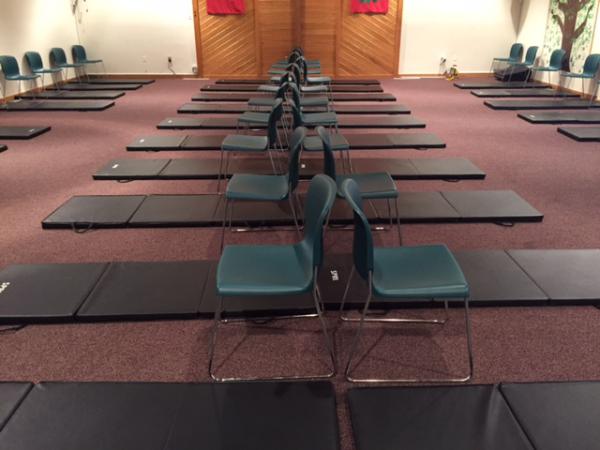
Typically, the county relies on faith communities and nonprofits to host the actual shelters, which rotate between different locations every week, but the churches and other buildings usually utilized were too small to allow for the approximately 100 square feet of space sought per guest.
This time, the county turned to its own facilities, ultimately identifying seven sites that were sufficiently spacious, centrally located, and accessible by public transportation.
Dunner says the hypothermia prevention program generally serves about 1,200 people across its four months of operation, and roughly 215 people utilize the shelters each night.
Though only a handful of people stayed at the Container Store site for the first couple of nights, the shelter averaged about 26 guests over the program’s first seven days, reaching 40 people on Dec. 7 with numbers expected to continue rising, according to Dykes.
Individuals are given 100 square-foot spaces marked off by tape, and they are required to wear masks except when eating and sleeping in their space.
Shelter staff, who also must wear face coverings, administer temperature checks and wellness questionnaires when guests arrive. If someone records a high temperature or reports COVID-19 symptoms, they are directed to one of the Quarantine, Protection, Isolation and Decompression sites that Fairfax County has set up in local hotels, where they can be monitored and tested.

As of Dec. 9, the county has 445 rooms at six hotels for QPID shelter. 360 of them are occupied by 477 guests, only seven of whom were not experiencing homelessness upon admission, Fairfax County Health and Human Services reported.
In addition to housing people who are unable to isolate or quarantine safely in their own home, the QPID rooms could serve as overflow shelter if the county’s emergency shelters and hypothermia prevention sites run out of capacity.
FACETS Senior Director of Programs Carole Huell says Fairfax County could also revisit sites that were previously considered for the hypothermia prevention program, but a second location would require hiring more staff, something that was already a challenge.
The volunteers that the program normally relies on to staff the shelters are not involved this year, since they tend to be older and, therefore, at higher risk of contracting COVID-19 if exposed.
“There is a back-up plan [if shelters exceed capacity],” Huell said. “It’s just we hope we don’t have to get to that, because each agency that needs additional space for a facility will have to man that space, and that’s additional resources and funding necessary.”
According to Dunner, Fairfax County is already seeing evidence of the pandemic’s economic fallout, as new people enter an increasingly strained social safety system that had glaring deficiencies even before a deadly contagion entered the picture.
Dunner says the county is “very concerned” about the ripple effects of the U.S. Centers for Disease Control and Prevention’s eviction moratorium ending on Dec. 31, but even with the ban in place, evictions have not wholly stopped.
Still, both county and nonprofit workers believe they have prepared adequately for the season. They have also gotten support from partners in various faith communities, who are contributing food, clothing, and other donations in lieu of being able to serve as hosts and volunteers.
“We’re hoping that, based on the spaces that we’ve chosen and the way that we planned the program, we’ll be able to accommodate anyone who’s in need of shelter,” Dunner said.
Image via Fairfax County Office to Prevent and End Homelessness
New COVID-19 Measures Go Into Effect on Monday — Gov. Ralph Northam’s latest executive orders calls on all residents to stay home from midnight to 5 a.m., imposes a universal mask requirement, and lowers the limit on social gatherings to 10 people. [Fairfax County Government]
Leidos to Buy Company for $215 Million — “Leidos Holdings Inc. (NYSE: LDOS) jumped back into the mergers and acquisition market late Thursday, acquiring 1901 Group in a $215 million cash on hand deal. The deal would shift the Reston-based managed information technology services and cloud solutions provider into Leidos’ defense business segment.” [Washington Business Journal]
Performance Comes to Reston Community Center with No Audience — “The Ravel Dance Studio will take the stage at the Reston Community CenterStage December 12th without an audience. They will be filming their Nutcracker Ballet and although the production will not be open to the public the school and their students are thrilled to be able to keep this holiday tradition alive.” [Reston Patch]
Photo via vantagehill/Flickr
Reston Woman Brightens Sister’s Holiday Season — “Carolina Oneill’s sister, Jess, was furloughed due to the coronavirus pandemic back in March. Although Jess was receiving unemployment insurance, it was cut off in October.” [Reston Patch]
A Peek Inside Made in Fairfax Manufacturers — “The Made in Fairfax Directory provides an opportunity for residents and supporters to connect directly with Fairfax County makers. Please note that listing in this directory is not an endorsement of businesses or products, and is provided for informational purposes only.” [Fairfax County Government]
Northam Expected to Announce New COVID-19 Restrictions — “Virginia’s Governor is expected to announce tighter COVID-19 restrictions following a record-setting day for new coronavirus cases. Gov. Ralph Northam hasn’t detailed yet what the restrictions will be but says ‘mitigation measures will be nuanced and in-line with our targeted, data-driven response.'” [NBC4]
Photo via vantagehill/Flickr
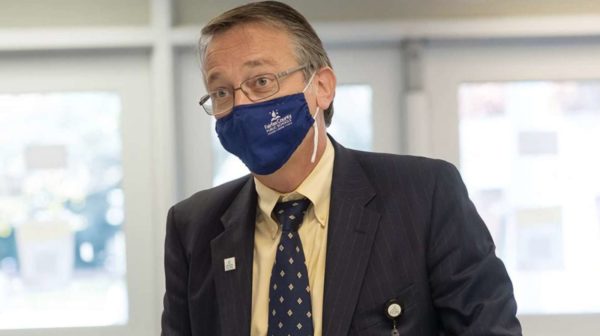
Fairfax County Public Schools is creating “Safety Teams” of staff members and retirees to monitor adherence to COVID-19 safety protocols at schools that have reopened to students.
Charged with enforcing the implementation of mitigation strategies recommended by the U.S. Centers for Disease Control and Prevention, the teams will conduct random on-site spot checks, provide education and resources, and report data to administrators, according to a news release that FCPS published yesterday (Monday).
“The role of these teams is to help protect staff and students, and to make sure we all know what we can do to ensure safe, clean, healthy spaces,” FCPS Assistant Superintendent of Facilities and Transportation Services Jeff Platenberg said. “We’ve been training teams and conducting checks in recent weeks across FCPS.”
To limit the transmission of COVID-19, the CDC says schools should, at a minimum, ensure that students and staff consistently and correctly use masks, maintain social distancing to the extent possible, practice hand hygiene and respiratory etiquette, clean and disinfect facilities, and collaborate on contact tracing with local health officials.
The announcement that FCPS has deployed safety teams comes as school officials face dueling pressures from reports indicating that virtual learning has hampered many students’ educational experience and from teachers’ unions who arguethat in-person classes are unsafe.
FCPS currently has approximately 5,500 students receiving in-person instruction, all of them in special education, career preparation, and other specialized programs.
FCPS returned 2,900 students to distance learning and suspended plans to bring more students into school buildings on Nov. 16, when the COVID-19 transmission rate in Fairfax County surpassed 200 new cases per 100,000 people.
The percentage of positive COVID-19 tests over the last 14 days also has to be lower than 10% for students to start or remain in class.
As of Dec. 7, Fairfax County’s COVID-19 case rate is now more than double the 200-case threshold at 431.4 new cases per 100,000 people within the past 14 days. The test positivity rate is currently at 9.4%.
The Fairfax County Federation of Teachers and Fairfax Education Association, two unions that represent faculty and staff in FCPS, have urged FCPS to return all students to virtual learning.
“In schools that are already open, COVID-19 cases are increasing and employees report unsafe working conditions,” the FCFT said as part of a letter-writing campaign. “Fairfax County must transition everyone to virtual learning until it is safe.”
FCPS has recorded 387 COVID-19 cases since Sept. 8, including 300 staff members and 58 students. 21 cases involved staff at multiple sites, according to the school system’s COVID-19 dashboard.
Platenberg says the data that FCPS collects through its new safety teams will help officials determine where to devote additional education or resources in their effort to curb the spread of COVID-19 in schools.
“We want to make sure we are consistently implementing the CDC’s strategies,” Platenberg said. “This is new for all of us, and so far, we are encouraged by what we see.”
Photo via FCPS
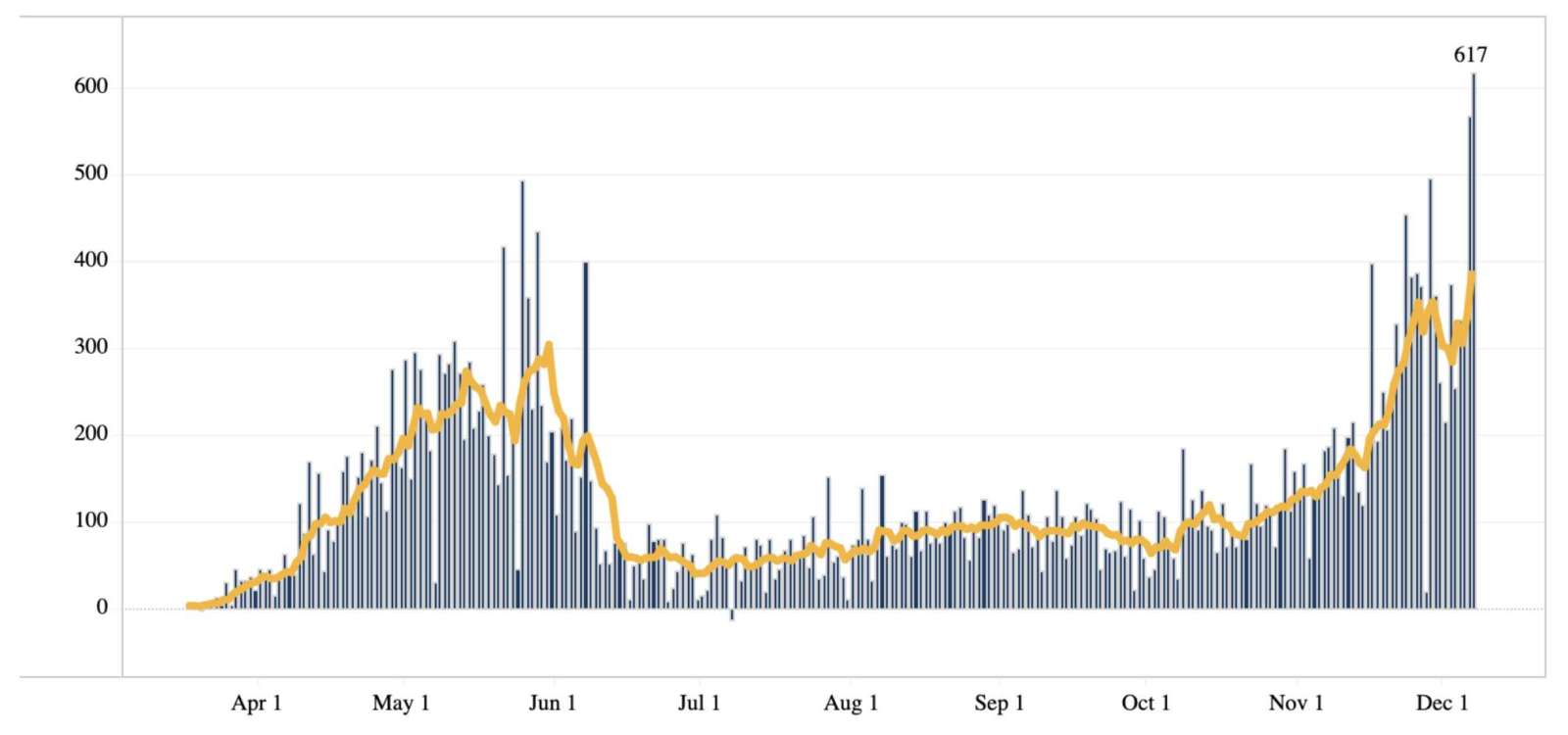
The number of new daily COVID-19 cases has reached an all-time high as of this weekend, far surpassing the previous peak immediately after Thanksgiving weekend and previous records over the summer.
The county recorded the highest number of new cases in a single day today (Monday) — 617 — since the pandemic began earlier this year. Both numbers exceed case counts that hovered around 500 on Thanksgiving weekend and when cases first peaked in June.
Statewide, cases also continue to soar. On Sunday, the state shattered previous records by recording 3,880 new cases. Over the summer, cases peaked to 2,015.
The latest numbers suggest that the second wave of the COVID-19 pandemic is surging with more strength than ever before, even as the reality of a new vaccine materializes.
Hospitalizations in the state and in the county also continue to climb. Although only 20 hospitalizations were reported today (Monday), the number of new hospitalizations peaked at 53 on Dec. 2.
In Fairfax County, however, the number of hospitalizations remains low. The state reported 20 new hospitalizations today. In early May, hospitalizations peaked at 53.
Another measure to determine community transmission — the weekly test positive rate — also continues to increase. The state’s test positivity rate is 10.8 percent while the county’s is at 11.5 percent. VDH updates data on the COVID-19 pandemic once a day at 5 p.m.
The county and the state have been preparing for the dispersal of a vaccine, which could have federal approval as early as this month. Gov. Ralph Northam previously stated that the first shipment to the state would include roughly 70,000. doses.
Photo via Virginia Department of Health
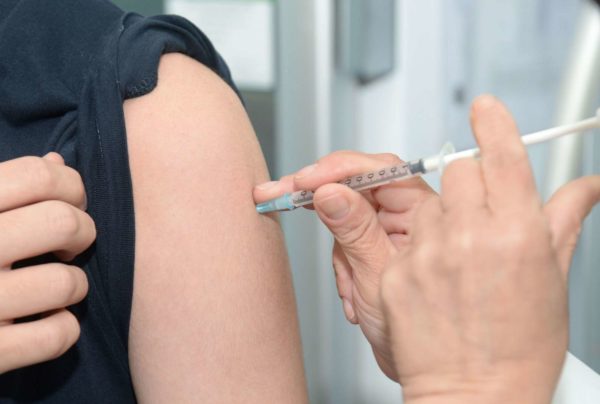
With the emergency approval of a COVID-19 vaccine expected before the end of the year, county officials are one step closer to getting ready for mass vaccination planning.
At a meeting on Tuesday (Dec. 1), the Fairfax County Board of Supervisors voted unanimously to accept a $500,000 state grant for the county’s mass vaccination program. Funds will be available through the state’s $22 million Coronavirus Relief Fund, which will be used to create a statewide program to distribute the vaccine, once it is available.
Two companies — Pfizer and Moderna — are awaiting emergency authorizations of their vaccines in the United States. The U.S. Food and Drug and Administration expected to authorize the approvals in mid-December.
The Centers for Disease Control and Prevention’s advisory committee on immunization practices voted earlier this week to make the first priority group health care workers and long-term care residents.
The county’s program also allocates roughly $14 million to help local health districts like the Fairfax Health District prepare for mass vaccination efforts. The grant must be used for facility rental costs, hiring for temporary positions, travel costs, printing, signage, and other expenses related to operating vaccination clinics.
Fairfax County Executive Brian Hill said his health department is actively working on a vaccination plan for the county “as we speak.” He noted that the county’s plan will depend heavily on the state’s strategy and other conditions, including who will receive the vaccine first.
“Once we know the particulars, we will have a plan in place per the Virginia Department of Health guidelines,” Hill said.
A county-based mass vaccination workgroup has been meeting since mid-June to discuss vaccination plans.
Hunter Mill District Supervisor Walter Alcorn urged the county to provide information on how the plan would be administered. He added that lines for the H1N1 vaccine program rivaled the lines the county recently saw for early voting.
“I just want to make sure we see what the plan is particularly as it relates to logistics,” he said.
Funds from the state grant must be spent by the end of the month, after which point unspent dollars will revert back to the state. However, county staff noted that the federal government could extend the date for the overall program. Acceptance of the grant requires no local match.
State officials are also considering other funding sources to support next year’s vaccination program. The Virginia Department of Health estimates that the program will cost $120 million.
Virginia is expected to get a little over 70,000 doses in the first shipment from Pfizer.
“When our turn comes, my family and I will have no hesitancy about getting vaccinated and I strongly encourage every Virginian to get the vaccine. That is our only path to getting back to that near normal,” Gov. Ralph Northam said in a press briefing yesterday (Wednesday).
Image via Unsplash
Virtual Job Fair Set for Job-seekers Age 50+ — The county is hosting a free virtual employment expo. On Friday (Dec. 4) between 10 a.m. and 2 p.m. Registration is open online. [Fairfax County Government]
Herndon High School’s NJROTC Donates Holiday Meals — “In response to the COVID-19 pandemic and the growing need for food in the area, the Herndon High School NJROTC donated 11 family meals for Thanksgiving and pledged another ten meals for Christmas, for a total of 21 in honor of the Class of 2021, to families in need via Food for Neighbors.” [Fairfax County Public Schools]
70,000 Doses of COVID-19 Vaccine Expected in Virginia — “Gov. Ralph Northam said in a Wednesday news conference in Richmond that an estimated 70,000 doses would be in the first wave of Pfizer vaccines sent to Virginia. Should the FDA give approval to Pfizer’s vaccine, doses would go to states immediately, which Northam expected would happen as early as mid-December.” [Reston Patch]
Photo via vantagehill/Flickr

Reston Association Courts Close for the Season — The clay tennis courts at Glade have closed for the season and will reopen in early April. The clay courts at North Hills will close next Monday and will also reopen in early April. [RA]
County Now Offers Contact Tracing Data — The county’s COVID-19 dashboard now includes data on contact tracing. Data show that the county has been able to reach roughly 82 percent of confirmed cases. [Fairfax County Government]
The Early Days of Reston — “At one time, Reston was just a short five to six-minute train ride away from Herndon on the Washington and Old Dominion Railroad,” writes Barbara Glakas. [Reston Patch]
Photo by Marjorie Copson
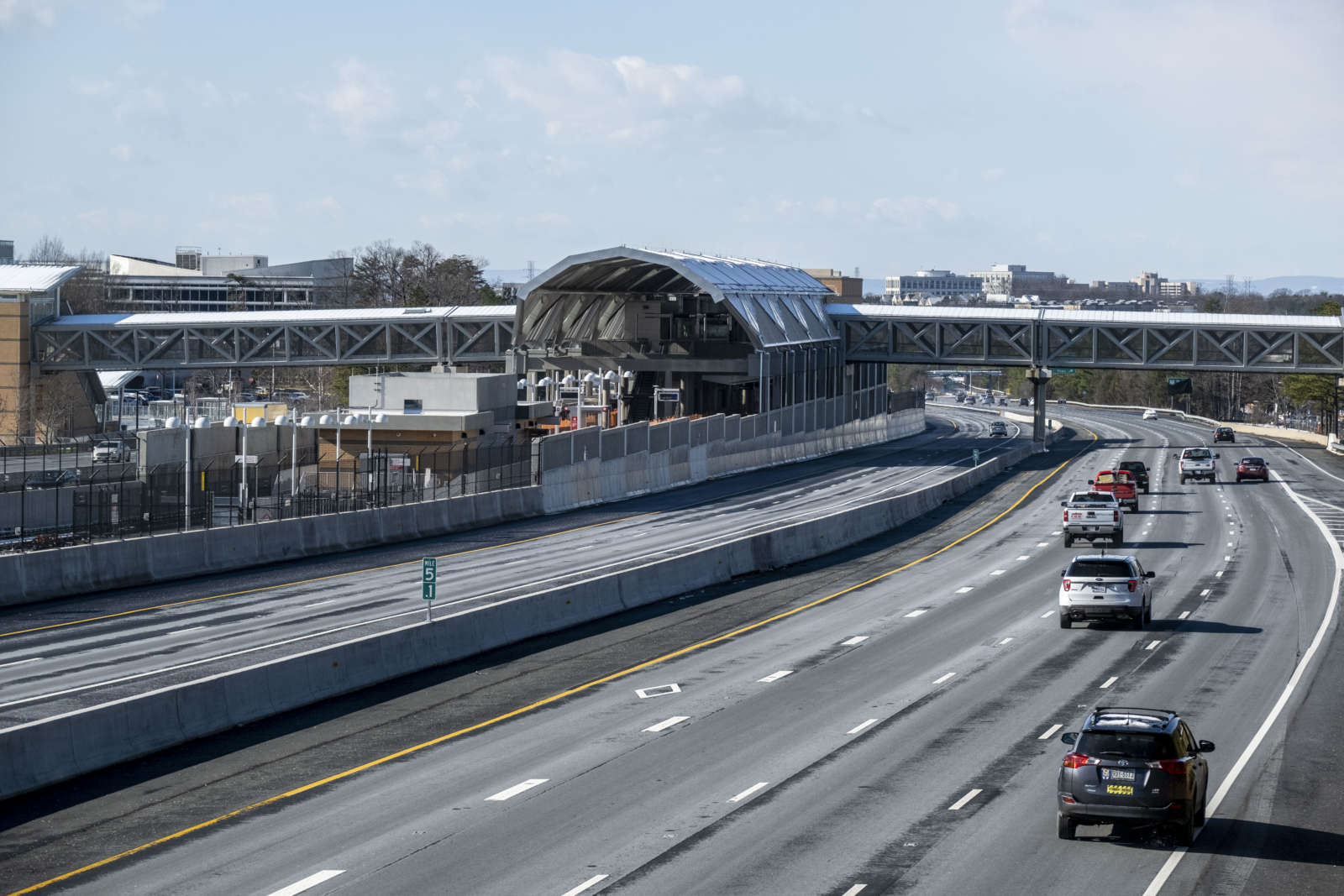
Metro is considering plans to eliminate weekend service as the system grapples with how to fill a nearly $500 million deficit.
The proposal, which the Washington Metropolitan Area Transit Authority board will hear on Friday, would also call for trains to run every half hour, shutter 19 stations and slash bus service levels.
According to the proposal, Metro would offer an “affordable bare-bones service network to sustain essential travel and support the region’s recovery.” Under the proposal, ridership would be reduced to around 45 percent of pre-pandemic levels. The system would also close at 9 p.m.
“We’re facing. obviously, a historic budget crisis. It started in (fiscal year) 21 and will continue in (fiscal year) 22,” Metro General Manager Paul Wiedefeld said.
But a federal coronavirus relief package that could include funding for public transit could change the otherwise grim outlook of the overall system. According to the American Public Transit Association, public transit needs $32 billion just to survive.
Metro was awarded $800 million from the CARES Act in May — funding that runs out early next year.
Nineteen stations with low ridership would close during the pandemic. Reopening would be determined based on the financial health of Metro. Weekday rail services would end two hours early at 9 p.m. Weekend service would be eliminated entirely and bus service would be slashed from 60 to 41 routes.
The proposal also calls on cutting 2,400 jobs in addition to workforce cuts already enacted this year.
The opening of additional Silver Line stations into Loudoun County will not be affected by the budget slashes, according to the presentation.
Metro’s fiscal year begins in July. Public hearings and outreach campaigns are planned until March.

People whose employment has been affected by the COVID-19 pandemic may now be eligible to receive free job training from the Fairfax County Department of Family Services.
According to a news release published on Nov. 19, DFS will cover up to $1,000 in training costs for individuals who are looking to gain new skills in the high-demand industries of healthcare, information technology, skilled trades, public safety, and early childhood education.
Anyone who lost a job due to the impact of COVID-19 and received unemployment benefits on or after Aug. 1 is eligible to apply, along with anyone who was laid off from a full-time job due to COVID-19 and now earns less than $15 per hour working part-time.
The offer of job training support comes as part of a Re-Employing Virginians (REV) initiative launched by Virginia Gov. Ralph Northam’s office on Oct. 30.
Funded by $30 million from the federal CARES Act, the REV initiative aims to mitigate the long-term economic impact of the COVID-19 pandemic by providing one-time $3,000 scholarships for workforce training.
The funds are being administered by the Virginia Community College System and localities in Northern Virginia and Hampton Roads, which, combined, represented nearly 50 percent of all unemployment claims in the state as of the end of October, according to the governor’s office.
“Investing in programs that help people develop skills in high-demand fields is a win for workers, employers, and our economy,” Northam said. “As we focus on recovering from the impacts of the global pandemic, the new REV initiative will give Virginians the resources they need to get back on their feet and help ensure that our Commonwealth emerges from this public health crisis even stronger than we were before.”
The application deadline for the DFS program is Dec. 8, and training must be completed by Dec. 29.
People interested in applying should contact DFS REV Intake Specialist Ziyoda Crew at 571-536-1979 or email the department at [email protected].
Individuals can also apply for short-term training or certification programs at Northern Virginia Community College by certifying their eligibility for the REV initiative and registering for a training voucher by Dec. 14.
Photo via Bruce Mars/Unsplash
COVID-19 is now more widespread in Fairfax County than it was when the pandemic’s first wave hit in the spring.
Reporting 262 new cases just today (Monday), the Fairfax Health District has recorded a total of 31,388 COVID-19 cases since the novel coronavirus first arrived in March. 2,561 people have been hospitalized, and 638 people have died from the disease.
Fairfax County officially surpassed the spring peak on Nov. 24 when it reported 308.3 cases on average over the previous seven days. The highest seven-day average recorded in the spring was 303 cases on May 31.
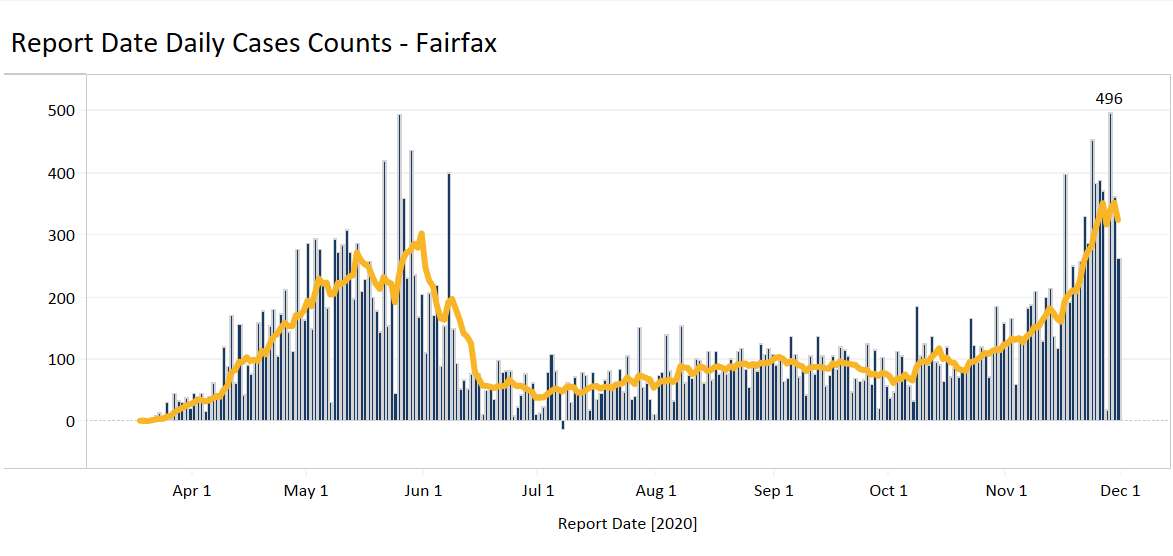
The weekly average caseload then hit an all-time high of 352.3 cases on Sunday (Nov. 29) before dipping down to a seven-day average of 324.9 cases today, according to Virginia Department of Health data.
Fairfax County also recorded its highest single-day case count of the pandemic this past weekend when it saw 496 new cases on Nov. 28. The previous record was 493 cases on May 25.
However, Fairfax County’s hospitalization and death rates remain well below where they were in the spring.
Currently, Fairfax County is averaging 7.86 hospitalizations over the past seven days, compared to the peak of 35.57 hospitalizations over seven days recorded on May 4. The county is seeing a seven-day average of 1.29 deaths right now, but the seven-day average was 14 deaths on May 4 after there was a single-day record of 31 deaths on May 3.
The surge in COVID-19 cases that Fairfax County is witnessing right now falls in line with the overall trend for Northern Virginia as a region, which recorded its highest seven-day moving average of 815.7 cases on Nov. 29.
By comparison, the pandemic’s spring surge peaked at a seven-day regional moving average of 685.3 cases on May 31.
The continued upward trajectory of COVID-19’s spread in Fairfax County comes after health officials warned that the traveling, intimate family gatherings, and in-person holiday shopping typically associated with Thanksgiving weekend could exacerbate the pandemic.
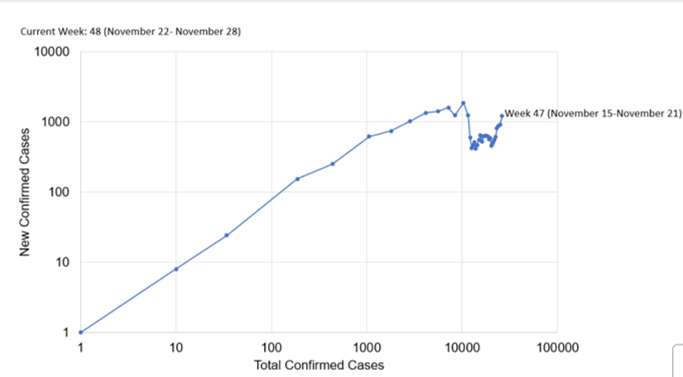
Given the lag time between when someone is exposed to the coronavirus and when a new case is actually reported, Fairfax County’s current COVID-19 data suggests the worst may still be on the horizon.
Images via CDC on Unsplash; graphs via Virginia Department of Health, Fairfax County Health Department
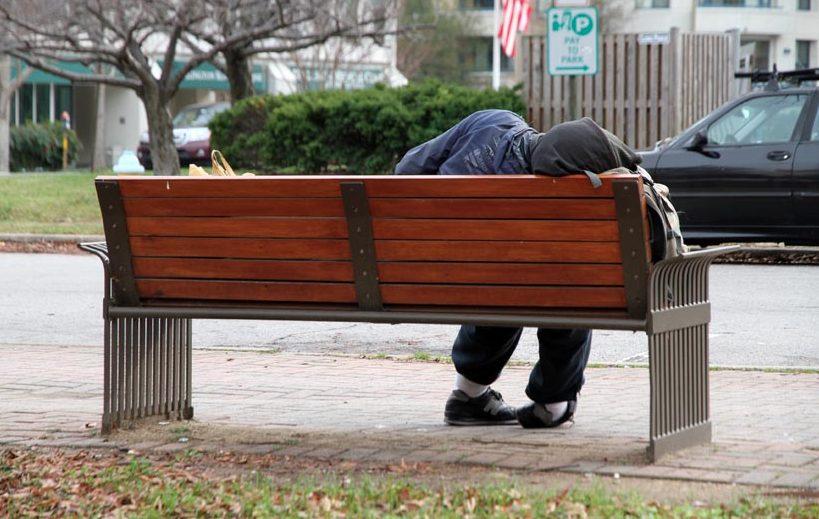
About 250 more people are using Fairfax County’s emergency homelessness services this November over last November, and there are enough beds for just over half of them.
That number could increase as the federal ban on evictions draws nearer.
“As we look at potential rising eviction numbers, we need to be aware of the capacity for the homelessness system,” Fairfax County Health, Housing and Human Services Chief Strategist Dean Klein told the Board of Supervisors during a Health and Human Services committee meeting on Tuesday (Nov. 24).
With COVID-19 cases rising, Fairfax County is dealing with increasing numbers of people experiencing homelessness as well as the threat of rising eviction rates. Klein says rent assistance and partnerships with landlords will be critical for preventing evictions and keeping people in homes this winter.
“Our ongoing efforts to reach out to vulnerable populations is increasingly critical,” he said.
One step Fairfax County has taken is to form an eviction prevention task force with representatives from various county agencies, the county sheriff’s office, and the nonprofit law firm Legal Services of Northern Virginia.
Klein says he hopes to receive financial support from the Board of Supervisors next month. His staff anticipates spending at the same level as it is right now, which is about $600,000 a week.
Providence District Supervisor Dalia Palchik said a board matter is in the works that would “give additional local support for our continuation of basic needs, which we know continues to be a concern for us.”
Although funding comes from a number of sources, some are set to run dry soon, adding to the sense of urgency.
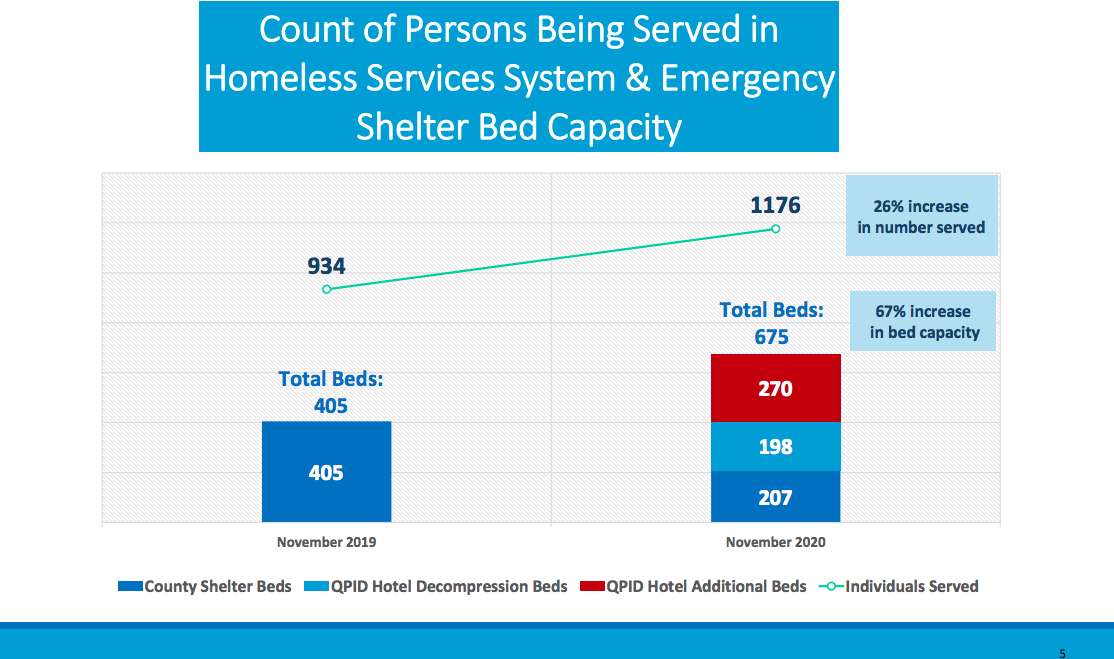
The Federal Emergency Management Agency stepped in this year to pay for hotel rooms so that people experiencing homelessness could have a place to sleep safely during the pandemic. However, it is unclear how long FEMA will continue to provide funding, Klein says.
Fairfax County Office to Prevent and End Homelessness Deputy Director Tom Barnett said the FEMA commitments are on a month-to-month basis and will last through the middle of December.
“We will continue to request extensions every month as they will support most of these expenses,” he said.
The U.S. Department of Housing and Urban Development has committed emergency-solutions grant funding to support shelter and rehousing efforts, but those funds “would be quickly used up if FEMA does not continue their support,” Barnett said.
Fairfax County also received more than $30 million in federal and state CARES Act funding and community development block grants to cover basic needs, including rent and mortgage assistance, on top of the $5 million that the county contributed.
“Not only do we need strategies and assistance to move through the end of the year, but we absolutely know this is not ending in 2020,” Palchik said. “Hopefully we will have more state and federal support to address the needs of our community.”
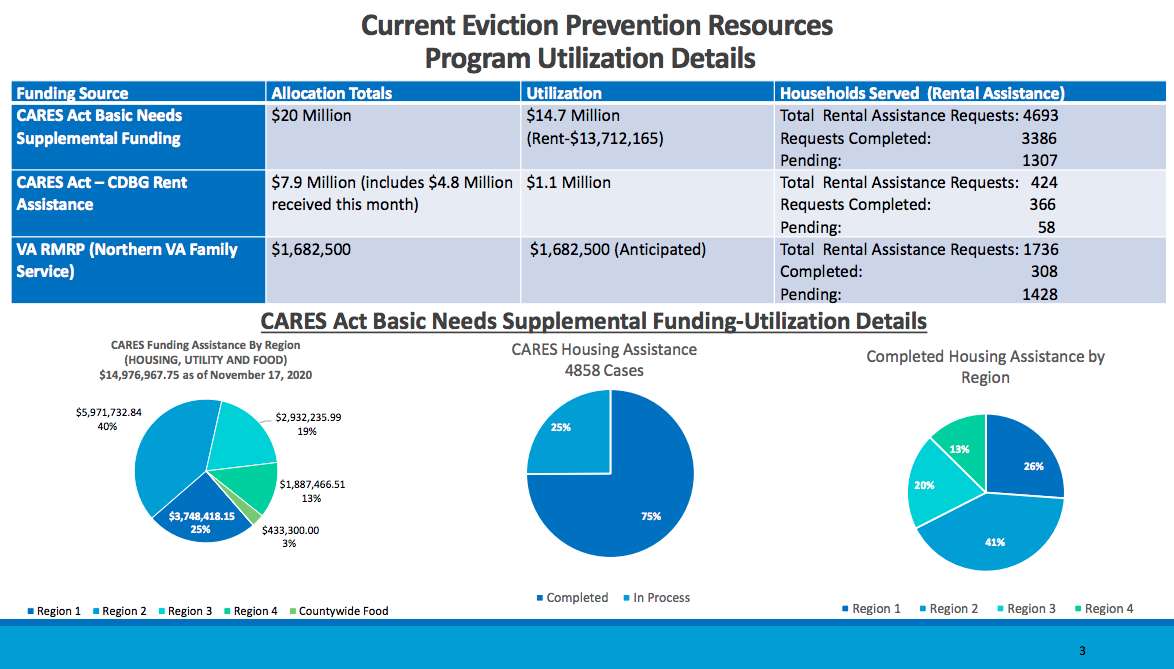
While some social support efforts tackle the challenge of sheltering people during the pandemic, others focus on preventing residents from ending up on the street in the first place.
In August, Klein’s office assigned social workers to 900 people in the legal system who are at-risk for evictions. So far, social workers have helped 300 people. Klein says the likely reason why so many did not respond is that the only way to reach this group of people was by mail.
The office is also beginning outreach to landlords, who might not receive rent payments from third parties. A $150,000 grant from the Kaiser Foundation has gone toward hiring people to work with landlords, but more outreach is needed, Klein says.
On the tenant side, Klein said his office developed guides that explain the current eviction moratorium and help tenants contact the organizations that provide rent payment assistance.
“With the numerous moratoriums, you can imagine how confusing it can be,” Klein said.
Dipti Pidikiti-Smith, the director of advocacy at Legal Services of Northern Virginia, says a number of new provisions protect tenants from being evicted.
Landlords cannot evict tenants unless they provide documentation of what they’re owed and information on available rental assistance programs. Landlords who own five or more units, or have at least 10% interest in five or more units, must offer a payment plan without late fees. Tenants cannot be evicted unless they refuse the plan.
These provisions remain in place through Dec. 31 and will be replaced by similar ones in January, Pidikiti-Smith said.
An ongoing local surge in COVID-19 cases has forced some Fairfax County Public Schools students to revert to online learning for the first time since FCPS started phasing in-person learning back in on Oct. 5.
FCPS announced on Monday (Nov. 23) that administrators had notified families that students in Group 4 would return to all-virtual instruction that day after Fairfax County’s health metrics surpassed the threshold that determines whether they should continue learning in person.
“The health metrics that guide our return to school in person reached a threshold yesterday that indicated we must dial back our Group 4 cohort in order to comply with the metrics we had stated to our community,” FCPS Director of News and Information Lucy Caldwell said in a statement.
Group 4 consists of 2,900 students, including elementary students at Burke School and students in specialized high school career preparatory programs. Affected classes range from culinary arts and musical theater to robotics, veterinary sciences, and the Junior Reserve Officers’ Training Corps (JROTC).
These students had been permitted to learn either virtually or through a hybrid model with two days of in-person instruction and two days of online instruction since Oct. 26.
Based on metrics recommended by the U.S. Centers for Disease Control and Prevention, FCPS determined that Group 4 could continue in-person learning as long as Fairfax County’s COVID-19 caseload did not exceed 200 cases per 100,000 people for seven consecutive days.
The county’s positivity rate for novel coronavirus testing also had to stay at or under 10%.
Fairfax County officially passed the 200-case threshold on Sunday (Nov. 22). At 289.8 cases per 100,000 people, Monday marked eight consecutive days of the county exceeding that limit.
The county’s cases-per-100,000-people and testing positivity rates must both fall under the established thresholds for seven consecutive days for students to resume in-person learning.
“As soon as these metrics indicate that it is safe to return to in-person instruction, Group 4 students will be phased back into schools,” FCPS said on Monday.
This is the second consecutive week that Fairfax County’s COVID-19 spread has required FCPS to revise its Return to School timeline.
Superintendent Scott Brabrand announced on Nov. 16 that FCPS would pause plans to welcome back an additional 6,800 kindergarten, preschool, and special education students that had been scheduled to return to classrooms on Nov. 17.
FCPS has set Dec. 1 as a possible new day for those students to start in-person learning, but with health experts anticipating the pandemic to worsen over Thanksgiving break, that date looks extremely tentative.
“As far as Group 5, we had indicated we would be communicating their in-person return closer to the December 1 date,” Caldwell said. “The numbers right now have not decreased as we have been hoping.”
With FCPS closed for the week starting on Wednesday, Caldwell says the school system will share more information on what Group 5 students can expect either today (Tuesday) or at the end of the break on Nov. 30.
Roughly 5,500 FCPS students are still attending in-person classes. Most of them are in special education, English Learners, career preparation, and other specialized programs.
Though their established thresholds are looser, those cohorts could potentially join Group 4 students in transitioning back to learning exclusively online.
“Given the COVID-19 infection rates in our community, we do anticipate that it may be necessary to dial up and dial back our in-person cohorts,” Caldwell said.
Photo via FCPS
