

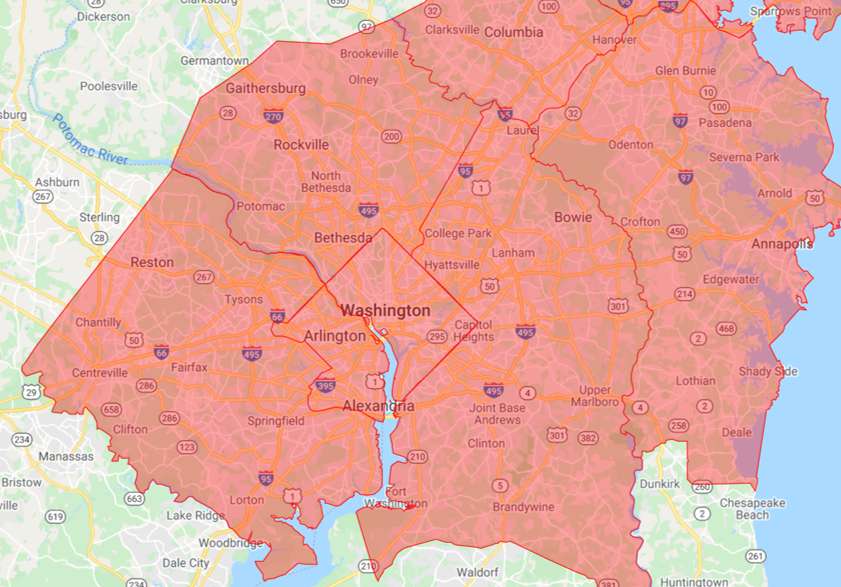
The National Weather Service has issued a Flash Flood Watch for much of the D.C. area, including Fairfax County.
In effect until 2 a.m. tomorrow (Tuesday), the alert says showers and thunderstorms could bring up to 4 inches of rain in some areas, potentially leading to rapidly rising stream and creek waters.
The full alert is below:
…FLASH FLOOD WATCH IN EFFECT UNTIL 2 AM EDT TUESDAY…
The National Weather Service in Sterling Virginia has issued a
* Flash Flood Watch for portions of DC, Maryland and northern Virginia, including the following areas: in DC, District of Columbia. In Maryland, Anne Arundel, Central and Southeast Howard, Central and Southeast Montgomery, Prince Georges and Southern Baltimore. In northern Virginia, Arlington/Falls Church/Alexandria and Fairfax.
* Until 2 AM EDT Tuesday.
* Showers and thunderstorms are expected to produce 1 to 2 inches of rain through this evening, with localized amounts of up to 4 inches possible. Heavy rain in a short amount of time may result in rapid rises of water on small creeks and streams and in urban areas.
PRECAUTIONARY/PREPAREDNESS ACTIONS…
You should monitor later forecasts and be prepared to take action should Flash Flood Warnings be issued.
A Severe Thunderstorm Warning is also in effect for Reston and Herndon until 6:30 p.m., with the NWS warning of 60 mile-per-hour wind gusts that could produce power outages and downed trees.
“At 544 PM EDT, severe thunderstorms were located along a line extending from South Riding to Herndon to Wolf Trap, moving northeast at 50 mph,” the agency said.
With the potential for multiple rounds of showers & thunderstorms into the overnight, a Flash Flood Watch has been issued for the DC metro into parts of northeast MD through 2 AM Tuesday. Flash flooding is possible in small streams and urban areas. Latest: https://t.co/5RyZgoXicj pic.twitter.com/qfUSunieBQ
— NWS Baltimore-Washington (@NWS_BaltWash) October 25, 2021

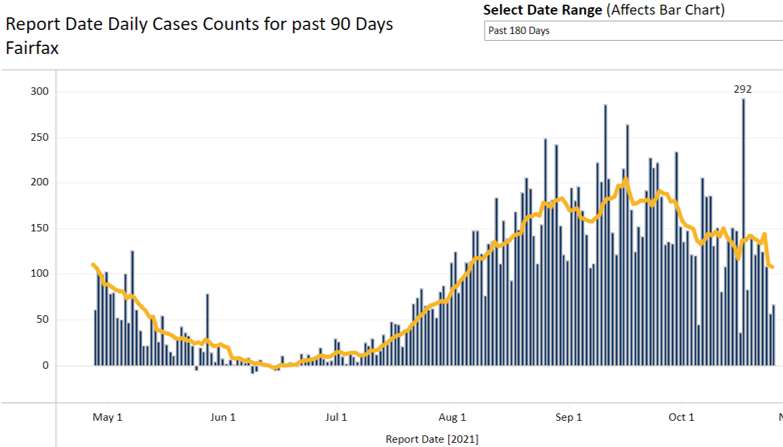
Fairfax County’s COVID-19 case levels haven’t entirely come down from the late-summer Delta variant surge, but they appear to be headed in that direction.
The Fairfax Health District, including the cities of Fairfax and Falls Church, added 72 cases today (Monday) for a total of 92,739 cases over the course of the pandemic. 4,360 residents have been hospitalized by the novel coronavirus, and 1,209 people have died, including eight people in the past week.
The county is now averaging 107.4 cases per day for the past week — just over half of what it was seeing at the height of the Delta surge on Sept. 16, when the weekly average was at 204.6 cases, according to Virginia Department of Health data.
While COVID-19 transmission has declined, Fairfax County has seen an uptick in vaccine demand that roughly coincides with the expansion of eligibility for booster shots at the end of September.
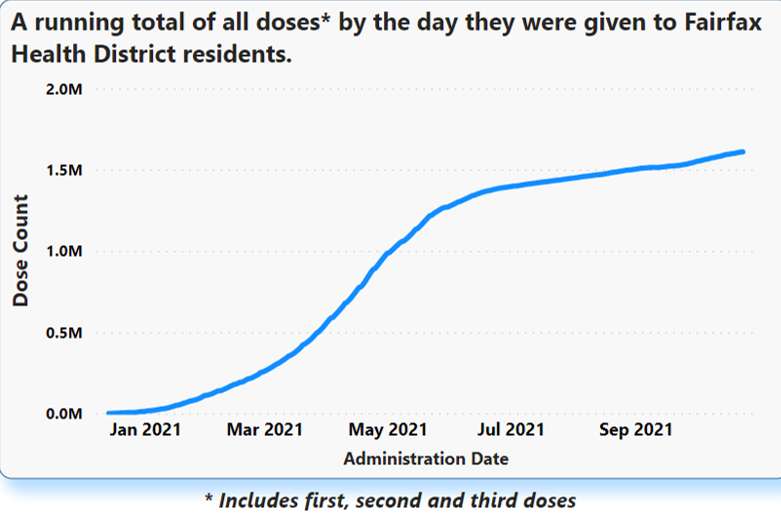
Since third doses of the Pfizer vaccine became more widely available on Sept. 28, the number of doses given to Fairfax Health District residents has increased from around 1.5 million to more than 1.6 million today, according to the Fairfax County Health Department.
The district took almost twice as long to get through the previous 100,000 shots, hitting 1.4 million doses administered on July 4 and not exceeding 1.5 million until Aug. 31.
Roughly 78,000 individuals have gotten a booster shot so far. That number is expected to increase now that additional doses of the Moderna and Johnson & Johnson vaccines have been authorized, FCHD spokesperson Lucy Caldwell says.
Updated on Thursday (Oct. 21), the Centers for Disease Control and Prevention’s booster shot guidelines recommend the Pfizer and Moderna vaccines for people 65 and older, long-term care residents, and adults who face a higher risk of infection due to an underlying medical condition or where they live or work.
The CDC also recommends that anyone 18 and older who received the J&J vaccine at least two months ago get a booster dose. People who get a booster can choose from any of the three available vaccines, not just the one that they originally received.
“If you decide to get a booster dose by mixing and matching, VDH urges you to consult with your doctor or healthcare provider who can assist you in making the best decision for your own situation,” Virginia State Vaccine Liaison Dr. Danny Avula said in a statement. “We also stress that all three vaccines authorized for administration in the United States are highly effective in preventing severe COVID-19 illness, hospitalization and death.”
824,722 Fairfax Health District residents — 69.7% of the population, including 82.4% of people 18 and older — have gotten at least one vaccine dose.
752,274 residents — 75.6% of adults and 63.7% of all residents — are fully vaccinated, meaning they’ve gotten at least two doses of the Pfizer or Moderna vaccine or a shot of the J&J vaccine.
Appointments for any of the vaccines can be found through vaccines.gov. The FCHD is providing assistance with scheduling from 9 a.m. to 7 p.m. on weekdays through its COVID-19 Call Center at 703-324-7404.
Photo via CDC/Unsplash
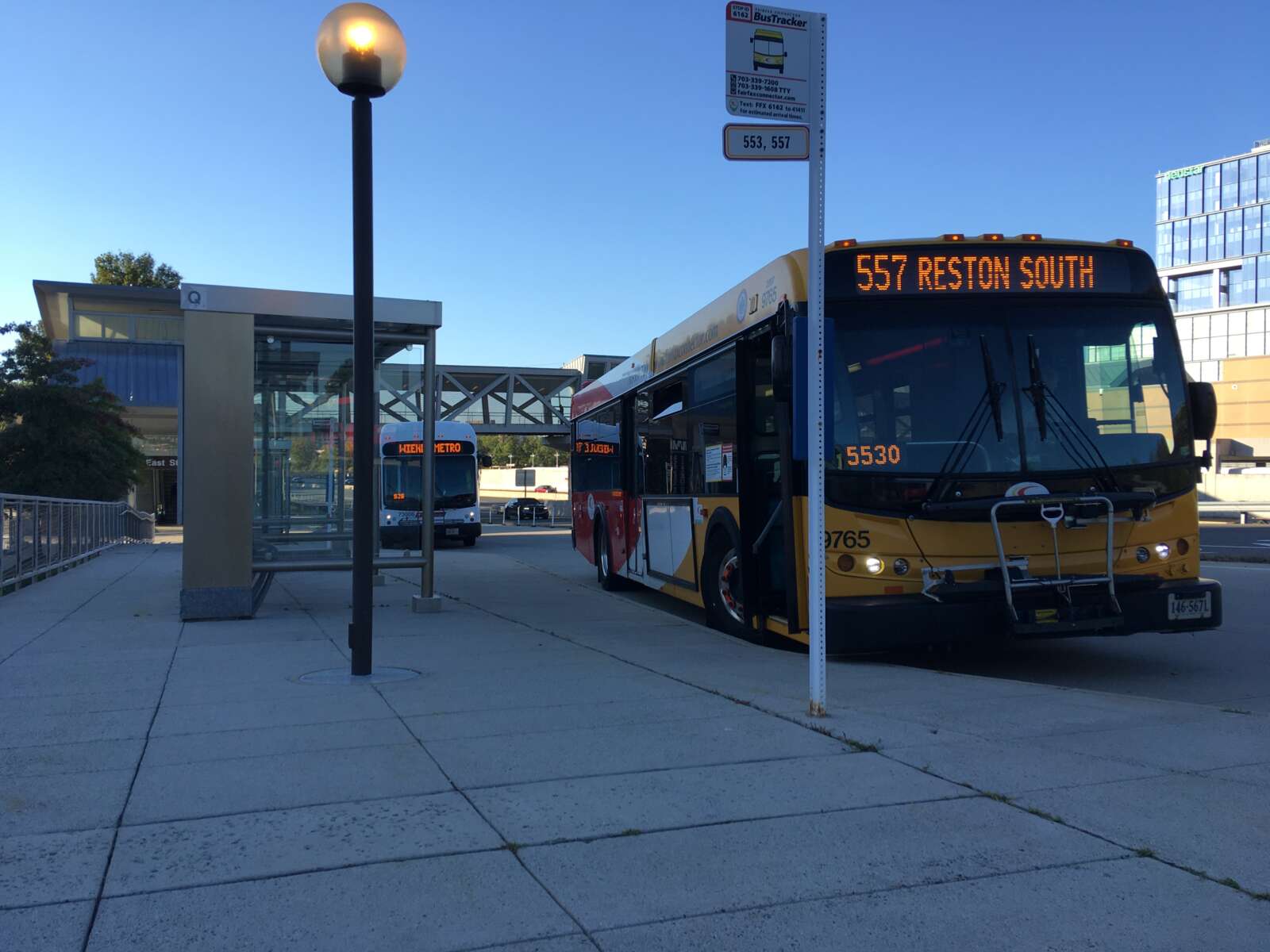
Portales Aloso waited an hour on Tuesday (Oct. 19) for a Metro train from Reston into D.C. The wait on Wednesday was 20 minutes.
He was among countless commuters in the D.C. area who faced travel delays this week after the Washington Metropolitan Area Transit Authority pulled more than half of its railcars from service due to reported safety issues.
The issues involving deficient wheel axles came to officials’ attention after a Blue Line train derailed in Arlington on Oct. 12, prompting mass inspections and a National Transportation Safety Board investigation.
The reduced service levels will continue through at least Oct. 31, WMATA General Manager Paul Wiedefeld announced at a media briefing today (Friday).
“We understand it has been a difficult week for people who depend on Metro in the region, and acknowledge the challenges our customers are experiencing,” Wiedefeld said. “We are working as quickly and safely as possible to inspect every wheel on the 7000-series railcars and it’s important to get that right.”
Metro says it is working to bring older trains into service to offset the absence of the 748 cars in its 7000-series fleet, bringing some 2000-series railcars out of storage and finishing maintenance repairs on the 6000 series.
The transit agency still has 100 cars in the 7000-series fleet remaining for inspection, and it currently has no estimate for when full service will be restored.
WMATA is encouraging riders to use its bus service, though Wiedefeld told media that Metrobus is operating at about 97% capacity.
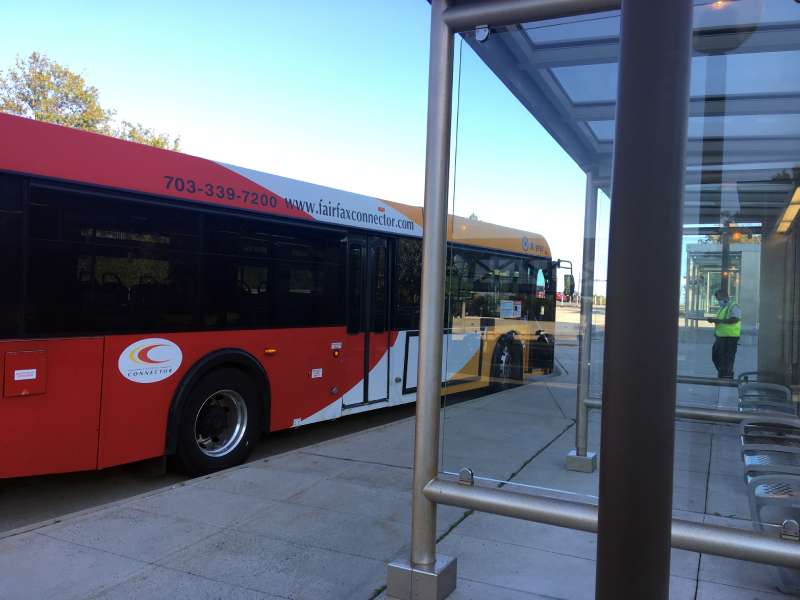
Multiple Fairfax Connector bus drivers told FFXnow earlier this week that, despite the Metro delays, they didn’t notice any differences in the number of passengers on their routes, suggesting riders haven’t opted for other public transit as an alternative.
Salim Furth, a senior fellow at George Mason University’s Mercatus Center who has analyzed how the pandemic could prompt long-term commuting changes, is pessimistic about the chances of Metro’s situation improving, at least in the near-term.
“This is bad, scary, and might get much, much worse before it gets better,” he said Monday on Twitter.
He’s encouraging policymakers and WMATA to plan now for worst-case scenarios and heavily focus on expanded bus service and pop-up bus lanes.
A Metro spokesperson told FFXnow that the service issues are not expected to impact the delivery of phase two of the Silver Line next year.
Fairfax County Board of Supervisors Chairman Jeff McKay says the county is investing in transit with projects over the next few years to cut congestion and incentivize public transportation, including bus rapid transit systems on Richmond Highway and Route 7.
“Ultimately, this incident demonstrates the need for extensive and accessible public transit infrastructure,” McKay said in a statement.
Still, there is no immediate plan to add bus drivers or routes to Fairfax Connector, the largest bus system in Northern Virginia, said transportation department spokesperson Robin Geiger.
She noted the system has room on express bus routes to D.C. and the Pentagon to accommodate additional riders, providing one alternative to rail.
Further down the road, Fairfax Connector is planning to add new express bus routes between Reston and Arlington using I-66 toll money. The county got a final approval on its application to the Commonwealth Transportation Board on Wednesday.
The Northern Virginia Transportation Commission, which ranks the I-66 Commuter Choice program projects, reviewed the proposal last year. The approval will cover the costs of acquiring six new buses.

Janie Daum sometimes wishes she never got involved investigating the paranormal and speaking with spirits.
“Most people that want to do it, they get obsessed with it,” she told FFX Now. “They want more. They want to be touched. They want to hear them. They want to see them. And that’s not always going to happen.”
Daum has been running Northern Virginia Paranormal out of her home in Vienna for about 12 years. She works with a medium to investigate all sorts of disturbances: ghostly run-ins at homes, moving furniture at department stores, odd happenings at old museums.
She specializes in electronic voice phenomenon (EVP), the recording of sounds that could be the voices of spirits.
“I’m still the kind of person that’s on the fence about a lot of things. There’s no just black and white,” Daum said. “There is just a lot of gray area and you just have to listen to what you’re hearing from the spirits, what you’re recording and playing back.”
Daum’s interest in the paranormal was sparked partly by her 18-year-old daughter. They watched the TV show “Paranormal State” together and decided to go on a trip to investigate a purportedly haunted bar in Long Island.
“I got an EVP from a man who said his name was Tommy,” she said. “And that kind of got me hooked.”
That wasn’t the first time, though, that Daum experienced something unexplainable. After her grandfather’s funeral, she spotted him walking down the hall of their home.
“There are little things in my life that kind of drew me to this direction,” she said.
Though she had some hesitations, Daum says her investigations stem from a desire to help folks in need, both those on this mortal coil and those that have left it.
“I always try and find out [the spirit’s] names, who they’re attached to, and if there’s any message that they need to get to a living being that is still walking the Earth, and if there’s a way we can help them,” she said.
Most spirits don’t mean any harm, she says. They are simply lost, stuck, or otherwise can’t go through to the light. However, spirits have the same character traits they did when they were alive.
“If they were an S.O.B. in life, they’re still an S.O.B. on the other side,” said Daum.
She prioritizes investigations for families with children. For instance, when a child repeatedly talks about a man who comes out of their closet and claims to be a doctor, that family needs her expertise.
“If it’s a repeating thing that is continuously happening, it’s not just a child’s imagination,” she said.
While Daum doesn’t like to reveal specifics out of respect for her clients’ privacy, she does more investigations in Loudoun County and rural Maryland than Fairfax County.
Fairfax County is more affluent with newer buildings, she explains. Plus, some are embarrassed about calling paranormal investigators.
“Even if they have issues, things happening that they can’t explain, they don’t want anybody to know about it,” Daum said.
That being said, she’s willing to share some stories about businesses that have since closed — like the Amphora Restaurant near her home in Vienna.
“I knew George[Bilidas] the owner and I was there after his death,” Daum said. “And he [was] there. He actually came and sat in the booth next to me and playing with a bunch of keys in his hand.”
There was also the time she got called to investigate the women’s restroom at the now-closed Lord & Taylor’s at Tysons Corner Center, which has recently been repurposed as a mass vaccination site.
“The woman who worked at the register there, which was just outside the ladies’ restrooms, would see the clothes on the racks move,” Daum said. “One customer was in the ladies’ bathroom and heard a chair being dragged across the floor.”
She went to the store and attempted to do EVP readings, but the music from the overhead speaker was too loud. When she asked to have it turned down, mall management wasn’t exactly on board.
Other cases have involved televisions randomly turning on at a teacher’s house in Fairfax, employees being bothered at a Fairfax County-owned building, and a Herndon neighborhood built on farmland.
“The farmer lost his land because of taxes,” Daum said. “He’s still around and he’s upset.”
After a bit of lull in 2020, she says calls for her investigative services have picked up again. She’s happy to help anyone who believes they have spirits in their home or workplace. Northern Virginia Paranormal can be reached via Facebook or by email at [email protected] or [email protected].
If you do encounter a spirit during this Halloween season or any other, Daum has some advice.
“We have to…always respect these spirits and treat them as if they’re a person. Some of them don’t even know that they’re deceased. Some of them think they’re still alive,” she said. “And they have feelings. You can hurt their feelings by the things you say to them. So, you do really have to be careful.”
Photo via Gregg Scott/Flickr
Though they have cropped up with increasing regularity both locally and nationally in recent years, conversations about how to handle symbolic reminders of the Confederacy remain as emotionally charged as ever.
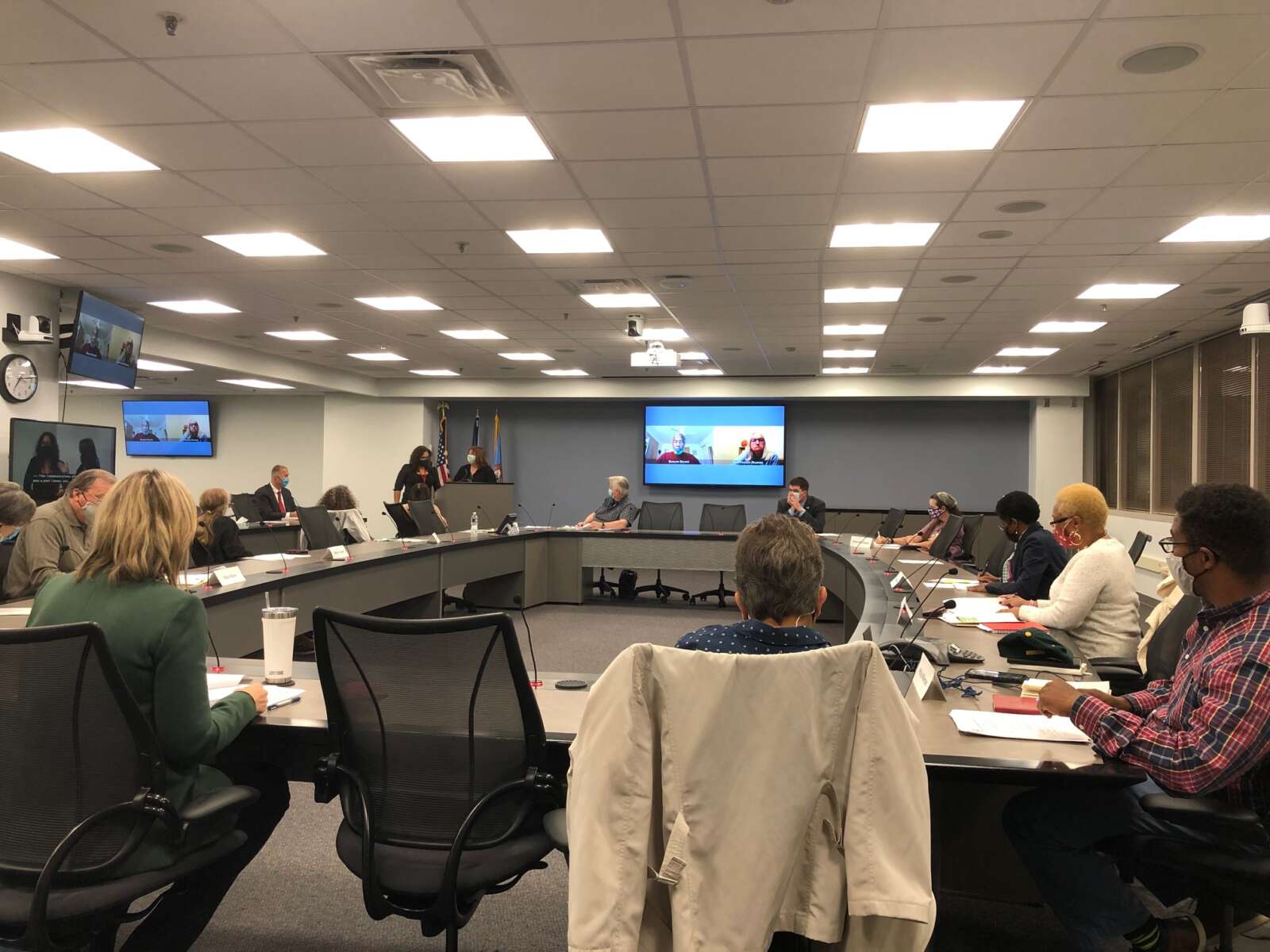
That was evident in the most recent meeting of Fairfax County’s Confederate Names Task Force, which has been charged with determining whether the county should rename Lee and Lee-Jackson Memorial highways.
“We have a nice taste of different people from different parts of Fairfax that want to weigh in,” task force chair Evelyn Spain said. “We value all of their opinions on whether this end result comes to change the name or not change the name of Fairfax streets.”
The two-hour meeting at the Fairfax County Government Center on Monday (Oct. 18) followed the launch of a community survey last week. Postcards advertising the survey are expected to roll out to residents across the county starting this weekend.
Also accepting public comments by email, phone, mail, and at four upcoming listening sessions, the task force will use the input to inform its recommendation to the Fairfax County Board of Supervisors.
“I don’t want people to be back here in 30 years because we made a wrong decision,” one member said.
The Financial Cost of Changing the Names
Changing the names of both highways could cost Fairfax County anywhere from $1 million to $4 million, Fairfax County Department of Transportation Director Tom Biesiadny told the task force.
According to FCDOT, there are 171 Lee Highway signs along the county’s 14.1-mile stretch of Route 29 and 55 Lee-Jackson Memorial Highway signs on 8.4 miles of Route 50.
The cost varies depending on each kind of sign, particularly ones on traffic light mast arms or other overhead structures. If a new street name is longer than the existing one, replacing the signs will require more work due to the added weight, Biesiadny explained.
“What we’re going to replace it with does matter,” he said.
Biesiadny also reported that, based on estimates from neighboring localities that have adopted new highway names, a name change would cost businesses about $500 each to update their address on signs, stationary, and legal documents, among other possible expenses.
Other jurisdictions are looking at providing grants to cover businesses’ costs, according to Biesiadny, who noted that the county would need to conduct a survey of businesses to get a more precise estimate.
What’s in a (Street) Name?
For the task force, however, the question of whether to rename the highways hinges less on money than on what the names say about a community’s values and identity.
In a facilitator-led discussion on street name criteria, several members cited inclusivity and reflecting Fairfax County’s increasingly diverse population as key concerns.
“There’s no reason that we need to keep telling these same limited truths,” Bunyan Bryant from Mason District said. “…We’re not bound forever and ever to that. Yes, there is this history some are wedded to, but that doesn’t represent us today.”
Some task force members said tying street names to history helps create a sense of place, even if that history is less-than-inspiring.
Ed Wenzel, one of four Springfield District representatives, noted that Lee-Jackson Memorial Highway was used by troops during the Civil War, which he said “had a tremendous impact” on Fairfax County.
“Gallows Road is grisly history, but I don’t think anyone would ask to change that name,” Braddock District member Robert Floyd said, citing the common but unproven impression that the street running from Tysons to Annandale once led to a gallows or hanging tree.
Others argued that Fairfax County has overly fixated on the Civil War at the expense of other people and events from its past, noting that the county has many historical sites commemorating that era, such as Ox Hill Battlefield Park.
“Remembering and learning about history is different from glorifying history,” said Dranesville District member Barbara Glakas, a member of the Herndon Historical Society. “I think we need to look at who we’ve been glorifying.”
Should the task force recommend changing the names in its report to the county board in December, a couple of members suggested eschewing people as namesakes, given the potential for controversy.
When asked, Biesiadny confirmed that simply calling the highways Route 29 and Route 50 is an option, pointing to Chesterfield County as an example.
In that case, the local board of supervisors approved Route 1 as the name for its segment of Jefferson Davis Highway in June, seemingly to avoid the moniker defaulting to Emancipation Highway as mandated by the Virginia General Assembly.
School-based COVID-19 vaccination clinics for elementary school-aged children could be set up as soon as mid-November, Fairfax County Public Schools officials say.
As reported to the Fairfax County School Board at a work session yesterday (Tuesday), these targeted vaccination clinics will be available in evenings or weekends and have a parent or guardian present.
FCPS is also working with the Fairfax County Health Department to provide vaccination clinics during the school day that would require advance parental consent for students to participate. Those clinics are expected to be available after winter break, officials said.
With COVID-19 vaccine eligibility potentially expanding to children aged 5-11 in early November, FCPS is currently developing plans for providing testing and vaccinations to students.
Most families who responded to an FCPS survey of their vaccination plans intend to get the vaccine for their young children, according to results that school officials shared with the school board.
Of the 85,302 surveys sent to parents and guardians of children who will be in the 5-11 age range on Nov. 1, 35,801 (36%) were returned with responses. The survey was designed to determine what supports, if any, families need to access vaccinations for their children.
Survey results indicated that 76% of parents or guardians plan to get the COVID-19 vaccine for their child, with 80% of that group planning to do so as soon as it’s available. 12% of those surveyed are undecided, and 10% do not plan to get their child vaccinated.
According to Superintendent Scott Brabrand, “common reasons” cited for not getting vaccinated include “personal beliefs” regarding vaccinations, followed by the vaccines’ emergency-use authorization status. So far, federal health officials have only officially approved the Pfizer vaccine for individuals 16 and older.
The survey also revealed an even split on the challenges of obtaining a vaccination appointment, with 45% indicating that wait times have been a challenge and 44% indicating there were no challenges.
49% of those surveyed would not let their child get vaccinated during the school day without a parent or guardian present, while 35% would consider that possibility.
FCPS Department of Special Services Assistant Superintendent Michelle Boyd emphasized that, on top of the information provided by the surveys, officials will look at data on community transmission, vaccination rates, and other factors to guide their plans.
“We’re also using that health data to inform what might be the best locations and also taking into consideration what local vaccination opportunities are available in close proximity so that we can make sure that we’re building those bridges for folks who don’t have readily available resources that are within accessible distance,” Boyd said.
While FCPS has not mandated COVID-19 vaccinations for students, except those involved in athletics and some other extracurricular activities, school officials have strongly encouraged them for those who are eligible and are developing a plan for providing testing and vaccinations.
In addition to the school-based clinics, vaccinations will be made available through mass vaccine sites at the Government Center, South County Government Center, and Tysons Community Vaccination Center.
FCPS says it will provide transportation support for families to mass vaccination clinics, along with supervision and emotional support for students at clinics that take place during the school day.
Inova will provide pediatric vaccination clinics at the Inova Center for Personalized Health and Inova Cares Clinic for Children & Families. The nonprofit health system will also have informational packets and videos on vaccination available for families in multiple languages.
COVID-19 vaccinations for children are also expected to be available at many community sites, including medical homes, local pharmacies, and local health department offices. 80% of the 20 practices that the Virginia Chapter of the American Academy of Pediatrics identified in the county as serving children plan to vaccinate in some capacity, according to FCPS.
FCPS will also offer optional screening testing starting next month to “promptly identify and isolate cases and quarantine those who may have been exposed to COVID-19 who are not fully vaccinated,” according to Boyd.
The optional screening testing for students who aren’t fully vaccinated will start with elementary students during the week of Nov. 8 before rolling out to middle and high school students the week of Nov. 15.
FCPS has partnered with third-party vendor Longview International Technology Solutions (LTS) to conduct the screenings.
All student testing will require parental consent. Parents and guardians will receive a link to register their child for testing, if they wish to do so.
While participation is optional for most students, it will be required for student athletes who are not fully vaccinated beginning the week of Nov. 1. Student athletes aged 12 to 15 will be tested every week, as will all student athletes 16 and older with a medical or religious waiver.
If a student athlete that is not fully vaccinated fails to participate in a weekly screening testing, they will be ineligible for participation in future activities until they provide a negative test result.
FCPS confirmed that its vaccination mandate for employees will take effect on Nov. 1. Staff that have not provided documentation of being fully vaccinated by then will be tested weekly.
According to a survey of FCPS staff, 97% of respondents said they are fully vaccinated. 92% of contracted employees responded to the survey. Those who have not responded will be included in the weekly testing, alongside those who are not fully vaccinated.
Brabrand said FCPS will continue to follow its 14-day quarantine guidance at this time, but will revisit the quarantine length in consultation with public health experts after a vaccine becomes available for children ages 5-11.
“Our plan to ensure the continuity of safe in-person learning is working, and it is my intention and that of our leadership team, working with our health partners, to continue to follow our public health guidance,” Brabrand said.
For the first time in decades, Fairfax County workers have collective bargaining powers.
The county Board of Supervisors passed an ordinance 9-1 yesterday (Tuesday) allowing unions to negotiate for pay, benefits, working conditions, scheduling, and more. The lone opposing vote came from Springfield District Supervisor Pat Herrity.
Providence District Supervisor Dalia Palchik called it a historic day, marking the first time in 44 years that collective bargaining is allowed for county government workers.
Collective bargaining will improve the county’s ability to retain employees and result in better services for the community, Chairman Jeff McKay said after the vote.
If you care about the services that FFX provides, including health, fire, police, libraries, parks, transit, & human services, you have a stake in collective bargaining. CB will improve our employee retention& make our services better. I was proud to vote to adopt this ordinance.
— Jeff McKay (@JeffreyCMcKay) October 19, 2021
“Approving this ordinance allows us to go to the next step to work on and establish a collective bargaining agreement, something that I know our employees have been asking for for a very long time,” McKay said.
Virginia had banned collective bargaining for government workers since the state Supreme Court ruled against the practice in 1977.
That changed last year when the General Assembly passed legislation giving local governments the option to create ordinances recognizing their employees’ labor unions and allowing collective bargaining for public workers.
The ordinance doesn’t affect the county’s 24,000-plus public school employees. The school board would have to adopt its own collective bargaining ordinance for Fairfax County Public Schools. But the ordinance could act as a model for other local governments and the county’s school board.
The new state law and Fairfax County’s ordinance still restrict workers’ ability to strike. If government employees do so, they will be fired and prohibited from working for a governmental body in Virginia for one year.
In response to the state law, Fairfax County created a collective bargaining workgroup on Sept. 29, 2020 that included elected officials, employee group representatives, and county government and school staff.
The board’s personnel committee received its first draft of the ordinance on May 25 and spent the summer working to refine it. The board held a public hearing on Oct. 5 but deferred a vote on the matter to its next regular meeting.
David Broder, president of SEIU Virginia 512, which represents over 2,000 Fairfax County general government workers, celebrated the vote as a historic victory achieved after years of advocacy.
The door to a Fairfax that works for everyone opens wider tonight as workers win a real seat at the bargaining table. We’re going to keep fighting, throw that door wide open, and ensure that every Virginian has the right to join a union and collectively bargain (2/6)
— David Broder (@Broder512) October 19, 2021
“Our union is thrilled to usher in a new era where employees and management collaborate to solve workplace issues, where workers have a real voice to improve their pay, benefits, and working conditions, and where every constituent in this community gets the quality public services we all deserve,” Tammie Wondong, president of SEIU Virginia 512’s Fairfax chapter, said in a statement. “Together, and with meaningful collective bargaining rights, we will transform Fairfax into a place where every working family can thrive.”
Other unions for groups ranging from firefighters and police to public works employees had advocated changes to the ordinance, including at this month’s public hearing.
Since then, the county made several changes to the proposed ordinance, such as having a labor relations administrator who assists with certifying elections and other matters be nominated by unions with 300 or more dues-paying members.
The administrator will be appointed by the county executive and confirmed by the Board of Supervisors.
The approved ordinance also extends collective bargaining abilities to more temporary employees than previously proposed. Rather than issuing a blanket exclusion, the ordinance only bans workers from participating if they’re employed by the county for four consecutive months or less.
In a move to appease unions, the ordinance will also allow employees to use county electronic systems to communicate employee organizing activities and other matters.
Another revision clarifies that the county would “at all times retain exclusive rights to establish the County budget and any tax levies,” where changes are in the sole and unfettered discretion of the board of supervisors.
But David Lyons, executive director of the Fairfax Workers Coalition, said his group remains dissatisfied with the final ordinance.
“None of the substantive changes we requested were addressed,” he said. “The bargaining units still are tilted towards wealthier white employees.”
In a letter to the board, Lyons argued that the changes to the ordinance, which he said were made last minute from Friday (Oct. 15) through Tuesday, “severely erode the labor/management relationship.”
Herrity argued in a statement after the vote that the ordinance is “particularly bad and will limit the ability of the County to provide quality, flexible, cost-effective service to our residents.”
He also alleged that influential unions wrote the ordinance in back rooms, a sentiment echoed by Lyons, who suggested that “corporate” unions and one unnamed large group unfairly influenced the process.
McKay dismissed those sentiments, saying his staff welcomes communication from all and detailing how the process lasted over a year with numerous meetings to gather input, from employee town halls to sessions with labor group representatives and stakeholders.
Photo via Machvee/Flickr
Fairfax County’s late summer, Delta variant-fueled surge in COVID-19 cases may have plateaued with fall’s arrival, but an uptick in deaths over the past week suggests the full toll of the pandemic’s most recent wave is only just starting to emerge.
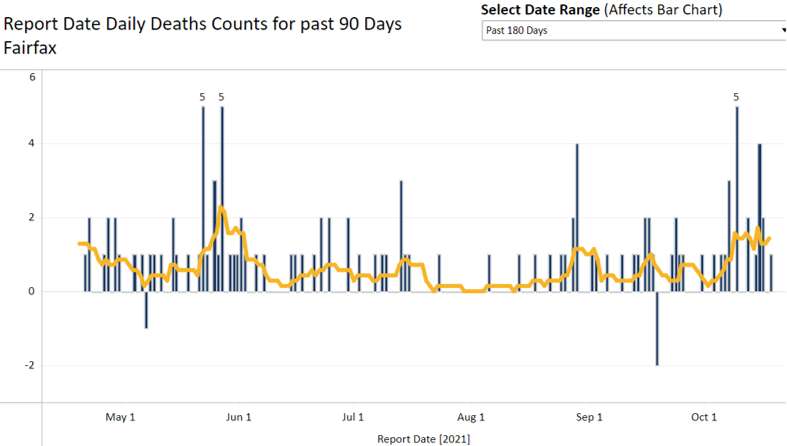
The county has reported 10 deaths from the coronavirus in the past seven days, including one person who died today (Monday), according to Virginia Department of Health data.
The Fairfax County Health Department said it can’t confirm whether that person was former Secretary of State Colin Powell, who died of complications from COVID-19 this morning. The first Black chairman of the Joint Chiefs of Staff, Powell lived in Fairfax County but was hospitalized at Walter Reed National Military Medical Center in Bethesda at the time of his death.
“Dashboard data is dependent upon several variables, including when report of covid death is logged in state system by an investigator,” an FCHD spokesperson said by email.
The Fairfax Health District, which includes the cities of Fairfax and Falls Church, has now seen 1,201 people die from COVID-19.
Fairfax County is averaging 1.4 deaths per day for the past week. The weekly average has exceeded one death per day since Oct. 9, when five new fatalities were reported — the longest such stretch since the end of May.
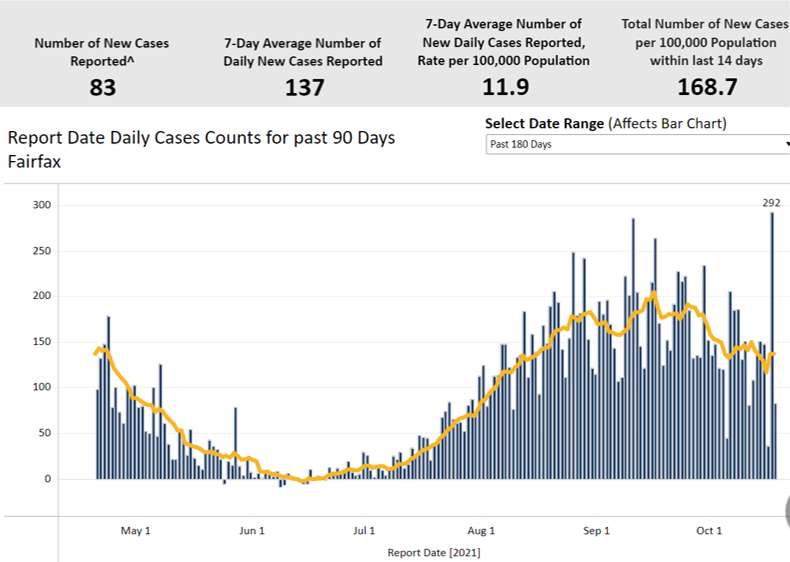
In terms of overall cases, though, the county continues to see a decline from the Delta variant’s peak on Sept. 16, when it was averaging 204.6 new cases a day. With 83 cases added today, the county has reported a total of 91,980 cases and 4,349 hospitalizations.
The current seven-day average of 136.7 cases is skewed slightly by an influx of 292 new cases recorded yesterday (Sunday). That’s the highest single-day total since 397 cases came in on Feb. 13, but the Fairfax County Health Department confirmed to FFXnow that the sudden jump is the result of a reporting backlog, rather than an increase in infections.
With the new school year now well underway, VDH launched a new dashboard today with data on COVID-19 cases, hospitalizations, and deaths among children under 18 years of age, citing a rise in infections within that age group since the end of summer.
According to the dashboard, which will be updated every Friday, the Fairfax Health District reported the most COVID-19 cases among children in the Commonwealth between July 21 and Oct. 9 with 3,324 cases — a rate of 1,203 cases per 100,000 children. The only district with a lower case rate is Arlington.
Seven children have been hospitalized by the coronavirus in that time frame, and one died.
Virginia has seen 127,997 COVID-19 cases, 380 hospitalizations, and nine deaths among children since March 2020, according to VDH, which reiterated the importance of vaccinations in its news release.
“While children under 12 years are not yet eligible to receive the COVID-19 vaccine, VDH recommends that everyone 12 years and older be fully vaccinated to help protect against COVID-19,” the department said. “Widespread vaccination of eligible Virginians can protect all children, especially those who are still too young to be vaccinated.”
In the Fairfax Health District, 820,987 people — or 69.4% of the population — have gotten at least one vaccine dose, including 82% of people 18 and older and 84.5% of people aged 12-17. 751,471 people — 75.3% of adults and 63.5% of all residents — are fully vaccinated.
The Pfizer-BioNTech vaccine could potentially become available to children younger than 12 next month, with a Food and Drug Administration panel scheduled to consider authorizing the shots on Oct. 26.
While not expected to issue a recommendation until early November, the Centers for Disease Control and Prevention gave states guidance last week for how to expand their vaccination programs, and state health officials can start placing advance supply orders this Wednesday (Oct. 20).
Photo via CDC/Unsplash
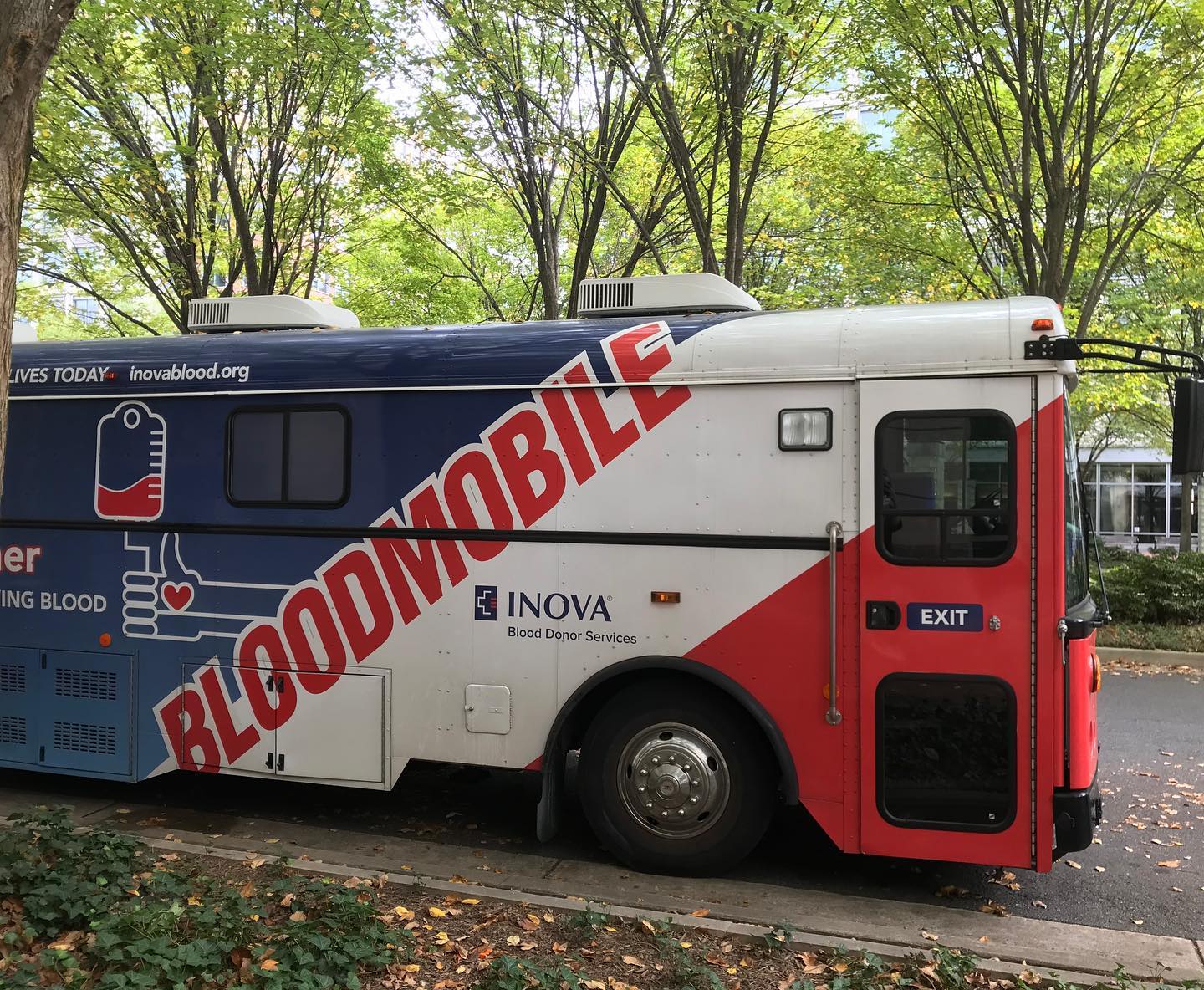
Local blood supplies have reached critically low levels, creating a potential crisis with hospitals operating at maximum capacity, Inova Health Systems reports.
The dangers of this imbalance between supply and demand became painfully clear last week, when the nonprofit health care system drained its Type B supplies and had to switch to Type O blood in order to stabilize one patient, according to an Inova spokesperson, who described the current need for blood donors as “urgent.”
The patient suffered significant blood loss that triggered a massive transfusion protocol (MTP), requiring medical workers to literally run units of blood, plasma, and platelets from a blood bank to the emergency room, explains Heather Wade, the donor recruitment manager for Inova Blood Donor Services.
“As clinicians, we strive to provide patients with their blood type,” Wade said. “It’s a matter of overall safety, but when that supply has been diminished, we then need to revert to caring for the patient with Type O blood product.”
Inova is seeking donors of all blood types, but it is especially in need of Type B and O blood.
As of Thursday (Oct. 14), Inova was completely out of both B-negative and AB-negative blood, with just 10 of the 90 B-positive units needed in stock, according to its red blood cell inventory.
Supplies are low in part because Type B blood is rare, comprising only about 10% of the U.S. population, according to the American Red Cross.
Type O blood is particularly valuable, because O-negative can be used for all patients. O-positive blood can help about 84% of patients and is carried by Fairfax, Arlington, and Loudoun county emergency responders for on-site transfusions, Wade says.
Inova currently has just 46 available units of O-positive blood and 68 units of O-negative blood.

Wade says Inova needs about 200 blood donations per day to maintain a sufficient, stable inventory to support the 4.5 million people it serves in Northern Virginia, Maryland, and D.C..
“The actual donation takes 15 minutes, and it can save three lives in our community,” Wade said. “Whether you donated in Sterling and the patient’s in Alexandria, Virginia, you’re helping someone in our Northern Virginia area.”
Low blood supplies have been a challenge nationwide throughout the COVID-19 pandemic, with the Red Cross reporting in March 2020 that it lost roughly 46,000 donations due to a surge in blood drive cancellations.
The shortage prompted the Food and Drug Administration to ease its restrictions on donations from men who have sex with men (MSM), though advocates and some elected officials have challenged the continued existence of any restrictions as discriminatory.
“Inova supports lifting the federal restrictions on MSM blood donation,” spokesperson Tracy Connell said.
A year and a half later, the situation has seen little improvement. The Red Cross said on Sept. 27 that donor turnout levels hit a low for 2021, dropping the nonprofit’s blood supply to its lowest point for this time of the year since 2015.
According to Wade, Inova actually saw a “significant increase in engagement” from new and recurring donors after putting out alerts about the need for blood in the initial days of the pandemic, but donations subsequently declined. Supplies have now been at critically low levels since March.
By contrast, demand for blood has gone up as hospitals report an influx of patients even outside of coronavirus cases, a trend that led Inova to temporarily close some of its urgent care centers.
A census of Northern Virginia hospitals found that 90 to 100% of all beds for in-patient care have been filled, Wade says.
“Some people opted to delay treatment because of the pandemic, and the consequences have been that their treatment, which could’ve probably been less significant early on in the pandemic, has become more aggressive,” she said.
For those interested in donating, Inova has three brick-and-mortar donor centers in Centreville, Annandale, and Sterling, along with bloodmobiles that travel throughout the region. Community organizations can also volunteer to host blood drives.
Inova Blood Donor Services announced last week that it will have blood drives at four Fairfax County high schools this fall: Edison, Woodson, McLean, and Robinson Secondary.
Wade notes that Inova continues to implement disinfecting practices in line with FDA and Centers for Disease Control guidelines. Blood drive workers have also always used sterile, single-use supplies, and masks are still required for both employees and donors.
“If we’re not safe and they’re not safe, then how can we make sure that every patient that needs a blood transfusion [is safe]?” Wade said. “We have to make sure that it’s safe…It’s imperative to the health and well-being of our community.”
Photo via Inova Blood Donor Services/Facebook
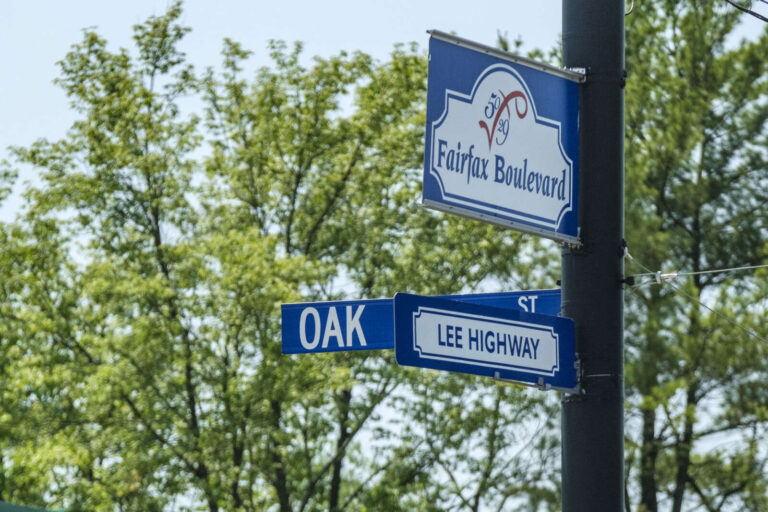
For anyone who feels strongly about whether or not Lee Highway and Lee-Jackson Memorial Highway should continue to bear those names, the time to share that opinion has arrived.
The Fairfax County Confederate Names Task Force launched a survey yesterday (Thursday), kicking off the community engagement phase of its review of whether to rename the highways.
Open until Nov. 12, the survey is available in English, Spanish, Arabic, Farsi, Korean, and Vietnamese. Chinese and Urdu versions will be coming soon, and print copies will be available at county libraries and district supervisor offices starting next Wednesday (Oct. 20), according to the task force’s website.
According to the news release, the task force will send out a countywide mailer to all residents later this month encouraging them to weigh in on the issue, and four public meetings — three in person, one virtual — have been scheduled through early November:
- Thursday, Oct. 28: Providence Community Center, 3001 Vaden Drive, Fairfax, 7-8:30 p.m.
- Saturday, Oct. 30: Fairfax County Government Center, 12000 Government Center Parkway, 10-11:30 a.m.
- Monday, Nov. 1: via WebEx, 7-8:30 p.m.
- Thursday, Nov. 4: Sully District Governmental Center, 4900 Stonecroft Boulevard, Chantilly, 7-8:30 p.m.
Comments can also be sent to the task force by email, phone (703-877-5600), and regular mail (Fairfax County Department of Transportation, 4050 Legato Road, Suite 400, Fairfax, VA 22033).
“Symbols matter and we want our community to feel welcome and reflect our values,” Fairfax County Board of Supervisors Chairman Jeff McKay said. “Community feedback is a key part of the renaming of Lee and Lee Jackson Memorial Highways process and will determine our next steps forward. There are multiple ways to offer feedback including a survey and community listening sessions. I encourage everyone who can to join the discussion.”
The Board of Supervisors appointed the 30-member task force in July after getting a report from the county’s history commission that identified more than 26,000 streets and other local landmarks bearing names associated with the Confederacy.
The Fairfax County History Commission narrowed its inventory down to 150 sites named after well-known Confederate figures, with Lee and Lee-Jackson highways among the most prominent.
The county’s portion of Route 29 spans 14.11 miles from Centreville to Falls Church and was named after Confederate general Robert E. Lee in 1919, according to the task force. Lee and fellow general Stonewall Jackson became the namesakes for the 8.43-mile stretch of Route 50 from Loudoun County to the City of Fairfax in 1922.
While those monikers have stuck for around a century now, nationwide efforts to remove names linked to the Confederacy or slavery from public places have gained momentum in recent years. Fairfax County Public Schools alone has renamed three buildings in the past four years.
Neighboring Arlington County renamed its section of Route 29 this past summer, replacing Lee’s name with that of abolitionist John M. Langston, Virginia’s first Congressional representative of color.
Expected to present a recommendation on whether to rename the roadways to the Board of Supervisors in December, the Confederate Names Task Force has been meeting on a regular basis since Aug. 16. The agenda for its upcoming meeting on Monday (Oct. 18) includes a staff briefing on the cost implications of a name change and a discussion of criteria for street names.
If the task force recommends changing the names, it will then offer up to five possible new names for each road, and after holding a public hearing, the Board of Supervisors will vote on the recommendation, potentially early next year. The name changes would then have to get state approval and go through the county budget process to cover the costs.

Fairfax County officials have a simple message for anyone who spots a spotted lanternfly: kill it immediately.
Native to China, the invasive insect can spread far and wide through its egg masses, making its way to Fairfax County via a recent shipment to a grocery store in Annandale. Loudoun County has also confirmed multiple sightings, but its presence has not reached the level of an infestation — yet.
“This is a relatively new pest in the area and the county is concerned about the potential impact this pest may pose,” Joan Allen, chief of the county’s forest pest management branch, told FFXnow.
Allen says that while the county has not found evidence of an infestation, the county has received several reports of a hitchhiker spotted lanternfly.
The insect can cause serious damage to home and commercial gardens, according to county officials. It thrives on more than 70 plant species, including grapes, apples, stone fruits, and tree-of-heaven. Officials say the state’s peach, apple, grape, and wine industries are most threatened by the insect.
The spotted lanternfly releases a sticky substance called honeydew that attracts wasps and ants. This substance can also encourage mold to grow on plants and trees, which can cover leaves, stunt plant growth, and ruin crops.
Although the insect has been in Virginia since 2018, its recent emergence has prompted the city of Winchester and Frederick, Clarke, and Warren counties to institute a spotted lanternfly quarantine. This effort is intended to slow its spread to un-infested areas of the state.
Businesses must receive a state permit and inspect articles to ensure that they do not contain any life stage of the spotted lanternfly, according to Fairfax County. This quarantine has been in effect since May 2019.
The insect has different colors during four different nymph stages. The county offers the following description of the insect’s changing appearance.
There are black and white nymphs; red, black and white nymphs; and adults. Adult lanternflies have gray-brown forewings, a black head and black spots. When at rest the hind wings, which are crimson in color, can be partially seen through the semi-translucent forewings, which gives the lanternfly a reddish cast. The lanternfly’s abdomen is yellow with black and white bands on the tip and bottom.
October is egg-laying season for most of the insects. Egg masses are typically covered with a light gray wax that looks like mud when it dries.
From this month through July, the county encourages residents to scrape egg masses from trees and trunks with adhesive bands. Scrapings should be discarded in containers of rubbing alcohol or hand sanitizer. Stump treatments, hack and squirt treatments, foliar sprays, and basal bark sprays can help during the other parts of the year.
For now, any spotted lanternfly should be killed immediately.
The first spotted lanternflies in the United States were found in Pennsylvania in 2014, according to the National Capital Partnership for Regional Invasive Species Management.
Four years later, Virginia officials documented the state’s first lanternflies infestation in Winchester. A quarantine was enacted by the Virginia Department of Agriculture and Consumer Services to slow the spread of the infestation.
Photo via Magi Kern/Unsplash
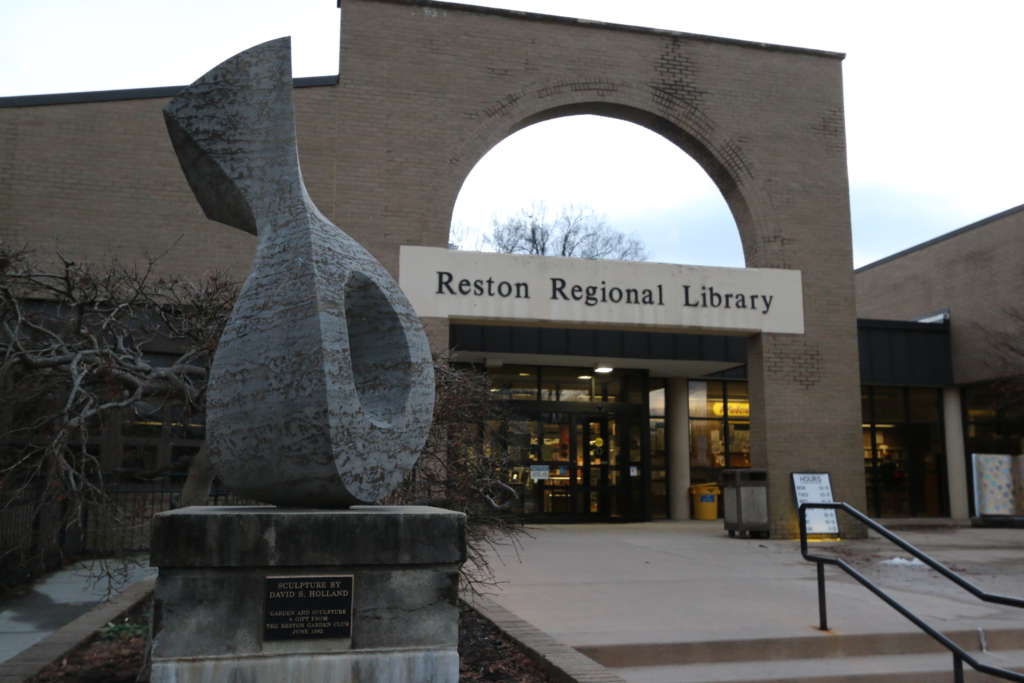
After a slight delay, Fairfax County Public Library has come to the same realization as dozens of other library systems in the D.C. area and across the country: that fining patrons for overdue materials doesn’t work.
The library’s Board of Trustees got informal but clear support from the Fairfax County Board of Supervisors at a joint meeting yesterday (Tuesday) to stop FCPL’s practice of charging late fees for unreturned books, DVDs, and other resources.
The trustees must still officially vote to eliminate library fines, but if that happens in November or December as anticipated, the new fine-free policy will take effect on Jan. 1, 2022, FCPL Director Jessica Hudson told the Board of Supervisors, noting that people will still be expected to pay back the cost of lost or damaged items.
“I have not heard anyone on this board that doesn’t wholeheartedly support [the fine-free strategy],” Board of Supervisors Chairman Jeff McKay said. “So, [I] look forward to the library board moving forward with that, and being able to accomplish that would be, I think, a big win for all our users.”
Fines Affect Library Access
Inspired by the One Fairfax policy, which commits the county to considering racial and social equity in its policies and decision-making, the FCPL Board of Trustees started exploring the idea of eliminating fines with the creation of an ad hoc committee in April.
Tasked with reviewing trends and determining the effectiveness of fines, the committee found that fines are not only futile at incentivizing the timely return of materials, but instead, actually discourage people from returning overdue items and utilizing library services.
“If you have a book checked out, and it’s a month late, and you know that you’ve got fines accrued on it, it doesn’t really make you want to run into the library and quickly turn it in and pay your fine,” Hudson said. “Instead, it acts as a punitive measure that ensures that some members of our population are never going to come back to the library.”
The committee recommended that FCPL eliminate fines at a Board of Trustees meeting on July 14, citing the policy’s ineffectiveness, its disproportionate impact on youth and low-income communities, and declining revenue from fines in a statement that the board accepted on Sept. 8.
According to the committee, 17% of the approximately 420,000 library cardholders that FCPL had prior to the pandemic — including 23% of cardholders younger than 18 — had their cards blocked because their accounts carried more than $15 in outstanding fines.
The number of blocked cards correlated closely with neighborhood income, with low-income areas served by the Reston, City of Fairfax, George Mason, Kingstowne, and Sherwood regional libraries having particularly high rates, according to Hudson.
The committee also reported that the revenue FCPL gets from fines, which goes into the county’s general fund, has been decreasing throughout the past decade, dropping from $1.3 million in fiscal year 2010 to just $127,067 in FY 2021.
“Is the effort of collecting those dollars really worth all of the negative impact that’s associated with it?” Hudson said, attributing the decline to the introduction of auto-renewals and an increase in usage of electronic materials that don’t accrue fines.
Better Late Than Never
Assuming the policy change is approved, Fairfax County will be the last jurisdiction in the D.C. region to end the use of library fines, a trend that started with Loudoun County in 2019 and continued most recently the City of Alexandria and Prince William County on July 1.
However, FCPL got some practice in going fine-free last year, when the COVID-19 pandemic closed all 22 branches, prompting the system to suspend fine collections for overdue materials from March through August.
Even before the pandemic, FCPL had implemented initiatives intended to make it easier for people to pay off their fines, partnering with the nonprofit Food for Others on a “Food for Fines” program in 2018 and introducing a “Read Away Your Fines” program in 2019.
It also joined forces with Fairfax County Public Schools on the fine-free Library Equity Access Pass program, which lets all students access public libraries without a library card. The program was piloted at one branch in 2019 before going countywide in October 2020.
The benefits of fully eliminating fines could be realized immediately, according to Sujatha Hampton, who represents Dranesville District on the trustees board and chaired the ad hoc fine review committee.
She noted that other library systems have seen spikes in returns after suspending the use of fines, including one case in San Francisco where a man returned a book that had been overdue for 100 years.
“The lifting of fines is associated with the return of the books,” Hampton said. “So, we could imagine that just putting this in place and strongly advertising it would bring back a flood of books that have been out.”

Fairfax County officials are undertaking a comprehensive review of off-street parking for the first time since the late 1980s.
Conducted by a consultant, the county’s Parking Reimagined project will kick off a community engagement process this month for the public to weigh in on how it could update its approach to parking, such as by revising parking rates or reassessing land-use requirements.
County staff presented their efforts to assess off-street parking yesterday (Tuesday) during a joint meeting between the Board of Supervisors and Planning Commission. The project is expected to last 12-18 months.
“One of the critical elements of this project is community engagement,” said Michael Davis, a county staffer and parking lead. “Our community outreach is intended to encompass all the different areas of the county in the sense of business owners, renters, residents, religious assembly leaders, nonprofits, because parking has an effect on all of these in some form or fashion.”
A white paper on the project notes the “engagement process will be ongoing and interactive with the community as we gain more knowledge of the parking needs…and propose changes to the requirements.”
Options to include the public may include community and town hall meetings, video presentations, surveys and more. Public hearings on proposed changes could occur in late 2022 into early 2023.
Two county departments are part of the project: Fairfax County Land Development Services, which deals with how property construction codes and regulations, and the Department of Land Development, which provides proposals, advice and assistance on land use, development review and zoning issues to decision-makers.
To assist with the review, the county hired Clarion-Nelson\Nygaard, a partnership of two land use and transportation consulting firms, this past spring.
The white paper says equity, affordability, land use, environmental, and economic concerns will all be considered as part of the study.
“Society has changed,” Mason District Supervisor Penny Gross said during the meeting, noting that residents of one townhouse community in Annandale built in 1972 are “screaming they have no place to park.”
Gross said the county needs to look at retrofitting existing townhouse communities to meet current parking needs.
Changes in technology, development, and people’s habits over the past few decades require a reevaluation of how spaces are used and where they’re actually needed. The white paper highlights the rise of electric and autonomous vehicles, ridesharing, remote work, and online retail among the trends that have affected parking needs.
On one end of the spectrum, limited parking spots can mean the difference between whether a business has enough spots and whether vehicles spill over onto nearby residential streets, Land Development Services director Bill Hicks said.
On the other, there are office parks and strip malls with lots that take up half a block but rarely host more than a handful of vehicles. Hunter Mill District Walter Alcorn called some parking situations in the county “bonkers.”
He also forecast that parking needs will continue to change over time, so county officials should examine the situation as it evolves over the coming years.
As the review of off-street parking gets underway, the county is also still considering potentially adding parking meters for certain on-street areas, particularly in Tysons and Reston. Proposals for that could be presented to the Board of Supervisors next year.
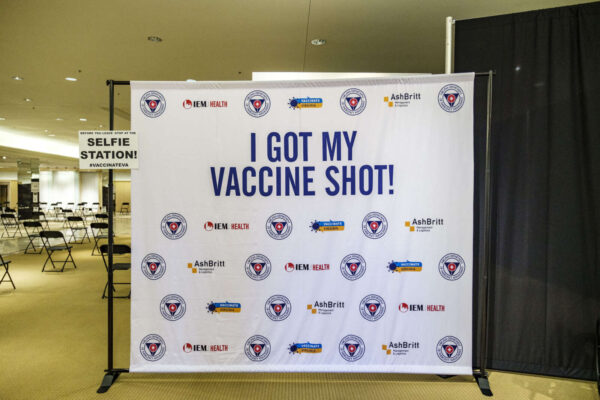
All Fairfax County government workers must now show proof of vaccination against COVID-19 or submit to weekly testing. The vast majority have chosen the former option, the county says.
As of yesterday (Monday), when the county’s policy took effect, 12,717 employees have been fully vaccinated, meaning it has been at least two weeks since they’ve received both doses of the two-shot Pfizer or Moderna vaccines or the one-shot Johnson & Johnson vaccine, according to county government spokesperson Tony Castrilli.
Another 320 employees are partially vaccinated, and the county is currently reviewing all 492 requests for a medical or religious exemption.
The Fairfax County Board of Supervisors directed staff to evaluate a possible COVID-19 vaccination requirement in July as part of the government’s return-to-office plan. The county confirmed that it would implement the mandate on Aug. 20.
The policy applies to all general county government employees. Fairfax County Public Schools has its own requirement that is expected to go in effect by the end of this month.
“Evidence shows that the COVID-19 vaccine continue to be safe and effective,” Chairman Jeff McKay said in a statement. “As a County, we have to do all we can to protect our community. I’m encouraged by our high vaccination rate among county staff and pleased that we’ve put additional measures in place to help keep our employees and community safe.”
McKay added that the county will keep working to increase vaccination rates among its employees as well as the general public.
The percentage of county employees who are fully vaccinated is currently in the mid-80s, though it “fluctuates daily” due to changes in the overall workforce, Castrilli says.
In comparison, 62.8% of Fairfax Health District residents, or 740,791 people, are fully vaccinated, including 74.2% of individuals 18 and older, according to the Fairfax County Health Department, which serves the cities of Fairfax and Falls Church as well as the county.
819,482 residents — 81.8% of adults and 69.2% of the total population — have gotten at least one vaccine dose.
The Virginia Department of Health reopened its mass vaccination site at Tysons Corner Center on Friday (Oct. 8) to accommodate potential demand for booster shots and the eventual rollout of the vaccine to children under 12, which could come after Halloween.

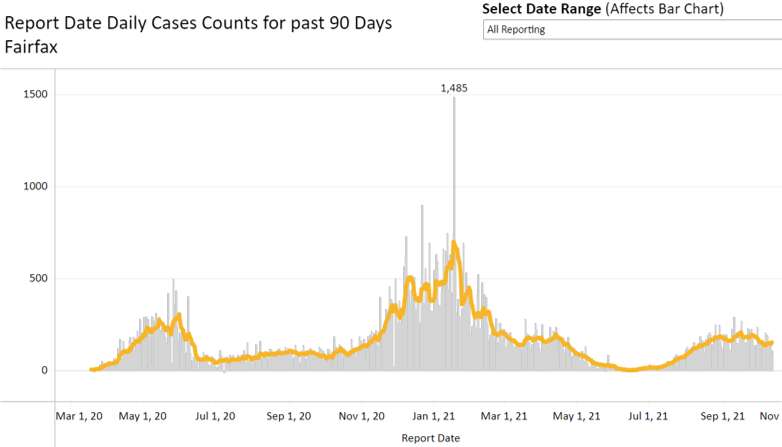
In the meantime, Fairfax County has seen its COVID-19 community spread dip back down to substantial for the past two weeks, reporting 86.5 new cases per 100,000 people and a 3.3% testing positivity rate for the week of Oct. 3-9.
That reflects a recent plateau in infections after the Delta variant pushed the county’s transmission levels to high at the end of August.
However, after getting just 44 new cases last Tuesday (Oct. 5) — the fewest since July 20 — the county’s seven-day average has started to climb back up, from 132.3 cases per day over the past week on Oct. 6 to 149.7 cases today, according to VDH data.
With a total of 128 new COVID-19 cases coming in today, the Fairfax Health District has now recorded 91,120 cases, 4,337 hospitalizations, and 1,193 deaths from the pandemic.
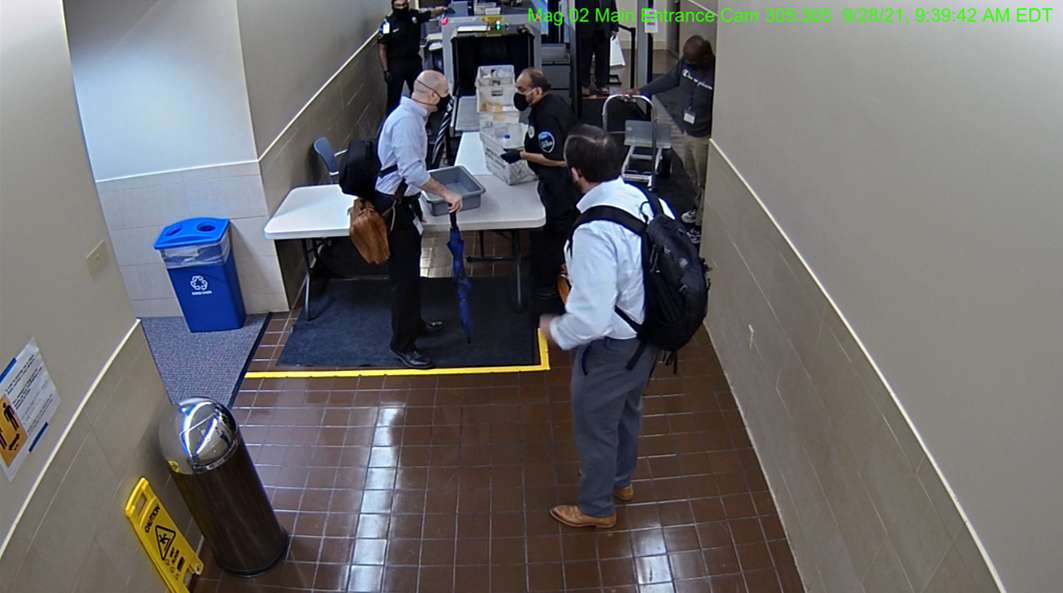
Video of an encounter between Fairfax County’s top prosecutor and security personnel at the county courthouse does not appear to be consistent with some of the allegations leveled in a Fairfax County Sheriff’s Office incident report.
The report claims Fairfax County Commonwealth’s Attorney Steve Descano and a colleague lost their tempers during a courthouse security screening. According to the Sept. 30 report, Descano and Chief Deputy Commonwealth Attorney Kyle Manikas questioned and cursed at security officers when directed to go through a metal detector upon entering the Fairfax County Courthouse at 9:37 a.m. on Sept. 28.
But the two main triggers that the report says prompted Descano and Manikas to display “disrespect” and “unprofessional conduct” toward the security guards are absent from the video, notes a courthouse source who has also seen the footage viewed by FFXnow.
The report states that, after seeing two law enforcement officers in full uniform bypass the checkpoint and being told by the security guards that uniformed law enforcement officers were exempt from the mandatory security screening, Descano responded by saying “That’s bullshit,” “Don’t you know who I am?”, and “I’m the top law enforcement officer in Fairfax County.”
While no audio was recorded, courthouse security camera footage provided by the sheriff’s office does not show any uniformed law enforcement officers coming into the building and passing the security checkpoint.
Around the time Descano arrives, a sheriff’s deputy and a uniformed man wearing a vest emblazoned with the logo for the security company Brink’s walk by the checkpoint, but they are leaving the courthouse, not entering.

The sheriff’s office report, which is signed by both a deputy and a supervisor, states that the two security guards gave statements and that facility security “provided a video to corroborate the visual part of the incident.”
“We do not have any comments about the report,” the sheriff’s office said when asked about the discrepancies between its incident report and the security camera video.
The report also says Manikas “was visibly upset about being screened and kept saying ‘This is f**king bulls**t.’”
According to the report, Manikas also became upset when told that the x-ray machine detected a knife in his lunch bag and that an additional search of the bag was needed, claiming that there was no knife in the bag.
After a security officer “rotated the screen of the x-ray around to show CDCA Kyle Manikas the image he was looking at,” the report claims the prosecutor stated, “This is f**king bulls**t, I know you are doing your job, but this is bulls**t.” A search of the bag revealed a butter knife.
In the video, however, when one of the security officers gestures that he needs to look through Manikas’s backpack, Manikas unzips the bag and opens what appears to be a lunch box without any visible hesitation. The officer doesn’t show Manikas a screen, and his side of the x-ray machine is inaccessible to visitors, blocked by the tables where people collect their belongings after getting screened.
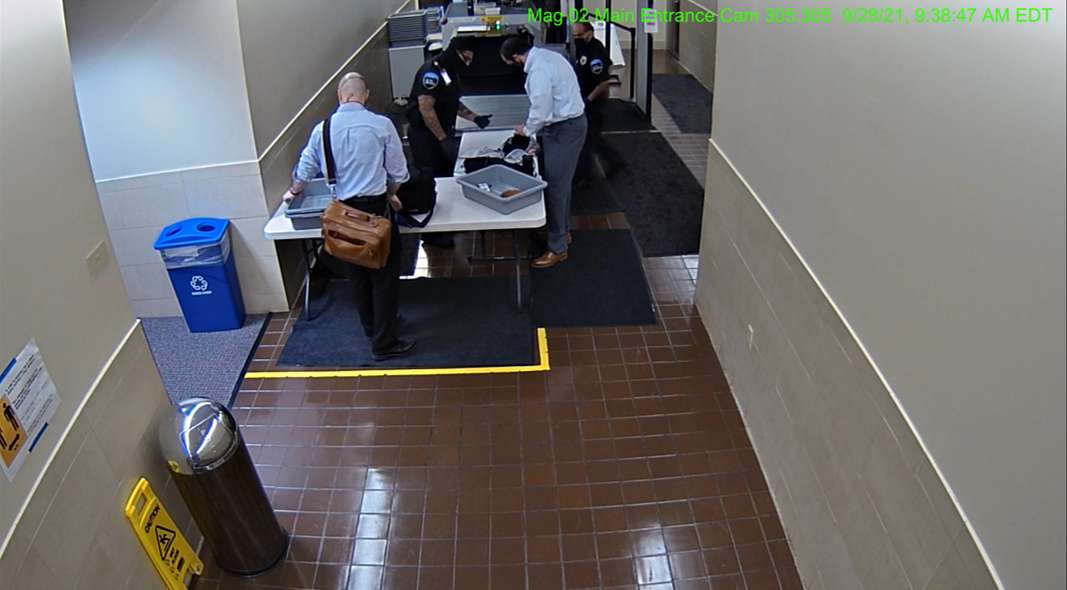
“As the full video reflects, the report paints an inconsistent picture of what actually occurred,” Benjamin Shnider, chief of staff for the Fairfax County Office of the Commonwealth’s Attorney, said in a statement to FFXnow.
Descano and Manikas were not available to comment directly.
The incident report circulated around conservative blogs and media before being reported by the Sun Gazette and FFXnow yesterday (Thursday).
Descano has become a target of conservatives since he was one of three Northern Virginia prosecutors elected in 2019 on criminal justice reform platforms, including pledges to stop prosecuting marijuana possession, end the use of cash-bail and the death penalty, and reduce mass incarceration.
Like his reform-minded counterparts in Arlington and Loudoun, Descano is currently facing a recall effort spearheaded by Virginians for Safe Communities, a group led by Republican operatives and funded by undisclosed donors.
A separate group called Stand Up Virginia launched its own recall campaign against Descano in April.
Both groups argue that his office has failed crime victims by declining to prosecute some misdemeanor cases and offering plea deals that some judges have criticized as inadequate.
