

Although the “short sessions” of the General Assembly held on the odd-numbered years are about two weeks less in length than the regular session in the even-numbered years because they do not consider a biennium budget, the fact is that the budget is adjusted at every session of the General Assembly.
Revenue projections that are made over a couple of years’ time frame almost always need to be adjusted. Revenues come over or under projections, necessitating corresponding changes to the budget. Recession-level declines like that in 2008 required severe budget reductions. The economic recovery has been slower than in the past, resulting in some tweaking being needed every year. The Commonwealth operates on a balanced budget with funds going into a rainy day fund when economic growth is strong, and the fund being used to smooth out declines from loss of revenue.
The House and Senate approved different versions of a revised budget for the next fiscal year without prolonged debate, which has been a part of these deliberations for many years. The governor presented a revised budget that brought the next year into balance and funded some high-priority items, upon which there was bipartisan agreement. Differences do remain that will be ironed out by a conference committee over the remaining weeks of the session.
Highlights of the budget include important new funding for mental health services. Although the needs in mental health have been recognized for a long time, it took advocates many years and the suicide of a senator’s son to finally get agreement on funding critically needed services. An important aspect of the new services will be to get mentally ill persons out of jails, where they have found themselves in recent years when they acted out and there was no other place for them to go.
State employees will finally be getting a raise after many years of waiting. The situation has become increasingly desperate with a high turnover rate. Teachers who are employed by local school boards will not be getting a direct appropriation for a raise from the state, but hopefully the modest increase to localities can be used in part to fund teacher pay raises that are likewise long overdue.
Although the action in the short session on the budget will get us through the next fiscal year, there are long-term structural issues that remain — particularly in funding education. While the division between state and local funding had historically been 60 to 40 percent, the actual division in recent years has been closer to 40 percent state and 60 percent local. The result has been that increasing costs have fallen on local property taxpayers.
Virginians like to brag about their low per capita state taxes at $2,275, 36th-lowest among the states. Sometimes overlooked is the fact that per capita local taxes in Virginia are $1,928, or 15th-highest among the states. We are going to balance the budget for the short run this session, but we need to do a lot more work about more fairly balancing the budget for the long term.
Most people can remember the flowchart from high school civics class that graphically showed how a bill becomes a law.
According to the chart, a legislator gets an idea for a bill that is drafted, introduced into one house of the Legislature where it is heard by a committee, sent to the floor for a vote if approved, and sent on to the other house for the same routine. Generally, that is what happens in the best of circumstances, but reality is much more complicated.
I can best make my point about what really happens in too many cases by reviewing the erratic course of a couple of bills in this session of the Virginia General Assembly that will not become law.
There is an increasing realization that many legislatures — including the General Assembly in Virginia — are not as responsive to public opinion as would be expected from democratically elected bodies, because of the way that legislative boundaries are drawn. An intense campaign by an organization named OneVirginia2021 has made many people aware that under the current system of having the Legislature drawing its own district boundaries, legislators are picking their voters rather than voters picking their representatives.
By comparing voting histories with census numbers, district boundaries can be drawn that are safe for incumbent legislators. The likelihood of incumbents being defeated is so slight that they go unchallenged. I have been working on this issue throughout my political career and once again introduced legislation to establish an independent legislative redistricting commission. My bill was sent to the Privileges and Elections Committee, where it was assigned to a subcommittee. The subcommittee allowed me and others with similar bills to make presentations with comments from the public.
A survey of my district indicates that about 80 percent of my constituents support a nonpartisan approach to drawing district lines. Other legislators introduced bills to accomplish the same result. My bill and all the others were swept together in one motion and defeated by a vote of four to one. On this important issue, four legislators made the decision for the entire 140 members of the General Assembly.
This is not an unusual situation. My bill that would have required universal background checks for gun purchases had the support of the governor and 90 percent of my constituents. It was sent to the Militia, Police and Public Safety Committee and then to a subcommittee of five legislators, four of whom have an A+ rating by the National Rifle Association. There was little surprise when my bill and all the other common-sense gun safety measures were defeated by a vote of four to one.
Under the Rules of the House, the Speaker of the House makes all committee assignments. Rather than a balance of points of views, the committee membership is stacked to reflect his position of the majority party. The Speaker also decides which committee will consider which bills. The rigged committee membership makes it easy to explain how a bill does not become a law in Virginia.
The 2017 session of the General Assembly, that got underway on Jan. 11, is barreling ahead toward its midpoint of Feb. 7.
At that midpoint, referred to as “crossover,” the House of Delegates and the State Senate must have completed action on bills that were introduced in their own chamber and start to work on bills from the other chamber. In order for a bill to become law, it must pass both houses exactly alike before being sent to the governor for his signature.
Already, about half of the bills that were introduced will have been defeated. See how your favorite bill is faring by going to http://lis.virginia.gov/lis.htm.
If the bill you felt most important to pass has been defeated, there really is no hope that it can be revived unless there was a companion bill that survived the other house of the Legislature. For bills you really oppose that passed their house of introduction, it is time to get to work lobbying members of the other house. Keep in mind that all the work of the Assembly for this annual session will be finished by about Feb. 24.
Some generalizations that can be made about the session to date, subject to shifting winds in the next few weeks, follow. There is a commitment to giving state employees a raise especially for State Police where turnover has become excessive with the low rate of pay. Providing the state share of funding for teachers who are local employees remains in doubt except that additional funding to schools is likely in a small amount. Funding for expanded mental health services that the Governor and a legislative study group recommended is likely. The need in this area is very serious.
The Republican majority that has a history of supporting less government but obtrusive laws into people’s private lives defeated an anti-LGBT bill much like the one that passed in North Carolina. The bill they passed last year was vetoed by the governor. There are bound to be more restrictive laws on women’s reproductive decisions passed, but Gov. McAuliffe has pledged to veto such bills. The appetite to expand access to guns seems insatiable. Numerous bills to expand access to concealed weapons and the defeat of bills that promote gun safety continues unabated. My bill to expand criminal background checks for all gun purchases was defeated in sub-committee.
Redrawing legislative district boundaries after the next federal census is of increasing concern to citizens who want voters picking their representatives not legislators picking their voters with most elections consisting of uncontested incumbents. My bill to establish a nonpartisan redistricting commission was defeated. A bill to define the process as being non-political may sound good, but it is unlikely to have any effect without the process being taken over by a truly non-partisan group.
Bills that are common sense to me and to most of the constituents with whom I talk like banning the use of cellphones while driving continue to fail in the Legislature. Much more to come after the half.
If you have a position on an issue before the Legislature, email me at [email protected].
—
Each year, I survey constituents on issues of concern to them and on issues that are likely to be considered by the General Assembly. Your views are important to me. Please take a few minutes to respond to the survey that can be found at www.kenplum.com.
Legislatures are about the serious work of governance even though they are often the brunt of jokes and criticism. For every seemingly weird bill that is introduced, there is a legislator representing a segment of his or her constituency. Delegate Bob Marshall is one of the better known members of the House for the anti-LGBT, anti-abortion and anti-marriage equality bills he introduces. He was first elected in 1992 and reelected every two years since then. Clearly, he is representing the point of view of a significant enough segment of his constituents to remain in office. Likewise, I believe I am representing my constituents in voting against his bills.
The diversity of Virginia is reflected in the representatives that are sent to the Legislature. But the state is changing. Look at any of the maps that show by red and blue the outcome of statewide elections. The cities and suburbs are most often blue with a huge segment of the map being red to reflect the more conservative voters in the rural areas. Even this generalization is not always true as more of the state has turned blue in recent years. Party organization and discipline work to hold onto or gain power. The artificial forces of gerrymandering slow changes in partisan control of the legislature in spite of strong citizen interest in changing the gerrymandering or gerryrigging process of drawing district boundaries. My bill to establish a nonpartisan redistricting commission was defeated once again this session.
New people moving into a legislative district can change the political complexion of a district, leading voters to ask whether the incumbent continues to represent their points of view. Such shifts in population can lead to a rare electoral defeat of an incumbent or an early voluntary retirement of a member. While the legislative agenda of a given member may seem to be too extreme in whatever direction, that member is representing a constituency. For the Commonwealth to move in a desired direction it may be necessary to “throw the bums out,” or there may be the need to better inform and educate the general public. I make it a point to try and inform my constituents as much as possible on issues and on resources they can use to learn more themselves. As far out as some legislative proposals you hear about may seem to be, they are important to someone. The challenge for the Legislature is to determine the public good among the diverse opinions and to govern in a way that is open and inclusive to all. When the Legislature is captured by extremists, the outcome will not be the best for citizens.
This weekly column will not be able to report the outcome of all or even a fraction of the bills being considered in this session of the General Assembly. News media will help, but to keep up in a comprehensive way go often to this website. You will come to appreciate the diversity of the Legislature even more. I would be pleased to hear your views on any issues; write to me at [email protected].
—
Each year I survey constituents on issues of concern to them and on issues that are likely to be considered by the General Assembly. Your views are important to me. Please take a few minutes to respond to the survey that can be found at www.kenplum.com.
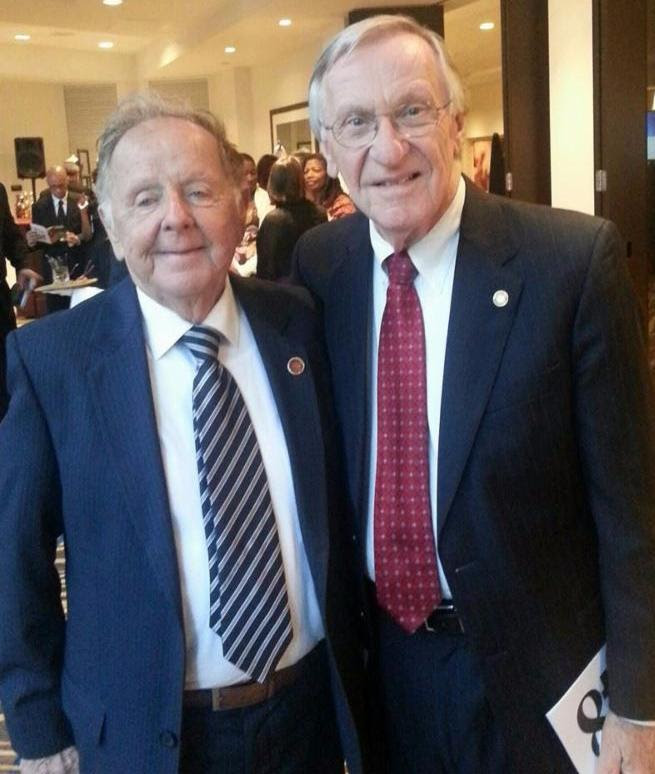 Former Senator Charles J. Colgan passed away earlier this month. He retired just a year ago as the longest-serving State Senator in Virginia history. He was the last remaining World War II veteran serving in the Commonwealth’s Senate. He truly earned a place among the “greatest generation.”
Chuck, as he preferred to be called by his peers, was orphaned by age 5, raised by his grandparents, and served in the Army Air Corps. Aviation was an important part of his life; he founded Colgan Airways, flying out of Manassas with service to 53 cities. His wife of 52 years preceded him in death. Surviving him are his eight children and their spouses, his second wife, 24 grandchildren, and 22 great-grandchildren.
Beyond his personal and business life, Senator Colgan’s public life was unparalleled. He served on the Prince William County Board of Supervisors before being elected to the Virginia Senate for the 40-year tenure he completed. His awards and recognitions are numerous — the most recent being the naming of the Charles J. Colgan Sr. High School in Prince William County. All this history of the man does not capture the essence of what made him so highly regarded. He ran and was elected as a Democrat all his life even as he voted consistently pro-life on issues of abortion. He stayed in office while Republicans won most of the elective positions in his area. In the Senate, he was known for his willingness to work across party lines on issues he thought were important. He was an avid supporter of public education and was greatly influential in supporting funding for George Mason University, including its Prince William campus, and funding for new buildings for the Manassas and Woodbridge campuses of Northern Virginia Community College.
He was a much-loved and towering figure for his philosophy of life that he often expressed in folksy terms. He was known to advise that one should always be worth more than you are being paid. A smile, he would say, is like a business card; it only works if you give it away. He was always cheery regardless of the tough issues he faced. These statements of his philosophy were included in the program for his celebration of life as “Colgan’s Top Ten.” He understood that the best way to defeat your enemy is to make him your friend. The qualities that made him so richly admired by his family, neighbors and legislative colleagues inspired 800 people to come to his retirement party and many hundreds to come to his Mass of Christian Burial. That kind of attendance proved he embodied his belief that when you are getting ahead in life, make sure you reach out and give someone a hand up. Live your life, he would say, in such a way that if someone speaks ill of you, no one will believe them.
I believe Chuck Colgan is a true role model for leadership, for he believed that one should always ask yourself, “Am I doing the right thing?”
—
Each year, I survey constituents on issues of concern to them and on issues that are likely to be considered by the General Assembly. Your views are important to me. Please take a few minutes to respond to the survey that can be found at www.kenplum.com.
This is a commentary from Del. Ken Plum (D), who represents Reston in Virginia’s House of Delegates. It does not reflect the opinion of Reston Now.
The Dulles Corridor Rail Association (DCRA) Board of Directors voted last week to merge with the Northern Virginia Transportation Alliance (NVTA) to represent transportation interests for the region.
As founder of DCRA I felt some sadness at the consolidation of the organization into another entity with a broader purpose, but at the same time I was very pleased with the greater meaning of the merger. On the one hand the merger represented “mission accomplished” for DCRA, and on the other hand it reflected a greater appreciation of the need for a multimodal transportation system for our region.
DCRA was founded in 1998 after conversations I had with members of the Reston Transportation Committee, area residents and members of the business community. My concern that I found was shared by many others was that road building alone would not meet the long-term needs of the region and specifically Reston located in the middle of the corridor.
Short-term solutions like widening roads, adding buses or bus rapid transit or light rail trains could be short-term fixes some of which would interfere with adding more substantial infrastructure in the future. The ensuing years were filled with much debate, fits and starts, and ups and downs before an extension of Metro from West Falls Church into Loudoun County was finally approved as the preferred local alternative, federal funds were approved, special tax districts were set up, and agreements and contracts were signed to make the Silver Line a reality.
For DCRA members the completion of Phase 1 and its operation and the contracting for Phase 2 to be completed by 2020 meant that the work on its narrowly drawn mission had been completed. While issues about maximizing the use of the rail system and access to it remain to be fine-tuned, those matters are best resolved within the framework of a multimodal approach. Northern Virginia Transportation Alliance has moved beyond its road building focus of the past to a more multimodal approach that will support the Silver Line while at the same time reducing congestion and supporting the many different ways that people in our community choose to travel.
DCRA would never have been able to declare victory without the active support of the many individuals, organizations and businesses that supported its mission. They joined together in the “Dulles Rail Now!” campaign at a critically important time, in the beginning sent faxes to key decision makers followed by email in more recent years, held educational seminars for residents and the business community to enhance understanding of transit-oriented development, and cajoled, flattered and persuaded political leaders to support the project.
Key to its successful operation was its president Patty Nicoson who joined the organization at its very beginning and continued with it until its victory celebration. She came to the organization with experience as a planner when Metro first came to the District of Columbia and later worked for Arlington County when Metro arrived there. Her persistent but reasoned approach may have been the most important element of DCRA completing its mission.
—
Each year I survey constituents on issues of concern to them and on issues that are likely to be considered by the General Assembly. Your views are important to me. Please take a few minutes to respond to the survey that can be found at www.kenplum.com.
This is a commentary from Del. Ken Plum (D), who represents Reston in Virginia’s House of Delegates. It does not reflect the opinion of Reston Now.
At noon on Jan. 11, the sergeant at arms will enter the chamber of the House of Delegates carrying a 20-pound, 24-karat gold-coated mace that he will place in a holder in the front and center of the chamber signifying that the House of Delegates is in session. That formality has been followed since the 18th century, when it signified that Virginia was one of the British royal colonies. On the Senate side of the Capitol, the Lieutenant Governor, who is the president of the Senate, will call that body to order. The Governor will address a joint session of the House and Senate that evening.
With all the history and pomp and circumstance that surround a legislative session, the list of issues before the Assembly is very up to date. The need for legislation related to Uber, Airbnb and Tesla electric cars is likely to be heard within the context of new practices of commerce coming up against established traditions and turf. Lobbyists outnumber legislators more than six to one with some seeking to protect the status quo and others wanting new directions and innovation. The job of legislators is to determine the public good among conflicting interests.
Fortunately, not all issues are earth-shattering. Many of the more than 3,000 bills and resolutions that will be considered this year are fairly mundane, dealing with the operation of government. Since localities have only the powers delegated to them by the General Assembly, there will be numerous “local” bills that may affect only a given local government. There are likely to be only 15 or 20 high profile bills that will get widespread press coverage and heavy public lobbying.
With the outcome of the national elections, the social conservatives will feel empowered to put in their bills to limit or eliminate legal abortions. The Governor is expected to veto these bills if they pass just as he did a year ago when he vetoed Virginia’s version of North Carolina’s HB2 permitting discrimination against LGBT persons. The national election experience last year will result in more bills to eliminate fraud from elections even though none has been shown to exist in Virginia. These bills do keep many citizens from being able to register and to vote.
There is a strong citizen effort to have Virginia adopt an independent non-partisan redistricting law for which I have been advocating since the 1980s, but the party in power would have to relinquish their power for that to happen which makes the legislation a long shot. I and others will be introducing gun safety legislation, but the NRA grip on the legislature is firm. Hopefully more citizen involvement will help to loosen that hold and reasonable common sense bills can be passed.
The good news likely to be coming out of the session is that meaningful reform of Virginia’s mental health system will take place and positive steps reforming public education will be enacted.
I will be covering other issues in future columns. In the meantime, learn more about Virginia’s legislation process and the bills and resolutions being considered at http://virginiageneralassembly.gov.
This is a commentary from Del. Ken Plum (D), who represents Reston in Virginia’s House of Delegates. It does not reflect the opinion of Reston Now.
While I enjoy studying history and reading the stories of the past, I equally enjoy studying the writing of history — historiography — which is “the writing of history based on the critical examination of sources, the selection of particulars from the authentic materials, and the synthesis of particulars into a narrative that will stand the test of critical methods.” (Merriam-Webster) Recently I taught a course at the Osher Lifelong Learning Institute (OLLI) at George Mason University that I entitled “A New Look at the Old Dominion.” The purpose of the course was not so much to retell the history of Virginia as it was to examine the way in which the story of the Commonwealth has been told over the decades. Certainly the story of Virginia is ideal for a historiographical analysis. Much of the history has been glamorized for so long as to leave a confusing and contradictory understanding of the state’s past. I have been particularly concerned about the picture of the Commonwealth presented in state-written textbooks that were used in our public schools over the years. One could get the impression from these books that the land settled as Virginia was god-given to the colonists that they could save it from the heathens who inhabited it, that slavery was good for the slaves, that the federal government was the bad guy in every controversy, and that states’ rights should be preeminent over human rights. Fortunately, through the hard work of many individuals much of that misinformation has been removed from the classroom.
My concern for the future is how individual citizens, historians and teachers deal with the deluge of fake news that is swirling around us. The presidential election of 2016 is historic in the amount of fake news to which voters were exposed through the new technologies of social media. Of great concern is the inability of traditional news sources to deal with the fake stories and the gullibility of some of the public to believe whatever they read or hear from their identified news source regardless of the lack of credibility that source may have. Journalists themselves were even questioning what was true among all the falsehoods, denials, and diversion to other topics that were going on during the campaign. Certainly historians will face a monumental task of explaining to future generations what happened during this phase of our history.
If our democratic republic is to exist, we cannot simply wait for future analysis to understand what is going on. Certainly students in school should learn about science, technology, engineering and math (STEM) for future potential employment and consumerism, but I believe that for the future of our country students need to learn the tools and methods of historiography: gathering and weighing evidence, critical thinking, evaluating sources, and others. Our citizens and voters need to arm themselves with the tools of social scientists as they choose their leaders. That is why we need more civics education in our schools.
This is a commentary from Del. Ken Plum (D), who represents Reston in Virginia’s House of Delegates. It does not reflect the opinion of Reston Now.
The State Board of Education recently released its 2016 Annual Report on the Condition and Needs of Public Schools in Virginia. I think it is the most hopeful report on public education that I have seen in my tenure in office.
The report is honest and forthright as to the condition of public schools in the state and totally realistic as to the needs of public schools if they are to be improved. My highest compliments to Dr. Billy Cannaday, President, and members of the Board for their work.
During the last ten years, school enrollment in Virginia increased just over five percent for a total enrollment in 2016 of 1,286,711. During that same time period, economically disadvantaged students increased 39 percent, English language learners increased by 78 percent, students identified with autism increased by 222 percent, and the number of students in health impairment disability categories increased by 26 percent.
At the same time, Virginia students outperform their peers nationwide on the ACT by 15 or more points. The on-time graduation rate grew to 91.3 percent with more than half the students graduating with the most rigorous diploma. The Report recognizes that with the progress that has been made there continues to be a lot of work to do.
What stands out to me are the priorities that the Board has identified “to ensure that all children in the Commonwealth, regardless of their circumstances, have access to a quality education that prepares them for a successful, healthy and fulfilling life.”
The priorities are:
- The public school experience must be redesigned to better prepare students for life after high school by ensuring that all students, during their K-12 experience, achieve and apply appropriate academic knowledge, demonstrate productive workplace skills, exhibit responsible and responsive citizenship, and align knowledge, skills, and interests with career opportunities.
- Teachers and school leaders must be better supported to effectively deliver and serve all Virginia K-12 students.
- Virginia’s accountability system must provide tiered interventions aligned to need, encourage continuous improvement for all schools, and measure and report multiple indicators of school quality.
- Greater attention and support must be provided to school communities with high poverty where achievement and opportunity gaps persist.
Public education is a shared responsibility between state and local governments as defined in the State Constitution. The responsibility for running the public schools is at the state level by the State Board of Education and at the local level by county and city school boards. None of the boards at the state or local levels have taxing authority.
The State Board is dependent on the General Assembly and the governor; local school boards depend on boards of supervisors and city councils. Needed revisions to the state Standards of Quality will require additional investments that are required for future success.
It is essential that all elected officials review the State Board’s report, embrace its findings, and provide the revenue to ensure the success of our public schools.
 This is a commentary from Del. Ken Plum (D), who represents Reston in Virginia’s House of Delegates. It does not reflect the opinion of Reston Now.
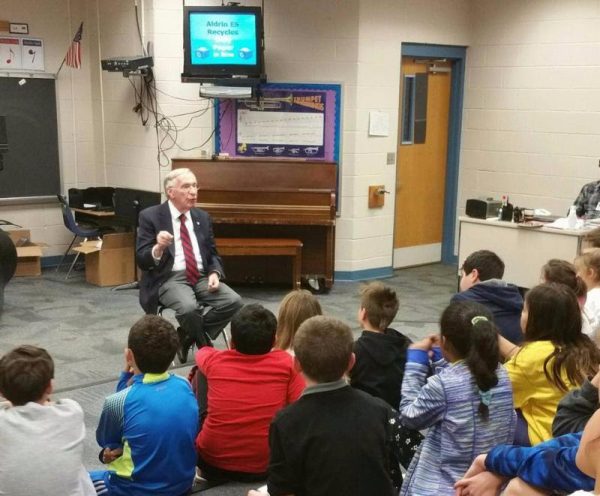
The National Conference of State Legislatures sponsors a “Legislators Back to School Day” each year as a way to promote the idea that more legislators should visit their local schools to see the good work they are doing, as well as to understand the challenges that school administrators and teachers face.
I take advantage of that opportunity, and other times I am invited to visit schools in my district, and sometimes to visit schools in other areas to learn about special programs.
For me, the visits are very positive experiences. I continue to be impressed with the outstanding work that our schools are doing, especially considering the thousands of children–more than 180,000 in Fairfax County–they have to educate. Ensuring that every child reaches his or her full potential is a continual challenge, but I find administrators and teachers at every level working earnestly and diligently to make sure it happens. The children in our community are amazing! They are, for the most part, eager learners who are full of questions and curiosity. And they are good citizens.
One question that I get from children that may be a curiosity of some adults as well is, just what is a delegate? I discuss with the students the meaning of “to delegate” and explain that I am given a delegation of responsibility by the voters of my district to go to the state capitol each year to represent their interests.
In most states, and at the federal level, members of one house of the legislature are called “representatives;” they represent their constituents in the legislature just as I am delegated to do by the people who live in my legislative district.
Their follow-up question is a key one that must be answered appropriately if our representative form of government or republic is to be successful: How do I know the interests of my constituents? I give several explanations.
My term of office is for two years. When I stand for re-election every two years, I tell the voters in my district what I stand for and believe in. Their vote for me is an affirmation that I stand for the kind of things that they want in their government. If I do not represent the interests of my voters, they have an opportunity every two years to take back the delegation of responsibility they have given to me and give it to someone else.
Secondly, I know many of the interests of my constituents because I am out and about in the community all the time. I listen to a lot of people. I encourage people to call or write to me. I try to stay very active in the community to understand my constituents and their needs. I encourage people to respond to my annual constituent survey, which you can do at my website.
Along with Senator Janet Howell, I also hold public meetings; the next one is Monday, Dec. 19, 7:30 to 9 p.m., at the Reston Community Center at Lake Anne. Please come and participate.
Being a delegate is supposed to be a part-time job in Virginia; for me it is a full-time job and a half, but I am very honored to have been entrusted with this delegation of responsibility.
Photo of Del. Ken Plum at 2016 Legislators Back to School Day, courtesy Del. Ken Plum.
This is a commentary from Del. Ken Plum (D), who represents Reston in Virginia’s House of Delegates. It does not reflect the opinion of Reston Now.
When my friend, August Wallmeyer, wrote his book, “The Extremes of Virginia, Southwest, Southside and the Eastern Shore: Two Separated and Unequal Commonwealths. Rural, Poor and Largely Unknown (Dementi Books, 2016),” he included a chapter on illegal drug use for obvious reasons. In 2014 for the first time on record fatal drug overdoses became the most common cause of accidental death in the Commonwealth, according to the Office of the Chief Medical Examiner.
As the Secretary of Health and Human Resources reported to Mr. Wallmeyer, “In 2015, we lost more than a thousand Virginians to opioid or heroin overdoses. More Virginians now die from drug overdoses than from car accidents.” For another reason, the rate of fatal drug/poison overdoses in the poorest areas of the state are 47 percent higher than those in Virginia as a whole. The picture has been getting worse.
Last week, the state health commissioner Dr. Marissa J. Levine declared opioid addiction to be a public health emergency in Virginia. She said the Commonwealth has seen a 77 percent increase in opioid deaths from 2012 to 2016. So great is the concern about this epidemic that Commissioner Levine issued a standing order that allows all Virginians to obtain the drug Naloxone without a specific prescription.
Naloxone is used to treat narcotic overdoes in emergency situations. Persons who know someone who is struggling with opioid addiction are advised to visit a local pharmacy to obtain Naloxone and keep it on hand for possible overdose emergencies. For more information on Naloxone, click here. Another website of the Virginia government offers resources on how to best discuss addiction with someone.
Attorney General Mark Herring is extremely active in combating drug abuse problems in Virginia. A documentary he produced on the heroin and prescription drug epidemic in Virginia is available to individuals and organizations for their use. The Attorney General has led the effort to distribute 80,000 drug disposal kits to individuals through the Department of Health and to hospitals, law enforcement and nonprofits.
These kits will allow for the safe disposal of prescriptions that could be abused by others. There is a strong link between misuse of prescription drugs, opioid addiction, and the use of heroin when prescription drugs become too expensive or are no long available. Some studies found that half of young people who use heroin got started abusing prescription opioids. The Attorney General reported that more than 500 people went to a Virginia emergency room from a heroin overdose in the first four months of 2016, a 250 percent increase over 2015.
No longer is the problem of opioid abuse one that is primarily in the poorer, “extremes” of the state. It can be found in all areas of the state affecting people of all income levels and backgrounds. The strong response to the need by the Attorney General and the State Health Commissioner are very important. Coordination among agencies and work at the local level to end root causes are critical. Fortunately, they are underway to end this epidemic.
This is a commentary from Del. Ken Plum (D), who represents Reston in Virginia’s House of Delegates. It does not reflect the opinion of Reston Now.
During the week following the national presidential election, I attended two lectures on George Mason, the man. There was no connection between the election and the lecture dates other than coincidence, but for me hearing again the work of George Mason in the formation of our nation was reassuring.
The first lecture featured Professor Jeff Broadwater who discussed his book, “George Mason: Forgotten Founder,” as part of a lecture series sponsored by the Virginia Historical Society, the Osher Lifelong Learning Institute, and the George Mason University Department of History.
Broadwater asserts that although Mason is often omitted today from the small circle of historical figures referred to as the Founding Fathers, his contributions to the basic framework of our government were legion. He wrote the first constitution for Virginia and was an active participant in writing a constitution for the new nation. He included a Declaration of Rights in the Virginia Constitution but went home from Philadelphia without signing the U.S. Constitution because it did not include a statement of the rights of citizens.
His firm opposition to a constitution that did not address rights of citizens led to a promise that such a statement called the Bill of Rights patterned after Mason’s Declaration of Rights would be added, and they became the first ten amendments to the Constitution.
Broadwater argues that “Mason’s recalcitrance was not the act of an isolated dissenter; rather, it emerged from the ideology of the American Revolution. Mason’s concerns about the abuse of political power went to the essence of the American experience.” That experience was the attack on natural rights by a series of acts passed by Parliament. An enumeration of rights in the constitution would protect citizen rights from future abuse by the government as Mason reasoned.
Those rights are the same ones that are being looked at by me and others who are apprehensive about the new administration taking over the federal government. Certainly the rhetoric of the campaign would suggest attitudes at odds with our constitutionally protected freedoms. I have as a result increased my annual giving to the Southern Poverty Law Center (www.splcenter.org) that does a superb job of defending our rights from extremists. I have joined the American Civil Liberties Union for the same reason. Organizations like these will be major watch dogs in protecting our rights in these uneasy times.
The other lecture I attended the same week was at the Fairfax County Annual History Conference whose theme this year was “Fairfax County’s Founding Fathers: The Masons Are Coming.” Of course Fairfax County does not have any hesitation in including its native son among the Founding Fathers. Scott Stroh, executive director of Mason’s home– Gunston Hall — in Fairfax County, put Mason’s contribution in clear focus with his lecture, “George Mason’s Virginia Declaration of Rights and the World Changing Power of One Document.”
One way to deal with the uncertainties of our time is to remember Mason and our rights and to be thankful for him and them.
 This is a commentary from Del. Ken Plum (D), who represents Reston in Virginia’s House of Delegates. It does not reflect the opinion of Reston Now.
As an avid user of social media I was surprised that a link to a Forbes article I posted recently on Facebook on “Why We Desperately Need to Bring Back Vocational Training in Schools” had been shared by nearly a hundred of my friends on their own pages.
Obviously, the subject hit a chord of interest on the part of many people. The author, Nicholas Wyman, asserts that the “college-for-everyone” attitude has pushed vocational and career education programs to the margins. He says that “if we want everyone’s kid to succeed, we need to bring vocational education back to the core of high school learning.”
He is not alone in his belief as evidenced by the wide range of readership of his article. I can relate to what he has to say because for several of the years of my 30-year career with Fairfax County Public Schools, my job title was director of vocational and adult education.
There is widespread interest in a redesign of high school education. As many point out, high schools are largely operated under an industrial model that has not changed in a 100 years even though the world around public schools has undergone major changes. The Bill and Melinda Gates Foundation funded Next Generation Learning Challenges that has funded dozens of new schools around the country that take new approaches to learning that include online and personalized learning. Read More
This is a commentary from Del. Ken Plum (D), who represents Reston in Virginia’s House of Delegates. It does not reflect the opinion of Reston Now.
As I write this column the final votes of this election year will not have been cast and hence not tallied. The winners and losers are not yet known. Whether voters in my district took the recommendations in my Voter Guide 2016 or made different judgments will only be known as the final votes are counted the day before this column appears in print.
Regardless of who the new president is and who controls the Congress there is much work to be done. Suddenly the realities of significant issues become clearer than the simplistic slogans of campaigns might suggest. There are no easy answers to ever-increasing tensions in many parts of the world, to the rising cost of health care and its lack of availability to too many people, to major inequities in wealth and opportunity among the people of our country and among the nations of the world, to crumbling infrastructure–to name just a few!
The greatest challenge of all may be the sharp division of opinion apparent during the election season on the role government should play in responding to these needs. Complicating any reasonable discussion of the differences of opinion is the lack of trust of governmental institutions and politicians felt even more strongly after the rough and tumble of this election season.
While the only state-level elections this year were special elections to fill vacancies, the tenor and outcomes of federal elections are likely to have an impact on how business is conducted in the 2017 session of the General Assembly beginning in January. If the extreme right is successful in this year’s elections, those that are in the General Assembly may feel emboldened to continue to oppose taking federal health care monies, to adopt additional restrictions on abortions, and to pass laws that discriminate against LGBTQ citizens. While Governor McAuliffe will still be around to wield his veto pen, there could be many protracted debates on social issues.
On the other hand, if Democrats are successful in capturing the presidency and one or both houses of Congress, moderate Republicans in Virginia may feel less need to insist on hard lines on many issues as we have seen in the past. After all, Virginia will elect a new governor and House of Delegates in 2017, and both parties will want to side with the prevailing political winds.
It is essential that all political leaders learn from this election cycle and do what we can to help mend divisions in our state and in the nation. One thing we can do is listen. Senator Janet Howell and I will have our annual pubic meeting to talk with voters on Monday, Dec. 19, 7:30 to 9 p.m. at the Reston Community Center at Lake Anne Plaza. Come and tell us what is on your mind and offer your suggestions as to what we should do in the upcoming General Assembly session.
Also, my constituent survey is on my website and I encourage you to complete it. After all, the elections are over – time to get back to work.
This is a commentary from Del. Ken Plum (D), who represents Reston in Virginia’s House of Delegates. It does not reflect the opinion of Reston Now.
Next time you are out to dinner or lunch notice the check you receive from the server for payment for your meal. Few people realize that in the Towns of Herndon and Vienna, the Cities of Fairfax, Falls Church and Alexandria and the County of Arlington a meals tax is added to the cost of the food. Not so in Fairfax County.
While initially that may sound like a good deal, it really is not. Revenues that may have been raised from business lunches and dinners, travelers passing through the County who stop to eat, and persons who come from neighboring jurisdictions are lost. With the limitations on the ways that counties can raise revenue the cost of local government falls disproportionally on property owners through the property tax. State law requires counties to have a referendum before a meals tax can be imposed as a way to diversify the tax base. Read More
