

 This is a commentary from Del. Ken Plum (D-Fairfax), who represents Reston in Virginia’s House of Delegates. It does not reflect the opinion of Reston Now.
The Virginia Constitution provides that in the even-numbered years the General Assembly is to meet in session for 60 days and in the odd-numbered years for 45 days. Either may be extended by half the number of days with a two-thirds vote by the membership. The reason for the longer session in even-numbered years was the additional responsibility of passing a biennial budget. Yet on Saturday, March 10, the General Assembly adjourned sine die (meaning with no appointed date for resumption) without having passed a budget for the next biennium!
The budget under which the Commonwealth is currently operating does not expire until June 30, 2018. The Governor is empowered to call a special session of the legislature, and he has indicated his expectation in the near future to call such a special session whose business would be limited to passage of a budget. Members of the House and Senate understood that would be the procedure to be followed when they voted to adjourn the regular session.
There is good news in all this procedural action to bring the legislature to an end for the year. The budgets of the two houses could not be reconciled by the constitutional deadline because of one great and meaningful difference: extending Medicaid to many more persons of limited income. The really good news is that Medicaid expansion is being discussed in a positive context, and I am certain it is going to take place in Virginia within the year.
A total of about 2500 bills and resolutions have been considered during the last 60 days. Of those, fewer than a thousand will make their way to the Governor for his signature. When duplicate bills are counted once, the total production of the General Assembly will be close to 500 new laws. While that small number may seem like limited production for such great effort, some of the bills introduced are really not good ideas. It is just as important that the legislature defeat bad bills as it is for the legislature to pass good bills.
This session was noteworthy for its lack of bills limiting women’s reproductive rights and bills that would discriminate against persons for their sexual orientation or identity. Much of that change can be attributed to the defeat of one incumbent delegate who specialized in such bills but also to the great number of defeats of incumbent legislators who voted for them.
There were 70 bills introduced relating to ending gun violence, and all were defeated in a six-person subcommittee. Recent public outrage over gun violence is likely to change that dynamic in the future. Good news for Metro was the passage of a bill to put Virginia’s contribution to the system on sound financial footing with a dedicated source of funding from the Commonwealth. Maryland and the District of Columbia are expected to take similar action.
A major victory for environmentalists was the passage of the Governor’s bill to expand the use of renewables in electricity generation, modernization of the electrical grid, and expansion of energy conservation. More to come on the work of the session in future columns
This is a commentary from Del. Ken Plum (D-Fairfax), who represents Reston in Virginia’s House of Delegates. It does not reflect the opinion of Reston Now.
Last week Democrats in the House of Delegates were able largely to sit on the sidelines as Republicans debated among themselves whether Virginia should expand access to medical care through the federal Medicaid program. Arguments that had been used by Democrats to support Medicaid in the past were now being used by Republicans to support their newly found support for expansion.
The news is good since Medicaid expansion could only come about with bipartisan support. When the final vote was taken on the issue, only 31 Republicans voted “nay” and all Democrats voting “aye” with 20 Republicans making the total for passage 69 votes. There was a sense of relief as a goal for which we had been working for more than a half dozen years moved closer to realization.
The news was not so good on the other side of the Capitol. The Senate passed a budget that did not include further Medicaid expansion. While there was an effort to amend the Senate bill to include the expansion of access to health care, it failed along a straight party line vote. Final passage of a budget for the next two years requires that the bills passed in each house be identical. A conference committee made up of House and Senate members must resolve the largest imbalance in the budget that I have ever seen before its final adoption.
If I had predicted before the session where we would be at this point I would have said that the Senate would have passed a version of Medicaid expansion but the Republicans in the House were maintaining their opposition. At least that’s what the public pronouncements and the rumor mill suggested.
How could we have been so wrong? I believe that the predictions on the outcome of the session left out one very important consideration: the results of the 2016 elections. The House’s 66 to 34 Republican control was diminished to a close margin of 51 to 49. For weeks it appeared that Democrats might take control. Among the losses were senior members and committee chairs who were opponents of Medicaid expansion and were expected to win re-election easily. The Speaker who opposed expansion retired.
The voters in 2016 sent a clear message that they supported Medicaid expansion. For most it simply did not make sense to leave more than ten billion federal dollars on the table when there were so many people without access to health care. Many more people went to the polls than usual to send the message to legislators. Whether it was public opinion polling or common sense that showed the Republican majority they were in trouble and needed to change the stance on issues, the public speaking through the ballot box brought about this very important change for Virginia.
How to explain the Senate vote? Senators with four-year terms have not been before the voters since 2014. They have not had a recent message from the electorate and could be in for a big surprise if they do not re-evaluate their positions. The real heroes in all this are the Indivisibles and other groups that mobilized voters in 2016 to elect responsive candidates. These new members are bringing balance to public policy as well as to the budget.
This is a commentary from Del. Ken Plum (D-Fairfax), who represents Reston in Virginia’s House of Delegates. It does not reflect the opinion of Reston Now.
“Enough is enough” is a slogan adopted by many advocates for action to end gun violence, but with 290 school shootings in the U.S. since 2013 clearly we are to the point that the shootings that have occurred in schools and numerous locales are more than enough.
Last Wednesday started off as a usual day at the legislature with the added feature that it was Valentine’s Day with lots of red decorations in the hallways and an abundance of chocolate available. It was also the first day of Lent with ashes offered at several nearby churches.
The day took a sharp turn in the late afternoon as the news media brought early reports of another instance of school shootings; this time at a school in Parkland, Florida. The timing was critical in that the General Assembly had over the past several weeks defeated with minimal debate and consideration more than 30 bills intended to reduce gun violence. My bill for universal background checks was among those.
The process for considering these bills was the same for all of them regardless of their approach. In the House the bills were assigned to the Militia, Police and Public Safety Committee and then to a subcommittee on guns composed of six members–four of whom have perfect NRA ratings. The outcome of the hearings is predictable. The advocates make many good and passionate arguments on behalf of common sense gun violence prevention legislation.
The NRA representative states the organization’s opposition along with someone from the Virginia Citizens Defense League with little argument or comments. The vote is always two for and four against. As important as the bills are to many people they are defeated; four members of the House of Delegates with their minds already made up decide for all 100 members of the House. There are few voting records to check because most members never get the opportunity to vote on gun regulation issues.
The strong concern among members of the press and on social media makes it clear that the legislature is going to have to respond to gun violence issues. Unfortunately, the schedule for introducing new bills in this session has passed; otherwise bills would have been introduced in response to the Florida shootings. Legislators would have had to confront the reality that there has been more than enough gun violence.
A New York Times article offered some direction as to how legislatures might proceed. An article “How to Reduce Mass Shooting Deaths? Experts Say These Gun Laws Could Help” first appeared on October 5, 2017. It found that there is no way to eliminate the risk of mass shootings, “but there are a handful of policies that could reduce the likelihood of such events or reduce the number of people killed when such shootings do occur.” These include denying purchases by anyone convicted of certain felonies, universal background checks, limiting the sale of certain types of weapons and ammunition, and waiting periods for purchases.
In the next cycle of elections, positions of candidates on gun violence will play an even greater role in who gets elected. If minds of incumbents do not change, voters are likely to change their elected officials. The public has had more than enough.
This is a commentary from Del. Ken Plum (D-Fairfax), who represents Reston in Virginia’s House of Delegates. It does not reflect the opinion of Reston Now.
In a sight too seldom seen in the State Capitol, Governor Ralph Northam and Speaker of the House Kirk Cox stood together at the same podium to announce a bipartisan agreement on criminal justice reform. Governor Northam has agreed to sign a bill on restitution in criminal cases that when it passed last year was vetoed by Governor McAuliffe, and the Republicans agreed to pass a bill to raise the threshold for felony larceny from the current $200 to $500 for which many interfaith and social justice groups have been forcefully advocating. While there are details about the agreements that continue to be open for criticism, they represent important steps in criminal justice reform.
The Governor intervened in a controversial bill on electric energy regulation that is likely to make the ultimate outcome more satisfactory to multiple stakeholders. The original bill was referred to as the “Dominion” bill because it impacted Dominion Energy, American Electric Power Company and the electric cooperatives. After the Governor called together 30 stakeholders and a professional mediator, a revised bill emerged that will keep the electric power companies financially stable while granting refunds to consumers with advances in smart metering, energy conservation and a giant step in moving towards renewable energy. For critics of any bill that deals with electric energy, take a look at the new bill that has been negotiated; I think there are very good reasons conservationists are happy with the new bill.
The critical need for Metro funding presents a challenge for working out a solution. There is no debate about the importance of Metro; all business organizations testify to its critical role in the success of the Northern Virginia region. Holding up the process of working out the new funding are legislators who continue to want to talk about reforms of Metro without specific proposals and who are not willing to make a commitment on funding. Hopefully the partisan political speeches can be set aside, and serious discussions can be carried on by sane heads that will result in a satisfactory compromise.
A bill passed recently that supports a work requirement for recipients of Medicaid that was supported by the Speaker was the first indication that there may be a path to an agreement on Medicaid expansion. Such requirements are becoming common among the states. While such a requirement may be adverse to some people, we need to do what is needed to move the program forward for the maximum number of persons who are otherwise qualified. Certainly, the program will be revised and improved most every year. I share the Governor’s priority that we make progress on expanding health care this year.
On every issue that comes before the legislature there are multiple points of view and different interests. Each has a legitimacy in the mind of the proponent. The continued challenge that keeps me interested and excited about legislating is the working out of complex issues to the best interest of the citizenry.
This is a commentary from Del. Ken Plum (D-Fairfax), who represents Reston in Virginia’s House of Delegates. It does not reflect the opinion of Reston Now.
Every session of the General Assembly, I am reminded of how much the functioning of the legislature is like a roller coaster ride. Every ride on a roller coaster regardless of how big it may be starts off very slowly.
The steep climb at the beginning is followed by a sudden acceleration as the bottom seems to drop out when the coaster descends into the first drop. While your stomach is still in your throat you go through sharp turns followed by other drops that leave most of us with white knuckles holding on for dear life. There is a great sense of relief when it is all over.
A session of the General Assembly is kind of like that. The first couple of weeks are busy with opening preliminaries, bill drafting, and this year settling into temporary offices. As bills get introduced and assigned to committees that start to meet you get that sense that the bottom is about to drop out. Days get longer and busier as the need to be in more than one place at a time becomes the rule rather than the exception, and the schedule for each day gets longer.
The final product of the session will not be known until the scheduled end of the session on March 10. In the meantime, I will update you on actions taken on the nearly 2,500 bills and resolutions that are moving down the track. Be aware that there are likely to be changes at the next sharp turn or sudden drop.
Hopes that the session would be less partisan with a 21 to 19 split in the Senate and a 51 to 49 division in the House with Republicans controlling both houses were dashed early as mostly Republican-sponsored bills were approved along partisan lines. All gun safety bills were quickly defeated including my bill for universal background checks.
A bill to repeal the current prohibition on guns in churches was passed. Ironically its proponents testified that it would make churches safer! Bills intended to keep the environment cleaner were mostly defeated while some technical and administrative bills related to the environment were passed.
Under the Dillon Rule, localities have only the powers granted to them in their charters or in general law. Many bills have been passed as usual to grant specific authority to a given locality; these are referred to as “local bills.” Many “housekeeping” measures add to the session agenda as they make technical corrections to existing law.
An increasing number of animal-related bills are under consideration as are bills related to hunting and fishing. Major legislation to regulate electric utility rates and expand the use of renewables is still being negotiated. Certificate of Public Need (COPN) for hospitals is likewise being negotiated among stakeholders.
The really big bill, the biennial budget, will be worked out among conference committee members and usually is one of the last bills to pass. The mystery of whether it will include an expansion of Medicaid has yet to be resolved. Many twists and turns are still ahead before the Assembly comes to its final stop for the year. Continue your advocacy on issues of concern to you. Check on the progress of bills of interest to you at lis.virginia.gov.
This is a commentary from Del. Ken Plum (D-Fairfax), who represents Reston in Virginia’s House of Delegates. It does not reflect the opinion of Reston Now.
The experiences of the Virginia colonists with King George III taught them a lesson not forgotten even until today. Executive authorities are not to be trusted. Monarchies are likely to try to take away the people’s rights and property. The assertions of the Declaration of Independence were to make it clear that the people of America had sworn off monarchial government. They were not about to replace a king with a president or a government who might try to exert the kind of absolute executive power they had under the king.
Instead, controls were incorporated in the U.S. Constitution as well as state constitutions to keep the executive authority in check. Virginia’s limitations on the governor were especially limiting. For example, the governor’s term was one year. He could run for re-election more than once, but likewise he could be turned out after just one year. We have loosened up somewhat in modern times by extending the term to four years, but there is a limitation of one consecutive term.
The governor can run for an additional term, but it cannot be consecutive with the first. I think the one-term limitation is unnecessarily restrictive and have voted more than once to allow the governor to run for a second consecutive term. One term may keep a governor under control, but it can also limit his or her effectiveness.
Governor Terry McAuliffe was a high-energy, strongly motivated, hard-charging governor whose accomplishments exceeded those of his predecessors. He accepted the fact he had just one term, and he worked energetically to get all he could done in the relatively short four-year term. He pushed the legislature to get things done, and he did not hesitate to use executive authority when necessary.
He was taken to court by the Republicans for restoring citizenship rights to those who had been incarcerated, but he won and restored citizenship rights to 172,000 ex-felons. He brought about a New Virginia Economy of high employment, job growth, and attractiveness to those seeking to locate a company here.
Governor Ralph Northam who served under the shadow of Governor McAuliffe as lieutenant governor was always recognized as being extremely able but without the show of high-energy and flair of the Governor. No one questioned his ability, but it was widely concluded that he would bring a different style to the governorship. Most expected a mild-mannered, cordial leader who would govern more by consensus.
Clearly the styles are different, but there may have been a bit of selling short Governor Northam because of his easy Eastern Shore manner. His inauguration speech as well his first speech to the General Assembly were anything but mild or equivocal. They were as strong and as direct as any that Governor McAuliffe delivered. Calling upon his background as a physician, he built a hard case for the expansion of health services to the people in need in the Commonwealth. He is as direct as anyone I have heard speak about the need for common-sense gun control measures. He is emphatic in his defense of women’s reproductive rights.
We may not have a second term for the governor in Virginia, but we have a governor taking over who is going to continue the policies of his predecessor. The difference in the two will simply be a matter of style.
This is a commentary from Del. Ken Plum (D-Fairfax), who represents Reston in Virginia’s House of Delegates. It does not reflect the opinion of Reston Now.
One of the first tasks in a new session of the Virginia General Assembly is to decide who is going to run the show. In the Senate of Virginia, the decision is made by the voters of the Commonwealth when they elect the Lieutenant Governor whose principal duty is to preside over the Senate. In the House, the Speaker of the House is the presiding officer who is elected by the members of the House.
The political party with the most members has control of the House and elects the Speaker. Republicans control of the House is 51 to 49 this session, a sharp drop in the 66-34 control of recent years. The closeness of the balance of power led to some meaningful discussions that should result in more transparency in the operation of the House.
My interest in becoming the presiding officer of the House by being elected Speaker was well known. Once the two disputed delegate elections where decided in favor of the Republicans there was no way I could reasonably expect to win. Only the Republican who had worked in his party and in the legislature for decades was nominated, and he was elected unanimously. That helped the session get underway in a cooperative spirit. There will be ample opportunity for debate when the many bills that reflect the issues before the General Assembly are considered.
What does a Speaker wannabe do when his party does not gain control of the legislative body? I have decided for myself that if I cannot be the formal Mr. Speaker of the House of Delegates then I can return to my role as Mr. speaker (small “s”) speaking out on tough issues that some may want to duck, and I can speak out on institutional practices that are not transparent or fair.
In this way, I can best serve my constituents and the long-term interest of the Commonwealth. I can also serve as a mentor to the many new exciting members that are joining the House of Delegates, and I can help to reduce any feelings of intimidation they might be experiencing. Certainly the legislature provides experiences that are not replicated in any other role in life.
The techniques of mass communication through phone calls, postcards, rallies, opinion writings, and other practices that were so successful in helping to get candidates elected can be utilized in the legislative process to help influence the outcome of legislation. I have already been seeing groups shifting from advocacy for individual candidates to advocacy for issues. On issues like expansion of health care and independent redistricting, a strong public voice and advocacy are necessary for success.
There will be more opportunities for the public to follow the legislature in real-time this year than ever before. Video streams of meetings of House Full Committees can be accessed online. Download an instruction sheet at Live Stream Instructions.
You can contact me in Richmond by using regular email, [email protected], or by calling my local telephone number 703-758-9733 that will ring in my Richmond office.
File photo
This is a commentary from Del. Ken Plum (D-Fairfax), who represents Reston in Virginia’s House of Delegates. It does not reflect the opinion of Reston Now.
The General Assembly convened for its annual session on Wednesday. Hopes that the historic election results of November brought forth have dimmed somewhat as the drawing of lots to settle the results of the final district race gave the Republicans a one-member advantage to control the House of Delegates. Many wonderful people have been at work on the terms for a power-sharing agreement.
Now the incentives for such reform have diminished with the acceptance of a disputed ballot that led to the Democrats losing a seat that would have made for a partisan tie in the House and much more likelihood of a power-sharing arrangement. There is likely to be some reform of the process but not a change of one-party dominance that has thwarted efforts to deal with some major issues.
I continue to be impressed with the make-up of the House of Delegates as the new members are reflective of the people of Virginia. For the first time in our history women will make up half the membership of the Democratic caucus. The new members bring wonderful backgrounds, expertise, and life experiences that will bring a greater sense of reality to legislative debates. We will make progress on more issues for sure but maybe not as great as I led people to believe when election results were announced.
One of my greatest concerns is that the thousands of men and women who chose to take part in the electoral process for the first time in ways other than just voting not become disillusioned with the process and retreat from it. Make no mistake about it: the outcomes of the legislative and state-wide races in Virginia in 2017 were historic. Voter turnout in these races was greater than in any other year with the same seats to be filled. The solid Republican majority of 66 to 34 was reduced to 51 to 49. Senior members of the majority with more than adequate monies to finance their races lost to a public uprising. All involved in this process can rightfully be proud. All that activity has been focused on campaigning; now we must turn to governing.
I hope that all those who campaigned so hard for candidates will identify one or perhaps several issues upon which they can focus their attention and with the same techniques of phoning, social media, door knocking, rallying and more can help persuade members of the legislature to vote responsibly on the issues. Just as we sold voters on candidates, we need to sell legislators on important issues. Such campaigns can make a difference in the outcome of legislation.
Political parties on both sides will be eager to take credit for the outcomes of elections in which they participated. Without a doubt, the success of elections this cycle came from the women and men who volunteered–sometimes in organized groups or acting as individuals–that made the difference. Political parties can learn from these people. Please do stay involved, for your participation can make such an important difference as the General Assembly lumbers along.
This is a commentary from Del. Ken Plum (D-Fairfax), who represents Reston in Virginia’s House of Delegates. It does not reflect the opinion of Reston Now.
For many years into the future the example of one vote making a difference will be the House of Delegates election in the 94th House district in Virginia. After all legal issues are resolved, a winner will be finally announced. The winner will have won by a single vote or by a drawing of lots as Virginia law prescribes. You simply cannot get an election outcome closer than that! Every vote does count. But the importance of that one vote goes beyond deciding who will represent the people in that district; it will also decide which of the two parties will have a majority in the House of Delegates or whether the parties will be tied! Too bad for the people who might have an interest in the outcome but did not bother to vote.
The one-vote outcome along with a wave of voter participation transformed the Commonwealth’s legislative control in the House from Republican dominance of 66 members to 34 Democratic legislators to an even division or an advantage of one depending on that one final vote. Legislation of importance like expanding health insurance to those in need to adequately funding schools and encouraging gun safety that could not make it through the majority party that has been dominated by ultra-conservatives is much more likely to receive a hearing with a greater chance of a favorable hearing.
I do not sense an appetite from the people with whom I have talked for political posturing and grand-standing. To the contrary, I believe there is a public expectation that we work out whatever we need in order to proceed with the business of the legislature and to resolving issues that have been left unaddressed for too long. The one-upmanship that too often dominates the political world needs to be set aside. There is important work that needs to get done.
A study by the National Conference of State Legislatures found that between 1970 and 2003 there have been 32 tied legislatures in 22 states. The report described various ways that states have dealt with the situation. The North Carolina House of Representatives resolved a tie in 2002 by having two speakers of the house, one from each party who alternated each day. Similar agreements were used in the Indiana House in 1988, the Michigan House in 1992 and the Nevada Assembly in 1994.
Wyoming’s law provides for a coin toss to pick the majority party. Indiana, Montana and South Dakota break a tie by selecting the party of a top official like the governor, the NCSL report said. Washington State had co-speakers for a session that was described as cumbersome but workable. When the Florida Senate tied, one party’s leader served as chamber president for the first year of the term, followed by the other party’s leader the second year.
The people have made their voices heard in a historic election turnout in 2017. Campaigning has ended; it is time to start governing. A power-sharing agreement can be worked out. Virginians will be the winners when a power-sharing agreement is in place.
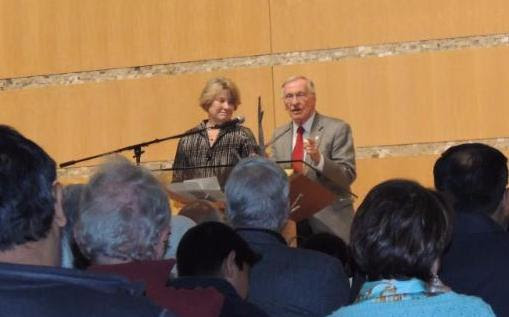 Ahead of the 2018 Virginia General Assembly, Reston residents will have a chance to discuss important issues with state Del. Ken Plum and Sen. Janet Howell, both Democrats who represent Reston.
The elected representatives will hold their annual pre-legislative session town hall at the Jo Ann Rose Gallery in Reston Community Center at Lake Anne (1609 Washington Plaza) on Tuesday, Dec. 19 from 7:30 – 9 p.m.
Plum, 76, is in his 37th year representing the 36th district in Virginia’s House of Delegates. The retired teacher and school administrator recently told the Richmond Times-Dispatch he is eyeing the top position in the House, posing a challenge to current House Minority Leader David Toscano, a Democrat of Charlottesville.
Howell has been a state senator since 1992, prior to which she was a PTA president, community association president and chair of the State Board of Social Services.
For more information about the town hall, call 703-758-9733.
File photo.
This is a commentary from Del. Ken Plum (D-Fairfax), who represents Reston in Virginia’s House of Delegates. It does not reflect the opinion of Reston Now.
Earlier last week there was a groundbreaking ceremony on the grounds of the State Capitol in Richmond for a memorial “recognizing the contributions of women across four centuries.” The first phase of the monument named “Voices from the Garden” will be an oval-shaped plaza that will contain 12 bronze statues depicting significant women in Virginia’s history. A glass Wall of Honor containing the names of several hundred additional women of note will surround the plaza. Supporters of the new monument claim it to be “the first of its kind on the grounds of a state capitol.” Certainly it is a step forward in recognizing the important place of women after English colonization and the transport of the first English women to the colony in 1619.
The grounds of the Capitol have been dominated by white men since Richmond became the capital of the Commonwealth in 1780. From the grand equestrian statue of George Washington that dominates the grounds to a lonely statue of senator and former governor Harry F. Byrd, only the Virginia Civil Rights Memorial opened in 2008 offers evidence of others than white men who contributed to Virginia’s history. The addition of the women’s memorial at a critically important time will help to fill in the blanks of history as will the Virginia Indian Tribute Memorial that is currently under construction.
Recognizing the historic contributions of women has become even more important at a time when the daily news brings information on the number of women having been sexually harassed by well-known political and entertainment figures. While those disclosures have brought attention to the situation, there needs to be recognition that we are only seeing the tip of a very great problem. Many women who are afraid, feel shame or powerlessness, or whose perpetrator is a relative, co-worker, or community member but who is not famous have had to suffer in silence. Now that the lid is sufficiently off, the issue will not be able to be swept away or ignored. The path forward is not entirely clear, but giving women the respect they have earned whether in history or as head of a family is an important step. A memorial on capitol grounds of a state that did not ratify until 1952 the Nineteenth Amendment giving women the right to vote in 1920 is an important step as well.
The greatest tribute to women in Virginia may have come with the outcome of the recent Virginia election. Pending final vote certification there will be 38 women in the Virginia General Assembly–27% versus the earlier 19%. The Democratic caucus in the House of Delegates will be nearly half women as it should be. Supporting these women candidates were thousands of women working to make a difference in numbers never before realized. Seeing these winning women candidates are thousands of young women who just witnessed a door opening for them. It is likely to be that Virginia will finally ratify the Equal Rights Amendment as I have supported my entire career.
This is a commentary from Del. Ken Plum (D-Fairfax), who represents Reston in Virginia’s House of Delegates. It does not reflect the opinion of Reston Now.
If there are any impartial observers left listening to the debate in Washington, D.C. on tax reform, they must be left scratching their heads over what they are hearing. When the wealthy have never had as much money as they have today, leadership in Congress is considering a tax bill that will cut the taxes of the very richest.
When income of the lowest to the middle classes has been stagnant or falling for decades, the latest tax reform proposals would raise their taxes. Under the guise of simplifying taxes, we are about to simply raise the taxes of those least able to pay and to enrich those who already have more money than they can spend in a century. Aren’t there enough sensible members of Congress left who have not sold out to the monied interests to put a stop to this craziness?
Members of Congress may tell me to tend to my own knitting at the state level, but actions at the federal level do impact state budgets. Virginia has been particularly dependent on federal spending even though there has been an effort to reduce that dependency in recent years. While Congress can approve an unbalanced budget like the one being discussed that will add more than $1.5 trillion to the national debt, states cannot afford that irresponsible luxury.
Virginia must pass a balanced biennium budget in 2018; the task will not be easy. A recent report by The Commonwealth Institute found that “Virginia’s current revenue system isn’t keeping up with changes and growth in the overall economy, and that’s putting the future prosperity of families and businesses at risk.” (The Commonwealth Institute, “A Tax System for Yesterday: Slow Revenue Growth amid Economic Change, November 13, 2017).
The Institute found that “the way the current revenue system works was designed decades ago, with provisions that no longer work for today’s economy…” For example, the shifts in consumer spending and growth in e-commerce nearly doubling in the last decade have contributed to a decline in state sales tax revenue relative to the total economy as internet sales mostly are not taxed. Likewise the shift of consumer spending from goods to services that are not taxed in Virginia added to the decline. There are opportunities in the tax code to update its corporate tax system to reduce opportunities for tax avoidance, according to The Institute.
The usual method of balancing the budget by simply dividing revenue among programs will no longer work in Virginia as the pace of growth of needs has out-stripped the growth in revenue. Some programs and services will once again be left under-funded. Shifting costs to local governments for things like public education has been resorted to in recent years, but that is a well that has largely dried up.
Virginia is going to need to do a serious accounting of its unmet needs with the public and the legislature deciding what we are going to seriously fund and what needs will go unmet. As the federal government plays with reforming the national tax structure, it is past time for Virginia to get serious about our own tax reform.
This is a commentary from Del. Ken Plum (D-Fairfax), who represents Reston in Virginia’s House of Delegates. It does not reflect the opinion of Reston Now.
What happens if a dog that chases vehicles catches one? What happens if a political party that struggles for nearly a decade to regain the majority in a political body realizes its goal? The question is not theoretical. Democrats in the House of Delegates have been working at a 34 to 66 seat disadvantage for the last several years.
In an election that produced results seemingly impossible, before recounts Democrats are down by one vote from being tied for control of the House. An even 50-50 or a one vote advantage are possible as soon as the official vote tallies in three elections are determined.
Regardless of the final number, the House of Delegates will have to operate more on consensus than on an absolute dominance of one party over the other. That is a good thing. Rather than either party having to play defense all the time, both parties will be responsible for the ultimate outcome of a legislative session. The new shift in the balance of power should be good for the Commonwealth.
There should be less bottling up tough bills in a committee or subcommittee without a hearing or vote. Legislators will be put on the spot to cast tough votes, but that is the way the legislative process should work. Some issues that have been side-stepped in recent years should reach the floor for a public vote.
For years members of the majority party of the House of Delegates have refused to allow a vote on health insurance for 400,000 of our most vulnerable citizens leaving more than 10 billion federal dollars on the table. I think the vote in the recent election reflected in part a disgust on the part of citizens for the legislators who refused to deal with a real public health issue. An early vote on agreeing to Medicaid expansion would send a signal to voters that their message has been received.
Election results also demonstrated the impact of gerry-rigging election district lines that has been going on for many years. Establishing a non-partisan redistricting commission as I have advocated for many years and as proposed by the OneVirginia2021 organization will reduce the politics in the redistricting process that will come again after the 2020 federal census. Voters will choose their representatives rather than having legislators choose their voters.
I believe that a newly constituted House of Delegates made up of members elected by the highest level of voter participation in decades will also be less prone to involve themselves in the personal lives and social issues of the times. Too much time has been expended in the recent past debating who someone should be able to love or marry or who should make health decisions for women.
Some incumbents may find difficulty adjusting to a wonderfully more diverse House membership or feel uncomfortable in a new power-sharing agreement with another party, but the outcome should be good for Virginia. What now? Great opportunities for moving Virginia forward!
This is a commentary from Del. Ken Plum (D-Fairfax), who represents Reston in Virginia’s House of Delegates. It does not reflect the opinion of Reston Now.
The recent election in Virginia brought about significant changes in the partisan composition of the House of Delegates. While the election of Dr. Ralph Northam as governor and attorney Justin Fairfax as lieutenant governor along with the re-election of Attorney General Mark Herring kept the executive branch of government in Democratic hands, election results in the 100 House of Delegates districts were dramatically different.
Republicans went into the election with a strong advantage controlling 66 of the 100 seats. It appears with some recounts to take place that they will end up with 51 seats or maybe even tied with Democrats at 50 seats each.
No one that I know predicted such a major shift; some refer to the outcome of the election as a political tsunami. It was not simply that Republicans lost 17 seats when the most optimistic prediction was that Democrats would gain maybe ten or so seats. The majority party went into the election with a 66 to 34 advantage; they ended the election with the possibility of only a one member advantage or depending on the recount of votes a tie with Democrats.
Beyond the number of seats lost, the majority party lost their caucus whip, chairs of three major committees and two members of the Appropriations Committee including one of its conferees. Their caucus chairman seemed to have lost until a transposition of numbers was discovered that allowed him to hang on by a thread.
I served during the term beginning in the year 2000 when a power sharing agreement was reached allowing an evenly split body to go forward with its business. I thought the system worked effectively as there was a process for working together. In such an arrangement there can be an emphasis on solving problems rather than simply getting credit.
Most encouraging during this election cycle was the gain in the number of people voting in the election. The experience over many decades was that about 75% of voters go to the polls in presidential election years and less than 50% in years when the governor is elected. That number increased to about 60% this year.Those people who decided to go to the polls made the difference especially in the House of Delegates races.
A further exciting outcome of this election was the dramatic diversification of the membership of the House that had been dominated by white men throughout its history. Most of the losses of incumbents came about by women candidates defeating them. Not only are there more women, there are two Latino and two Asian women, the first transgender woman, and a lesbian. There will be more diversity in the General Assembly than ever before in its history. The Commonwealth will be better for it.
The challenge will be to bring the new members quickly into the process and embrace the strengths that diversity brings. The institution can accommodate the changes that the bloodless revolution of 2017 brought about to the degree that the leadership will permit it.
This is a commentary from Del. Ken Plum (D-Fairfax), who represents Reston in Virginia’s House of Delegates. It does not reflect the opinion of Reston Now.
I am sure I will have some commentary on the outcome of the November 7 election in future columns, but as I write this column results are not yet known. No matter the outcome, I share the frustration experienced by many with the negativity that seems to inevitably overtake campaigns with high stakes. Political operatives who provide the advice upon which campaigns are planned continue to insist that negative advertising wins elections as it gets people’s attention and creates a fear or anger that moves voters to take part. I am not sure if anyone has measured how many people get turned off and decide not to vote because of the vicious ads.
Even more concerning to me than the half-truths and falsehoods that have slipped into campaigning is the cruelty that has moved into the operation of government. After years of complaining about the Affordable Care Act while in complete control of the Congress and now also the presidency, the Republicans have not been able to repeal and replace what they came to call Obamacare. The reason might simply be that provision of health care to all with coverage for pre-existing conditions in a developed nation is the right thing to do. Failing to achieve legislative success, the administration has set about trying to kill the program through administrative actions and neglect. That is where the cruelty sets in.
The first effort at killing the program came with an executive order to withhold subsidies which allowed insurance companies to keep premium increases to a minimum. With the loss of the subsidies, Anthem pulled out of Virginia in August leaving 60 jurisdictions with no insurer offering coverage; they reversed their action after intense efforts by Governor McAuliffe. The loss of federal support will be devastating in Virginia where 240,000 Virginians rely on subsidies to be able to afford insurance. There clearly must not be a lack of money in Washington with the huge tax cuts now being proposed for the very wealthy.
The cruelty does not end there. To reduce the program further the advertising budget to remind persons about open enrollment was slashed by 90 percent, and the time to enroll was reduced from 12 weeks to 6 weeks. The open enrollment started November 1 and will close on December 15. Tell anyone you know who might be eligible and spread the information through social media programs in which you participate that open enrollment ends on December 15.
A final crippling blow could be the administration announcement that it will not enforce the individual mandate that has been critical to keeping costs down by spreading the risk across a wide pool of participants. As though this is not enough, the Republican Congress and administration failed to reauthorize the Children’s Health Insurance Program (CHIP) that provided care to 65,000 children and 1,100 pregnant mothers in Virginia. We have a new insurance program in place in this country; it is called Trumpcare. It is a very cruel system!
