

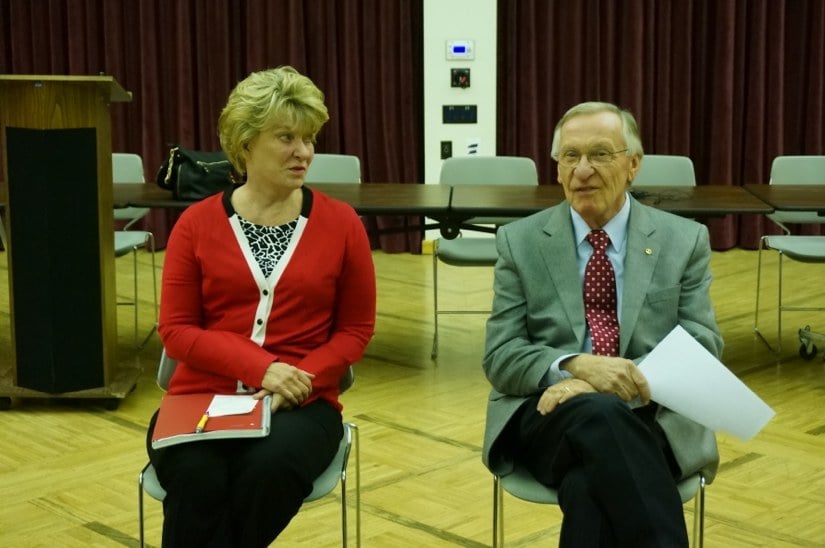
 Sen. Janet Howell (D-Reston) and Del. Ken Plum (D-Reston) will hold their annual pre-session Town Hall Meeting on Thursday, Jan. 8 at 7:30 p.m. at Reston Community Center Hunters Woods.
This is a chance for Restonians to tell their state representatives what issues matter to them prior to the 2015 Virginia General Assembly session. The 45-day session begins Jan. 14 in Richmond.
Plum is a co-sponsor on several bills this session. Among them:
HB 1288 and 1289 Same-sex marriages; civil unions. Repeals the statutory prohibitions on same-sex marriages and civil unions or other arrangements between persons of the same sex purporting to bestow the privileges and obligations of marriage. The bill does not affect the prohibition on these relationships contained in Article I, Section 15-A of the Constitution of Virginia.
HB 1343 Campus police departments; sexual assault reporting. Requires that mutual aid agreements between campus police force and law-enforcement agencies contain provisions requiring either the campus police force or an agency with which it has established a mutual aid agreement to notify the local attorney for the Commonwealth of any investigation involving felony criminal sexual assault occurring on property owned or controlled by the institution of higher education within 48 hours of beginning such investigation.
HJ 493, SJ 214 Constitutional amendment (first resolution); marriage. Proposes the repeal of the constitutional amendment dealing with marriage that was approved by referendum at the November 2006 election.
Howell is the chief patron on several bills. Among them:
SB 677 Elections; absentee voting; no-excuse, in-person. Allows qualified voters to vote absentee in person without providing an excuse for not being able to vote in person on election day. The bill retains the statutory list of specific reasons allowing a voter to cast an absentee ballot by mail.
SB 679 Adoption; person other than spouse of birth or adoptive parent may adopt child. Provides that a person other than the spouse of a parent may adopt a child if the child has only one parent, the adoption would not terminate the parental rights of the parent, and the parent joins in the petition for the purpose of indicating his consent.
SB 734 Higher education; reporting of sexual assault; penalty. Requires any administrator or professor employed by a public institution of higher education who through the course of his employment obtains information alleging that a criminal sexual assault has occurred to report within 24 hours such information to law enforcement. The bill provides that a person in violation of the reporting requirement is guilty of a Class 1 misdemeanor.
SJ 213 Constitutional amendment (first resolution); marriage. Proposes the repeal of the constitutional amendment dealing with marriage that was approved by referendum at the November 2006 election.
Virginia General Assembly members adjourned their 2014 session last week without passing a $98 billion budget.
That also means that expanding Medicaid in Virginia — one of Gov. Terry McAullife’s top priorities — remains in limbo as well.
McAuliffe and other Democrats, including Reston legislators Sen. Janet Howell and Del. Ken Plum, want a budget that includes accepting federal Medicaid funds to expand coverage to close to 500,000 additional residents.
But Republicans control the House of Delegates, and they oppose expansion. They say the federal government can’t be trusted to keep its promise to fully fund the expansion and the bill will eventually be paid by the state.
GOP lawmakers say public opinion backs their position that the budget should be passed immediately and the Medicaid issue should be considered separately.
Howell and Plum are hosting a community conversation on Medicaid expansion at 7:30 p.m. Tuesday at South Lakes High School.
The legislators will return to Richmond to resume budget talks next week.
“The refusal of the House Republicans to accept federal money to insure 400,000 working Virginians has brought everything to a halt,” Howell wrote in an email to constituents on Monday. “We are giving up $5 million a day in funds that we Virginians have paid in fees and taxes intended to provide healthcare coverage in Virginia.
“As a member of the Medicaid Innovation and Reform Commission (MIRC) and as a budget conferee, I have been actively involved in trying to find a solution,” Howell wrote, adding that her work on Marketplace Virginia has the support of “most Chambers of Commerce and business groups, hospitals, religious organizations, medical groups and editorial boards, as well as McAuliffe, Senate Democrats, some Senate Republicans, and virtually all House Democrats.
“The House Republicans, standing alone, have said “No!” They have offered no alternative. Because the funding involved is so significant and ripples through the whole budget, we cannot approve a budget until this is resolved,’ said Howell.
Meanwhile, McAuliffe has been touring the state to promote the benefits of Medicaid expansion.
Virginia ranked 48th in per capita Medicaid spending last year, according to state figures.
“This is too much money,” McAuliffe said at an appearance at a clinic in Wise, Va., last week, according to the Associated Press. He said a state budget estimate projects the Affordable Care Act with expanded Medicaid for 400,000 residents would save Virginia $1 billion by 2022.
If Virginia chooses not to expand Medicaid, thousands of Virginians will fall into a ‘no-coverage ravine’– unable to enroll in Medicaid and barred from getting tax credits to buy coverage in the new health insurance exchange, says a report from The Commonwealth Institute.
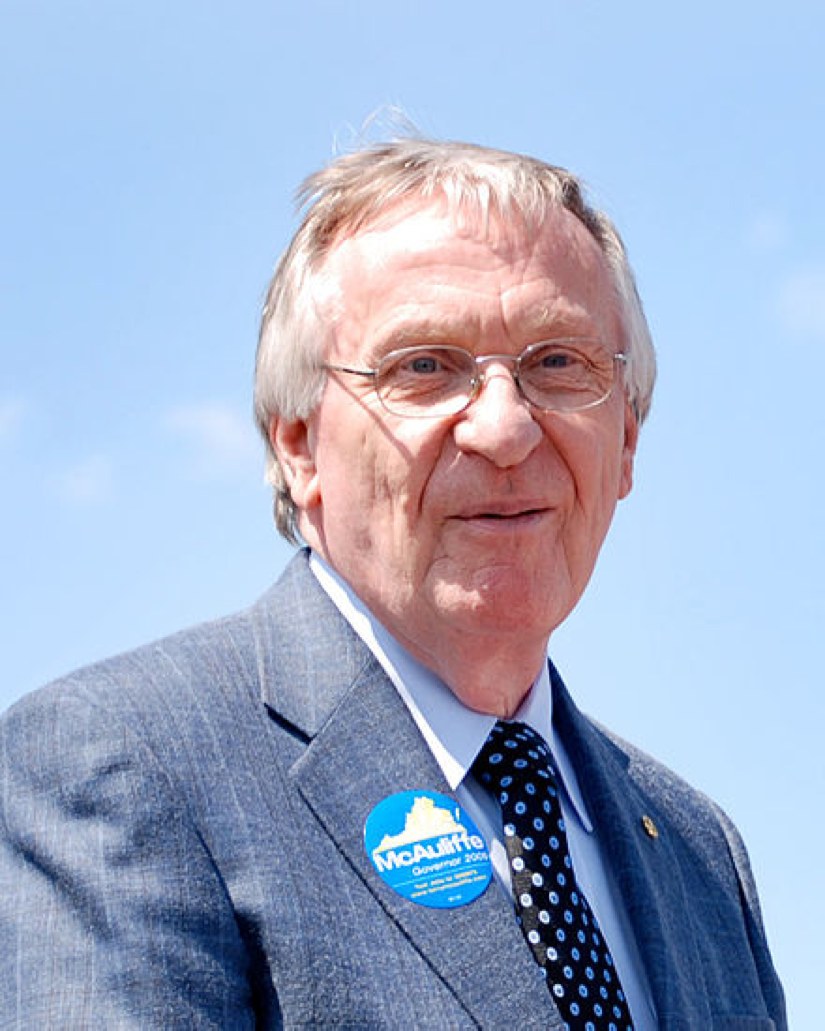 Each year, the Governor of Virginia addresses a joint assembly of the House of Delegates and the State Senate in a speech. It’s not unlike the President’s State of the Union address, except that the Governor provides a “State of the Commonwealth” as well as his recommendations for legislative action.
Last week, I heard the 35th such speech since I have been a member of the House of Delegates. I think Gov. Terry McAuliffe made the best of any of the speeches I have heard over my career in the legislature.
He emphasized the need for all to work together: “…as we launch this new chapter in our history, let us resolve to show the partisans in Washington and across the nation that here in Virginia, in a Commonwealth that pioneered government by consensus, there is no challenge too great, no debate too intractable and no idea too ambitious that we cannot come together on common ground to build the future our families deserve.” The theme of his inaugural events was “common ground.”
He will put an emphasis on economic development. In his speech, he announced two economic development projects that he had already concluded after just three days in office.
“In today’s modern economy, Virginia has to be smarter, more productive and far more aggressive than our sister states for new jobs and investment,” he said. From the tone of his speech it is obvious that no one will be accusing the new Governor of not being aggressive enough in economic development.
His goals are clear, and he does not duck controversial issues. In his own words, “We should stop over-testing our students…The General Assembly should not wait another year to pass the bipartisan Dream Act…On Saturday I was proud to sign Executive Order Number One, which prohibits discrimination in state government on the basis of sexual orientation and gender identity…An open and welcoming Commonwealth requires a state government that trusts women to make their own health care decisions, and works to expand access to quality care…I am eager to work with the coalition of Virginia leaders who agree that we need to strengthen our democracy by passing legislation putting Virginia on the path toward non-partisan redistricting.”
He was just as direct in his support for an expansion of Medicaid to help those “families (who) are just a major illness or accident away from financial ruin.” As he pointed out, if we fail to exercise the option of federal funding for Medicaid, “we will forgo $2.1 billion annually in federal funding over the next three years. That is more than $5 million per day.”
The Governor has extended an invitation for legislators of both parties to work with him. I look forward to working with him in moving Virginia forward.
To read the full text of the Governor’s speech, go toGovernor’s Address.
Ken Plum represents Reston in Virginia’s General Assembly. He writes weekly on Reston Now. He can be reached at [email protected].
Virginia taxpayer dollars not returned to them has amounted to $5 million each day since Jan. 1, 2014, and will continue at that rate each day that Virginia refuses to expand its Medicaid program.
In addition, at least 400,000 working Virginians will continue to be uninsured.
The 2013 session of the General Assembly created the Medicaid Innovation and Reform Commission (MIRC) to consider whether reforms to Virginia’s Medicaid program were sufficient to allow Virginia to proceed with some form of coverage expansion through the Affordable Care Act. MIRC members have been assured by staff that all requested reforms have been made, but the Commission members from the House of Delegates have refused to acknowledge the reforms and continue along with the Speaker of the House of Delegates to oppose expansion of Medicaid.
For otherwise fiscal conservatives to turn down $5 million of Virginia taxpayer dollars being returned to them to pay the full cost of Medicaid expansion shows the continued animosity that some Republicans have toward the Affordable Care Act that they refer to as Obamacare. To the concern that the federal government will not be able to continue funding the program into the future, Virginia could make a decision to withdraw at that time.
At the same time, the Virginia Chamber of Commerce business plan for the Commonwealth, “Blueprint for Virginia,” supports the Medicaid reforms that have been made and recommends Medicaid expansion. Chamber leadership has termed Medicaid expansion to be both an economic development as well as a workforce issue. Most of Virginia’s one million uninsured residents are employed. It is projected that the expansion would create an estimated 33,000 jobs and bring $21 billion dollars back to the Commonwealth.
Gov. Terry McAuliffe is a staunch supporter of Medicaid expansion. As he stated to the Chamber, “Let me be clear on one point. If Medicaid expansion is not the business community’s number one priority in your communication with the General Assembly, it will not happen.” He calls for “coming together, putting old ideological differences aside and focusing on what makes sense from a business perspective.”
The case for Medicaid expansion goes beyond the strong business case; it is also a humanitarian cause. Social justice organizations, faith communities, and individuals need also to give priority to making their views known to legislators. Give priority to writing or calling House and Senate leadership and members of the House Appropriations and Senate Finance Committees and ask them to approve the expansion of Medicaid. Contact information is available at House and Senate members.
Five million dollars a day is a lot of money. It is too much to turn down, especially when it can improve the health and well-being of Virginians. Please make sure your voice is heard on this issue.
Ken Plum represents Reston in Virginia’s House of Delegates. He can be reached at [email protected].
Last month, the disAbility Law Center (dLCV) issued a report on the condition of mental health services in Virginia. It is an eye-opening report: Broken Promises, the Failure of Mental Health Services in Virginia. (Broken Promises Report)
Its findings are direct: “Despite the promises of reform to the mental health service system in the last decade, Virginia’s mental health services system fails to serve many of those in need of its services.”
According to dLCV, there are more than 40,000 Virginians living with serious mental illness and thousands more with less serious emotional disorders that require treatment including an estimated 130,658 children between the ages of 9 and 18 who need treatment. The dLCV which advocates for all people with disabilities to be free from abuse, neglect, and discrimination considers the problem in part to be a misallocation of resources.
As its report points out, on any given month about 10 percent of residents of state hospitals continue to be hospitalized even though their treating professionals have found that they no longer need to be hospitalized. Thirty-one of the 133 individuals in such hospital placements in November, 2013, had been waiting for discharge for more than a year. The problem is that there are inadequate or nonexistent facilities or programs in the community to continue services to these persons. At the same time, there were an estimated 26,990 inmates confined in local and regional jails of whom nearly 25 percent were known or suspected to be mentally ill. More than 3,500 persons in jails were diagnosed with a serious mental illness.
The dLCV maintains that funding is misdirected towards unnecessary hospitalization when funding is needed desperately for community-based crisis response services and housing options for people with mental health needs. Their position is not without controversy. Others maintain that both more hospital spaces and more community-based facilities are needed.
The tragic event surrounding the family of Senator Creigh Deeds has brought the need to the public’s attention. Outgoing Governor Bob McDonnell has proposed a more than $50 million increase in the budget for mental health services and has established a commission to develop a plan for mental health services in the Commonwealth. There is bipartisan support to address the issue in terms of additional funding as well as to amend existing statutes to permit persons who are a danger to themselves and to others to be held for a longer period of time until appropriate treatment is available to them.
We are past the time when we should have met the promises for reform to persons with mental health problems and their families. The 2014 session of the General Assembly must respond. You can view my interview with Colleen Miller, Executive Director of disAbility Law Center of Virginia and another interview with George Braunstein, Director of the Fairfax-Falls Church Community Services Board, both on the topic of mental health reform at Virginia Report.
Del. Ken Plum (D-36th) represents Reston in Virginia’s General Assembly. He can be reached at [email protected].
Legislation that is proposed for consideration by the General Assembly is called a bill. A bill that has passed the House of Delegates and the Senate and has been signed by the Governor in identical form becomes a law on July 1 after the adjournment of the legislative session and is included in the Code of Virginia.
To know what the laws of the Commonwealth are, go to the Code at http://leg1.state.va.us/000/
In addition to passing laws, the General Assembly passes a lot of resolutions. When famous or noteworthy people die, the delegate or senator from that person’s community is likely to introduce a memorial resolution. These resolutions pass routinely without discussion or debate and are approved on a voice vote.
After being printed in a formal format, these resolutions are given to family members in appreciation of and respect for the contributions the individuals made to their communities. Commending resolutions that recognize the accomplishments of individuals, organizations or businesses are handled in a similar way but could result in some debate if a person or action is viewed as being controversial.
This year, I will be asking the General Assembly to commend Robert E. Simon on his 100th birthday and will be recognizing Reston on its 50th anniversary. Such resolutions are educational for members of the General Assembly as well as the public. Framed resolutions are often hung in prominent places by the recipients. Resolutions also are used by legislative bodies to direct their own operations and order of business and to establish studies of issues. Resolutions do not take up much time of the legislature, but they do provide an important way to recognize outstanding people and events in the Commonwealth and to have the legislature state a position on an issue for which a new law may not be appropriate or needed.
The legislature does not have a tradition of passing a resolution at the beginning of each year stating as individuals often attempt to do with their “new year resolutions” what will be done that year. Debate on such a resolution would take up the entirety of the session, and if ever agreed upon may likely be forgotten as realities of the year and the session set in
Such a lack of resolve on the part of legislative bodies at all levels mean that attention is focused on the next great crisis until it is forgotten and then attention is turned to the next. Few issues are truly resolved conclusively, and in fact, the matters with which legislative bodies deal do not lend themselves to one-time solutions. Most legislative actions are incremental as agreements can be reached and are built upon over time. Since conclusive solutions are not immediately evident for the most contentious of issues, the gradual approach to resolving an issue may make more sense. There is little evidence to suggest that legislatures would be any better at keeping annual resolutions than we are as individuals.
Ken Plum represents Reston in Virginia’s House of Delegates. He writes weekly on Reston Now. He can be reached at [email protected].
The editorial in the Sept. 21, 1897 New York Sun, responding to a letter from eight-year-old Virginia O’Hanlon who had inquired about whether there was a Santa Claus, has become the most reprinted newspaper editorial, according to the Newseum.
Virginia’s father had told her that if she read it in the Sun it was certain to be true. The editor wrote, “Yes, Virginia, there is a Santa Claus. He exists as certainly as love and generosity and devotion exist, and you know that they abound and give to your life its highest beauty and joy.”
Virginians, especially those around the capital city, have long believed in Santa Claus. The “Legendary Santa” has been meeting with boys and girls at Miller and Rhoads — first a department store and now a hotel in Richmond — for more than 75 years.
There is ample proof that he is the “real” Santa Claus for he is able with assistance from the Snow Queen and some technology to call every child by name.
We go as a family of four generations with Jane’s mother and our grandchildren to see him at his latest location at the Children’s Museum of Richmond. Read more about this Virginia tradition in Legendary Santa’s Stories from the Chair. On page six is a photograph of young Jane Durham (now Plum) and her brother visiting Santa many years ago.
Throughout the capital, there is a quickened pace of activity during the holiday season in anticipation of the General Assembly convening on Jan. 8 and the new governor being inaugurated on Jan. 11. There are wish lists from all the agencies and special interests. And, yes, Virginia, if there is a Santa Claus here is my wish list for the legislative session.
Virginia would extend health insurance to nearly half its uninsured working poor by expanding Medicaid. Not only would more people have access to preventative care as well as treatment, but Virginians would get more of their federal tax dollars back and a boost to the economy with the health care jobs being created. Also in the area of health, I want Virginia to increase funding for its presently inadequate mental health care program.
While I am wishing, I want the General Assembly to expand background checks for all gun purchases to keep guns out of the hands of criminals and violent people. I also want the legislature to approve my bill to establish an independent redistricting commission that will fairly and objectively draw legislative boundaries. We would on my wish list repeal the marriage amendment and other discrimination based on sexual orientation. And while we are at it, we need to get the state back to the position of being an equal partner in funding public schools.
None of these goals will be reached by simply wishing for them. Hard work, determination, and public pressure can make them reality. Just like in Santa’s workshop, there will be a lot of work behind the scenes.
Del. Ken Plum represents Reston in the Virginia General Assembly. He writes weekly on Reston Now. He can be reached at [email protected].

Is there something you would like addressed in the Virginia General Assembly this year? Your local Virginia General Assembly members want to know.
There are several opportunities to speak with Del, Ken Plum (D-Reston) and Sen. Janet Howell (D-Reston) before they head to Richmond for the 2014 legislative session, which begins in Jan. 8.
Howell and Plum are hosting a public meeting in Thursday, Jan. 2, 7:30 to 9:00 p.m. at the Reston Community Center at Hunters Woods, 2310 Colts Neck Road, Reston.
Additionally, the entire Fairfax County General Assembly delegation will be at at hearing for public comment on Saturday, Jan. 4, at 9 a.m. at the Fairfax County Government Center. The public is invited to attend and comment.
The Reston meeting will be a very casual format, but organizers of the countywide meeting ask that you register in advance if you want to speak. To sign up contact the Office of the Clerk to the Board of Supervisors at 703-324-3151, TTY 711, by noon on Friday, Jan. 3. Speakers also may sign up at the hearing.
Photo of Sen. Janet Howell courtesy of office of Janet Howell
