


Diva Central Accessories Drive ends — A donation drive to collect shoes, jewelry, handbags and other accessories for the Reston Community Center’s annual prom and middle school formal dress giveaway ends today. [Reston Community Center]
General Assembly wrap-up — An infographic gives an easy breakdown on which bills failed and passed. [Virginia Public Access Project]
Pet hedgehog photo — Who doesn’t love pictures of pets? An article rounded up some pictures of Restonians’ pets. [Connection Newspapers]
Reston Hospital Center wins award — “Reston Hospital Center announced it is the first facility in Virginia to earn The Joint Commission’s Gold Seal of Approval(R) for Advanced Certification for Total Hip and Total Knee Replacement… Reston Hospital Center performs more than 1,000 total joint replacements every year.” [Reston Hospital Center]

This is an opinion column by Del. Ken Plum (D), who represents Reston in Virginia’s House of Delegates. It does not reflect the opinion of Reston Now.
As you read this column the Virginia General Assembly will be nearing its adjournment sine die for the 400th year of its existence, having first met in the church on Jamestowne Island in 1619.
During this commemorative year, there will be many opportunities to learn more about Virginia and to reflect on how its history influences it to today even in the current legislative session and in what on another occasion was referred to as its “recent unpleasantries.”
That first session of what became known a century and a half later as the General Assembly was composed of a representative of the 22 plantations that had sprung up along the major rivers of the state as there were no local government, political boundaries or transportation networks in existence. The representatives were all white males who were landowners.
African Americans had to wait for the outcome of the Civil War and women had to wait for the twentieth century before they became part of the electorate. While the right to vote has begrudgingly expanded, over time there continues to be a resistance to making it easier to vote.
In the current session, there were proposals to allow people to vote early or vote absentee without an excuse and to make election day a holiday for the convenience of voters, but it does not appear that any will become law. Establishing a fair way to draw legislative boundaries has been hotly debated, but the decision to establish an independent redistricting commission will await the closing hours of the session.
Slaves were brought to the colony of Virginia in 1619 to work the tobacco fields that were the mainstay of the colony’s economy. They had none of the rights that Englishmen claimed and beginning in the 1640s were subjected to “slave codes” that defined them as property to be bought and sold with no access to learning to read and write or to move about freely.
After the Civil War, these restrictive laws became the Jim Crow laws that continued to limit the rights of black people who were kept in line by the Ku Klux Klan and by public lynchings. White supremacy reigned with black-face entertainment intended to degrade black people through crude humor.
Happenings during this legislative session showed how little we have progressed on issues of human rights and respect, but there is hope. The reminder to the governor of his racist past will make him an even more enlightened person who if he continues can provide important leadership to dismantling racism in the state.
The incredible people of color who were elected to the House of Delegates in the last election bring strong voices to the need for greater equity and justice in the Commonwealth. Some limited reforms that will help establish equity and remove racism in the criminal justice system are on their way to passage.
Women first came to the Virginia colony in 1619. While rights of women have expanded slowly over the centuries, having Virginia ratify the Equal Rights Amendment is still in doubt. May the lessons of this historic legislative session move us forward in future years.
To check on the fate of specific bills, go to lis.virginia.gov.
File photo
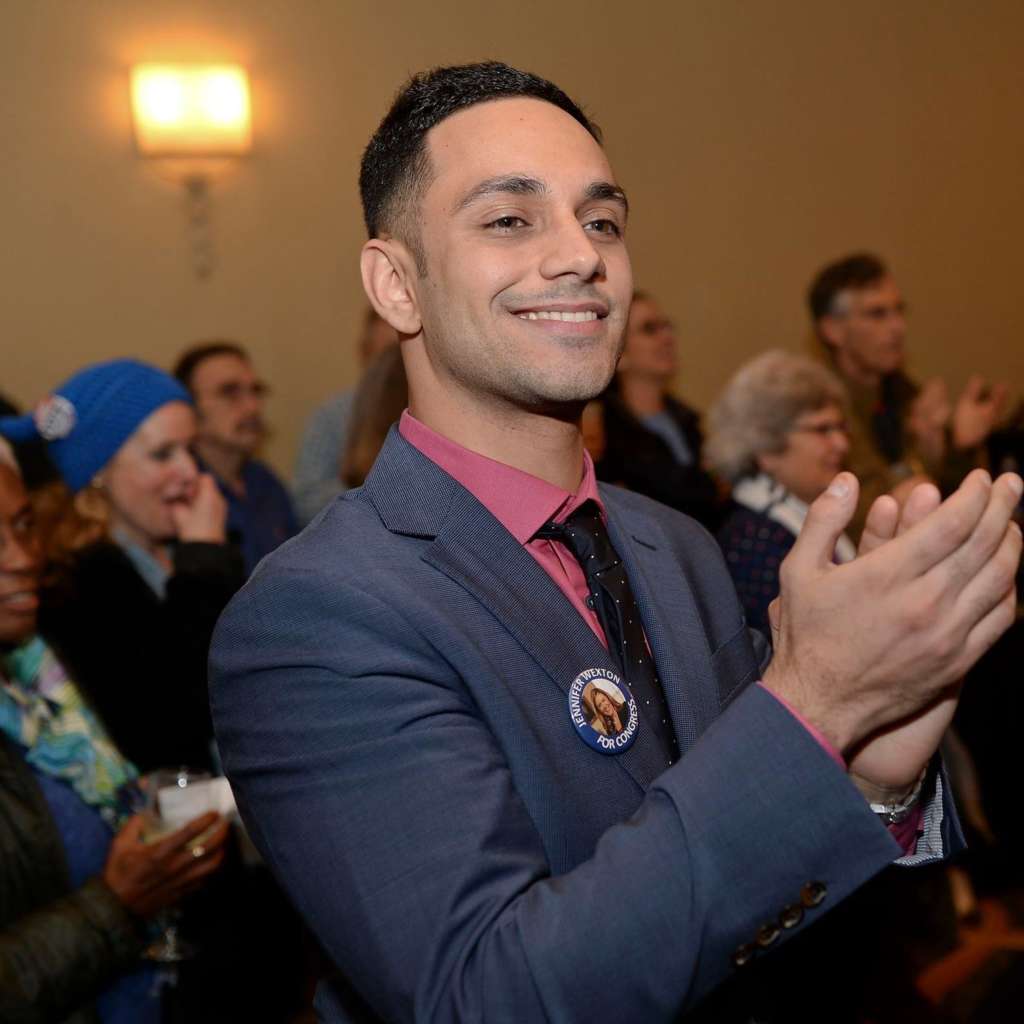 Democrat Ibraheem Samirah, a dentist from Herndon, was sworn into the Virginia House of Delegates this morning after winning the election for the 86th District Seat.
He joins Del. Sam Rasoul as the second Muslim — they are both Democrats — in Virginia’s General Assembly, according to a press release from his campaign.
Samirah, who is the son of Palestinian refugees, was separated from his father in middle school when his father was barred from re-entering the U.S.
The special election yesterday (Feb. 19) to fill now-State Sen. Jennifer Boysko’s former seat was the first time Virginia voters took to the polls after a series of scandals erupted in the state, starting with unearthed racist photos on Gov. Ralph Northam’s medical school yearbook.
The scandals continued with sexual assault allegations against Lt. Gov. Justin Fairfax and with Attorney General Mark Herring’s admission that he wore blackface. News reports revealed that Virginia Senate Majority Leader Tommy Norment (R-James City County) was a top editor of a yearbook that included photos of people in blackface and racial slurs.
Before the special election, Samirah faced attacks after a conservative website published two of his social media posts from five years ago, including one where he said sending money to Israel was worse than sending it to the Ku Klux Klan, according to news reports.
Samirah apologized for the posts, which he said were used in “a slander campaign questioning my views on Israel and my Jewish friends,” in a two-page statement posted on Facebook.
“I am so sorry that my ill-chosen words added to the pain of the Jewish community and I seek your understanding and compassion as I prove to you our common humanity,” the statement said.
Samirah was just shy of receiving 60 percent of the votes, according to unofficial results from Virginia’s Department of Elections.
Republican Gregg Nelson, a U.S. Air Force veteran, received 34 percent of the votes and Connie Haines Hutchinson, a former vice mayor of the Herndon Town Council who ran as an Independent, received almost 6 percent of the votes.
In total, 6,283 people voted in the special election.
Boysko took to Twitter to congratulate Samirah on his win.
Congratulations to @IbraheemSamirah on his resounding win tonight! @VAHouseDems #86th!
— Senator Jennifer Boysko (@JenniferBoysko) February 20, 2019
Samirah ran a campaign focused on healthcare, transportation and education.
Now in office, Samirah is planning “to build on the 2018 Virginia Medicaid expansion and bringing healthcare costs down across the state by ensuring that the healthcare marketplace is competitive and accessible to all,” according to the press release.
Photos from the Virginia House Democrats on Twitter show Samirah being sworn in today.
Congrats to @IbraheemSamirah on being sworn into the @VaHouse this morning. pic.twitter.com/9sBk6mmPbt
— VA House Democrats (@VAHouseDems) February 20, 2019
Photo via Samirah for Delegate/Facebook
This is an opinion column by Del. Ken Plum (D), who represents Reston in Virginia’s House of Delegates. It does not reflect the opinion of Reston Now.
Despite all the distraction associated with events in Richmond these days, the General Assembly is staying on task dealing with legislative and budgetary issues it faces.
Each house of the legislature has started to work on legislation passed by the other with conflicts resolved in conference committees made up of members from both houses. The really big conference committee is working to resolve differences on the budget. The big differences on the budget are between the Democrats and Republicans and not the two houses — how to deal with additional revenues coming to the state from the federal tax changes. Stay tuned for the differences on the budget because they will not be resolved until the last few days of the session that is scheduled to adjourn on Feb. 23.
Some good news is emerging from the session. Requiring hands-free phones in cars has been required in most other states many years ago and may finally be coming to Virginia. Research shows that the greatest cause of auto accidents is distracted driving with calls and texting being the chief reason.
I remember the many sessions that it took to pass requirements for smoke-free areas. Richmond as the cigarette manufacturing capital was finally over-ridden by popular sentiments, and smoke-free areas were legislated. Amazingly but happily the age to buy cigarettes and the latest craze of buying electronic vaping devices is being raised from age 18 to 21.
Efforts to legalize gambling establishments in areas of the state as diverse as Portsmouth, Bedford and Danville failed this year in favor of a year-long study to determine state policy. I predict we will see casinos established in the state in a few years as some regions see them as economic development and a source of new revenue offsetting anemic state funding. I voted to let a study go forward but would not support public financing of a stadium or gambling establishment.
Bills that would have decriminalized marijuana did not make it out of committee in either house. My bill introduced at the suggestion of the Chris Atwood Foundation to make Naloxone more available to reduce deaths from drug overdoses passed.
Different bills passed that purport to create a fairer way to draw legislative district boundaries, but neither comes close to the independent processes that the public has been seeking to end gerrymandering.
On the environment, bills to require Dominion to clean up their coal-ash ponds passed both houses with endorsement by major environmental groups. A bill I voted for that would have established an ambitious agenda for cleaning up the environment in Virginia failed in the House.
The Senate passed a bill to require public schools to teach a class on the Bible! I will not be voting for it if it makes its way through committee.
All the gun safety bills were defeated in both houses. A bill to make it easier to get a concealed weapon if you are from another state passed with a likely veto by the governor.
Yes, there are other big challenges in the capital these days. I will be addressing them in future columns as the facts involved become better known.
File photo
This is an opinion column by Del. Ken Plum (D), who represents Reston in Virginia’s House of Delegates. It does not reflect the opinion of Reston Now.
[Note: This column was written before the release of the photos from Gov. Northam’s medical school yearbook.]
The 2019 session of the General Assembly has reached its mid-point, or crossover, when the two houses start to consider bills that have survived the other house. It also represents the final action on many bills giving an indication of what the ultimate legislation for the session is likely to be.
In the back of most legislators’ minds is the fact that when the legislature adjourns sine die (until another day) the election season will begin. The thought of going home to meet their voters motivates many votes. After all, that is the way it should be in a representative democracy. The results, however, create some absurdities.
Republicans appear to be planning to focus once again on abortion. Although Roe v. Wade — decided in 1973 — was supposed to set the rules for abortions, the debate still goes on. This week in a massive media campaign linked to fundraising, the opponents accused Gov. Ralph Northam, who is a pediatrician, and first-term Del. Kathy Tran, a mother of four (the youngest of whom she was nursing during the session last year), of favoring infanticide!
I witnessed the verbal ambush by some of the most skilled lawyers in the House who with some editing of the tape of their cross-examination of her created a false impression of her bill and what it did. Calling the episode absurd is a mild description; I think Gov. Northam came closer to an accurate description when he called it disgusting. (Read more at abortion restrictions bill.)
Thirty-seven states have ratified the Equal Rights Amendment. It is looking doubtful that Virginia will join that group this year. In floor speeches on the amendment, one of the women opposing the amendment said that she did not need “words on a piece of paper” to get what she wanted.
Bills that would have created an independent redistricting commission including my perennial bill have been defeated in the House. A bill introduced by the Speaker of the House that would create a commission to redistrict the legislature is far from independent in that it still has legislators picking their voters in order to protect incumbents and hold onto the majority. If the bill makes it through the legislature, it will be amended or vetoed by the governor.
It remains difficult for the majority to play fair especially when it holds control by such a slim sliver of power. A two-vote shift in both houses would put Democrats in charge of the legislature.
Major divisions continue to exist between the parties on finalizing the budget. Republicans favor a plan that continues the federal approach of giving tax breaks to those with the highest income. My bill to establish a partially refundable Earned Income Tax Credit (EITC) was defeated. About half the states have used an EITC to help raise the income of working families. There is a slight possibility that Gov. Northam could get the EITC in a compromise budget as he is a strong proponent of it.
Several weeks remain for the legislature to work its will. Some good bills are passing that will be favorable to the people of the Commonwealth, and I will discuss these in future columns. With an election looming in the fall, we may still see more absurdities!
File photo
This is an opinion column by Del. Ken Plum (D), who represents Reston in Virginia’s House of Delegates. It does not reflect the opinion of Reston Now.
The arrival of W-2 forms in the mail reminds us, even if we may have momentarily tried to forget, that tax season is upon us. This is no ordinary tax year, however. Massive changes in federal tax laws will result in significant changes at the state level as well. No one can speak with authority as to what the differences will be for an individual taxpayer as the General Assembly has not revised state tax law to reflect the federal changes.
The situation we are in is not new. Anytime the Congress makes changes in federal tax policy, the state must adjust to those changes and decide whether to adopt the federal policy or to put in new state provisions. As a conformity state, Virginia has generally followed federal policy allowing taxpayers to file state returns using the information on their federal form.
The difference this year is that the federal changes are so massive that conformity is not realistic without major changes in the way state forms are filed. Adding to the fact that the forms may be different is that there are major differences between the way deductions and credits have been handled and what will constitute taxable income. High-income taxpayers that were the winners with the federal changes could significantly reduce monies to a state that is already struggling to meet its obligations to funding schools, mental health programs and other priorities.
Essentially, Gov. Ralph Northam proposed that additional revenues be used for investments in education, workforce development, expanded broadband and targeted tax relief to those who work at the lowest wages. Republicans have proposed a plan to return more monies to taxpayers, but there is strong concern that the Republican plan will make big dents in the state budget.
All agree that a decision needs to be reached soon for taxpayers to file their tax forms as soon as possible and as accurately as possible. In past years as many as 650,000 taxpayers have filed in the first 10 days of February.
I am the patron of a bill supported by Northam that would make a portion of the Earned Income Tax Credit (EITC) refundable to taxpayers based on their income and family size. The current Virginia EITC set at 20 percent of the federal EITC does not allow for a refund of its full value as is done in 23 other states. Under the bill I introduced, it is estimated that as much as $250 million would be returned to the pockets of hard-working Virginians who are at the lowest pay levels. This helps not only those workers, but — since low-income residents typically spend that money on goods and services — it boosts the local economy as well.
There is a sense of urgency in the General Assembly that this issue needs to be resolved as soon as possible, because it impacts every household. Not only is there a great deal of confusion, but that confusion will be multiplied many times as people start to prepare their returns with incomplete directions. The challenge has been known for several months. Tax season is upon us. Our tax policy needs to be resolved now.
File photo
This is an opinion column by Del. Ken Plum (D), who represents Reston in Virginia’s House of Delegates. It does not reflect the opinion of Reston Now.
In a recent social media post, I indicated that the annual General Assembly session would be underway very soon. AutoCorrect changed the text to be “underwater very soon.” My son alerted me to the change, and I made what I thought was a correction. As the General Assembly session has gotten underway I am starting to wonder if AutoCorrect knew something that I am now coming to realize: the General Assembly may well be underwater!
The session is scheduled to go until Feb. 22. Meeting five days a week means 38 actual days for work on more than 2,000 bills and resolutions. While I have highlighted big issues like redistricting reform, preventing gun violence and ERA ratification, there are many more issues large and small that make up the agenda for the session.
Virginia has always conformed its income tax policies to the federal system. With the massive changes that have been made in federal tax law, the General Assembly will wrestle with what we will do in Virginia. There will be an effort to resolve the issue early in the session to accommodate taxpayers who want to file their returns early. Part of the tax policy debate will be making the Earned Income Tax Credit (EITC) refundable as promoted by the governor in a bill that I have introduced. The purpose would be to allow persons of low income to keep more of the money they earn and be more self-supporting.
As a Dillon Rule State — meaning local governments have only the powers granted to them by the state — dozens of bills called “local bills” are introduced to extend powers some of which are very minor to a particular locality. Another group of bills is called “housekeeping” to make corrections or clarifications to legislation that passed in previous sessions. All these bills are important but add to the workload of a session.
Challenging environmental issues will be coming before the legislature many of which relate to energy. There are proposals to increase the required uses of alternative and renewable fuels. Cleaning up from the past use of fossils fuels and the resulting growth in coal ash ponds will be taken up. There is a strong need to deal with the degradation of water quality in the Chesapeake Bay area. The Tidewater area is subject to recurrent flooding coming about with climate change that needs addressing now rather than later.
There are many bills dealing with criminal justice reform including bills intended to reduce the school to prison pipeline. The governor has announced his support of decriminalizing possession of small quantities of marijuana. A bill that has been introduced would allow casino and sports gambling.
There will be a number of dog and cat bills that include high levels of emotion from interested parties. Being able to limit dogs running across the properties of landowners is a big concern in rural areas.
You can review all the bills on the agenda of the General Assembly.
If you have not done so already, let me know your positions on issues by going to my website and click on Legislative Session Survey.
File photo

Nearly one month away from the special election for the 86th District seat, the Fairfax County Republican Committee will hold a meeting on Saturday (Jan. 19) to nominate a candidate.
Yesterday (Jan. 14), the committee put a call for a mass meeting to nominate a Republican candidate for the now-State Sen. Jennifer Boysko’s vacated seat, which represents parts of Fairfax County and Loudoun County.
The meeting is scheduled to take place at the Fairfax Christian School at 22870 Pacific Blvd in Dulles with a start time of 9 a.m. Only Republicans in the 86th District can participate in the mass meeting, according to the website.
Candidates have until 9 a.m. on Friday (Jan. 18) to provide a written statement of intent to Committee Chairman Amanda Morris.
The special election is set for Feb. 19.
On Saturday (Jan. 12), Ibraheem Samirah was nominated to represent the Democratic Party.
This is an opinion column by Del. Ken Plum (D), who represents Reston in Virginia’s House of Delegates. It does not reflect the opinion of Reston Now.
The Virginia General Assembly will convene for its annual session at noon today. The opening session will no doubt note that a form of representative government first met at the church at Jamestown 400 years ago. I am honored to have served nearly 10 percent of the span of existence of the Assembly.
The events of 400 years ago are being observed through a coordinating body, American Evolution, that in its publicity states that “1619 was a pivotal year in the establishment of the first permanent English colony in North America. It was the year of the first representative legislative assembly in the New World, the arrival of the first recorded Africans to English North America, the recruitment of English women in significant numbers, the first official English Thanksgiving in North America, and the development of the Virginia colony’s entrepreneurial and innovative spirit.”
I encourage constituents to participate in the events of the year for I believe they form an excellent starting point for an understanding of where Virginia is today and most importantly where Virginia is headed.
Some historians and public relations experts would proclaim what happened in Virginia in 1619 as the birth of democracy in America. Certainly, it was a small step, but that was 400 years ago. It is time to take another step in our evolution to a more democratic phase in our government. Namely, it is time for the people of Virginia to pick their legislative representatives rather than their representatives picking them. I am referring to the process of redistricting legislative boundaries after the federal census that is often referred to as “gerrymandering.”
In 1982 I introduced what I believe to be the first bill in Virginia to create a nonpartisan and independent legislative redistricting commission. The Democrats who overwhelmingly controlled the General Assembly at the time dismissed the idea for they were firmly in control. When the Republicans took the majority in the General Assembly years later, they also rejected my proposal because they were now in control.
I am pleased with the growth of awareness on the part of the public that the current partisan-controlled system of dividing up the population into legislative districts serves the legislators’ interests instead of their constituents and the issues important to them.
The General Assembly must act in this session to get a constitutional amendment on the ballot in time for a commission to be organized to do redistricting after the 2020 census. Thanks to all associated with OneVirginia 2021 for the advocacy they are doing to bring about this evolution of democracy in the Commonwealth.
Plan to visit the General Assembly during this session that runs five days a week through Feb. 22. All committee meetings are open to the public. Legislator offices are just across Bank Street from the Capitol, and I am always pleased to see constituents. Let’s make sure that when the history of the 2019 session is written that a major step in representative government will have taken place.
File photo
This is an opinion column by Del. Ken Plum (D), who represents Reston in Virginia’s House of Delegates. It does not reflect the opinion of Reston Now.
Governor Ralph Northam took two significant steps last week related to Virginia’s energy future. In a word, both could be summed up as “conserving.” One action of the Governor was to announce the 2018 Virginia Energy Plan. Later in the week, he announced his signing of an executive order establishing a conservation cabinet.
The Virginia Plan makes recommendations in five areas: solar, onshore and offshore wind, energy efficiency, energy storage, and electric vehicles and advanced transportation. The goals within each of these areas are ambitious, but they are essential in shifting energy use in Virginia to a more environment-friendly direction. In a press release on October 2, the Governor is quoted as saying that “the clean energy sector has the power to create new business opportunities, expand customer access to renewable energy, and spark the high-demand jobs of the 21st century.”
Among the goals of the plan are achieving at least 3,000 megawatts of solar and wind energy by 2022, expanding net metering and community solar programs, and doubling the state’s renewable energy procurement target to 16 percent by 2022. The plan recommends that the state support Dominion Energy’s planned 12-megawatt offshore wind turbine demonstration project with a target of 2,000 megawatts of offshore wind energy by 2028.
The plan also recommends that the state-sponsored efficiency programs and financing set a 16 percent renewable procurement target and a 20 percent energy efficiency target for state agencies, moving state agencies in the direction of greater efficiencies and the use of renewable energy in a lead-by-example approach. The plan seeks also to increase the annual dollars of investments by utilities in energy efficiency programs. Recommendations also call for action to promote alternative-fuel vehicles with the development of an Advanced Clean Cars program with targets for charging stations and the state’s vehicle fleet.
The Commonwealth and utilities in the state have started efforts in many of these areas as a result of legislation passed by the General Assembly earlier this year. The plan reflects an underlying goal that the strategy not unfairly impact low-income and minority communities. Review the plan at Virginia Energy Plan.
In a separate action, Governor Northam issued an Executive Order establishing the Governor’s Conservation Cabinet, a new initiative “to better protect Virginia’s vulnerable natural resources and improve environmental quality across the Commonwealth.” The Governor stated that “this effort will strengthen our inter-agency coordination and allow us to bring all of our resources to bear in addressing environmental threats and ensuring best practices across state-driven conservation initiatives.” The initiative will seek to work with state agencies, localities, nonprofit land trusts, and willing landowners as well as partners in both public and private sectors, according to the press release announcing the Governor’s action.
Members of the Conservation Cabinet include the Secretaries of Agriculture and Forestry, Commerce and Trade, Finance, Natural Resources and Transportation. The full text of the Governor’s announcement can be found at Governor’s Conservation Cabinet.
While some will criticize state government for moving too slowly and not being bold enough in the areas of energy and the environment, I am pleased that we are at least moving in the right direction as it relates to Virginia’s energy future.
File photo
This is an opinion column by Del. Ken Plum (D), who represents Reston in Virginia’s House of Delegates. It does not reflect the opinion of Reston Now.
The proposed Equal Rights Amendment (ERA) designed to guarantee equal legal rights for all American citizens regardless of sex has had a long and tortuous history. With the almost daily unfolding stories of abuse of women from lower pay, discrimination in employment, physical and mental abuse and other degradation, it has become obvious that it is about time for the ERA.
Alice Paul of the women’s suffragist movement is credited with writing the first draft of the ERA that was introduced in Congress in 1921. An amendment for submission to the states for ratification as required by Article V of the Constitution did not pass both houses of Congress until 1972 with a deadline of March 22, 1979 for the states to act. That deadline has been extended twice as the required 38 state ratification has never been met.
Currently 37 states have ratified the ERA although several states have sought under questionable legality to rescind their ratification. Both houses of the Virginia General Assembly have never ratified the ERA, but the State Senate has ratified it in 2011, 2012, 2014, 2015, and 2016. The Senate resolutions were never reported from the House Privileges and Elections Committee nor were resolutions introduced by House members ever reported from committee. I have been a supporter of the ERA during my entire tenure in the House of Delegates and co-patron of resolutions to ratify it; I have never had an opportunity to vote on it because the conservative House Privileges and Elections Committee has never had enough favorable votes to report it to the floor.
I am hopeful that the Virginia legislature will step up to be the state to finally ratify the ERA. Even with a favorable vote there are certain to be court challenges to the ratification because of the missed deadlines and because of efforts by some states to rescind their earlier ratifications. Even with these challenges the Virginia General Assembly should take action. The outcome of the 2016 state elections with the increased number of women in the House of Delegates should be enough to nudge Virginia forward. The phenomenal increase in activity by women in various political organizations in Virginia will send a signal to candidates for the House of Delegates in 2019 that they need to support the ERA.
The arguments of the past that women would be drafted into the armed services if the amendment was ratified no longer seem legitimate with women already providing outstanding service in the military. The high-profile stories of women being harassed and abused in work and social situations provide support for the ERA being part of the Constitution.
Virginia’s declaration of rights drafted by George Mason became the model for the Bill of Rights of our federal Constitution. Just as Virginia led in the fight to enumerate our rights, the Virginia General Assembly can lead again albeit a little tardy by being the final state needed to ratify the Equal Rights Amendment. It’s about time!
File photo
This is an opinion column by Del. Ken Plum (D), who represents Reston in Virginia’s House of Delegates. It does not reflect the opinion of Reston Now.
Sorry, but this is yet another column on the continuing effort to de-gerrymander House of Delegates districts in Virginia as directed by the federal courts. In this instance, it was the Republican Party who in the majority after the 2010 census drew district lines that were designed to keep them in the majority until the next census in 2020 when lines must be drawn again. They ran into trouble when to dilute the votes of African Americans who traditionally vote Democratic they packed them into eleven districts in the Richmond and Hampton Roads regions. A panel of federal judges found the practice violated the constitutional rights of the individuals involved and ordered the districts to be redrawn. The Governor called the General Assembly into special session last week to carry out the court’s directive. The legislature went home without success after one day of effort.
Why is the Republican majority failing to do as the court directed? The reason is quite simple. If it took an unconstitutional drawing of district lines to maintain their majority in the House of Delegates, an undoing of those lines would likely take away their majority. Is the court favoring Democrats in what they are doing? No, the court is protecting the constitutional rights of individuals. The court does not take into account partisan outcomes. You simply cannot deny equal representation in the legislature of a class of people without running afoul of their constitutional protections.
When the court found Virginia’s Congressional districts to be unconstitutional several years ago, the remedy of that situation was new districts that resulted in the election of an additional African American congressman from the state that up to that point had only one. Both happen also to be Democrats.
The court has denied an appeal from the Republicans of their directive to resolve the unconstitutional districts. If the General Assembly fails to carry out the court’s mandate, the court will redraw the districts themselves. Presumably there would be special elections held right away in the new districts.
In the meantime, House Democrats have proposed a redrawing of the legislative lines to make the districts constitutional which unsurprisingly could result in the election of as many as five new Democrats. The authors of the new maps insist that they did what needed to be done to follow the court’s directive and not what would give them more seats. The day of the special session was spent with the Republicans picking apart the proposed map in an attempt to show that it was too partisan.
Republicans called the map hypocritical, and one of my Democratic colleagues, Delegate Steve Heretick, called it a “self-serving political power grab.” I draw two conclusions from the last several months: The court needs to take immediate remedial action to correct the constitutional problems with the current districts, and the General Assembly at its next legislative session must pass a constitutional amendment establishing a truly independent commission to do redistricting. The amendment would need to pass a second session of the General Assembly and a referendum of the people. Legislative bodies simply cannot rise above their own self-interests to do the job fairly.
File photo
This is an opinion column by Del. Ken Plum (D), who represents Reston in Virginia’s House of Delegates. It does not reflect the opinion of Reston Now.
Last week I had the opportunity to visit one of my grandsons’ school, and I was genuinely impressed. Parents were invited to come by last week to meet the teachers because his school started on August 15. It was one of the friendliest environments I have experienced–smiles everywhere, genuinely warm greetings for all, and an obvious feeling of caring for all children and parents and grandparents coming into the school. My grandson was clearly eager to get back to school and to see his teachers. He has some special needs that require additional understanding and assistance, and he is clearly getting it in his school setting.
The teachers and administrators wore the school’s special tee shirt and were giving high-fives all around. As one who taught in the classroom for several years, many old memories came back to me. I remember the need to always be “on” in the school day for students who needed help or attention. In most careers we can coast on a bad day and make up for it later; not so with teaching. You are always the center of attention and must be appropriately responsive to student needs whenever they occur. Students can learn as much about life from your body language and attitude as they can from the subject you are teaching them.
While teachers are assigned a grade level or a subject area, ultimately teachers are teaching children more than just content. I am convinced my son who teaches students in automotive technology is teaching as much about attitude, work habits, developing confidence and being a good citizen as he is about an automobile. Our daughter who teaches multiply challenged children at the elementary level is demonstrating for parents, the school, and the community the inherent value and potential for every student regardless of the challenges they might face. My wife who was a preschool teacher and director demonstrated how important it is that young children get off to a good start and is now teaching other teachers to do the same.
Increasingly school divisions are getting an exception to the “Kings Dominion Law” requiring that schools begin after Labor Day. Fairfax County Public Schools is one district now starting before Labor Day. I have always opposed the current law and have voted to repeal it many times. A bill carried over from the past session for further consideration would leave the decision of the starting date for schools up to the local school division based on the unique circumstances of the community.
The legislature can do much more to support the education of our children than dabble in the starting date for schools. Pay for Virginia teachers lags below the national average by about $4,000. Clearly, teachers do not stay in the profession for the money, but they should not have to suffer with low pay because they chose to educate our children. At least in the community, we can express appreciation and offer our thank you to our teachers for the important work they do!
File photo
This is an opinion column by Del. Ken Plum (D), who represents Reston in Virginia’s House of Delegates. It does not reflect the opinion of Reston Now.
Regardless of the old adage, it is possible to teach old dogs new tricks. In fact, if old dogs are to survive in a modern world characterized by rapid change they must adopt many new tricks of survival and adaptation. Those who do not are headed to the scrap pile of history to serve as examples for those who follow.
As I have mentioned in this column many times, the forerunner of the Virginia General Assembly met first in 1619 making it the oldest continuous legislative body in this hemisphere. Sometimes our current General Assembly meets serious challenges as the leader in change for the good, but too often it acts as a barrier to change that was needed.
I was reminded of this in my recent attendance at the annual meeting of the National Conference of State Legislatures (NCSL). NCSL describes the states as the laboratories of democracy where different histories, culture, and geography define each of the 50 states with similar challenges for which various approaches to governance are tried. As I explained last week, we can learn a great deal from each other as we meet together. I will share several examples that I think make my point.
All states are struggling with making higher education more accessible, affordable and relevant. Most state higher education systems are based on models that date back centuries. Most agree that those models are not meeting the needs of the students of today. I attended a session at NCSL where the president of the University of Arizona spoke on the changes he has brought about at his school in increasing enrollment, raising the graduation rate, reducing student debt, and increasing research dollars all while decreasing the per student costs.
His story is a very impressive one that can be most easily explained by his setting aside the usual model of university organization and operation and the adoption of an enterprise model that combines good educational policies with successful business practices. We need to take a hard look at adopting some of these successful practices in Virginia.
The conference was in California that is suffering through historically high temperatures, a very serious drought and wildfires that are devouring thousands of acres. My cell phone was set to alert me of happenings back home in Virginia. I got regular alerts of heavy rains, lightning, flash flooding and road closures. It is obvious that the federal government is not going to provide leadership on climate change that is at the root of these issues, and the states must take on the responsibility.
A final example of the need for the old dogs of state legislatures to step up and provide leadership is in juvenile justice reform. We must reduce the classroom to prison pipeline by intervening early with young people in need of services and assistance to keep kids out of prisons that increase rather than resolve their problems. It is less expensive and more humane. Virginia is doing a much better job in this area, but I was also impressed with what I heard is going on in Kentucky and California.
Old and new legislative leaders must learn new solutions!
File photo

Serving the Walker Nature Center — The center has several open volunteer opportunities in July. Volunteers can sign up online. [Volunteer Reston]
The little mermaid — Tickets for the performance of Disney’s “The Little Mermaid” are on sale ahead of the July performance. [Herndon Drama]
Stateside: New laws begin July 1 — New state laws going into effect on Sunday would create a program for abducted adults, prohibit lunch shaming and more. [NBC4]
Flickr pool photo by vantagehill
