

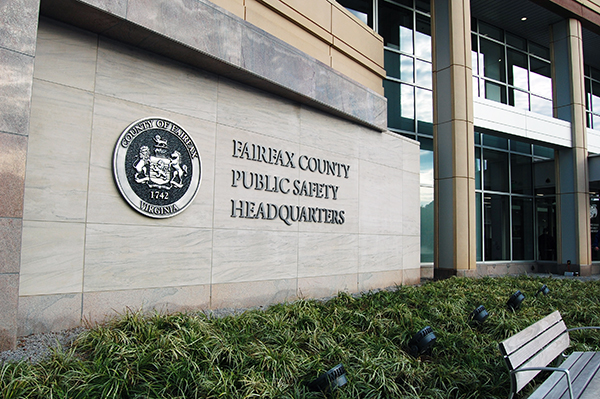
Human remains found near Route 1 earlier this week could be the victim of a possible serial killer, the Fairfax County Police Department says.
Police say the remains were found Wednesday (Dec. 15) in a container near a shopping cart in the 2400 block of Fairhaven Avenue in the Alexandria area. The surrounding area is described as isolated and wooded.
Fairfax County Police Chief Kevin Davis will share details this afternoon about evidence that police have gathered suggesting the dead individual is the victim of a serial killer, with four bodies discovered across the state since August, according to a media alert.
Kelley Warner, the chief of police for the City of Harrisonburg, will also be present at the news conference, which will be held at 1:15 p.m. today (Friday) in the Public Safety Headquarters (12099 Government Center Parkway).
The conference will be livestreamed on the FCPD’s Facebook page.

As Fairfax County prepares for a “likely” wave of omicron infections, officials are cautiously optimistic that vaccination rates and the potentially less-severe illness caused by the variant may prevent a surge like what was seen last winter.
Fairfax County Health Department Director Dr. Gloria Addo-Ayensu and epidemiologist Dr. Ben Schwartz lauded the county’s vaccination rates in a status update for the Board of Supervisors’ health and human services committee on Tuesday (Dec. 14).
At the same time, the officials urged residents to get their booster shots in anticipation of already-rising case rates getting accelerated by the omnicron variant that’s quickly spreading around the globe.
While early research suggests the variant is more transmissible and has an increased ability to infect those who are already vaccinated, officials remain hopeful that Fairfax County can avoid a winter surge as drastic as the one seen a year ago.
“We are likely to have an omicron wave here,” said Schwartz. “[But] what we are hearing so far about omicron is that there are fewer hospitalizations.”
The COVID-19 vaccines, particularly booster shots, help prevent severe illness, the experts note. As of yesterday (Wednesday), nearly 69% of all Fairfax Health District residents were considered fully vaccinated, one of the highest rates in the D.C. area.
But that doesn’t mean residents no longer need to be cautious or careful during the holiday season.
“Even if most infections are mild, a highly transmissible variant could result in enough cases to overwhelm the health care systems,” Schwartz said.
Booster shots are being highly recommended as well as continuing to mask indoors, even if it’s technically no longer required.
“We’ve got to stay with the mitigation efforts,” Board of Supervisors Chairman Jeff McKay said. “I know everyone is exhausted with them, but now is no time to let our guard down.”
Omicron aside, hospitalizations and deaths are currently down across the county, with officials crediting vaccinations.
In addition, while infections were once higher among communities of color compared to the county’s white population, those rates have since more or less evened out.
“This is…a consequence of vaccination, where Hispanics in Fairfax County have a higher vaccination coverage rate than other racial and ethnic groups,” Schwartz said.
Children between the ages of 5 and 9 currently have the highest rate of infection, likely due to that age group just being approved for vaccines a little over a month ago.
Cases within Fairfax County Public Schools, though, have remained very low, according to county health department statistics. Just 0.76% of all students have contracted COVID-19 since late September. The rate is highest among elementary school students, likely due to the delay in vaccination approval.
To this point, 40 school outbreaks have occurred, which are classified as three or more cases within a class or group, but no schools have had to close due to COVID-19.
“This should be proclaimed very widely to the community. These school numbers…are a massive success,” McKay said.
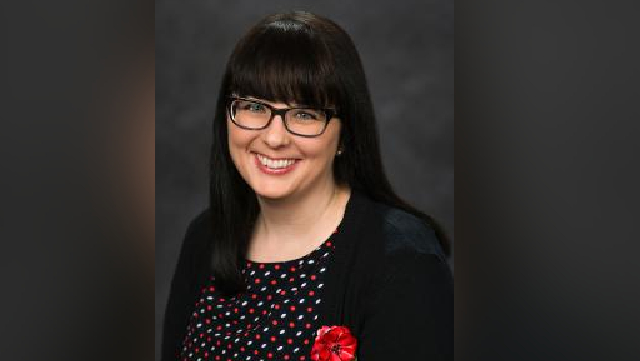
A coalition that tried to recall school board member Elaine Tholen has filed another recall petition, this time for school board member Laura Jane Cohen.
Open FCPS Coalition says it’s seeking to remove the Springfield District representative over Fairfax County Public Schools’ pandemic response. Dee O’Neal Jackson, the group’s founder, said in a statement that the school board has failed students during the pandemic, especially those with learning disabilities.
“We hope the Court recognizes the concerns of these 8,000 residents and requires Ms. Cohen to explain why the concerns of these parents are invalid,” the group said in a statement, stating that it filed the 8,000-plus signatures collected for the petition on Friday (Dec. 10) at the Fairfax County Courthouse.
Open FCPS Coalition has gathered signatures against multiple school board members and previously noted concerns with school closings during the COVID-19 pandemic. The Open FCPS Coalition formed in fall 2020 to protest Fairfax County Public Schools going virtual during the pandemic and campaigned to recall Tholen, who represents Dranesville District, and Member-at-Large Abrar Omeish.
Cohen noted Tholen’s case was summarily dismissed after a special prosecutor said he had investigated the allegations in the petition and found that none of them could be substantiated.
“Allowing public officials to be recalled over policy disagreements unnecessarily politicizes their work,” Cohen said in a statement. “Virginia law is clear: differences of opinion over matters of policy are simply not grounds for removal from office.”
While the Open FCPS Coalition describes itself as a grassroots, bipartisan group concerned with keeping politics out of schools, it’s received funding contributions from former Republican gubernatorial candidate Pete Snyder and N2 America, a nonprofit dedicated to advancing center-right policies in the suburbs.
Open FCPS Coalition previously said only one school board member, Braddock District representative Megan McLaughlin, advocated for reopening in a way it felt was consistent and a priority.
“The Board has worked hard to ensure the safety and health of our 180,000 students and tens of thousands of teachers and staff during the pandemic,” Cohen said in a statement. “I’m proud that we’ve been able to successfully return and keep students in our buildings this year and provide a much more normal school experience in spite of the pandemic related challenges all systems are facing.”
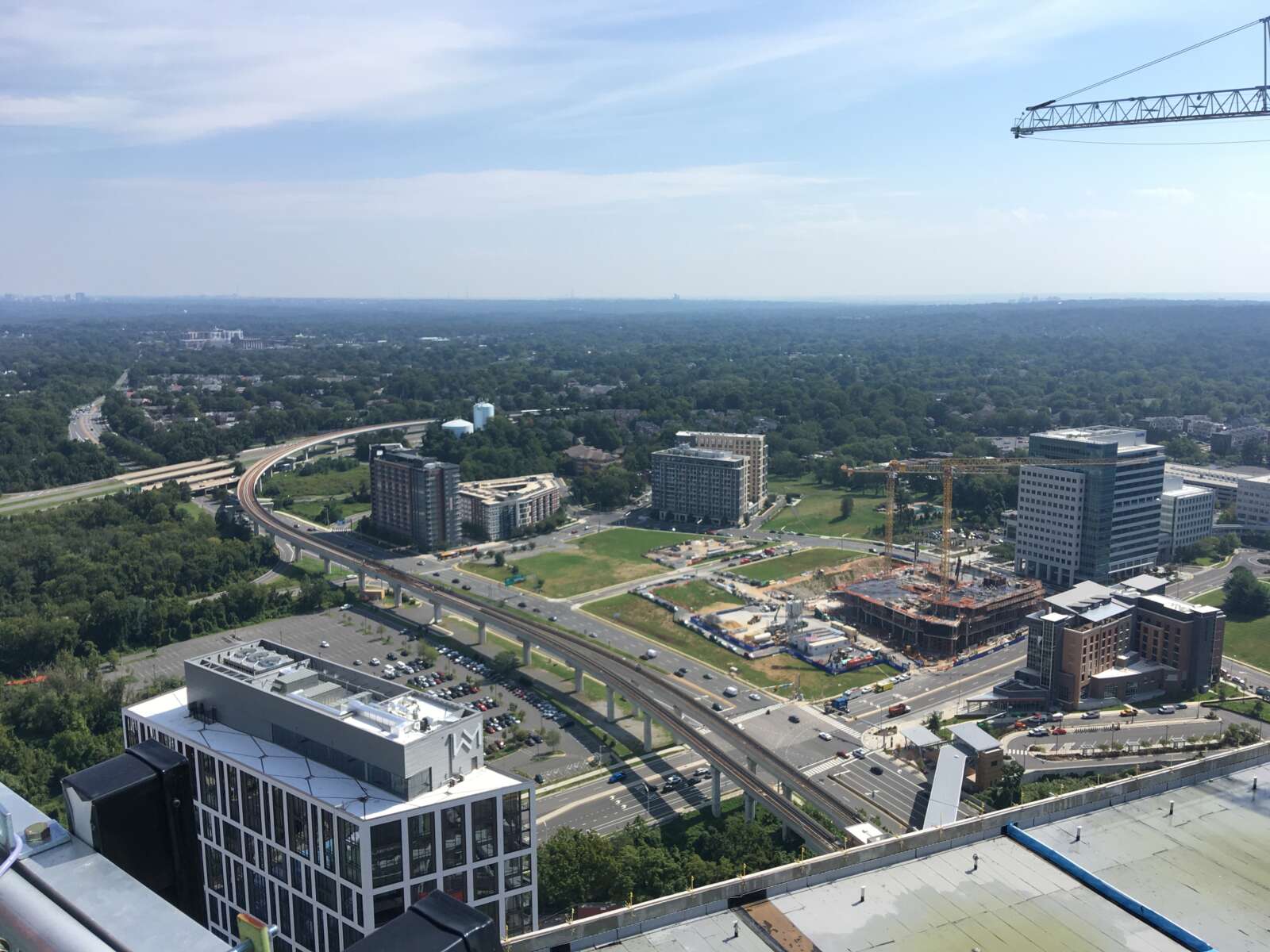
Fairfax County’s growth has come with deadly and dangerous roads for pedestrians, congestion for drivers, and other consequences that planning leaders hope to reverse.
At a Tysons committee meeting on Thursday (Dec. 9), the Fairfax County Planning Commission cited downtown Falls Church, Merrifield’s Mosaic District, and Reston Town Center as examples of what developers and governments should strive to make: mixed-use communities where people can live, shop, work, and play.
Deputy County Executive Rachel Flynn said the emergence of major thoroughfares, shopping meccas, and other projects have dramatically changed how pedestrians interact with streets, which were increasingly built with the goal of getting vehicles from point A to point B as quickly as possible.
“We shifted how we built…our roads,” she said, noting how 100 years ago, pedestrians shared roads with bicycles, horses, streetcars, and automobiles, and speed limits were about the same pace as pedestrians themselves.
She said streets used to be considered “owned” by everyone, used for everything from a marketplace for businesses to playground for kids.
“Everybody got to use the street equally,” she said.
Is Mixed-Use Development Helping?
Mixed-use projects like Reston Town Center and the Mosaic District present an alternate path forward that more consciously balances the needs of different road users, Flynn said, pointing to The Boro in Tysons, Comstock’s Reston Station, and the upcoming Halley Rise complex in Reston as other examples.
“Whenever you see people just walking in the street, you know you’ve a great street. You know it’s safe,” Flynn said.
Suggesting their walkability is closer to what might be seen in a city, she said these projects have proven successful for developers and the public, creating places where people want to live as well as destinations.
However, with lower parking requirements and other measures aimed at reducing vehicles, such projects haven’t always come with community support. The pending Campus Commons redevelopment caused an uproar over congestion at Wiehle Avenue and ultimately included changes to accommodate concerns.
The Fairfax County Board of Supervisors also recently approved an expansion of The Boro that some feel lacks sufficient accessibility accommodations and traffic controls, particularly across Westpark and Greensboro drives.
How We Got Here
Fairfax County’s road network is hardly alone in privileging cars, with everyone else as an afterthought.
With the rise of mass-produced vehicles, the automobile industry campaigned to change how streets were used and designed. Lobby groups pushed the term jaywalker to shift blame for crashes onto pedestrians, and the rise of highways and sprawling suburbs in the mid-20th century — not to mention some conspiring by oil and car companies like General Motors and Standard Oil — led to the demise of rail-based transit systems.
As time went on, regions across the country expanded lanes to allow more vehicles to travel, but as the D.C. region knows all too well, those changes can have the opposite effect, accommodating congestion that brings traffic to a stop.
Flynn noted that 71% of people drive alone to work in Fairfax County — a number she says the county should “get down to 50%” by including multimodal improvements in road and development projects.
“We’re not going to widen our way out of this,” she said.
What Could Happen Next
To establish a more comprehensive vision for walking, bicycling, and other non-motorized forms of travel, the county started developing an ActiveFairfax Transportation Plan last year.
Expected to be completed at the end of 2022, the project incorporates a “Complete Streets” concept that emphasizes safety and mobility for all road users and prompted the creation of a Safe Streets for All initiative.
Some options for improving street safety in dense population centers like Tysons and Reston include slowing speeds between 25 to 35 mph, limiting certain roads to six thru-lanes, adding on-street parking, and pursuing other ways to calm traffic, Flynn said.
She wants the county to make “beautiful boulevards,” not “car sewers.” Addressing I-95 congestion and the use of Route 1 in the Lorton area to bypass problems, Flynn suggested the county could rethink how to discourage cut-through traffic.
“We’d be glad to have you,” she said. “You can come here, but it’s going to take you a little longer and this is our main street. This is not our 95 anymore.”
Flynn also said inadequate crosswalks create problems, noting that seniors, people of color, and poorer people are disproportionately among the pedestrians killed in crashes, according to D.C. advocacy group Smart Growth America.
Planning Commission representatives expressed their support for a less car-centered mindset, saying they would like involve the Virginia Department of Transportation and other organizations in discussions.
At-Large Commissioner Timothy Sargeant said the county’s planners have already changed their thinking, embracing seemingly bad grades for traffic efficiency.
With fatal crashes, merchants losing business, and limited space for development, several cities have shifted away from the volume-based metric are highlighting another model: reducing vehicle miles traveled.
Flynn also suggested infrastructure improvements can help create a sense of place and show people “we care about you,” praising the presence and beauty of the Arlington Memorial Bridge.
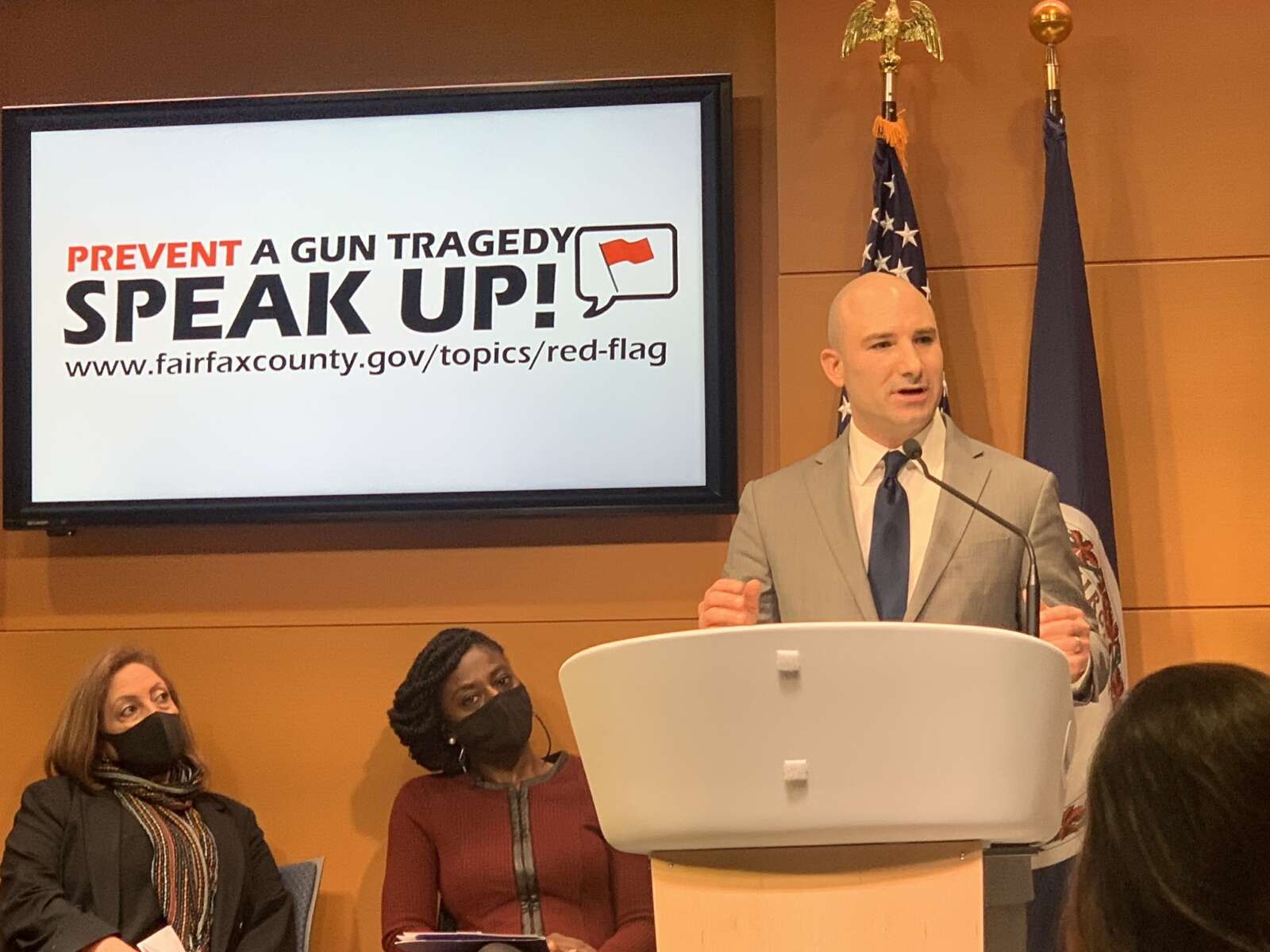
Fairfax County police can now temporarily take guns away from people deemed a risk.
The procedures allow law enforcement to intervene before violence occurs, rather then retroactively responding to crimes, according to county leaders, who touted Virginia’s legislative change that went into effect July 1 last year.
Advocates suggested the law can help prevent domestic violence, suicides, and school shootings.
“Help us to prevent another gun tragedy,” Commonwealth’s Attorney Steve Descano said yesterday (Monday) during a news conference at the county’s Public Safety Headquarters.
Previously, law enforcement’s hands were tied, Descano said. Now, people can call or text 911, which initiates a Fairfax County Police Department investigation.
If a court determines with probable cause that a person poses a risk of harming themselves or others with a firearm they have or could get, the court can prohibit them from purchasing, possessing, or transporting those weapons.
In addition to D.C., 18 other states have introduced similar measures, dubbed “red flag laws,” starting with Connecticut in 1999. It has been upheld in courts because it has a due process element, said Paul Friedman, executive director of the Alexandria-based nonprofit Safer Country, which advocates for gun violence prevention.
While critics have argued that red flag laws take away Second Amendment rights, Descano said that those affected are given a full hearing.
Intended as the launch of a new communications campaign to increase awareness of the new law, the press conference took place one day before the nine-year anniversary of the Sandy Hook Elementary School shooting in Connecticut on Dec. 14, 2012, when 20 children and six educators were killed.
Friedman also noted the 2018 Parkland, Florida, high school shooting that left 14 students and three staff dead, and parent Fred Guttenberg, whose daughter was one of the victims, has said he wished the state had a red flag law at the time. Florida later created one.
“We are now living in a world with…a gun violence crisis,” said Friedman, whose organization advocated for the change in Virginia. “We can save lives with this law.”
The law allows a law enforcement officer or the Office of the Commonwealth Attorney to petition a court through an emergency substantial risk order, which can be used to enforce a temporary removal and purchase restrictions on weapons.
The court has to hold a hearing no later than 14 days later, where the affected party has the right to attend and can be represented by counsel. The court then rules on whether the removal should be turned into a substantial risk order for 180-day periods, which can be renewed indefinitely, if a court finds cause to do so.
Belinda Massaro, a mobile crisis unit manager with the Fairfax-Falls Church Community Services Board, said family members are often in the best position to know about potential issues, noting that suicide is a leading cause of death in the U.S.
She also challenged the harmful narrative that violence stems from mental illness, noting that serious mental illness is only involved 4% of violent acts in the country.
“People with mental illness are more often victims of violence than the cause of violence,” she said. “Studies have shown that people with mental illness are 23 times more likely to be victims of a violent crime than others.”
However, the future of the red flag law is uncertain, as Virginia prepares for a legislature and governor’s office now led by Republicans, who could dismantle the measure amid pressure from the National Rifle Association.
A reversal would remove Fairfax County’s power to use it, Friedman told FFXnow. He said it would survive if Democratic legislators who narrowly hold a majority in the Senate keep their stances the same.
Descano said he wanted the law strengthened, suggesting a 180-day provision could be doubled to provide more comfort to families.
Fairfax County authorities said they’ve used the law for 34 emergency substantial risk orders and 18 substantial risk orders. They encouraged people to speak up if they notice a potential issue.

Fairfax County’s current COVID-19 surge has now surpassed the late summer wave fueled by the delta variant’s arrival.
The county is averaging 216.7 new cases per day for the past week — the most since Feb. 19, when the weekly average was at 228.9 cases, according to Virginia Department of Health data.
While cases have been rising since early November, the weekly average has increased by 100 cases since Nov. 28, suggesting the county is starting to see the effects of Thanksgiving gatherings and other holiday activities.
Fairfax County added 338 cases on Wednesday (Dec. 8) and another 361 cases yesterday (Sunday). Prior to this week, the county had not seen more than 300 cases in one day since Feb. 13, though the number of new cases dropped to 139 today (Monday).
At this rate, the Fairfax Health District’s case total for the pandemic could reach six digits within the next week. The district, which includes the cities of Fairfax and Falls Church, has reported 99,541 COVID-19 cases so far, along with 4,212 hospitalizations and 1,228 deaths, two of them in the past week.


Virginia as a whole has now surpassed 1 million cases, and the Commonwealth identified its first infection by the emerging omicron variant last Thursday (Dec. 9), though it hasn’t confirmed any additional cases from that strain since.
With community transmission levels now high, the Fairfax County Health Department has urged residents to get a COVID-19 vaccine or a booster shot, for those who have already been vaccinated, before meeting with family and friends during the upcoming Christmas and New Year’s holidays.
According to FCHD data, 915,160 Fairfax Health District residents — 77.3% of the population — have gotten at least one vaccine dose, including 87.3% of people 18 and older, almost 89.7% of adolescents aged 12-17, and 38.3% of 5-11 year olds.
813,245 residents, or 68.7% of the population, are fully vaccinated, including 79% of adults.
216,150 residents have received a booster or third dose, including 383 people aged 12-17. Booster shots of the Pfizer vaccine became available to 16 and 17 year olds on Friday (Dec. 10) after the Centers for Disease Control and Prevention expanded its recommendation to include that age group.
The CDC is also now recommending that individuals conduct a self-test for COVID-19 before participating in an indoor gathering with people who aren’t in their household.
After its initial batch of kits ran out within an hour of their availability, Fairfax County Public Library received an additional 30,000 rapid COVID-19 testing kits last week and reported that all branches had some in stock as of Friday afternoon.
Testing is also available through health care providers, retail pharmacies, FCHD sites, and other locations in the community.
While the Fairfax Health District has seen a decline in testing encounters over the past week, the testing positivity rate has jumped from a seven-day average of 3.4% on Nov. 23 to 5.4% as of Dec. 9.

Fairfax County could be hit by wind gusts of up to 55 miles per hour this weekend, courtesy of stormy weather that could pass through the D.C. region ahead of an expected cold front.
A Wind Advisory has been issued for the area, starting at 4 p.m. tomorrow (Saturday) and continuing until 1 a.m. Sunday (Dec. 12).
The National Weather Service says to prepare for west winds of 15 to 25 miles per hour, with gusts that could reach up to 55 miles per hour. The highest wind speeds are expected to come between 6 p.m. and midnight.
“Gusty winds could blow around unsecured objects,” the NWS said in its alert. “Tree limbs could be blown down and a few power outages may result.”
According to the Capital Weather Gang, the high winds will contribute to a rise in temperatures, which current forecasts indicate could hit an unseasonable high of 70 degrees Fahrenheit on Saturday even with a 70% chance of precipitation during the day.
Temperatures are expected to drop back into the 40s on Sunday.
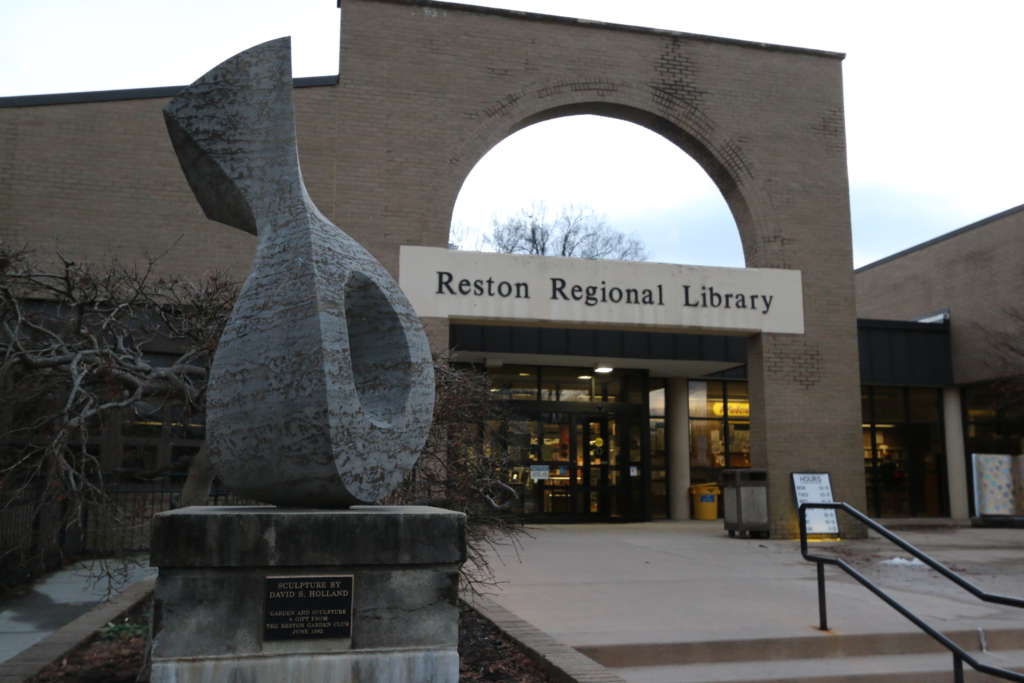
Fairfax County Public Libraries will no longer charge fines for most overdue materials, joining other jurisdictions in the D.C. area in an effort to maintain equity.
The FCPL Board of Trustees unanimously approved the policy in a meeting on Wednesday (Dec. 8). The new system, which begins on Jan. 1, would also reset fines that have already been incurred.
Board of Trustees Chair Fran Millhouser said the policy change is intended to encourage all individuals to take advantage of the library system.
“The FCPL Board of Trustees has approved eliminating fines on most materials and joins surrounding jurisdictions in removing this significant barrier to equitable access to information and library services,” said Millhouser.
The move comes after the board discussed the issue with the Fairfax County Board of Supervisors in mid-October. An FCPL analysis showed that overdue fines affect young people and individuals in low-income areas.
Blocked cards — cards that are not allowed to check out materials due to fines exceeding $15 — were more prevalent in the following areas:
- Reston Regional Library
- City of Fairfax Regional Library
- George Mason Regional Library
- Kingstowne Library
- Sherwood Regional Library
Before the pandemic, 17% of all cardholders had blocked cards. Blocked youth cards accounted for 23% of the total youth cardholder population. A link was found between low-income communities and blocked cards.
Library systems across the country, including in neighboring Alexandria City, Loudoun County, and Prince William County, have adopted fine-free models — a move that has resulted in a surge of returned materials.
Fines will still apply to materials in special collections like interlibrary loan materials, Chromebooks and mobile hotspots.
At the Thursday meeting, board trustee Liz Walker encouraged the library system to further identify what items were still not fine-free.
But Millhouser noted that a prescriptive approach was not appropriate because the library offers many resources.
“It’s good to leave it open as the library just becomes so diversified… we’re not just a library anymore.”
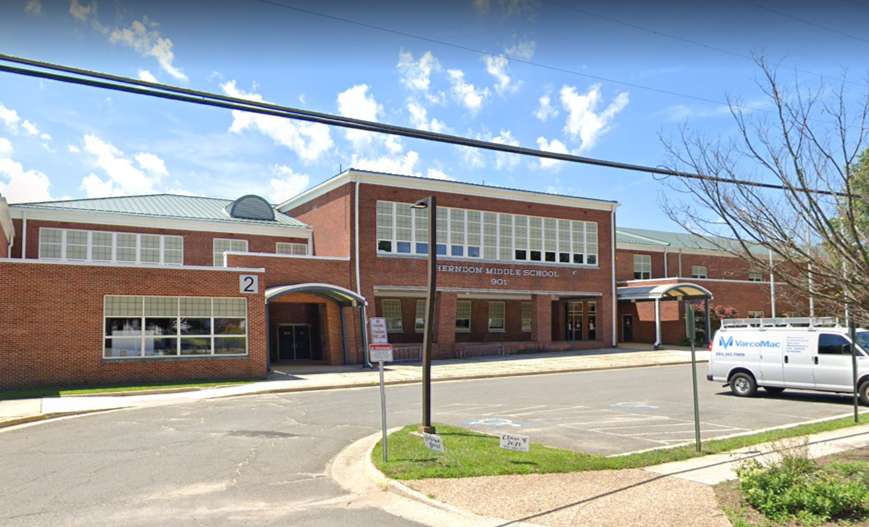
Fairfax County police are investigating two threats of violence reported at schools in the county earlier this week.
Both threats concerned schools in the Herndon area and were determined to be unfounded, according to the Fairfax County Police Department.
The first incident involved a threat of violence written inside a bathroom at Rachel Carson Middle School. School officials notified a school resource officer at the site about the discovery around 2:10 p.m. on Tuesday (Dec. 7), according to police.
The FCPD says it provided additional officers who conducted extra patrols of the area around the school on Wednesday “out of an abundance of caution.”
“FCPD takes these threats serious and continues to investigate the case with the assistance of FCPS administrators,” the police department said. “…We encourage anyone with information about this threat to please share it with either school officials or our officers.”
At approximately 6:15 a.m. yesterday (Wednesday), Herndon Middle School officials notified a school resource officer that they came across “a vague threat of violence made over social media,” according to police.
Fairfax County police investigated the threat with support from the Herndon Police Department and Fairfax County Public School administrators. Investigators identifed the person behind the post and determined they did not have access to any weapons.
“Officers are continuing to investigate further and charges are pending,” the FCPD said.
FCPS confirmed to FFXnow that there were two threats involving local schools, but the school system opted to share details only with the affected schools.
“We are not proactively sharing details to those outside the immediate school community to avoid encouraging copycat threats,” FCPS spokesperson Julie Moult said.
The two FCPS threats came at the same time that the Loudoun County Sheriff’s Office announced the arrest of 18-year-old Fairfax resident Shane D. Lucas, who allegedly made threatening statements toward Farmwell Station Middle School in Ashburn in a social media post that included a photo of a firearm.
Detectives determined that the photo came from the internet and did not find any firearms in Lucas’s house, but he has been charged with threats of bodily injury or death to persons on school property.
FCPS says students, parents, and other community members can report concerns through its safety tip line at 571-423-2020. Tips can also be sent by text to 88-777 with the keyword TIP FCPS.
Photo via Google Maps
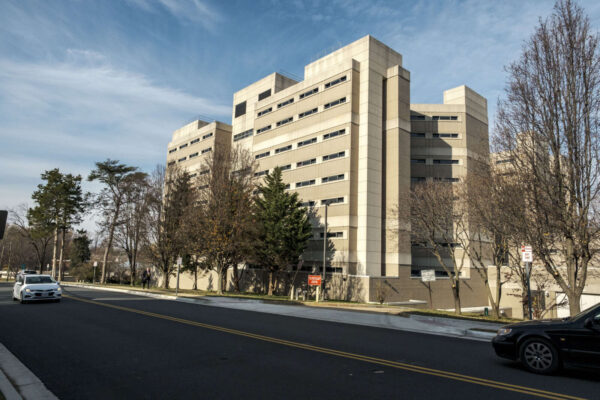
Fairfax County’s approach to criminal justice is quite different from when public defender Bryan Kennedy started his job here a decade ago.
In 2010, the county housed 1,207 people in its jail. That population has been nearly halved, down to 667 people in 2020, according to 2020 Census data compiled by The Marshall Project.
Going back further, the county’s inmate population was 3,749 people in 2000. But the changes from 2000-2010 involved the 2001 closure of the Lorton Reformatory, which housed over 2,800 people as of Dec. 31, 1999 and had its inmates moved to other facilities across Virginia and the federal prison system.
More recently, policy and cultural changes have dramatically altered the county’s judicial system, according to Kennedy, who also belongs to the criminal justice reform group Justice Forward Virginia.
“Ten years ago judges sentenced people to jail much more frequently on low level charges (both misdemeanors and felonies), including misdemeanors like possession of marijuana and driving on a suspended license,” Kennedy said in an email. “People were also held pretrial and held on secured bonds (cash bonds) that they could not afford much more frequently.”
After taking office in 2020 as one of three new progressive prosecutors in Northern Virginia, current Commonwealth’s Attorney Steve Descano ended the use of cash bail and stopped prosecuting simple marijuana possession cases prior to the state’s legalization, though future reform efforts could be challenged by Virginia’s incoming Republican administration.
Kennedy told FFXnow that the judicial system is now more receptive to alternatives to incarceration, as judges and prosecutors feel more comfortable not placing people in jail, because those individuals are getting more services outside of jail.
County Adopts Diversion Framework
One possible driving force behind the decline in Fairfax County’s incarcerated population in the last decade is its Diversion First policy, which began in 2016 after Natasha McKenna’s death at the Fairfax County Adult Detention Center in February 2015.
The initiative aims to reduce the incarceration of people with mental health and substance use issues, as well as intellectual and developmental disabilities, by directing those arrested for nonviolent offenses to services instead of jail, which the county says is less costly.
“Through broad stakeholder collaboration, we are giving individuals with mental illness, developmental disabilities and co-occurring substance use disorders the treatment and support they need to maintain a healthy and productive life in the community and stay out of jail,” Fairfax County Sheriff’s Office spokesperson Andi Ceisler said in an email.
She noted that Sheriff Stacey Kincaid’s office has increased the availability of education, life skills, therapeutic, and behavioral health programs that give inmates more opportunities and reduce recidivism.
Tied to the diversion policy, the county also launched the Merrifield Crisis Response Center (MCRC) in 2016 as an alternative to jailing people experiencing mental health problems.
A Diversion First annual report released in August noted that the number of individuals with behavioral health issues incarcerated on misdemeanors decreased by 28% from 2015 to 2020, and MCRC cases increased 37% from 2016 to 2020.
A state corrections spokesman, Benjamin Jarvela, said the Fairfax County probation office and the Commonwealth felt it was “too early” to comment or determine the effect of the diversion policy, saying doing so would be “premature.”
Police Credit New Training
The county also reworked its crisis intervention team training for law enforcement in 2016, following criticism and a lawsuit over how its handling of a police officer’s fatal shooting of Springfield resident John Geer in 2013.
The Fairfax County Police Department says its use of crisis intervention team training has helped officers with a better understanding and deeper appreciation for people experiencing mental health crises.
Other nearby law enforcement have had higher training rates, but the FCPD says the training is just one of the many efforts to lower the inmate population, along with social services, the county’s Mobile Crisis Unit, and a Community Response Team that assists with people who frequently utilize public safety services.
“Diversion First has undoubtedly helped divert individuals suffering from mental illness who commit low level, low risk offenses from the criminal justice system,” FCPD said in a statement. “We also recognize our community partnership with the Fairfax County-Falls Church Community Services Board (CSB) has played a key role in helping reduce the number of individuals arrested.”
The Fairfax-Falls Church CSB was formed to provide mental health, substance use treatment, and disability services in January 1969, making it one of the first in Virginia after the state adopted legislation establishing the agencies in 1968.
Over the first six months of Diversion First, law enforcement officers brought 771 people to the CSB’s Merrifield Crisis Response Center, 209 of whom ultimately received treatment services instead of facing criminal charges.
The number of diversions has slightly increased since then, with 484 diversions out of the 2,176 individuals transported to the MCRC in fiscal year 2021, according to the CSB’s most recent annual report.
Overall, more than 2,100 people have been diverted from potential arrest under Diversion First, as of Dec. 31, 2020.
Kennedy says the CSB has done a lot of outreach, assisted the judicial system, and “helped ensure that our jail is used as a mental health facility less frequently, although it is still a problem and more work needs to be done.”
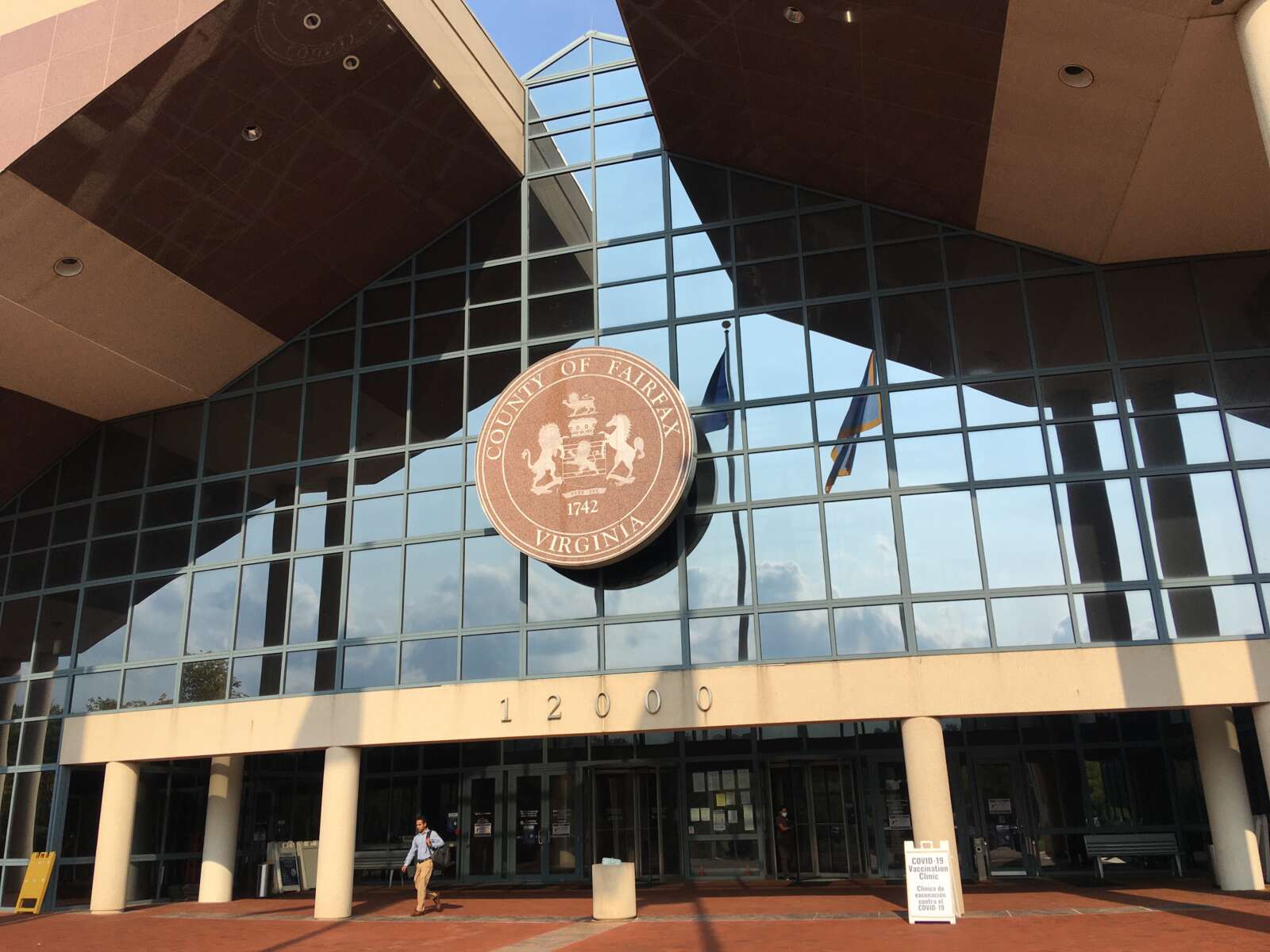
Fairfax County has officially expanded its tax relief program for seniors and people with disabilities for the first time in more than 15 years.
At a Tuesday (Dec. 7) meeting, the Fairfax County Board of Supervisors unanimously approved expanding the county’s real estate tax relief program by allowing people with higher incomes and net worth to qualify. A 75% tax relief bracket was also added, and the program gives some residents the option to defer payments.
The changes are expected to serve an additional 2,500 Fairfax County residents, according to Jay Doshi, director of the county’s Department of Tax Administration.
Doshi said the county’s tax relief program is now three times the size of Virginia Beach’s program, which is the next largest jurisdiction in the state.
“These proposals represent the largest change and an increase for our residents,” Doshi said.
The maximum gross income to qualify for tax relief was raised from $72,000 to $90,000, while the limit on net worth increased from up to $340,000 to $400,000.
The program also allows homeowners to exclude up to five acres of land that can’t be subdivided when calculating their net worth.
The 75% relief bracket would be available to households with a combined income of between $60,0001 to $70,000. But the amount of tax relief for all brackets would be capped at 125% of the mean assessed value of county homes.

Residents can also defer payment of real estate taxes if the household has a combined total income not more than $100,000 and a net worth of $500,000. Deferred taxes would be subject to interest.
Changes will go into effect on Jan. 1 and will be phased out over the next two years.
Older adults pushed for the changes at Tuesday’s board meeting.
“Having a tax relief program designed for the economic reality of 2006 does not make sense in the economic reality of 2021,” said Catherine Cole, chairwoman of the Fairfax Area Commission on Aging.
Cole noted that rapid inflation, rising economic insecurity among the county’s older populations, declining assets, and rising housing costs have strained many seniors, pushing some to leave Fairfax County.
“It would make sense to encourage those who are growing older to remain in their homes,” Cole said.
But others said the changes did not go far enough.
Daniel Campbell, a Fairfax County resident with two adult sons who are handicapped, said the county should consider freezing property tax assessments once residents retire and remove net worth as a requirement for seniors to qualify for property tax relief.
He said the net worth requirement penalizes people who have significant savings. Campbell and his wife hope to leave savings for their sons in the form of a special needs trust.
Fairfax County Board of Supervisors Chairman Jeff McKay said the changes — though imperfect — were long “overdue.”
“This has become an acute need at this point,” McKay said, calling the changes a significant advancement. He said the changes increased the yearly fiscal impact on the county from $28 million to $48 million.
McKay said he would like to evaluate tweaks to the program in the future.
Others said the county needs to find other ways to diversify its income beyond real estate taxes as the primary revenue source.
“Tax reform is really where we have to go,” said Hunter Mill District Supervisor Walter Alcorn. State law limits sources of revenue for jurisdictions.
But Springfield District Supervisor Pat Herrity — who supported the changes — said that controlling spending, not diversifying revenue should be the priority.
“It’s unfortunate that it took the pandemic for us to do this,” he said.
Graphic via Fairfax County Government
The Fairfax County Board of Supervisors approved slight changes to the boundaries of local electoral districts yesterday (Tuesday), following population changes reported by the 2020 Census.
The board voted 9-1 to adopt a new map that keeps the county at nine magisterial districts. The dissent came from the county’s lone Republican supervisor, Pat Herrity, who represents Springfield District, which is affected by five of seven voting precinct changes.
County leaders heralded the redistrict process as transparent and equitable.
“These small adjustments aim to take population changes into account while minimizing the disruption to the daily lives of our residents and keeping communities together,” Board of Supervisors Chairman Jeff McKay said in a statement following the vote.
The redistricting primarily sought to make supervisors have roughly the same amount of constituents represented in districts and treated equally, McKay said, noting that all districts grew during the last decade except Springfield District.
The board moved forward with a slightly tweaked citizen-proposed plan that shifted seven precincts to a different district:
- Saratoga (626) — from Mount Vernon to Springfield
- Fort Buffalo (703) — from Providence to Mason
- Woodburn (717) — split along the Capital Beltway between Providence and Mason
- Penderbrook (730) — from Providence to Springfield
- Irving (827) — from Springfield to Braddock
- West Springfield (840) — from Springfield to Lee
- Compton (933) — from Sully to Springfield
The approved map was one of 64 plans proposed by citizens and the county’s 20-person Redistricting Advisory Committee (RAC).
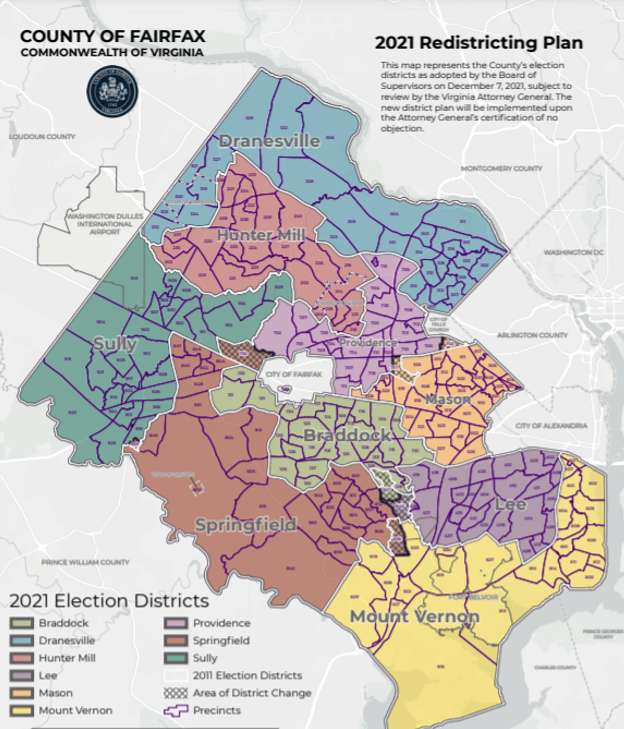
Appointed by the county board in June, the RAC voted on Sept. 27 on their preferred nine, 10, and 11-district plans. There was only one submitted map with 11 districts, and the two preferred 10-district maps were chosen without much contest, but the committee struggled to agree on two nine-district recommendations, ultimately only choosing one.
Stating that he only learned about the anticipated changes to his district on Monday (Dec. 6), Herrity requested that the board vote on the Redistricting Advisory Committee’s preferred nine-district plan, but he failed to get a second to take the matter to a vote.
“The public or the RAC has not seen this particular map,” Herrity said in a lengthy statement that accused Braddock District Supervisor James Walkinshaw, who chairs the board’s legislative committee, and his other colleagues of adopting the plan behind closed doors based on politics.
The typically year-long redistricting process was shortened into five months, because the COVID-19 pandemic delayed the release of 2020 Census figures.
County officials noted that there was a public hearing on the matter and meetings throughout the process. Walkinshaw said at the meeting that his door was always open for Herrity to express concerns.
“This is a plan that’s minimally disruptive,” Walkinshaw said, as county officials noted that consistency was a driving factor. He added that ideas from the public can be the best approach, saying the modified plan of “RAC_9_0924_1309″ could have been made by someone in their pajamas.
The Board of Supervisors accepted the last redistricting plan for Fairfax County 9-0 a decade ago. Herrity agreed with that plan, but then-Hunter Mill District Supervisor Cathy Hudgins abstained.
Because of Virginia’s new Voting Rights Act, which took effect on July 1, the adopted district map needs to get certified by the state attorney general before becoming active.
Going forward, the Redistricting Advisory Committee has been tasked with evaluating potential name changes to districts. It has until March 1 to make a recommendation to the county board, which would then vote on whether to make any changes.
The Fairfax County Police Department is about to bring its public records request system a little closer to the 21st century.
Starting early next year, the many people who request Fairfax County police records every year through the Virginia Freedom of Information Act (FOIA) will be able to pay the attached fees online, the county’s FOIA office confirmed to FFXnow.
Currently, the FCPD and nearly all other county departments and agencies require a physical check sent by snail mail for FOIA fees, which cover the costs of labor, copying, and other expenses incurred in the process of obtaining and delivering requested records.
With the new system, records requesters will fill out an online form with their contact information and details about their FOIA request before submitting an electronic check through a secure checkout screen.
“This new process is still being finalized, but we are confident that certain high-volume FOIA agencies (like the FCPD) will be able to collect FOIA fees electronically in early 2022,” Amanda Kastl, the Fairfax County Office of Public Affairs’ countywide FOIA officer, said by email.
The county introduced the online fee portal in August 2020 for the countywide FOIA office, which handles complex requests and ones that involve multiple departments. The office also oversees the overall FOIA process, including standardizing fee collection and processing.
Kastl says her office partnered with the Fairfax County Department of Finance to develop, test, and implement the new system after seeing an increased desire for the ability to pay fees electronically from those requesting records.
The COVID-19 pandemic also played a role, since FOIA staffers were working remotely, which made it harder to process checks.
According to Kastl, the online portal was intended to make the FOIA process simpler and more efficient for both the community and staff, and so far, it has paid off.
“We have received positive feedback from requesters on the convenience and efficiency of submitting payments electronically,” she said.
While online payments are now accepted for everything from grocery shopping to federal taxes, Fairfax County appears to among the vanguard in Northern Virginia when it comes letting people pay FOIA fees electronically.
The only other jurisdiction with an online option is the City of Falls Church, which allows requesters to pay fees through an e-check and credit card payment portal under the “general billing” category.
Arlington County instructs requesters to pay via check, and FFXnow’s sister site ALXnow says that’s also the case for the City of Alexandria. Loudoun County has an online portal for submitting and tracking requests, but it’s unclear whether the system can also be used to pay fees.
The Prince William County Attorney’s Office says it does not have an online system. FOIA payments are normally made by check to the specific department that’s the subject of the document request.
The Town of Vienna does not have any electronic payment options and isn’t planning on implementing one anytime soon, since the number of FOIA requests it receives is “very low,” according to Vienna Police Department public information officer Juan Vasquez.
For now, Fairfax County is only planning to expand its online payment system to the police department, which consistently receives the most public record requests of any county agency.
According to the county’s annual FOIA report for fiscal year 2021, which ran from July 1, 2020 to June 30 of this year, the FCPD received 5,716 requests — more than twice as many as any other agency. It also assessed $40,926 in fees, which is about as much money as the next nine top agencies combined.
Police reports tend to be among the most requested documents, along with complaint records, salary information, and emails and text messages, according to reports from fiscal years 2019 and 2020.
Notably, the amount of FOIA fees collected by the county has declined from $109,710 in FY 2019 to $94,253 in FY 2020 and $86,758 in FY 2021, even though the number of records requested has increased over that same time period.
Kastl notes that one records request with over $15,000 in fees from FY 2019 contributed to the discrepancy, but she says agencies have also become more willing to grant fee waivers to people experiencing hardships under the county’s One Fairfax policy, which directs the government to consider racial and social equity issues in its decision-making.
In addition, county staff have been providing more FOIA responses by email during the pandemic instead of in person or by mail, reducing the amount of processing time for staff and assessed fees, according to Kastl.
“The pandemic taught us the importance of improving efficiency through utilization of innovative IT solutions — from a cloud-based countywide FOIA request tracking application to search-friendly digitization of more and more public records,” Kastl said.

Like the rest of the country, Fairfax County continues to see increasing levels of COVID-19 transmission.
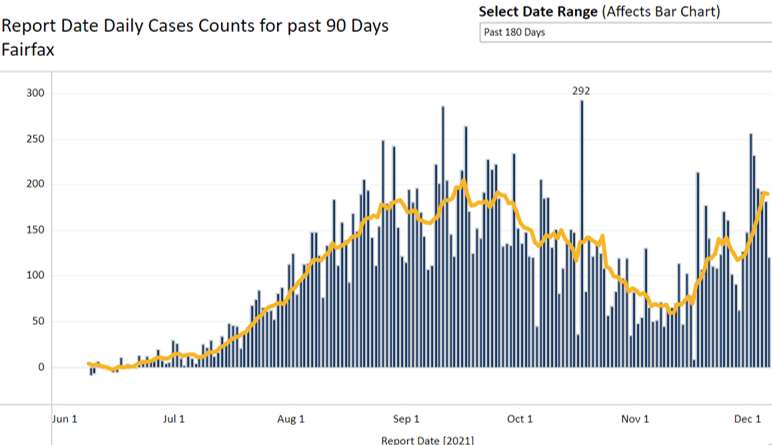
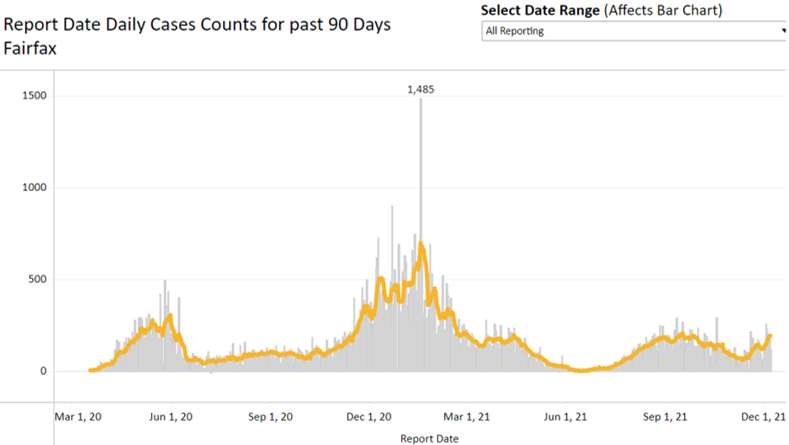
The county is now averaging about three times as many new cases per day as it was less than a month ago, with a seven-day average of 189.4 cases today (Monday), according to Virginia Department of Health data.
In comparison, the county was averaging 58.7 cases a day for the preceding week on Nov. 10. That day was the first time the weekly average dipped below 60 cases since the delta variant started becoming prevalent in late July.
Including the cities of Fairfax and Falls Church, the Fairfax Health District reported an additional 131 COVID-19 infections today, bringing its total for the pandemic to 97,999 cases, 4,201 hospitalizations, and 1,227 deaths.
Locally, the ongoing coronavirus surge comes without any apparent assistance from the omicron variant, which has been detected in 17 states so far, including Maryland. Virginia is monitoring the relatively new variant but has not identified any cases involving it yet.
While initial reports suggest the omicron variant may not produce severe illness like the delta variant, concerns that it might be more transmissible and less susceptible to the immunity granted by vaccines prompted the Fairfax County Health Department to strengthen its recommendation that all adults get a booster shot six months after their primary vaccinations on Thursday (Dec. 2).
“Taking measures to reduce the spread of infection, including getting a COVID-19 vaccine, is the best way to slow the emergence of new variants,” Fairfax County Health Director Dr. Gloria Addo-Ayensu said in the blog post.
So far, more than 238,000 Fairfax Health District residents have gotten a booster or third dose, including 63.5% of adults between the ages of 75 and 84, according to the FCHD vaccine data dashboard.
908,544 residents — or 76.8% of the population — have received at least one vaccine dose, including 86.8% of adults, 89.4% of adolescents aged 12-17, and 36.2% of children aged 5-11.
Representing 68% of the population, 804,239 residents are fully vaccinated, including 78.8% of people 18 and older.
Providers in the Fairfax Health District have administered over 1.9 million vaccine doses. If the current weekly average of about 7,440 doses per day holds, the district could potentially reach 2 million doses around the one-year anniversary of when the county received its first shipment last December.
Photo via CDC/Unsplash

Fairfax County Public Library offered at-home COVID-19 test kits to the community for the first time this morning (Friday). An hour later, they were all gone.
The county announced on Monday (Nov. 29) that it would join a pilot program that the Virginia Department of Health launched last month to distribute free COVID-19 tests through participating public libraries.
FCPL received 2,300 BinaxNOW COVID-19 Antigen Card Home Test that were made available at its 13 open community branches and eight regional libraries when they opened at 10 a.m. today.
All of the kits were distributed within the first hour, according to FCPL spokesperson Erin Julius, who says demand was high at all branches.
“The high demand for these test kits this morning indicates a continued need for accessible COVID-19 testing kits in Fairfax County, and FCPL is pleased to help distribute them,” FCPL Director Jessica Hudson said. “Libraries are trusted community hubs and we are glad to help stop the spread of COVID-19 in our community by making testing kits more accessible. We will continue to distribute tests as more are made available to us.”
Julius said the state is sending more test kits that will arrive next week, but she advises residents to call their local branch to ensure their availability before visiting. The library system also asks that anyone with COVID-19 symptoms request a kit using its contactless curbside pickup service.
VDH says the number of test kits distributed to participating localities depends on the size of each library system and feedback about how much interest they expect in the program, along with the general availability of supplies.
“The uptake varies,” VDH spokesperson Cheryl Rodriguez said. “However, some library systems are reporting that distribution has been brisk.”
According to VDH data, COVID-19 testing has been trending upwards in the Fairfax Health District since early November, with a spike seen in the days leading up to Thanksgiving (Nov. 25).
Fairfax County joined the state’s library test kits pilot slightly later than the other participating localities, but the move comes amid rising COVID-19 cases and renewed anxiety over the new omicron variant, which was confirmed in the U.S. for the first time on Wednesday (Dec. 1).
The Fairfax County Health Department said there has been increased demand for testing throughout Virginia recently, and offering free test kits at libraries gives people an alternative when retail supplies have been low.
Rapid COVID-19 tests have been in short supply since this summer after declining testing rates led manufacturers to decrease production. As infections surged again due to the delta variant, the federal government committed over $560 million to help boost the country’s supply.
“During the late summer months and early fall, many states across the country experienced limited access to rapid testing kits, due in part to slower production,” Rodriguez said. “However, production is increasing and more rapid tests should become available.”
Photo via Jernej Furman/Flickr
