

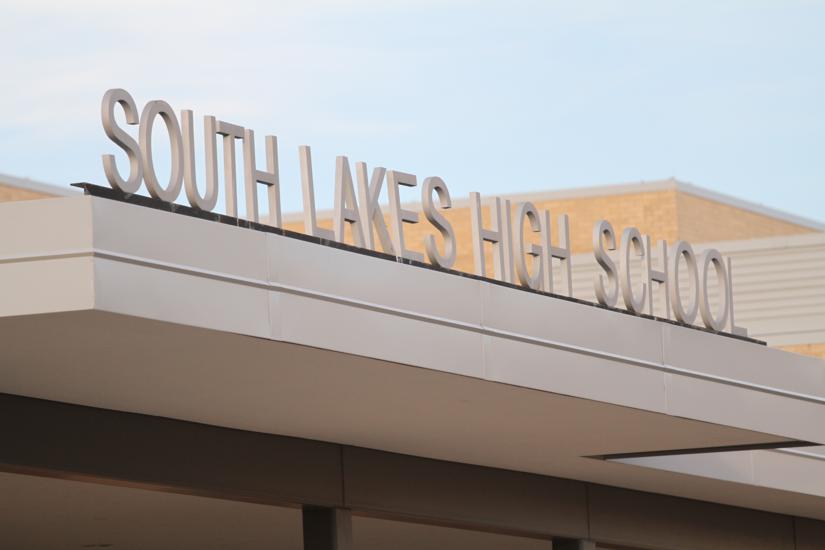
 The graduating seniors of South Lakes High School, their families and the South Lakes PTSA extend their heartfelt thanks to all those who donated so generously to the All Night Graduation Party held on June 18.
The party was a huge success and was attended by more than 350 students. A great time was had by all, in a safe, drug-free and alcohol-free environment. This much-loved South Lakes tradition, stretching back 28 years, would not be possible without the support of our community. Thank you.
Platinum Sponsors
Reston Association
The Eyewear Gallery at Reston Town Center
Gold Sponsors
St Anne’s Episcopal Church
St John Neumann Catholic Church
Town Center Orthopaedics
Kyle Knight Insurance Agency Inc
Clyde’s Restaurant Group
Beloved Yoga
Glory Days
Ledo Pizza
Moe’s Southwest Grill
LaRock Family
Christine Gambrel
David W Houghtailing
Bryan and Traci Nicol
Ferzoco Family
Mott Family
Stephanie Baird
Paul Baumgartner and Linda Johnson
Ana Woodward
Joan Burkhart
Amy Persil
Barbara Papile
Joanne Woestman
Beaulac Family
Payne Family
 The Reston Association Board of Directors last week approved a request for three homeowners on Sourwood Lane to hold a controlled deer hunt on their property.
The homeowners say their properties are overrun with deer, who eat the ground cover (which will lead to erosion) and may harbor Lyme Disease-carrying ticks.
RA’s board voted to allow the deer hunt. The homeowners will hire Suburban Whitetail Management, a professional wildlife management firm, to use crossbows and hunt the deer from 12-foot high tree stands in order to avoid hitting other wildlife and people.
Reston Now readers have many opinions on this development. Here is what some of you had to say in the article comments:
Animal LOVER in the right places: Last year my cousin was seriously injured (his collar bone was broken) when a deer slammed into him while he was rollerskating through our Reston neighborhood. He spooked the a herd, and in the scramble one of the larger deer ran him over. Overpopulation of deer in our areas is a serious issue that needs to be resolved in a manner that may not seem humane to all. Overpopulation will only lead to more incidents like this.
Preserve Reston: Disgusted…what about those of us who value the quality of life those deer provide to us? Disturbing and selfish.
Steward of Animals: It seems to me that birth control is a reasonable alternative to killing the deer. On another note, killing by bow and arrow is cruel because when the arrow misses the mark the animal is exposed to hours of a slow death. If we must kill the deer, resort to shooting the animals.
Cathie Gorman Freeman: I, too, hate the idea of killing the deer. What I hate more is driving down Soapstone and finding the bodies of the recently frolicking Bambi’s dead by the side of the road. Do what must be done to manage the ever-growing herd. At least someone will benefit from the donated meat.
Juli Vermillion: I am very against this hunt. I live about a block away from the proposed hunt and have lived here for over 10 years. The deer population has remained constant. I suggest if people don’t like deer doing what deer do, then perhaps they should move back into town. The deer have a right to live too and people have so many more options. I for one moved to Reston precisely because I can live in peace with nature.
Sub40 10k: I see tons of deer along my morning runs along the W&OD we could hunt them and then donate the meat to the homeless shelter next to the library; maybe we could go with the “born to run” method and run down one of the deer and exhaust it then kill it with a spear (wanted to do this with antelope in Texas but this could do) alternatively we could release mountain lions as a natural predator.
JR: Urban deer populations are out of control and without proper management the forested areas that make Reston a special place will be lost. Between the overpopulated white-tailed deer and the continued expansion of non-native invasive plants natural forest regeneration no longer occurs. The amazing oaks and hickories of our RA natural areas look great and are special today, but there are no young trees able to grow to replace them. The deer eat all of the young trees and in their place invasive plants replace them. … Not only should we be encouraging this deer management activity but also we should be requesting that our RA dues be spent to maintain our natural areas.
PL: I am strongly against this and I have lyme disease. If these deer are killed, then others will move into the area and then what?
 Since the Dec. 14, 2012 massacre at Sandy Hook Elementary School in Newtown, Connecticut, in which 27 people including 20 children and the shooter were killed, there have been 79 more school shootings.
Gun rights advocates dispute the number related to schools, but that is the figure Bill Moyers reported a few weeks ago and there are certain to have been even more since his report. The total number of people killed by guns, suicide and accidental deaths between Newtown and December 2013 is 12,042.
With all the fear and anguish brought on by these shootings at whatever rate they may be occurring, little has been done to address the issue in Congress or in state legislatures.
Previous mass murders have had minimal impact on laws to reduce gun violence. One exception is the attempted assassination of President Ronald Reagan in 1981. While no one was killed, four were wounded, including the President and his press secretary, Jim Brady, who was left confined to a wheelchair with slurred speech and nightmares.
The efforts of Brady, along with the strong leadership of his wife Sarah, led to the enactment after six years, seven Congressional votes and three presidential administrations to passage of background check legislation known as the Brady Handgun Violence Prevention Act. Recently, I attended the Brady Campaign to Prevent Gun Violence National Summit in Washington, D.C. ,that had as its theme to complete the job on background checks to make them universal.
Since the Brady law went into effect on Feb. 28, 1994, background checks have stopped more than 2.1 million gun sales to prohibited purchasers including convicted felons, domestic abusers, fugitives from justice, and other dangerous individuals. But the Brady bill requires background checks only for sales by licensed firearms dealers. Sales by individuals, unlicensed dealers, or internet vendors do not require a background check. The Brady Campaign is mounting a strong lobbying effort that I support to close the loophole on background checks and require them for all gun sales. To learn more, go to www.bradycampaign.org.
As announced at their National Summit, the Brady Campaign is working in other ways to reduce gun violence. Its “Ask Campaign” (Asking Saves Kids) in conjunction with the American Academy of Pediatrics urges parents to ask if there are unlocked guns in homes where their children play. An estimated 18,000 youth are injured or killed each year due to gun violence. More information is at askingsaveskids.org.
This November, make sure candidates you support for the House of Representatives and the U.S. Senate support expansion of the Brady bill. I continue to participate along with many good friends in vigils at NRA Headquarters in Fairfax on the 14th of each month to ensure that the issue is not forgotten. I will be working to expand background checks in the legislature.
Looking at other nations of the world makes us realize it is time to do all we can to prevent gun violence in America.
Ken Plum represents Reston in Virginia’s House of Delegates
 Last night, I attended one of my favorite meetings. I got together with RCA Vice President John Hanley, RA President Ken Knueven and CEO Cate Fulkerson, and ARCH President Jerry Volloy. We had a couple drinks and talked about the hot issues in Reston, what we’re each working on, and how we can help each other out. We laughed a lot and teased each other a fair bit, but we left feeling like we understood each other and the community a little better.
This is the Gang of 5. We’ve been gathering, in various configurations and at various times, for the last two years. Meeting with the Gang has been one of the highlights of my RCA presidency, and I believe it’s been a great benefit to our organizations and to Reston as a whole.
Our meetings are very informal. There’s no agenda, no one takes minutes, and Robert’s Rules of Order definitely don’t apply. It’s a chance for us to let our hair down, say what’s on our minds, smooth out any bumps in the road, and find ways to better serve our constituents.
One of my goals when I became RCA president three years ago was to strengthen our relationship with other Reston organizations. We’re all serving the community and we share many of the same broad objectives; why shouldn’t we work together more? If we don’t, we risk duplicating efforts or, worse, fighting where we could collaborate. We may not agree on everything, but I suspected we might agree on a lot if we sat down and talked things out.
This wasn’t the first effort to bring Reston organizations together. About 10 years ago, the leaders of many Reston groups formed the Coalition of Reston Organizational Leadership (COROL), to share information about what everyone was working on. But that effort faded quickly, and since then, our organizations had largely been stuck in their silos. Too often, we didn’t talk to each other, we didn’t really trust each other, and we spent too much time guarding our own turf instead of looking for ways to help each other.
The “Gang of 5” concept was John Hanley’s idea. John is a great raconteur, and he believes that big things can happen in casual meetings. So he proposed a get-together with Jerry, Ken, and then-RA VP Andy Sigle. Happily, they were all on board. We met at the now-closed Greenberry’s Coffee, and spoke about our organizations, our projects, and our goals for the community. The relationship bloomed from there. Read More
About this time of year in 1966 I wrote a letter to my hometown newspaper, Page News and Courier, suggesting that Virginia had just undergone one of the “bloodless revolutions” that Thomas Jefferson had suggested would be good for society periodically.
In the Democratic primary in a very different 8th Congressional District than we know today, liberal state delegate George Rawlings defeated the 36-year veteran Congressman Howard Smith who in his position as chairman of the Rules Committee had thwarted the will of presidents through his control of the flow of legislation and his bottling up of the Civil Rights Act for nearly a decade.
The shock waves when the polling results came in were as great as those heard in the 7th Congressional District this year. As if the defeat of a powerful committee chair was not enough, in that same primary moderate State Senator William B. Spong, Jr. defeated Virginia’s Senator A. Willis Robertson, who had been in the Senate for 20 years. President Lyndon Johnson had recruited Spong to challenge Robertson because the Senator opposed the Civil Rights Act and supported school segregation.
When Lady Bird Johnson came through Virginia campaigning for her husband on the Lady Bird Special train, Robertson was the only elected Democrat who did not come out to greet her. George Rawlings lost in the general election to William “Bill” Scott as conservative Southern Democrats voted for the Republican, and many never returned to the Democratic Party.
Spong was elected to the U.S. Senate where he served for one term before being defeated by the same Bill Scott who had defeated Rawlings six years before. Scott’s service in the House and in the Senate earned him the title given by one publication as being “the dumbest man” in Congress.
The primary defeats of two Southern Democrats in 1966 marked a sharp decline of influence of the Byrd Machine in Virginia politics and a realignment of the conservatives who had called themselves Democrats since Reconstruction. Some became Independents, but others switched to the Republican Party where they felt more at home with their conservatism. When Harry Byrd, Jr. ran for the U.S. Senate to replace his father, he won as an Independent.
No Democratic candidate for President was able to carry Virginia until ironically Barack Obama carried the state in 2008. While Democrats and moderate Republicans are celebrating the defeat of House Majority Leader Eric Cantor in another historic primary, it is important to consider the outcome of the election for the future of the Commonwealth.
The candidate who defeated Cantor did so by being more conservative than Cantor, and from the comments I have been reading he is a far-out Tea Party candidate. Just last year two Tea Party candidates defeated two Republican committee chairs in primaries and went on to win the general election.
An already conservative General Assembly is likely to be pushed further to the right by Republicans who fear a primary challenge. A bloodless revolution is occurring in the Commonwealth; Virginians will not be better for it.
Ken Plum represents Reston in Virginia’s House of Delegates.
With the RCA election in full swing (vote now!) and my time as President winding down, I’ve been trying to fill you in on what we’re doing before I depart. It occurs to me that I haven’t talked about the Reston Accessibility Committee lately.
Happily, Ken Fredgren and his committee are still working hard to make Reston’s commercial buildings and facilities more accessible to people with disabilities. This week, I’ll bring you up to date on some of their most recent projects.
When I last discussed RAC’s work, I shared the success of a major effort by Ken and other advocates to make Virginia’s building codes friendlier for people with disabilities. This was a major, multi-year effort, and I’m thrilled that it came to fruition. But I know the completion of that effort was also something of a relief for RAC’s chair. He no longer needs to travel back and forth to Richmond, and he’s able to focus his efforts back home in Reston. That renewed focus is reaping significant benefits for the community.
Because most RAC projects deal with outdoor facilities (parking lots, sidewalks, and the like), construction tends to take place in the warmer months. This can make winter a somewhat frustrating time for RAC, as progress slows down considerably. The bright side is that come springtime, there’s often a surge as several projects move forward almost simultaneously. I will report on three projects in this installment, but there’s more good work in progress.
Two of RAC’s recent successes are actually updates on long-standing projects. One of them, Hunters Woods Village Center, is actually up for a third go-round. In 2009, RAC worked with the then-owners to add accessible parking spaces and access aisles, curb cuts, and crosswalks. When Edens & Avant purchased the center in 2012 and planned to redesign the parking lot, RAC engaged them to ensure that the existing improvements would be preserved. Not only were the improvements retained, but the accessible spaces were moved closer to the buildings, making them even more convenient. Read More
As you may know, I grew up in a very rural part of Virginia — in Page County near the little town of Shenandoah in the Page Valley that is part of the grander Shenandoah Valley.
At that time there were about 50 people living in nine houses in the less than 10 miles on Crooked Run Road between Comertown Road and River Road. Except for activities around the schools and holiday parades and carnivals in the Town of Shenandoah, there was little or no sense of community as I have come to understand the word.
My parents had limited formal education, and we had very few reading materials in our home. We did subscribe to Southern Planter and Progressive Farmer magazines that I read from cover to cover, even though my interest in many of the articles was not great.
Progressive Farmer was most interesting to me for its continuing theme of needing to develop a sense of community in rural areas throughout the South.
The topic fascinated me, and I sent in the 50 cents required to get a copy of The Community Handbook (Progressive Farmer Company: 1948). I recently acquired another copy from a used book shop to help me recall why I was so enthralled by it and read it dozens of times. It had information on community organization, parliamentary procedure and social and recreational activities. It provided my first lessons in community leadership.
Along with other experiences I had, I developed an interest in government and public service that I have pursued throughout my adult life. Just as the voids in my early experiences gave me an appreciation of the importance of community, the richness of Reston reinforces for me the significance of community in helping to realize success and quality of life. There are few if any places in this country that have the abundance of community organizations and civic and social activities that are found here.
We are a community of great diversity that adds to our richness. I have the great honor and privilege as an elected official to take part in the Fairfax and Greater Reston Chambers of Commerce but also in the Asian American and the Hispanic American Chambers of Commerce as well as the ecumenical church I attend regularly, the All Dulles Area Muslim Society (ADAMS) Center, the local synagogue, and other religious traditions.
I attend a multicultural fair each year, but I also attend the Pakistani American, Korean American, and other racial and ethnic groups’ activities, along with events sponsored by the LGBT community. I apologize in advance to any groups I may have inadvertently left out.
In those early years when I was trying to gain a sense of community, I would never have dreamed that a place could embrace both a strong sense of oneness and at the same time such great diversity that is celebrated in so many ways. I have grown in my appreciation of the importance of community by being part of Reston.
Ken Plum represents Reston in Virginia’s House of Delegates.
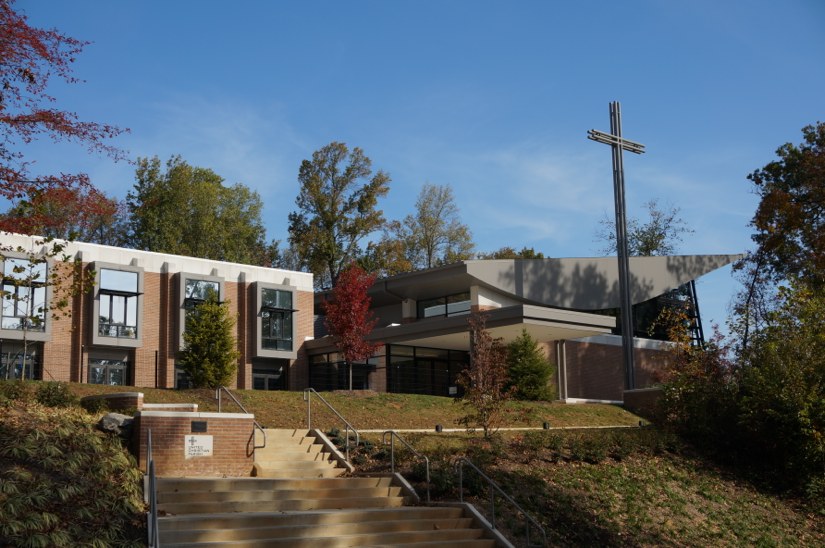 This Saturday, June 7, 8:30-10:30 a.m., Fairfax County will hold an Open House at the United Christian Parish church (11508 North Shore Drive) to explain the goals and process for Phase 2 of the Reston Master Plan (RMP).
Phase 2 covers suburban Reston, virtually all of it covered by the Reston Association Deed. It will address the future of our neighborhoods, our village centers (excluding Lake Anne), and other selected Reston areas (convenience centers, the business area just north of Baron Cameron Avenue, and more) not covered in the just-completed Phase 1, which replanned the Metrorail station areas.
We know little about what the county will do, even those of us who have been deeply involved in the Phase 1 process. The County’s new process — “Fast Forward” — is designed to streamline updating of the County’s Comprehensive Plan, including Reston’s Master Plan.
In the version that is being used for RMP Phase 2, there will be no task force, charrette, or other efforts to join the community’s stakeholders — residences, businesses, landowners, and more — in a discussion about what the community should become.
Instead, we have been asked to submit comments–but only on specific development proposals, per County staff–before July 11 with only the information provided at the Open House this Saturday. It is very important for Reston’s residents to turn out in force at this walk-through event–where County staff will discuss the plan’s goals and process.
It’s election season again! No, I’m not talking about the seemingly endless parade of Congressional and gubernatorial primaries. I’m talking about the RCA elections.
The RCA elections open on Saturday, and I’m once again encouraging you all to take a few minutes to cast your vote. You can help determine who will be standing up for Reston’s citizens on issues from the future of our libraries to the revisions to our Master Plan to ensuring that the Silver Line is built in a way that doesn’t overburden Toll Road users.
This is a particularly important year to cast your vote. As I’ve noted before, I’m stepping down as president, and longtime Board members Terry Maynard and Dick Rogers are retiring to focus on planning and transportation issues. RCA will have a new president and a number of new Board members (including the three new Board members we added in February). There’s new blood and the possibility of a new direction for RCA; casting your vote will give you a voice in shaping that new direction.
For the third year in a row, we’re holding our voting online to make it as easy as possible to cast your vote. You can vote from the comfort of your home or office, or at the Starbucks, whenever it’s convenient for you: on your lunch hour, in the morning before work, or in the middle of the night.
We’ve made an additional change this year to make it easier for you to vote. For as long as I’ve been on the Board, the RCA has held its elections in July. This is because we used to hold the vote at the Reston Festival. Now that the Festival is defunct and we’ve gone to online voting, we realize that July is a tough time for people to vote: a lot of folks are on vacation, and those that aren’t might not be paying close attention to community issues in the dead of summer. By moving the elections back to June, before school lets out and before vacations start, we’re hoping to see a jump in turnout.
The Virginia General Assembly has been in recess since early March, when a special session was called by the Governor to pass a biennial budget that had failed to pass in the regular session.
The impasse, of course, is about expanding Medicaid to provide health insurance to 400,000 of Virginia’s working poor or turning down $5 five million a day because it is related to “Obamacare.”
We will return from our recess whenever there is a compromise proposed or some solution on which to vote. I have already endorsed a compromise offered by three Republican senators that would establish a program similar to those set up in a number of very conservative states that have expanded Medicaid.
In the meantime, I have had more time to spend in my garden than I have had any spring for many years. I had almost forgotten how relaxing and satisfying working in the soil can be. I live on a postage stamp size lot of maybe a third of an acre. When we moved in more than 20 years ago, I loved our new house but was disappointed that the lot was so small. I now find the lot to be plenty big to maintain.
I grew up in rural Page County, Virginia. We did not have a farm, but we did have enough land that Dad and Mom had a wonderful vegetable garden. Dad raised enough vegetables to feed us all summer, and Mom canned or froze enough to last the rest of the year. The unfinished cellar under our house had large bins that kept potatoes year-round.
My parents raised some flowers, but my interest in flowers was piqued by Mr. Johnson, who lived in D. C. but had a weekend home on the Shenandoah River near my home. I was paid $5 a week to mow the lawn but also got to observe him and the multitude of flowers and shrubs he had. He often gave me starts of plants that I could take home for our yard.
I have never lived any place where I could have a vegetable garden like my Dad’s nor was I probably ever willing to do the tremendous amount of work he did to make it successful. I always have had lots of flowers as my Facebook (Kenneth R. Plum) friends can attest with the number of photos I post.
While working in the garden this spring trying to fill in the bare spots in the lawn, putting up new window boxes, pruning and restoring perennials, I remembered a book I used for years as a gardening guide, The Complete Book of Garden Magic by Roy E. Biles (Ferguson: Chicago, 1956). I could not find my original copy, but I was able to purchase a used one through the internet. Though obviously dated in many of its recommendations, it nonetheless reminded me that the magic in gardening comes not only in what you plant and grow but in the soothing effect the process can have on your life.
Ken Plum represents Reston in Virginia’s House of Delegates.
A couple of weeks ago, I took a day trip over to Annapolis. As much as I love Reston, I do escape its borders from time to time!
Annapolis is a lovely town, and I enjoyed the boutique shops along Main Street, the top-notch seafood and Key lime pie at a good old-fashioned crab shack, the museums and historic buildings, and the beautiful views along the Bay. But an unscheduled stop at the World War II Memorial proved the highlight of my trip, and got me thinking about the idea of creating something like that in Reston.
Driving down Ritchie Highway, I saw a small sign indicating a World War II Memorial and scenic overlook. Being both a history buff and a fan of scenic views, I figured it might be worth a few minutes of my time. Little did I know just how breathtaking and thought-provoking the memorial would turn out to be.
The memorial is built into the side of a hill, so you have no idea what you’re about to experience when you approach from the parking lot. The first thing you encounter is the overlook, a pavilion that provides gorgeous views of the Severn River, the Naval Academy, and parts of downtown Annapolis. I stood there for a few minutes, enjoying the beautiful weather and the sense of calm that overtook me. Even though the memorial is between two busy highways, it’s surprisingly peaceful and well-protected by the trees and hedges that surround it. Read More
Recently, the New York Times editorial board wrote about the “health care showdown in Virginia.” Their comments were not favorable.
“In Virginia, there are 400,000 low-income people who can’t afford health care coverage but don’t qualify for federal subsidies,” they wrote. “If they lived across the state line in Maryland, West Virginia or Kentucky, which have expanded their Medicaid programs, they could get the coverage they need.”
The reason they cannot; “a group of recalcitrant Republicans in the House of Delegates” have blocked Medicaid expansion at every opportunity.
Highly regarded retired editorial writer for the Virginia Pilot, Margaret Edds, wrote about the current impasse in Virginia two weeks ago. Drawing on her extensive command of Virginia’s history, Edds points out that Virginia was the last state to join Social Security in the 1930s. She argues that there is a moral imperative that “we cannot afford to take this risk” of not expanding Medicaid.
She writes that “designing a health care system that embraces everyone is the right thing to do.” Reston resident, Elliot Wicks, in a recent letter to the editor makes the same argument that closing the coverage gap morally is the right thing to do.
In an unprecedented move, the Virginia Chapter of the American Association of Retired People (AARP) called a press conference to announce that letters sent by the Speaker of the House and other Republican lawmakers to their constituents over age 60 contained “inaccurate information about changes in Medicare.” These letters from Speaker Howell and other lawmakers implied that expanding Medicaid in Virginia would hurt Medicare beneficiaries. “Expanding Medicaid to uninsured Virginians won’t harm the Medicare program or its beneficiaries,” the AARP spokesperson said.
Revenues for the Commonwealth are expected to fall short of projection for this year by as much as $300 million. Ironically, Virginia is losing $5 million a day amounting now to three-fourths of a billion dollars paid by Virginians that could be returned to the state through Medicaid expansion. The money could not be used to balance the budget in the current year, but in future years more than $200 million that Virginia pays for indigent care from its general tax revenue could be paid by Medicaid.
State and local chambers of commerce, medical and health care associations, and editorial boards of the major newspapers in the state have endorsed Medicaid expansion. A major compromise in the form of Marketplace Virginia, proposed by three Republican senators and endorsed by all Democratic legislators, has been introduced.
The compromise proposed in Marketplace Virginia addresses the Republicans’ stated concerns by including a provision to discontinue the program if the federal government reneges on its commitments. It is time for Republicans in the House of Delegates to agree to the compromise.
Their insistence on separating Medicaid from the state budget is a costly stalling tactic that is hurting a large number of Virginians and threatens to hurt even more if the budget stalemate continues.
Ken Plum represents Reston in the Virginia House of Delegates. He writes weekly on Reston Now.
Real life doesn’t work like it does in the movies. We all know this is true for a lot of reasons. But one in particular is especially challenging: Storylines don’t resolve into neat and tidy endings. That’s one of the aspects of movies that we love, and it’s easy to see why. The leading man proposes to his beloved, or the underdog wins the big game, or the hero finally defeats the villain, and then… roll credits. Story over.
Wouldn’t it be nice if life worked the same way? Alas, life insists that we keep going, even after the “happy ending.” Can the romantic couple deal with the day-to-day nature of married life? Will the lovable underdog play well again next season, under the burden of higher expectations? Can the hero help the city rebuild after the climactic battle, or defeat the next bad guy that shows up? Movies rarely address those questions, but they’re what real life is all about.
This challenge is particularly acute in politics, especially at the more local levels. Most people don’t follow the ins and outs of local and state politics; there’s too much else going on in their lives. They generally start paying attention when something big happens, something that’s perceived as a real benefit or a real threat.
When those potential threats or benefits arise, it’s easy to get people paying attention. Those moments are tremendous and inspiring. But they only right before a big event: a crucial vote, an important hearing, a major decision.
The good news is that when people show up and make their voices heard, our elected officials tend to listen. The problem is that once that key vote or hearing occurs, most people treat it like the climax of a movie. That’s it; story’s over. Time to roll the credits and go home.
But politics is all about the long struggle. Getting hundreds of people in a room for one meeting is impressive, but politicians know that a few months later, most of those people won’t remain engaged, and may not even remember the issue. That’s why delays are so common in the political process; citizens have short attention spans, and often, even widespread grassroots outrage fades away given enough time. Read More
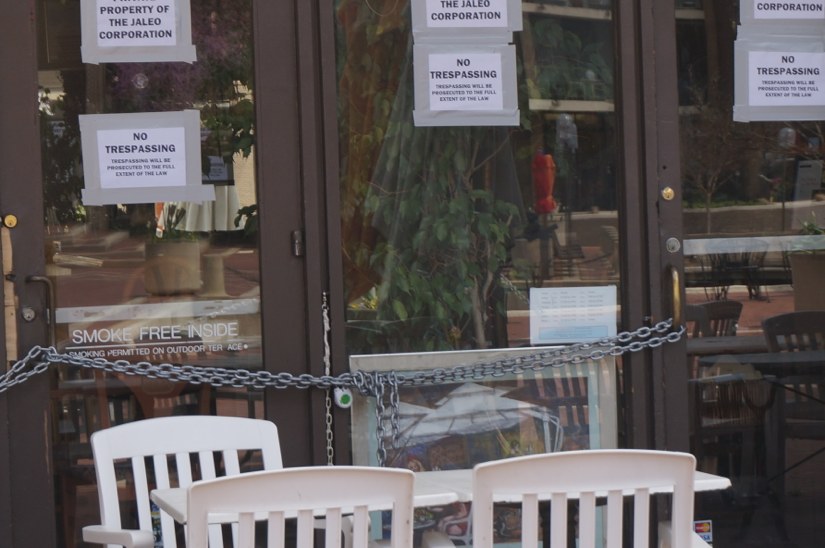 Jasmine Cafe, the longtime Lake Anne Plaza restaurant, has been closed for a month ever since the landlord locked out the owner for rent that was in arrears.
It does not appear the restaurant will reopen.
Lake Anne Plaza is home to several other restaurants, including Cafe Montmartre, Kalypso’s, Singh Thai and Lake Anne Coffee House.
Jasmine Cafe had been located at Lake Anne for more than 20 years. The restaurant has a local following for owner/chef Eduardo Faubert and his seasonal menu, as well as outdoor seating on the plaza.
What do you think should open in this spot? Tell us in the comments.
While I enjoy watching college athletic competitions, I do not watch many professional sports on television. For sure I do not watch any of the post-game shows. Panels for these shows seem carefully selected to ensure controversy and banter to fill the time slot.
I have the same feeling about post-election panels that provide an instant analysis with conflicting views of why the voters voted as they did. Some thoughtful commentary after the fact can be useful to understand the mood of voters and implications for the future, but a panel of so-called experts who continue to talk well after they have made their point can get to be irritating. I suppose the same could be said about weekly columnists!
In weeks (not months), the Silver Line extension of Metro will be opening. For someone who has been working on this project for nearly two decades, the setting of the actual date to start service is particularly exciting.
I share the frustration of many that the stations and tracks have appeared to be ready for about six months, yet pesky but important details have prevented the announcement of a start date. As Chairman of the Board of the Dulles Corridor Rail Association, an organization I formed nearly 20 years ago to boost the project when I was the only elected official to endorse it, I am especially eager to see the trains start running.
With the delay in opening, a post-construction analysis has been underway. Contrary to some suggestions, there is no great conspiracy delaying the opening; no one profits from a delay. The system must be deemed safe for it to open. Yes, Bechtel was part of the “big dig” in Boston and its problems, and Bechtel is one of the partners in Dulles Transit Partners that built the Silver Line, but the Silver Line work and outcomes have no correlation to what happened in Boston. Yes, the project manager left early, but he left to take over as head of the Long Island Rail Road.
The Silver Line is the largest infrastructure project underway in this country. The budget is $2.9 billion, and the project will be finished on budget. Some argue that a $150 million increase in the budget to cover costs of updated standards should be considered an overrun. If so, the project would exceed budget by less than two percent. Know any other project of this magnitude that has come that close?
The opening date for the project will be set by the Washington Metropolitan Area Transit Authority (WMATA) which will operate the Silver Line as part of the larger Metro system. The opening date will be seven months beyond the best case projection but still before the December 2014 date the Federal Transit Administration had set for the project.
I continue to nudge the process along to ensure that public dollars are appropriately spent and contractual obligations are met, but you will not see me as part of any panel speculating what may have been. The project will bring immense benefits to our region.
Ken Plum represents Reston in Virginia’s House of Delegates. He writes weekly on Reston Now.
