

 As the Virginia General Assembly nears its midpoint for consideration of proposed legislation, the fissures of differences among the many stakeholders who have interests before the law-making body become evident.
The clash of interests is much more complex than House v. Senate, Republicans v. Democrats, or rural v. suburban.
Differences in ideas and ideals make compromise challenging.
Last week, advocates of an Article V constitutional convention to rein in the power of the federal government descended on Richmond to make their case before receptive legislators who like to bash Washington with regularity. Calling on the words of the founding fathers, the advocates of a constitutional convention called by the states promised a balanced federal budget and strict limitations on the powers of Congress and the presidency in their new constitution.
The evening before the hearing on the proposed constitutional convention the members of the Rules Committee of which I am a member received a flurry of emails from Second Amendment gun rights advocates asking that the proposal for a constitutional convention be defeated for “such a convention would surely be a threat to the Second Amendment’s rights.”
Interesting that the gun rights advocates who like to complain about the power of government fear that a debate on the Second Amendment today might limit their rights. The resolution for the convention passed with my nay vote because of my general concerns about turning over the redefining of our government to those who oppose many personal liberties.
There are many examples of the balancing of ideas and ideals that can lead to meaningful discussion and hopefully better solutions. At the same time a discussion of issues can lead to misunderstandings.
In a recent opinion column it was suggested that I insisted “meals and trips be protected from reform” of ethics laws. Nothing could be further from the truth. In a discussion about the complexities of writing an ethics reform law that defines inappropriate behavior I raised a question about invitations to legislators to speak at luncheon or dinner meetings of business or community leaders or trips that were truly educational. I do not want anything left out; I want the grey areas addressed in a way that will not reduce legitimate interaction among legislators and people they represent while sharply defining ethical behavior. I am confident that such a bill will be passed.
In a recent letter to the editor, questions were raised about a member of the House who took an Alford plea to involvement with a 17-year-old girl. I was part of a unanimous Democratic Caucus that expelled him from the caucus and called for his resignation or removal from the House. He subsequently resigned, ran as an Independent, and was re-elected.
Ideally it seems that he should be removed from the House, but there has been reluctance to remove a member who was just duly elected. Further criminal charges related to that individual since his re-election could lead to his removal.
Tough issues come to the legislature for resolution. Too often environmental protections are cast as being bad for business, but they do not have to be in conflict. There are many green job opportunities. New technology with new business models, like Uber, are threatening to the traditional taxicab industry, but there is room for both to succeed.
Ideas and ideals clash in the legislature. That makes the job interesting and at the same time challenging. I am always available to discuss my position on issues or my votes with anyone, [email protected].
Ken Plum represents Reston in Virginia’s House of Delegates. His opinions are not necessarily those of Reston Now’s.
Del. Ken Plum’s (D-Reston) bill to require a background check for all gun purchases was defeated in a House subcommittee at the Virginia General Assembly session in Richmond on Thursday.
The bill had the support of Gov. Terry McAuliffe, as well as several groups advocating for new Virginia gun laws.
HB 1604 would have added a definition of “firearms show vendor” or “vendor” and require that a criminal history record information check be performed on the prospective transferee before the vendor may transfer firearms at a gun show.
Under current law, only licensed dealers must obtain such a check. The bill also required that the promoter of a firearms show provide vendors access to licensed dealers who will conduct the criminal history record information check.
“Of course I am disappointed,” Plum said. “But the outcome was pre-ordained. Four of the five members of the subcommittee have perfect or near-perfect ratings on the National Rifle Association scorecard. That same subcommittee defeated all the common sense gun safety bills including one to prohibit domestic abusers from having access to guns.”
On the Senate side, the Republican-led Courts of Justice committee earlier in the week killed off 10 gun bills, the majority of a gun control package introduced by McAuliffe. Among the dead bills, a bid to reinstate Virginia’s one-handgun-purchase a month law, which the General Assembly dismantled in 2012, and one that would take away concealed carry permits from owners behind on child support payments.
The Courts of Justice committee advanced several bills that will ease state codes for gun owners. Among them: one that allows lifetime concealed-carry permits rather than requiring re-registration every five years. Other bills allow the possession of weapons on private religious school campuses and allow people with concealed carry licenses to leave guns in their cars in public school parking lots.
However, many of the bills will still face a veto from McAuliffe if they pass the full General Assembly, the Newport News Daily Press reported.
Photo: Ken Plum/file photo
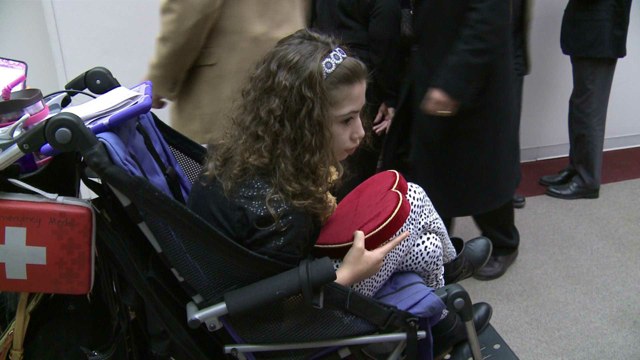 Del. Ken Plum (D-Reston) wants Virginians who are suffering from debilitating medical conditions to be able to use marijuana to seek relief.
Currently, the commonwealth allows cannabis for treatment of cancer and glaucoma, but not other medical conditions.
Plum introduced a bill (HB 1605) earlier in the 2015 Virginia General Assembly session that “allows a person to possess marijuana or tetrahydrocannabinol pursuant to a recommendation of a prescriber acting in the course of his professional practice and allows a medical doctor or pharmacist to distribute such substances in the course of his professional practice without being subject to prosecution and eliminates the requirement that marijuana or tetrahydrocannabinol be recommended and dispensed solely for the treatment of cancer or glaucoma. “
The bill also clarifies that the penalties for forging or altering a recommendation for medical marijuana or for making or uttering a false or forged recommendation are the same as the penalties for committing the same acts with regard to prescriptions.
“This isn’t about smoking pot,” said Plum. “This is about taking or using the oil for a medical condition.”
Plum’s bill is similar to HB 1455 introduced by Del. Dave Albo (R-Springfield), which seeks to add epilepsy to the list of conditions for which patients can possess medical marijuana. Last week, the General Assembly heard testimony from families whose children could benefit from medical marijuana, during which a young girl suffered a seizure in front of legislators.
Haley Smith, who suffers from Dravet Syndrome, had 1,200 seizures last year. Plum, who gave Haley a big, heart-shaped box of candy when she came to his office Thursday, said he inspired by Haley’s story and that of Jennifer Collins, the 15-year-old Fairfax County girl whose family moved to Colorado and back in order to gain legal cannabis relief for her seizures.
“When people are in the amount of pain and stress they are in, there is no reason the government should stand between relief from that pain,” said Plum. “There is far more addictive stuff behind the counter at the pharmacy.”
Plum said that federal restrictions are standing in the way of changing Virginia laws. Medical marijuana has actually been legal in Virginia since 1979 — except that it requires a valid prescription, and doctors cannot legally prescribe marijuana since it is federally restricted.
“We need to take appropriate action in Virginia and get us an exception to federal enforcement related to medical marijuana,” said Plum.
Medical marijuana has been given an exception in 23 states and in DC, where small amounts are legal for pain relief.
Plum’s bill has been referred to the Courts of Justice Committee.
Photo: Haley Smith, who had more than 1,200 seizures last year, was a given a box of candy by Del. Ken Plum in Richmond last week/Credit: WTVR.com.
Virginia is well on its way to economic recovery for many families, but working families across the state are telling me and other legislators that they feel like the recession never ended. Even in Northern Virginia, home to some of the wealthiest localities in the country, too many families struggle to earn enough to pay for basic necessities despite having full-time jobs.
At the same time that households are struggling, Virginia’s economy is growing at a snail’s pace, according to studies by the Commonwealth Institute for Fiscal Analysis.
Job growth has not kept up with the number of workers who want jobs, and state revenues have fallen as a result. Virginia needs families who earn good wages, who spend their earnings in the local economy to buy fuel, food, clothes, and other necessities, and who in doing so, help jump-start our economy. But when wages stagnate, the economy stalls, and that hurts all of us.
Fortunately, we have proven policy solutions to help strengthen our working families. We can make our state’s Earned Income Credit (EIC) refundable and increase the minimum wage. Unfortunately, many of my colleagues in the General Assembly have chosen to leave these income boosting solutions on the table. That’s unfortunate and short-sighted.
The Earned Income Credit is a targeted tax credit that middle class and low-income families can claim at tax time to reduce what they owe in state income tax. It also promotes work because you have to be working in order to claim it, and the credit is structured to reward working more hours.
As it stands now, if the value of the credit is greater than what you owe in state income tax, you’re not able to get the difference in a refund. But if the EIC were refundable, working families would get back some of their wages that they paid in sales taxes in one lump sum to pay for a car repair or for the child care they need to go to work. Nineteen states provide for some amount of refund.
While the EIC provides a bump in income once a year, raising the state minimum wage will increase earnings for low-wage workers in each paycheck. If Virginia increases the minimum wage to just over $10 by 2017, close to 700,000 workers throughout the state would see an increase in their wages. Out of this group, the vast majority are 20 or older, and close to 300,000 children have at least one parent who will get a raise.
Clearly, increasing the minimum wage predominantly helps working adults, not just teenagers, and it will help many parents who rely on these wages to care for children. More money to the working poor generates economic activity for small businesses.
Making Virginia’s Earned Income Credit refundable and increasing the minimum wage should be part of an effective, long-term strategy to strengthen our families and the economy. I have introduced two bills to accomplish this purpose. I hope local business groups will drop their opposition in order for the bills to pass. These bills should not be partisan. They will benefit all Virginians and Virginia businesses.
Del. Ken Plum represents Reston in Virginia’s House of Delegates. His opinions are not necessarily those of Reston Now’s.
Terry McAuliffe campaigned for Virginia governor on a platform of “building a new Virginia economy.” His theme clearly resonated with voters who elected him and with those who were concerned with Virginia’s sluggish recovery from the Great Recession.
Following his campaign closely, I was impressed with his grasp of the issues and his commitment to resolving them. With his usual exuberance, the candidate and now governor made clear that he broadly defines the elements of a new economy. If there was any question remaining about what the governor views as the new economy, those questions were likely answered in his speech to a joint session of the General Assembly last week.
Certainly a new economy is about bringing in new business and diversifying the state’s economic interests, especially in light of federal sequestration. In his first year in office the Governor has brought $5.58 billion in capital investment to the Commonwealth — more than twice as much as any previous administration. Sometimes referred to derogatorily during the campaign as a “deal-maker,” his skills are proving invaluable in attracting new and expanded business to the state. He clearly relishes his role as chief salesman for the commonwealth.
As the governor made clear in his speech, a new economy needs a world-class workforce to support it. He proposed to the legislature that funding for workforce programs be increased and that the complex and confusing structure of job training programs be streamlined and simplified with more attention to apprenticeship programs and greater transparency and accountability in the system.
To ensure that young people are prepared to enter the workforce, the Governor requested that K-12 and colleges and universities be spared from further cuts as the budget is balanced. He also proposed legislation to make daycare safe, to expand preschool education, and to reduce the number of children who go hungry at school. He will give special emphasis to seeing that veterans get jobs.
The governor describes the new economy as a place where no Virginian would go without access to quality, affordable healthcare. While his definition is supported by policy in about half the states, it is controversial in Virginia where the General Assembly has refused to accept more than two billion dollars in federal funds to expand Medicaid to cover healthcare needs of the working poor.
Other elements of the governor’s vision of a new economy that I support include diversifying the state’s fuel mix through solar, wind and nuclear power; ensuring the public’s safety with commonsense, reasonable laws to reduce gun violence, sexual violence and domestic abuse; and ending discrimination based on race, gender, religion or sexual orientation. He wants women to be paid equally for equal work and to have their rights protected to make their own healthcare decisions.
Many of his proposals may be threatening to the old establishment in Virginia, but that is alright. Virginia in so many regards needs to move into the 21st century and embrace the global new economy.
Ken Plum represents Reston in Virginia’s House of Delegates. His opinions do not necessarily represent those of Reston Now.
The General Assembly convened for its annual session on Jan. 14. Although the session scheduled to adjourn at the end of February is termed “the short session,” it will have a full agenda of opportunities and challenges.
Gov. Terry McAuliffe has made it clear that he will be providing strong leadership on tough issues. With a Republican-controlled General Assembly the debate is likely to become intense. The Governor needs the legislature to act on many of his priorities; legislators need the Governor to sign bills that they want passed. In some instances trade-offs are possible. In others, principles or values will preclude deals being made.
I am pleased with the Governor’s willingness to take on difficult issues. In the instance of gun violence, the Governor has proposed a series of common sense measures that will keep Virginians safer while at the same time respecting constitutional rights.
I am chief patron on his bill to close the gun show loophole to require uniform background checks. Background checks at gun dealerships have been shown to keep guns out of the hands of criminals and those who are violent. Having all sales subject to background checks is reasonable and will enhance public safety.
The Governor has also proposed to reinstate the one handgun per month limitation that was in effect for more than a decade before being repealed two years ago. I support this bill. Before the original limitation was enacted, Virginia had become known as the gun-running capital of the East! I also support the Governor’s proposal to deny concealed weapons permits to those who are under a court restraining order. Too many acts of violence occur in domestic situations that might be prevented.
I support the Governor’s proposals to expand regulations of home-operated daycare centers. There have been too many tragic deaths in Virginia in recent years in daycare programs where there are not adequate adult supervision or safety measures in place. While such regulations seem commonsense to most of us, there will be stiff opposition from the “no government, don’t tread on me” crowd. I hope that reasonableness can prevail in this and other issues.
Two other concerns that I have addressed at length in this column include Medicaid expansion and independent redistricting. The fact of the matter is that Virginia could save money and extend health care to a couple hundred thousand Virginians with Medicaid expansion, and I will be working to make this happen.
Other bills that I will be introducing include a bill to raise the minimum wage to $10.10 over the next three years. Certainly no one can live on the current $7.25. I will also be introducing a bill to make part of the earned income tax credit refundable as a way to get more money into the households of the working poor.
All members of the House and Senate are up for re-election this November. There will be more than a little political posturing looking forward to the elections. Many will have an eye out for primary challenges, especially from the Tea Party. Hopefully the citizen voices can be heard, and there will be a productive General Assembly session.
Ken Plum (D) represents Reston in Virginia’s House of Delegates. His opinions are not necessarily those of Reston Now.
By Ryan Goff
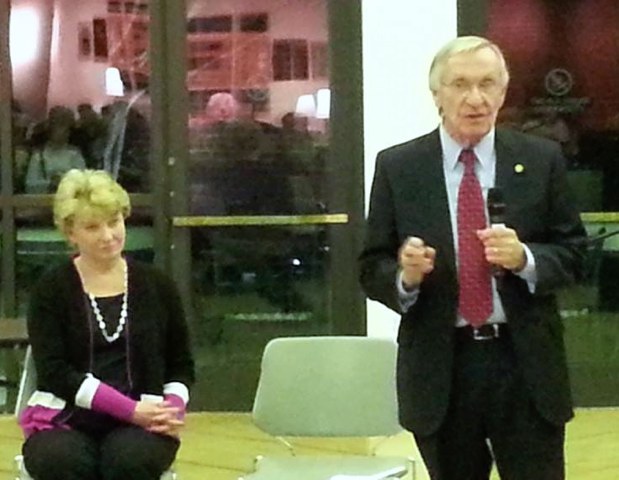
Del. Ken Plum (D-Reston) and Sen. Janet Howell (D-Reston) held their annual meeting with constituents Thursday night, where they discussed issues important to them and those that the public wants to see brought to attention in the 2015 Virginia General Assembly session that begins Wednesday in Richmond.
The event drew several dozen residents to the Reston Community Center Hunters Woods, where they listened to the legislators’ plans for the session, and were able to give feedback on several topics.
Among the topics discussed:
Gun Control — Plum advocated for “common-sense approaches” to gun safety, including the expansion of background checks to cover the “gun-show loophole,” in which gun buyers are able to bypass a background check by purchasing their firearm from an individual seller at a gun show.
Plum also addressed the challenges of passing bills regarding gun control.
“That whole arena of gun legislation is very controversial.” Plum said, “I will tell you that in the House there is a subcommittee that is made up of persons who have straight-A ratings by the NRA, and get all these bills, so it’s a hard climb to get these bills passed […] we need to bring pressure to say that we can protect people’s constitutional rights, but we can have common sense gun legislation.”
Several speakers from the community also voiced their support for Plum’s proposed gun safety measures.
Medicaid Expansion — Both Plum and Howell voiced their support for the expansion of Medicaid. Plum has drafted a bill allowing Gov. Terry McAuliffe (D) to proceed with the expansion of Medicaid.
“There are hundreds of thousands of Virginians today without medical insurance because of the legislature’s inability to act.” Plum said, before urging the public to contact other legislators across the state about supporting this bill.
Gerrymandering — Plum voiced his concern about the way that legislative districts are drawn by legislators, calling it “a total conflict of interest.”
Plum has once again introduced a bill calling for a non-partisan organization to handle the redrawing of district boundaries.
Howell, the former chairman of the Privileges and Elections Committee in the Senate, has introduced a similar bill.
“I have put in, like Ken has, a bill for non-partisan redistricting,” said Howell. “It was my misfortune during last redistricting to be chairing that committee in the Senate. Like Ken said, we have a lot of lawsuits, unfortunately not challenged, with the Senate redistricting. But I will tell you that process was horrible because we had to take all these political factors, and it was almost impossible to keep communities of interest together, and yet that is something we need to do.”
Although the drawing of legislative district lines is supposed to take place each decade after the federal census, the controversy over where and how lines are drawn keeps the issue alive every year.
Most recently, a federal court declared the current Congressional district lines in Virginia invalid because the way the lines are drawn discriminates against minorities being able to get elected. Essentially, the black population is packed into one district.
The 2015 session of the General Assembly will have to redraw the lines. Just last week, about a dozen black citizens brought suit against the current House of Delegates districts contending that they are drawn in a way that discriminates against minorities.
The purpose of the redistricting process is to ensure that persons are equally represented in the legislature. As population shifts with some areas growing and others declining, district lines are redrawn based on the U.S. Census. A numeric equality of the numbers of persons in a district is achieved and has been enforced by the federal courts to be within a couple of percentage points.
But going back to the earliest years of our republic, there has been recognition that the way in which lines are drawn can determine the likely outcome of an election in a district. In 1812, Governor Elbridge Gerry of Massachusetts signed a redistricting bill so favorable to his political party that the newspapers pointed out that one of the districts looked like a salamander, hence the term “gerrymandering.”
There is no doubt that both parties have taken part in gerrymandering districts to their political advantage. The party in power attempts to continue its dominance by drawing lines that are likely to elect more of their party members to the legislature.
The result in Virginia and in other states is to reduce the number of contested elections. Candidates are less likely to run in a district where the numbers are stacked against them. Elected officials who represent these “safe” seats may be less responsive to constituents’ concerns and adhere to stronger political party dictates.
The real electoral contests in these districts tend to be in the primaries selecting candidates. Some of the districts heavily stacked with Republicans in Virginia are seeing increased challenges from Tea Party activists in primaries. Even the Speaker of the House has a Tea Party challenger in a primary this year.
Just last month, a panel appointed by Gov. Terry McAuliffe to look at ethics issues in state government recommended that Virginia establish an independent redistricting commission to draw legislative district lines. Such commissions have proven effective in reducing political influences in how district lines are drawn.
This is not a new idea. In 1982, I introduced a bill to establish an independent redistricting commission and have reintroduced the bill many times since then. While it was rejected by Democrats when they were in the majority and by the Republicans now that they control the majority, it is the right thing to do. As some advocates maintain, citizens should elect their representatives, not the representatives selecting their constituents.
Ken Plum represents Reston in Virginia’s House of Delegates. His opinions are not necessarily those of Reston Now.
The editorial in the Sept. 21, 1897 New York Sun, responding to a letter from 8-year-old Virginia O’Hanlon, who had inquired about whether there was a Santa Claus, has become the most reprinted newspaper editorial, according to the Newseum.
Virginia’s father had told her that if she read it in the Sun it was certain to be true. The editor wrote, “Yes, Virginia, there is a Santa Claus. He exists as certainly as love and generosity and devotion exist, and you know that they abound and give to your life its highest beauty and joy.”
Virginians, especially those around the capitol city, have long believed in Santa Claus. The “Legendary Santa” has been meeting with boys and girls at Miller and Rhoads — first a department store and now a hotel in Richmond — for more than 75 years.
There is ample proof that he is the “real” Santa Claus for he is able with assistance from the Snow Queen and some technology to call every child by name. We go with our grandchildren to see him at his latest location at the Children’s Museum of Richmond.
Read more about this Virginia tradition in Legendary Santa’s Stories from the Chair (Children’s Museum of Richmond, 2011). On page 6 is a photograph of young Jane Durham (now Plum) and her brother visiting Santa many years ago.
Throughout the capitol there is a quickened pace of activity during the holiday season in anticipation of the General Assembly convening on
Jan. 14.
There are wish lists from all the agencies and special interests. And, yes, Virginia, if there is a Santa Claus here is my wish list for the legislative session, essentially requesting my list from last year.
Virginia should extend health insurance to nearly half its uninsured working poor by expanding Medicaid. Not only would more people have access to preventative care as well as treatment, but Virginians would get more of their federal tax dollars back and a boost to the economy with the health care jobs being created.
While I am wishing, I want the General Assembly to expand background checks for all gun purchases to keep guns out of the hands of criminals and violent people. I just this past weekend attended a vigil on the second anniversary of the massacre of 20 children and six adults at Sandy Hook Elementary School, the second highest such shooting after Virginia Tech in 2007, and yet common sense gun safety laws have not been enacted.
I also want the legislature to approve my bill to establish an independent redistricting commission that will fairly and objectively draw legislative boundaries. We would on my wish list repeal the marriage amendment and other discrimination based on sexual orientation. And while we are at it, we need to get the state back to the position of being an equal partner in funding public schools.
None of these goals will be reached by simply wishing for them. Hard work, determination, and public pressure can make them reality. Just like in Santa’s workshop, there needs to be a lot of work done behind the scenes.
Ken Plum represents Reston in Virginia’s House of Delegates. His opinions are his own and not necessarily those of Reston Now.
One of the most frequently asked questions of me this time of year is, “What will the General Assembly be doing when it meets?”
The question is understandable, with the regular session of the legislature scheduled to begin on Jan. 14. The answer is not simple, however, even at this late date. There is unfinished business left over from previous sessions, hot issues that have come to our attention, and recent events that warrant the legislature’s response.
Although the General Assembly passes a two-year budget in the even-numbered years, there are always adjustments that must be made in the odd-numbered years. In stable economic times, these adjustments can be fairly technical and minor. In recent years with the uncertainty in the economy, adjustments can be major. That’s the way it will be this session. Already $1.5 billion has been reduced in the budget passed for this biennium, and additional reductions exceeding $300 million must be made to keep the budget in balance.
Since this will constitute a second round of budget reductions, the choices are not clear or easy. Higher education will likely get a second round of cuts with higher tuitions being available to make up the difference. There seems to be agreement not to reduce state aid to schools which is very important since schools are already funded by the state at a level below 2007. With all 140 members of the House and Senate up for re-election in November, 2015, you can be sure that there will be no discussion of revenue enhancements.
An issue that the Republican majority will try to keep in the background is the expansion of Medicaid that under the Affordable Care Act would provide health insurance coverage for nearly 400,000 of the working poor in the state. The Tea Party wing of the Party vehemently opposes the expansion.
Ironically, expansion of Medicaid would provide about $200 million in federal monies to supplant state monies and help reduce the budget deficit by two-thirds. Moderate Republicans in gerrymandered districts who fear a primary challenge from the right more than a general election opponent will not want to deal with Medicaid expansion. It is too important to delay further. I will continue pushing for expansion.
The ethical lapses under former Governor McDonnell resulted in some tightening of disclosure and ethics laws, but more recent events require the General Assembly to do more work on this issue.
There is some competition between the parties as to who wants to be the toughest. Other breaking news stories like the rape and sexual assault reports at the University of Virginia will result in some legislation to address a concern that has been ignored too long.
Headlines not yet written may well add other issues to the 2015 agenda of the General Assembly. One thing is clear: the agenda will be full. There is much work to be done.
Please share your views on the upcoming legislative session with me on my constituent survey that can be completed online at www.kenplum.com.
Ken Plum represents Reston in the Virginia House of Delegates. His opinions do not necessarily reflect those of Reston Now.
Gov. Terry McAuliffe will address the House Appropriations and Senate Finance Committees on Dec. 17 in a statutorily required report on the state’s finances.
The news will not be good nor will it be surprising. For the last two years, the state has seen a steady erosion of its revenue base. Significant cuts have already been made in the budget, and the state has dipped into its rainy day fund.
The problem has not been significant new spending programs. To the contrary — the state has been reducing its spending over the last couple of years even though the state’s economy and employment levels have seen modest growth.
Representatives of local government and colleges and universities can attest to the budget reductions. A significant part of the revenue shortfall experienced in Virginia and in other states that have an income tax was the change in taxpayer behavior to accelerate gains into tax year 2012 in advance of federal rate increases on high-income taxpayers. Payments were high in the spring of 2013, but dropped dramatically in FY2014 because of the accelerated gains.
With adjustments that were made to the forecast by this and other factors there was a need to make up a $2.4 billion shortfall for the biennium. Most of the reductions have been made with about $272 million cuts still needed in FY2016. Clearly, there will not be any additional money under the current budget structure for higher education, preschool, mental health, or state employees who have had few raises in recent years.
The legislators on the money committees already know much of what the governor will say. Money is short for the state as it is for many individuals. We will need to tighten our belts even further.
According to press accounts, some members of the Senate Finance Committee even used the “T” word, suggesting that rather than further cut critically important programs, we consider raising revenue.
There is no way that a Tea Party-dominated House of Delegates would pass a tax bill, especially during 2015 when all 140 members of the General Assembly are up for election. The reported discussion was more about tax preferences or loop holes that might be changed to increase revenue.
Nearly $1 billion of the state’s $18 billion of general fund monies go to pay a portion of a taxpayer’s car tax obligation to local government. The campaign against the car tax once elected a governor to office and despite the fact that it only partially pays the local car tax is not likely to be revisited. Ironically, Fairfax County and Northern Virginia taxpayers make out well with the car tax program taking money that might otherwise go to poorer communities.
If the state expanded Medicaid, it could pick up over $200 million for the budget. Tax preferences related to the estate tax repeal, coal severance tax, and film production tax credits may be examined.
The 2015 session is not supposed to focus on the budget, but the topic is likely to dominate the term. Even the “T” word may be whispered — but not likely acted upon.
Ken Plum (D) represents Reston in Virginia’s House of Delegates. His opinions are not necessarily those of Reston Now’s.
With the number of rockets my high school friend, Joe Hammock, and I built and launched I am fortunate to have all my fingers and no serious injuries.
Our rockets were not the hobbyist models you can buy today that use water or air pressure to launch; our rockets used black powder or a fuel we mixed ourselves. Launches were sometimes like explosions as the sides of our small rockets went outward rather than upward. We were doing our work (or some would say play) before Sputnik and the Space Age.
I was reminded of those early experiences last week as I chaired the Nanosatellite Advisory Committee of the Joint Commission on Technology and Science.
Even the professionals have their problems with rocket launches with about 1 of 10 not being successful. Most recently, Orbital Sciences which has its headquarters on Route 28 near the intersection with Route 7 had a rocket blow up almost immediately after its launch at Wallops Island, Virginia. Out west the rocket plane for which tickets have already been sold to take people on suborbital flight blew up in a test flight killing the pilot.
For every failure there are many more successes. Who would have imagined that a rocket launched ten years ago would have its payload land on a comet within the last two weeks! Virginia has been involved in many of these successes through NASA Langley and NASA Wallops. The Virginia Space Grant Consortium that has goals of promoting aerospace education at all levels has been rated by NASA as being the top-ranked program among the 52 in the nation.
Students at Virginia universities including Virginia Tech, the University of Virginia, and Old Dominion University are involved in designing, building and launching small satellites that despite their small size can conduct meaningful research while in orbit.
These small “nanosatellites” can be launched with dozens in a payload as part of a larger satellite launch but still have the capability to gather significant scientific data. Students who work on these projects often go on to internships and careers with NASA and private aerospace companies. The Commonwealth STEM Industry Internship Program (CSIIP) matches students to internship possibilities.
The Virginia Space Grant Consortium does not limit its activities to the university level. Through the Virginia Aerospace Science and Technology Scholars program, public school students can take online courses for college credit, compete statewide with other students, and attend a summer academy at NASA Langley Research Center. Specific programs are also aimed at younger students and girls to interest them in science, technology, engineering and math.
As policy makers and government leaders look to the future, it is important to consider space for the limitless potential it offers. Virginia has many unique assets: Wallops Island is strategically located for space launches; a number of federal research facilities are located here; our university system is strong; and the private industry sector has shown a strong interest in investing in space. From experience I know that we need to include a safety course for our young rocket scientists.
Ken Plum represents Reston in Virginia’s House of Delegates. His opinions are not necessarily those of Reston Now’s.
The Virginia General Assembly adjourned its regular session in early March this year and immediately went into special session that while still continuing has become the longest special session ever. The special session was needed to complete work on the biennial budget and to fill judicial vacancies.
While technically in special session, we actually only meet as an assembled body a few days every couple of months. We passed a budget but have had to revise it because of declining state revenue. We considered expansion of Medicaid services in what some termed a “sham” session as the majority party had indicated its no-compromise opposition to closing the coverage gap. We filled a number of judicial positions although the drawn-out political process of selecting judges has made the flaws of the current method painfully apparent.
Since the legislature is in session, albeit a special session, the Governor is prevented from making judicial appointments. As at the federal level, there is gridlock as Republicans fight among themselves as to who should be appointed to the bench.
The necessity of revising a budget soon after its passage reflects what a report from Stateline terms “volatility” in income tax revenue that is disproportionately affected by economic booms and busts. The problem that Virginia and other states are having is trying to predict revenues with stock market fluctuations and other cyclical events that are having a larger impact on incomes, especially for the wealthy causing income taxes and capital gains taxes to vary widely from year to year.
A report from Standard and Poor’s Rating Services found that overall revenues in the top most income-tax-dependent states like Virginia have grown only 5.25 percent since 2009 compared to 9.32 percent in 1980-1989 and 5.7 percent in 1990-1999.
Virginia’s effort to balance its budget is made more difficult by what the Commonwealth Institute for Fiscal Analysis terms “willful ignorance” to recognize the positive impact expanding Medicaid would have on the state’s budget.
At a recent Statewide Policy Summit I attended that the Institute sponsored, a report “RX for an Ailing Virginia: Budget Savings in Expansion States Can Happen in Virginia” was released. The report contends that 27 states and Washington, D.C. have freed up precious resources for critical needs like education by closing their health coverage gaps and saving money on medical care, and that savings in Virginia could amount to $161 million.
While proponents of Medicaid expansion have contended that the program would save states money, the evidence is now available from its first year of implementation — Kentucky has saved $80 million, Arkansas $89 million and Michigan $100 million. Virginia would save money by using federal money to replace state-funded healthcare
Virginia taxpayers are the losers for the state not recognizing and dealing with its systemic budget challenges and for its bullheadedness in not expanding its Medicaid program. Responsible leadership on the part of legislators, not a protracted year-long legislative session, is needed for the Commonwealth.
Ken Plum (D) represents Reston in Virginia’s House of Delegates. His views do not necessarily represent those of Reston Now.
The outcome of the most recent elections demonstrates once again how divided we are as a nation and as a state.
The clearest winner is gridlock, as it is hard to see how progress can be made by Congress on important issues that await resolution. The Senate has not moved closer to a balance where a meaningful debate can occur and issues can be resolved. Rather, the Senate is polarized between opposing points of view with a willingness to compromise being seen as a sign of weakness.
The current circumstance is much more complex than simply Democrats versus Republicans. There are at least three parties in the Congress: the Democratic, Republican and Tea Parties.
On the Democratic side, the number of old-time liberals can be counted on your fingers. There are some Democrats who gravitate to the middle leaving themselves neither fish nor fowl in the eyes of their constituents. The “damn the torpedoes” Tea Partiers run the Congress. Old-time moderate Republicans defer to them for fear of a primary challenge from the right in the next election cycle. The goal of the Tea Party leaders is to stall the operation of government functions which they do not support.
My concern is that the same kind of election results we have seen at the federal level has permeated Virginia state elections as well. I am convinced that there are enough Democrats in the House of Delegates and enough moderate Republicans to pass Medicaid expansion in Virginia if it were not for the influence and threat of Tea Party primary challenges.
Rather than realizing the fate of two Republican committee chairs that were defeated in primaries last election cycle, moderate Republicans are playing it safe and going along with Tea Party priorities as absurd as some turn out to be. The consequence is that Virginia leaves $5 million in federal money on the table each day just so that some politicians can continue to be elected. It seems like a high price to pay!
The other major factor affecting federal and state election outcomes is the incredible amount of money poured into campaigns. Americans for Prosperity, funded in part by the Libertarian Koch brothers, are active in Virginia and were major players in refusing Medicaid expansion. They will keep the pressure on their Republican charges in next year’s Virginia General Assembly elections.
I recently attended a workshop featuring one of my greatest heroes — Sister Simone Campbell of Nuns on the Bus fame. Sister Simone is one of the most effective spokespersons for the poor and those in need of medical services. She is harsh in her criticism of Congress for not raising the minimum wage and reforming immigration laws and of Virginia for not expanding Medicaid. She is insistent, however, that both sides must engage in a conversation in order to find common ground and reach compromises that are so important for the public.
As tough as it seems, I am going to take her advice and get myself in that frame of mind for the General Assembly session starting in January to help it be productive.
Ken Plum represents Reston in Virginia’s House of Delegates. His opinions do not necessarily represent those of Reston Now.
Events of the past couple of weeks remind me of the wonderful people in our community who tirelessly and endlessly work to ensure that others have a good quality of life.
A good friend and former colleague of mine, Elizabeth Link, passed away from cancer. Visiting with her family and fellow educators I was reminded of our past experiences in working together, and I heard new stories of the work that she did on behalf of pregnant teenagers and teen parents.
Her “girls” were always at the forefront of Liz’s mind, and she was relentless in her work to see that the young women in Project Opportunities finished high school and went on to college or career training and that they acquired the skills they needed to be good parents.
The educational establishment and society in general have not always been kind or supportive to teenage girls who get pregnant, but Liz could see the value in each of these young women and their babies. She went to bat for them in a program whose continued funding was always tenuous. There are hundreds of young women who have a better life because of her intervention.
The comments recorded in the friend registry at her memorial service were among the warmest I have ever read as testimony to the many ways Liz supported them and influenced their lives.
Last week, I also attended a workshop sponsored by Voices for Virginia’s Children. A panel of preschool directors and others involved in early intervention and social services for children reminded me of how fortunate we are in this region to have programs that serve our youngest citizens.
Although the evidence is overwhelming as to the value of such programs in making a positive difference in the lives of children and their futures, such programs continue to struggle with limited funding. The range of needs among children is broad. Well-trained and caring teachers are needed to provide a quality program, but the pay scale remains at the level of service employees. It is dedication that keeps the staff of these programs going with the success they see in the faces of their young charges and in the stories they hear about the successes their students of the past are having as they grow older.
Early intervention with children with special needs saves society millions of dollars in reducing the need for programs and services in the future. We need to continue to work to increase the investment to ensure that the needs of many more children are met.
Our teachers come the closest anyone can hope for to immortality. The Liz Links and the early childhood educators of the world will be remembered, and the models they leave will influence others long after they’ve left us. Everyone remembers and thinks about his or her best teacher. The world can see the legacy of their investment in young lives.
Ken Plum (D) represents Reston in Virginia’s House of Delegates. His views do not necessarily represent those of Reston Now.
