

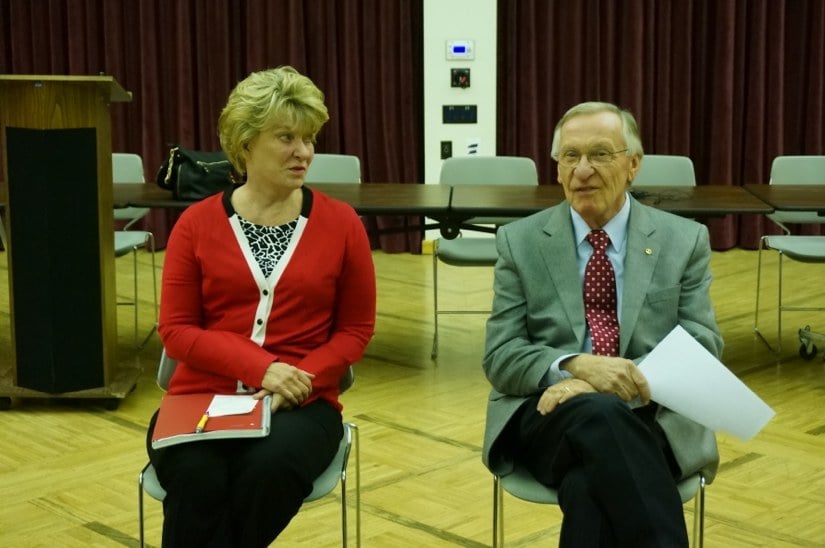
 Sen. Janet Howell (D-Reston) and Del. Ken Plum (D-Reston) will hold their annual pre-session Town Hall Meeting on Thursday, Jan. 8 at 7:30 p.m. at Reston Community Center Hunters Woods.
This is a chance for Restonians to tell their state representatives what issues matter to them prior to the 2015 Virginia General Assembly session. The 45-day session begins Jan. 14 in Richmond.
Plum is a co-sponsor on several bills this session. Among them:
HB 1288 and 1289 Same-sex marriages; civil unions. Repeals the statutory prohibitions on same-sex marriages and civil unions or other arrangements between persons of the same sex purporting to bestow the privileges and obligations of marriage. The bill does not affect the prohibition on these relationships contained in Article I, Section 15-A of the Constitution of Virginia.
HB 1343 Campus police departments; sexual assault reporting. Requires that mutual aid agreements between campus police force and law-enforcement agencies contain provisions requiring either the campus police force or an agency with which it has established a mutual aid agreement to notify the local attorney for the Commonwealth of any investigation involving felony criminal sexual assault occurring on property owned or controlled by the institution of higher education within 48 hours of beginning such investigation.
HJ 493, SJ 214 Constitutional amendment (first resolution); marriage. Proposes the repeal of the constitutional amendment dealing with marriage that was approved by referendum at the November 2006 election.
Howell is the chief patron on several bills. Among them:
SB 677 Elections; absentee voting; no-excuse, in-person. Allows qualified voters to vote absentee in person without providing an excuse for not being able to vote in person on election day. The bill retains the statutory list of specific reasons allowing a voter to cast an absentee ballot by mail.
SB 679 Adoption; person other than spouse of birth or adoptive parent may adopt child. Provides that a person other than the spouse of a parent may adopt a child if the child has only one parent, the adoption would not terminate the parental rights of the parent, and the parent joins in the petition for the purpose of indicating his consent.
SB 734 Higher education; reporting of sexual assault; penalty. Requires any administrator or professor employed by a public institution of higher education who through the course of his employment obtains information alleging that a criminal sexual assault has occurred to report within 24 hours such information to law enforcement. The bill provides that a person in violation of the reporting requirement is guilty of a Class 1 misdemeanor.
SJ 213 Constitutional amendment (first resolution); marriage. Proposes the repeal of the constitutional amendment dealing with marriage that was approved by referendum at the November 2006 election.
 By the time you are reading this column, Virginia will have reached the milestone by having refused to accept a billion dollars of monies paid by Virginia taxpayers to close the coverage gap for 400,000 working poor Virginians who cannot afford health insurance. A $1,000,000,000 is a lot of money!
We got to this point by the Republican majority in the General Assembly refusing to pass a plan for Medicaid expansion that would bring more than $5 million dollars a day to the state, produce as many as 30,000 new jobs in the health care industry, insure as many as 400,000 of the working poor, and enhance the quality of life for Virginia’s workforce and their families.
What is the alternative proposed by the Republicans? Speaker of the House Howell was quoted last month as saying that House Republicans propose to help the uninsured through “free clinics and community health centers and through expanded hospital services.” Hospital representatives are saying that they need the Medicaid money in order to expand services. One hospital in the state has closed, and others report financial stress. The free clinic serving this region is reported to be in economic difficulties.
Last week, Stan Brock’s Remote Area Medical (RAM) set up its mobile clinic in Wise County, VA, as it has been doing one weekend a year for more than a decade. More than 1,000 people who do not have medical insurance or access to regular medical services show up and stand in line for hours to be seen by one or several of the more than a hundred medical care professionals who volunteer each year to run this free clinic. Brock, who achieved fame for his television series Wild Kingdom, has described health care needs and services in the Appalachian region that includes Southwest Virginia as being like that of a third-world country.
The General Assembly majority has been able to stymie efforts by the Governor to get a plan for Medicaid expansion approved. While the legislature is still in special session, it is not expected to meet again until Sept. 22. There is little optimism that there will be a change of heart on the part of Republicans as the national organization Americans for Prosperity threaten a primary challenge to anyone who breaks rank. Two senior Republican committee chairs were defeated in primaries in the last election cycle by Tea Party Republicans as was House Majority Leader Congressman Eric Cantor defeated this year. Unfortunately, the desire to keep one’s legislative seat seems stronger than the moral call to do the right thing and provide health care to people who need it.
The billion-dollar give-away is money paid by Virginians under the Affordable Care Act that goes to Washington and is not returned because of the legislature’s refusal to act. Write to your friends, family, and colleagues and encourage them to contact their legislators to support legislation that will keep $5 million a day that will add up to another billion dollars by early next year in the state for the benefit of Virginians.
Ken Plum represents Reston in Virginia’s House of Delegates
The Silver Line Metrorail extension will open for riders on July 26! For those of us who have been looking at the seemingly completed infrastructure for many months, announcement of the actual date that we can ride this important new service for our community is welcome news.
Having worked on bringing Metrorail to Reston and beyond for the last 20 years, I am especially excited about the opening. In the 1990s, I was the lone politician calling for rail service in the Dulles Corridor while some dismissed the idea as a pipe dream.
In order to develop support for the rail project, I enlisted the help of business and community leaders who supported the idea. In August 1998, I announced the formation of the Dulles Corridor Rail Association (DCRA) as a nonprofit, nonpartisan advocacy group supporting rail in the Dulles Corridor. Joining in the announcement were professional planner Patty Nicoson, who became president of the group and continues in that capacity today; former Delegate Vincent Callahan, who demonstrated bipartisan representation; former Virginia Secretary of Transportation John Milliken; and Restonians Joe Stowers and Steve Cerny, among others.
We set to work, with letters and opinion columns, testimony at public hearings and a variety of advocacy activities that built support for the project. The task was not easy and not without setbacks. While there was widespread agreement about the need for more public transit options in a metropolitan area that had outgrown its transit service planned for in the 1960s, we had to convince some elected leaders that rail was justified over simply expanded bus service or bus rapid transit.
The idea of putting the extension in a tunnel sounded attractive, but was cost prohibitive. Commercial interests were agreeable to additional taxes to help pay for the system, but the project had to be broken into two phases to accommodate when a business interest would start paying an additional tax and when they would receive service. Toll increases on commuters were projected to be unbearably high requiring DCRA to successfully lobby for more direct state appropriations to keep tolls down.
With no direct financial support for the project and a 2010 goal to deliver a completed system, the 30 men and women who made up the original board and those who have joined and left since that time are to be thanked and congratulated. I am honored to continue to serve as chairman of the board of DCRA.
The Silver Line will not be a silver bullet to solve all our transportation woes. We still live in an area ranked 10th in the country for the worst traffic! Rail and bus riders will be asked to make adjustments; drivers may have to change their commuting habits; and some will complain about tolls and fares. Even so, the Silver Line brings a critically important part of infrastructure to our area that will add to our quality of life in getting to and from work and taking advantage of the rich educational and cultural resources of our region and our nation’s capital.
Ken Plum represents Reston in the Virginia House of Delegates
Since the Dec. 14, 2012 massacre at Sandy Hook Elementary School in Newtown, Connecticut, in which 27 people including 20 children and the shooter were killed, there have been 79 more school shootings.
Gun rights advocates dispute the number related to schools, but that is the figure Bill Moyers reported a few weeks ago and there are certain to have been even more since his report. The total number of people killed by guns, suicide and accidental deaths between Newtown and December 2013 is 12,042.
With all the fear and anguish brought on by these shootings at whatever rate they may be occurring, little has been done to address the issue in Congress or in state legislatures.
Previous mass murders have had minimal impact on laws to reduce gun violence. One exception is the attempted assassination of President Ronald Reagan in 1981. While no one was killed, four were wounded, including the President and his press secretary, Jim Brady, who was left confined to a wheelchair with slurred speech and nightmares.
The efforts of Brady, along with the strong leadership of his wife Sarah, led to the enactment after six years, seven Congressional votes and three presidential administrations to passage of background check legislation known as the Brady Handgun Violence Prevention Act. Recently, I attended the Brady Campaign to Prevent Gun Violence National Summit in Washington, D.C. ,that had as its theme to complete the job on background checks to make them universal.
Since the Brady law went into effect on Feb. 28, 1994, background checks have stopped more than 2.1 million gun sales to prohibited purchasers including convicted felons, domestic abusers, fugitives from justice, and other dangerous individuals. But the Brady bill requires background checks only for sales by licensed firearms dealers. Sales by individuals, unlicensed dealers, or internet vendors do not require a background check. The Brady Campaign is mounting a strong lobbying effort that I support to close the loophole on background checks and require them for all gun sales. To learn more, go to www.bradycampaign.org.
As announced at their National Summit, the Brady Campaign is working in other ways to reduce gun violence. Its “Ask Campaign” (Asking Saves Kids) in conjunction with the American Academy of Pediatrics urges parents to ask if there are unlocked guns in homes where their children play. An estimated 18,000 youth are injured or killed each year due to gun violence. More information is at askingsaveskids.org.
This November, make sure candidates you support for the House of Representatives and the U.S. Senate support expansion of the Brady bill. I continue to participate along with many good friends in vigils at NRA Headquarters in Fairfax on the 14th of each month to ensure that the issue is not forgotten. I will be working to expand background checks in the legislature.
Looking at other nations of the world makes us realize it is time to do all we can to prevent gun violence in America.
Ken Plum represents Reston in Virginia’s House of Delegates
About this time of year in 1966 I wrote a letter to my hometown newspaper, Page News and Courier, suggesting that Virginia had just undergone one of the “bloodless revolutions” that Thomas Jefferson had suggested would be good for society periodically.
In the Democratic primary in a very different 8th Congressional District than we know today, liberal state delegate George Rawlings defeated the 36-year veteran Congressman Howard Smith who in his position as chairman of the Rules Committee had thwarted the will of presidents through his control of the flow of legislation and his bottling up of the Civil Rights Act for nearly a decade.
The shock waves when the polling results came in were as great as those heard in the 7th Congressional District this year. As if the defeat of a powerful committee chair was not enough, in that same primary moderate State Senator William B. Spong, Jr. defeated Virginia’s Senator A. Willis Robertson, who had been in the Senate for 20 years. President Lyndon Johnson had recruited Spong to challenge Robertson because the Senator opposed the Civil Rights Act and supported school segregation.
When Lady Bird Johnson came through Virginia campaigning for her husband on the Lady Bird Special train, Robertson was the only elected Democrat who did not come out to greet her. George Rawlings lost in the general election to William “Bill” Scott as conservative Southern Democrats voted for the Republican, and many never returned to the Democratic Party.
Spong was elected to the U.S. Senate where he served for one term before being defeated by the same Bill Scott who had defeated Rawlings six years before. Scott’s service in the House and in the Senate earned him the title given by one publication as being “the dumbest man” in Congress.
The primary defeats of two Southern Democrats in 1966 marked a sharp decline of influence of the Byrd Machine in Virginia politics and a realignment of the conservatives who had called themselves Democrats since Reconstruction. Some became Independents, but others switched to the Republican Party where they felt more at home with their conservatism. When Harry Byrd, Jr. ran for the U.S. Senate to replace his father, he won as an Independent.
No Democratic candidate for President was able to carry Virginia until ironically Barack Obama carried the state in 2008. While Democrats and moderate Republicans are celebrating the defeat of House Majority Leader Eric Cantor in another historic primary, it is important to consider the outcome of the election for the future of the Commonwealth.
The candidate who defeated Cantor did so by being more conservative than Cantor, and from the comments I have been reading he is a far-out Tea Party candidate. Just last year two Tea Party candidates defeated two Republican committee chairs in primaries and went on to win the general election.
An already conservative General Assembly is likely to be pushed further to the right by Republicans who fear a primary challenge. A bloodless revolution is occurring in the Commonwealth; Virginians will not be better for it.
Ken Plum represents Reston in Virginia’s House of Delegates.
As you may know, I grew up in a very rural part of Virginia — in Page County near the little town of Shenandoah in the Page Valley that is part of the grander Shenandoah Valley.
At that time there were about 50 people living in nine houses in the less than 10 miles on Crooked Run Road between Comertown Road and River Road. Except for activities around the schools and holiday parades and carnivals in the Town of Shenandoah, there was little or no sense of community as I have come to understand the word.
My parents had limited formal education, and we had very few reading materials in our home. We did subscribe to Southern Planter and Progressive Farmer magazines that I read from cover to cover, even though my interest in many of the articles was not great.
Progressive Farmer was most interesting to me for its continuing theme of needing to develop a sense of community in rural areas throughout the South.
The topic fascinated me, and I sent in the 50 cents required to get a copy of The Community Handbook (Progressive Farmer Company: 1948). I recently acquired another copy from a used book shop to help me recall why I was so enthralled by it and read it dozens of times. It had information on community organization, parliamentary procedure and social and recreational activities. It provided my first lessons in community leadership.
Along with other experiences I had, I developed an interest in government and public service that I have pursued throughout my adult life. Just as the voids in my early experiences gave me an appreciation of the importance of community, the richness of Reston reinforces for me the significance of community in helping to realize success and quality of life. There are few if any places in this country that have the abundance of community organizations and civic and social activities that are found here.
We are a community of great diversity that adds to our richness. I have the great honor and privilege as an elected official to take part in the Fairfax and Greater Reston Chambers of Commerce but also in the Asian American and the Hispanic American Chambers of Commerce as well as the ecumenical church I attend regularly, the All Dulles Area Muslim Society (ADAMS) Center, the local synagogue, and other religious traditions.
I attend a multicultural fair each year, but I also attend the Pakistani American, Korean American, and other racial and ethnic groups’ activities, along with events sponsored by the LGBT community. I apologize in advance to any groups I may have inadvertently left out.
In those early years when I was trying to gain a sense of community, I would never have dreamed that a place could embrace both a strong sense of oneness and at the same time such great diversity that is celebrated in so many ways. I have grown in my appreciation of the importance of community by being part of Reston.
Ken Plum represents Reston in Virginia’s House of Delegates.
Recently, the New York Times editorial board wrote about the “health care showdown in Virginia.” Their comments were not favorable.
“In Virginia, there are 400,000 low-income people who can’t afford health care coverage but don’t qualify for federal subsidies,” they wrote. “If they lived across the state line in Maryland, West Virginia or Kentucky, which have expanded their Medicaid programs, they could get the coverage they need.”
The reason they cannot; “a group of recalcitrant Republicans in the House of Delegates” have blocked Medicaid expansion at every opportunity.
Highly regarded retired editorial writer for the Virginia Pilot, Margaret Edds, wrote about the current impasse in Virginia two weeks ago. Drawing on her extensive command of Virginia’s history, Edds points out that Virginia was the last state to join Social Security in the 1930s. She argues that there is a moral imperative that “we cannot afford to take this risk” of not expanding Medicaid.
She writes that “designing a health care system that embraces everyone is the right thing to do.” Reston resident, Elliot Wicks, in a recent letter to the editor makes the same argument that closing the coverage gap morally is the right thing to do.
In an unprecedented move, the Virginia Chapter of the American Association of Retired People (AARP) called a press conference to announce that letters sent by the Speaker of the House and other Republican lawmakers to their constituents over age 60 contained “inaccurate information about changes in Medicare.” These letters from Speaker Howell and other lawmakers implied that expanding Medicaid in Virginia would hurt Medicare beneficiaries. “Expanding Medicaid to uninsured Virginians won’t harm the Medicare program or its beneficiaries,” the AARP spokesperson said.
Revenues for the Commonwealth are expected to fall short of projection for this year by as much as $300 million. Ironically, Virginia is losing $5 million a day amounting now to three-fourths of a billion dollars paid by Virginians that could be returned to the state through Medicaid expansion. The money could not be used to balance the budget in the current year, but in future years more than $200 million that Virginia pays for indigent care from its general tax revenue could be paid by Medicaid.
State and local chambers of commerce, medical and health care associations, and editorial boards of the major newspapers in the state have endorsed Medicaid expansion. A major compromise in the form of Marketplace Virginia, proposed by three Republican senators and endorsed by all Democratic legislators, has been introduced.
The compromise proposed in Marketplace Virginia addresses the Republicans’ stated concerns by including a provision to discontinue the program if the federal government reneges on its commitments. It is time for Republicans in the House of Delegates to agree to the compromise.
Their insistence on separating Medicaid from the state budget is a costly stalling tactic that is hurting a large number of Virginians and threatens to hurt even more if the budget stalemate continues.
Ken Plum represents Reston in the Virginia House of Delegates. He writes weekly on Reston Now.
While I enjoy watching college athletic competitions, I do not watch many professional sports on television. For sure I do not watch any of the post-game shows. Panels for these shows seem carefully selected to ensure controversy and banter to fill the time slot.
I have the same feeling about post-election panels that provide an instant analysis with conflicting views of why the voters voted as they did. Some thoughtful commentary after the fact can be useful to understand the mood of voters and implications for the future, but a panel of so-called experts who continue to talk well after they have made their point can get to be irritating. I suppose the same could be said about weekly columnists!
In weeks (not months), the Silver Line extension of Metro will be opening. For someone who has been working on this project for nearly two decades, the setting of the actual date to start service is particularly exciting.
I share the frustration of many that the stations and tracks have appeared to be ready for about six months, yet pesky but important details have prevented the announcement of a start date. As Chairman of the Board of the Dulles Corridor Rail Association, an organization I formed nearly 20 years ago to boost the project when I was the only elected official to endorse it, I am especially eager to see the trains start running.
With the delay in opening, a post-construction analysis has been underway. Contrary to some suggestions, there is no great conspiracy delaying the opening; no one profits from a delay. The system must be deemed safe for it to open. Yes, Bechtel was part of the “big dig” in Boston and its problems, and Bechtel is one of the partners in Dulles Transit Partners that built the Silver Line, but the Silver Line work and outcomes have no correlation to what happened in Boston. Yes, the project manager left early, but he left to take over as head of the Long Island Rail Road.
The Silver Line is the largest infrastructure project underway in this country. The budget is $2.9 billion, and the project will be finished on budget. Some argue that a $150 million increase in the budget to cover costs of updated standards should be considered an overrun. If so, the project would exceed budget by less than two percent. Know any other project of this magnitude that has come that close?
The opening date for the project will be set by the Washington Metropolitan Area Transit Authority (WMATA) which will operate the Silver Line as part of the larger Metro system. The opening date will be seven months beyond the best case projection but still before the December 2014 date the Federal Transit Administration had set for the project.
I continue to nudge the process along to ensure that public dollars are appropriately spent and contractual obligations are met, but you will not see me as part of any panel speculating what may have been. The project will bring immense benefits to our region.
Ken Plum represents Reston in Virginia’s House of Delegates. He writes weekly on Reston Now.
Last week, I had the honor of meeting Stan Brock, the legendary Wild Kingdom TV star and founder and president of Remote Area Medical (RAM).
He held a press conference in Richmond to announce the details of expanding the Remote Area Medical program in Virginia. RAM already sponsors a once-a-year health clinic in Wise County in Southwest Virginia where thousands come on a weekend for the only medical care they will receive all year. The expanded effort in Virginia will be headed by Dr. Vicki Weiss, who has been providing volunteer eye care with RAM for over 15 years. Also participating in the press conference was Dr. Teresa Gardiner who serves on the Health Wagon in the region that was featured on 60 Minutes recently.
Stan Brock started RAM in 1985 primarily to help people in South America who did not have access to health care, but as he explained at the press conference, he soon expanded to this country for the needs in Appalachia, Virginia, and other parts of the country are as great as any third world country.
Last year, RAM served nearly 2,000 people in Virginia, but with the expanded program “Stop the Suffering” over the next two years RAM expects to have a clinic within driving distance of everyone living in Appalachia. Stan Brock talked about “the people we do not see but whose health care needs in Virginia could not be greater” with no references to politics, ideology, or partisanship.
In contrast, there were several informational meetings on Medicaid expansion held last week in locations throughout the state, including one in nearby Ashburn. From talking to persons who attended the meeting and reading press accounts, I was struck by the sharp contrast with the press conference I had attended.
These “informational” meetings were sponsored by the Koch Brothers-funded Americans for Prosperity that is spending millions in the state to defeat what it disdainfully refers to as Obamacare. Invited to participate in these meetings were only delegates opposed to any expansion of Medicaid. The meetings focused on legislative maneuvering, constitutional issues and placing blame for the budget impasse. There was talk of a “clean budget.”
By separating the budget negotiations and the expansion of Medicaid, Americans for Prosperity and their legislative puppets hope to defeat expansion of Medicaid in the state. What wasn’t said is that separating Medicaid expansion from the budget would ignore 20 percent of current expenditures and the potential for five million dollars a day in revenue to serve those most in need of health insurance. Noticeably absent from the delegates were real-life references to the people in need of health care.
It is time for legislators in Richmond to stop talking politics and start listening to the people in need of health care and to those in the community who have health insurance but are concerned for the people who do not. The contrast is stark between those who want to wage a partisan ideological battle to deliver a defeat to the President and those who want to help people who desperately need health care.
For many years, Jane and I have used our spring break to visit locations throughout the Commonwealth of Virginia.
This year was no exception as we went to the southwestern region of the state. Although we drove about 225 miles to Roanoke from Reston, we were not yet in what the locals call Southwest Virginia. In fact, only by driving another 134 miles down I-81 to Abingdon did we get to what many consider the doorstep to Southwest Virginia.
It would have been possible to drive another 111 miles west with a short swing into Tennessee to get to the western-most point in Virginia at Cumberland Gap. That point is further west than Detroit. Regardless of how far you travel, the natural beauty of the mountains and streams in this part of the state are unequaled, and the local people are wonderful to meet.
A visit to the Town of Abingdon is always recommended (visitabingdonvirginia.com). Its historic streets in the center of town are lined with beautiful early Nineteenth Century homes.
Its best known attraction is Barter Theatre, with two stages offering professional productions. The name came from the fact that in 1933 when it was first founded attendees often paid in produce for there was little money to be had.
Abingdon is also the beginning of the Virginia Creeper Trail, southwestern Virginia’s equivalent of the W&OD. It is a 34-mile walking and biking trail that runs by the Holston River and through beautiful mountains. Jane and I took a fabulous 8-mile circular hike from nearby Damascus with half the distance on the Appalachian Trail and the remainder on the Virginia Creeper Trail.
To better understand the history and culture of the region a stop at Heartwood, the Southwest Virginia Artisan Gallery, in Abingdon is a must. While the exhibits are very informative and the creative works of the artisans are beautiful, the structure of Heartwood itself is a work of art and fine craftsmanship.
Southwestern Virginia is filled with wonderful country and bluegrass music. Check the schedule at www.myswva.org for festivals and musical entertainment almost every weekend at some location on the Crooked Road, Virginia’s Heritage Music Trail.
From Abingdon near the Tennessee border we headed almost due north with many, many twists and turns on 70 miles of winding mountains roads to Breaks Interstate Park –“the Grand Canyon of the South”– on the Kentucky border. Almost 200 million years ago the Russell Fork River gouged out a five-mile gorge that created a “break” from crossing the mountains for the settlers passing through the region and spectacular geologic formations and views for modern day visitors. As one local resident advised us, be sure to take the geologic trail to view the wonders of the formations from below.
E-mail me at [email protected] if you need help planning your trip to the great Southwest or to other regions of the state. It is a great place to visit.
Ken Plum represents Reston in the Virginia House of Delegates. He writes weekly on Reston Now.
In Virginia, a governor can serve two terms, but the terms cannot be successive. All newly elected governors of Virginia take office at the beginning of a biennial budget cycle where the outgoing governor has proposed a budget for that cycle. Since the General Assembly is considering the budget when the new governor comes into office, the new governor can attempt to influence the legislature’s consideration of the budget.
Gov. Terry McAuliffe took office in early January when the General Assembly was already meeting and was already considering the budget for the next two years as proposed by outgoing Gov. Bob McDonnell. The Republican-controlled House of Delegates refused to consider any budget amendments proposed by Democrat McAuliffe. As it turns out, however, the House and the Senate could not agree on a budget. The General Assembly adjourned without passing a two-year budget to take effect on July 1, 2014.
Gov. McAuliffe immediately called a special session of the legislature to continue work on the budget, and he used the opportunity to propose a budget of his own. The major difference between the budget Governor McAuliffe introduced and the one Gov. McDonnell had proposed that was passed by the House was that McAuliffe included closing the coverage gap through the expansion of Medicaid. It was the proper action for McAuliffe to take and demonstrated clearly the positive impact that Medicaid expansion would have on the entire state budget.
As Gov. McAuliffe’s budget clearly shows, Medicaid expansion frees up a net of $225 million of current dollars that can be used to give a long-overdue two percent increase for state employees, K-12 teachers and support personnel, and college and university faculty; $17 million for the line of duty act for families of first responders; an additional nearly $9 million for mental health; more than $7 million for pre-K funding and a like amount for land conservation; over $5 million restored to Northern Virginia schools; and other benefits to Virginians.
Most significantly, the Governor’s budget provides medical insurance coverage for up to 400,000 working poor Virginians and brings back to the state $5 million a day in federal taxes paid by Virginians.
Last week in a fraternity-like stunt, the Republican leadership of the House marched across the Capitol with the House passed budget to the Senate Chamber that they knew would be empty as the Senate had adjourned in order to hold public hearings on the Governor’s proposed budget.
The rush down the hall to the Senate was symbolic of the House Republicans’ insistence on passing a bill quickly and without a discussion of a program that absorbs more than 20 percent of the budget. Clearly, they are in a panic about what will happen when the general public becomes aware of the positive implications to the entire budget with an expansion of the Medicaid program.
When compared with the Governor’s budget, the budget pushed through by the House majority is woefully deficient. Though not their intent, it was fitting that the House Republican leaders delivered their budget to an empty Senate Chamber.
Del Ken Plum represents Reston in Virginia’s House of Representatives. He writes weekly on Reston Now.
On the 14th of each month, the anniversary of the Sandy Hook tragedy, I join dozens of others at a vigil at the National Rifle Association headquarters in Fairfax to remind everyone of the need for sensible gun safety measures.
After the most recent vigil, I got an email from Erin Nikitchyuk, which I share with her permission to remind us of how we all need to be concerned about this issue.
“I lived in Reston from the age of two and returned after college, settling in Herndon. We landed in New England after graduate school and eventually in the Sandy Hook section of Newtown, Connecticut. It’s a place that reminds us very much of Reston in so many ways. In fact, I know of six other Restonians who ended up here, too. Sandy Hook is very much like a New England version of the Hunters Woods or Lake Anne communities where we have our own “town center” inside the bigger town of Newtown.
I remember your name in the news all the time–it always caught my eye even though I was never very engaged in following politics, especially at a young age. (My maiden name is Pflaum, which is German for Plum, and I always thought how much simpler it would be to just be Plum, too!).
I was the same age as my son is now when you were elected to office. My son, “Bear” as he’s known to just about everyone, was a third-grader last year at Sandy Hook School. On that morning of 12/14, he should have been safe at the back of the school with the rest of the older kids, but he and his classmate had the much-coveted helper assignments of office and cafeteria messengers. He had just dropped off the attendance forms in the office and was turning to head back to class with his classmate when the window a few yards behind them shattered from gunfire. They were shot at and ran down the hall where a teacher broke lock-down to reach out and pull them to safety.
Today on my Facebook feed, someone had shared the photo of you at this month’s protest on 3/14 in front of the National Rifle Association. I wanted to reach out and thank you personally for being there. It is a brave thing for politicians to take such definitive and public actions on issues, especially divisive ones like guns and especially in a state with a healthy and thriving gun culture.
Our town here still reels from the losses. From my house to just about anywhere I drive, I pass seven homes that should have happy second graders in them and one cemetery with a small stone that should not be there. Many days the mental list of names I unintentionally recite as I pass each house still brings me to tears. No town should be like this. There is not a 14th of the month that goes unnoticed now. We realize it is a rare town that has a tragedy like this, but for many of us it drives home the fact that communities suffer these losses daily, just like a slow-motion mass murder, and they grieve and reel as we do.
There are so many common sense things that we can embrace to keep guns only in responsible hands. Thank you so much for standing up with us and doing so publicly, especially standing in front of the organization that works so hard to keep us from common sense change.”
Thank you, Erin, for writing. The issue can affect any of us at any moment.
Ken Plum represents Reston in the Virginia House of Delegates. He writes weekly on Reston Now.
 Each year, the Governor of Virginia addresses a joint assembly of the House of Delegates and the State Senate in a speech. It’s not unlike the President’s State of the Union address, except that the Governor provides a “State of the Commonwealth” as well as his recommendations for legislative action.
Last week, I heard the 35th such speech since I have been a member of the House of Delegates. I think Gov. Terry McAuliffe made the best of any of the speeches I have heard over my career in the legislature.
He emphasized the need for all to work together: “…as we launch this new chapter in our history, let us resolve to show the partisans in Washington and across the nation that here in Virginia, in a Commonwealth that pioneered government by consensus, there is no challenge too great, no debate too intractable and no idea too ambitious that we cannot come together on common ground to build the future our families deserve.” The theme of his inaugural events was “common ground.”
He will put an emphasis on economic development. In his speech, he announced two economic development projects that he had already concluded after just three days in office.
“In today’s modern economy, Virginia has to be smarter, more productive and far more aggressive than our sister states for new jobs and investment,” he said. From the tone of his speech it is obvious that no one will be accusing the new Governor of not being aggressive enough in economic development.
His goals are clear, and he does not duck controversial issues. In his own words, “We should stop over-testing our students…The General Assembly should not wait another year to pass the bipartisan Dream Act…On Saturday I was proud to sign Executive Order Number One, which prohibits discrimination in state government on the basis of sexual orientation and gender identity…An open and welcoming Commonwealth requires a state government that trusts women to make their own health care decisions, and works to expand access to quality care…I am eager to work with the coalition of Virginia leaders who agree that we need to strengthen our democracy by passing legislation putting Virginia on the path toward non-partisan redistricting.”
He was just as direct in his support for an expansion of Medicaid to help those “families (who) are just a major illness or accident away from financial ruin.” As he pointed out, if we fail to exercise the option of federal funding for Medicaid, “we will forgo $2.1 billion annually in federal funding over the next three years. That is more than $5 million per day.”
The Governor has extended an invitation for legislators of both parties to work with him. I look forward to working with him in moving Virginia forward.
To read the full text of the Governor’s speech, go toGovernor’s Address.
Ken Plum represents Reston in Virginia’s General Assembly. He writes weekly on Reston Now. He can be reached at [email protected].
Virginia taxpayer dollars not returned to them has amounted to $5 million each day since Jan. 1, 2014, and will continue at that rate each day that Virginia refuses to expand its Medicaid program.
In addition, at least 400,000 working Virginians will continue to be uninsured.
The 2013 session of the General Assembly created the Medicaid Innovation and Reform Commission (MIRC) to consider whether reforms to Virginia’s Medicaid program were sufficient to allow Virginia to proceed with some form of coverage expansion through the Affordable Care Act. MIRC members have been assured by staff that all requested reforms have been made, but the Commission members from the House of Delegates have refused to acknowledge the reforms and continue along with the Speaker of the House of Delegates to oppose expansion of Medicaid.
For otherwise fiscal conservatives to turn down $5 million of Virginia taxpayer dollars being returned to them to pay the full cost of Medicaid expansion shows the continued animosity that some Republicans have toward the Affordable Care Act that they refer to as Obamacare. To the concern that the federal government will not be able to continue funding the program into the future, Virginia could make a decision to withdraw at that time.
At the same time, the Virginia Chamber of Commerce business plan for the Commonwealth, “Blueprint for Virginia,” supports the Medicaid reforms that have been made and recommends Medicaid expansion. Chamber leadership has termed Medicaid expansion to be both an economic development as well as a workforce issue. Most of Virginia’s one million uninsured residents are employed. It is projected that the expansion would create an estimated 33,000 jobs and bring $21 billion dollars back to the Commonwealth.
Gov. Terry McAuliffe is a staunch supporter of Medicaid expansion. As he stated to the Chamber, “Let me be clear on one point. If Medicaid expansion is not the business community’s number one priority in your communication with the General Assembly, it will not happen.” He calls for “coming together, putting old ideological differences aside and focusing on what makes sense from a business perspective.”
The case for Medicaid expansion goes beyond the strong business case; it is also a humanitarian cause. Social justice organizations, faith communities, and individuals need also to give priority to making their views known to legislators. Give priority to writing or calling House and Senate leadership and members of the House Appropriations and Senate Finance Committees and ask them to approve the expansion of Medicaid. Contact information is available at House and Senate members.
Five million dollars a day is a lot of money. It is too much to turn down, especially when it can improve the health and well-being of Virginians. Please make sure your voice is heard on this issue.
Ken Plum represents Reston in Virginia’s House of Delegates. He can be reached at [email protected].
Del. Ken Plum knows what he is in for every General Assembly session.
Plum, a Democrat who has represented Reston in the Virginia House of Delegates since 1982, introduces legislation annually on topics he feels strongly about, including gun control, expanding Medicaid and repealing Virginia’s Constitutional Amendment banning gay marriage.
Every year, his bills generally gain no traction in the Republican-led Virginia house. But he will keep trying.
“We know who is going to be in control in the house,” he said at a Town Hall meeting at Reston Community Center on Thursday. “Unfortunately, I am part of the the loyal minority.
Plum and Sen. Janet Howell (D-Reston) held their annual pre-session public meeting to talk about the 2014 General Assembly session, which begins Wednesday, and hear from residents about which issues are important to them. Both legislators are optimistic that some of their proposed legislation may go farther this year under Democratic governor-elect Terry McAullife.
Two special elections will be held later this month to fill vacant state Senate seats. Should Democrats win, the Senate will be evenly divided. At stake seats of Lt. Gov.-elect Ralph Northam in the (D-Virginia Beach) on Tuesday and Attorney General-elect Mark Herring in the (D-Loudoun County) on Jan. 21. The present Senate lineup is 20 Republicans, 18 Democrats, and the two vacancies.
Some of the top topics at the Reston meeting:
* Ethics. Current governor Bob McDonnell (R) is leaving office under the cloud of an ethics scandal for receiving excessive gifts. Howell has been asked to chair a committee dealing with ethics. Plum will also serve on an ethics committee.
“We have to beef it up in Virginia,” she said. It is not sufficient. We have found out the hard way you just can’t trust people.”
* Medicaid Expansion. McAuliffe is in favor of expanding Medicaid coverage to 400,000 Virginians who need it. Most Republicans remain opposed.
