

Fairfax County Public Schools students will start resuming in-person instruction on Feb. 16 under a new timeline unanimously approved by the Fairfax County School Board yesterday.
The board intended to formally vote on the latest proposal from FCPS Superintendent Scott Brabrand during its regular meeting on Thursday (Feb. 4), but enough members stated that they would support the plan during the board’s work session on Tuesday that they ultimately decided to not wait to give their consensus.
“While there’s no guarantee for anything in life regarding a pandemic, I think this is a strong plan with the resources we have to return to some semblance of what school was like before COVID,” Melanie Meren, who represents Hunter Mill District on the school board, said. “Of course, a lot will be different, but I think it’s needed to help people recover their learning loss.”
As with previous Return to School plans, families have a choice between all-virtual learning and a hybrid model with two days of in-person learning and two days of distance learning. All students have been learning virtually since FCPS returned from winter break.
Under the new timeline, students who opt to get some in-person learning will return to school buildings in phases, starting on Feb. 16 with about 8,000 special education and career and technical education students and concluding with third through sixth-grade students on Mar. 16.
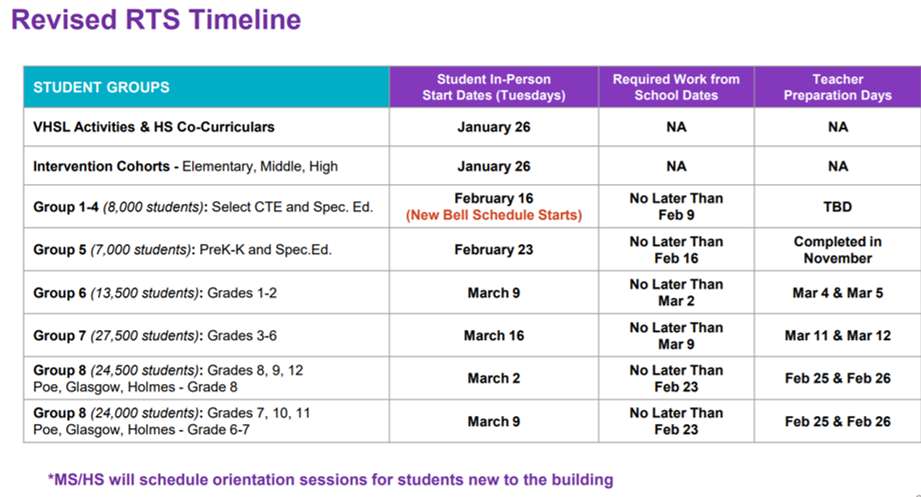
This schedule deviates from the one that was implemented in the fall before being suspended in having elementary school students restart in-person learning at the same time or even later than their older peers in middle and high school, whose return will be staggered across Mar. 2 and 9.
Braddock District Representative Megan McLaughlin questioned the two-week gaps between groups of elementary school students, noting that Loudoun County Public Schools plans to have students in pre-kindergarten through fifth grade in buildings by Feb. 16.
FCPS officials attributed the extended timeline for elementary schools primarily to staffing issues.
As of Feb. 1, FCPS has filled 74% of the 846 classroom monitor positions that it says are needed to restart in-person learning, but that still leaves 205 vacancies. The biggest gap is in grades three through six, where 94 positions – or 46% — remain vacant.
FCPS Deputy Superintendent Frances Ivey told the school board that, while some may prefer a more aggressive timeline, discussions with elementary school principals indicate that most of them support Brabrand’s proposal.
“There’s an overall positive consensus to the timeline, and recommendations were made based on that feedback,” Ivey said.
Brabrand acknowledged that not all teachers and staff will be fully vaccinated by the time in-person learning restarts, but more than 7,000 FCPS employees had received their first dose by Jan. 25, and nearly 90% of staff members had scheduled an appointment with Inova by Jan. 27.
Inova stopped scheduling first-dose appointments on Jan. 25 due to an anticipated drop in supply levels, but FCPS rescheduled approximately 5,000 appointments that had been canceled over the past weekend, and Brabrand says he is “really confident” that the remainder will be taken care of in the next week or two.
“There really isn’t a perfect Return to School timeline. We’re trying to balance so many competing factors, and that’s what’s been hard,” Brabrand said. “…I am proud of what Inova and the county health department did. They brought us in with open arms and worked through the glitches.”
Even with vaccinations, implementing mitigation protocols like face masks, social distancing, and good hygiene and cleaning practices will be “paramount” to enabling safe in-person learning, according to Brabrand’s presentation.
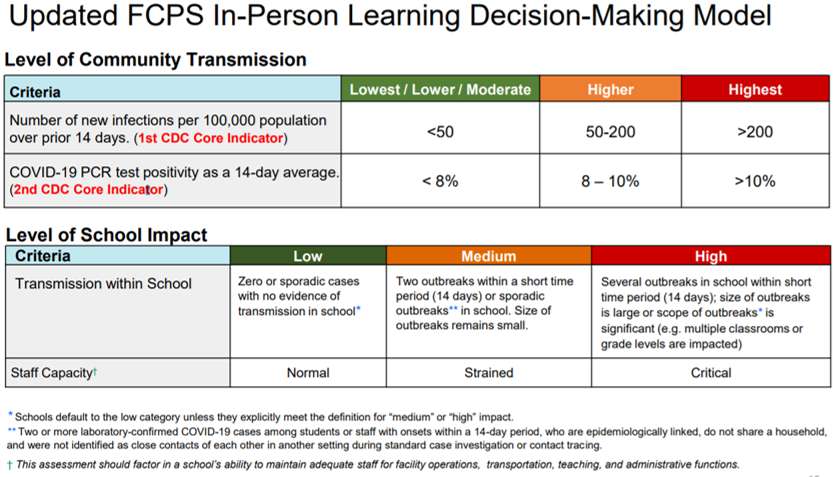
Individual schools or classes could revert to virtual learning based on COVID-19 transmission levels and staff capacity within those schools, as well as community spread as indicated by the 14-day case rate per 100,000 people and 14-day testing positivity rates.
The inability to create six feet of distance between students on buses will be a challenge, but FCPS officials say they are working with transportation staff to address those concerns, and adequate personal protective equipment will be available for all workers.
“We have certainly enough PPE on hand, and the quality for which we’re purchasing is based on health department guidelines,” FCPS Chief Operating Officer Marty Smith said. “…We certainly wouldn’t want to undercut the safety of our staff or students.”
Now that the school board has settled on a Return to School plan, Brabrand said he is committed to ensuring teachers, staff, administrators, and students get what they need to safely and successfully transition back to in-person learning.
“We’ve got to stay on the data,” Springfield District Representative Laura Jane Cohen said. “We’ve got to be as transparent as humanly possible and a lot more transparent than we have been able to be up to this point. Our staff and families deserve to know what they’re walking into.”
Images via FCPS
Fairfax County has made progress in its efforts to vaccinate priority groups for COVID-19, but challenges remain as officials contend with still-limited supplies while attempting to improve communications and outreach, particularly to minority and disadvantaged communities.
According to a presentation delivered to the Fairfax County Board of Supervisors Tuesday morning, 53,731 of the 58,825 first doses that the Fairfax County Health Department has received since late December have been administered by either the health department or its partners, which include Emergency Medical Services, the Fairfax County Adult Detention Center, pharmacies, and other healthcare providers.
The county health department has also received 25,800 second doses of the Moderna vaccine. 7,875 of those doses have been administered.
With its weekly allocation from Virginia currently limited to 13,600 doses, Fairfax County has scaled back the number of available vaccination sites. The health department is now only providing first doses at the county government center, reserving local health district offices for second doses.
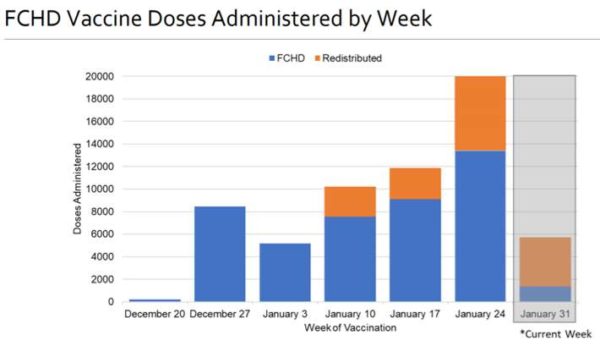
However, the county has also started working with more partners over the past week, including Kaiser, the first private healthcare provider to get the COVID-19 vaccine, and George Mason University’s Mason and Partners (MAP) clinics.
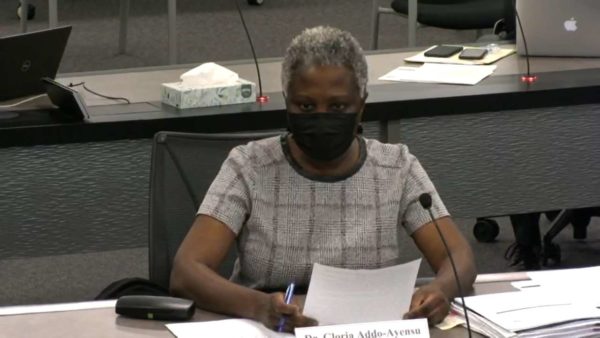
Fairfax County Health Director Dr. Gloria Addo-Ayensu says partnerships like those will be critical to getting the vaccine to more people in Fairfax County, since not everyone can easily travel to the Fairfax County Government Center and other established vaccination sites.
“The ideal thing would be for us to be able to engage clinicians, private providers when we have sufficient vaccine,” Addo-Ayensu said. “…We do know for sure that more vaccine is coming our way, but we just don’t have dates and timelines. All we’re doing right now is building that capacity by engaging with our partners.”
While acknowledging that supply constraints remain the biggest challenge facing the county’s vaccine program, several supervisors shared frustrations that they have heard from constituents who have registered for a vaccination but have no clear sense of when it will actually be their turn to get an appointment. Read More
The novel coronavirus has now killed 802 people in the Fairfax Health District, which includes Fairfax County and the Cities of Fairfax and Falls Church.
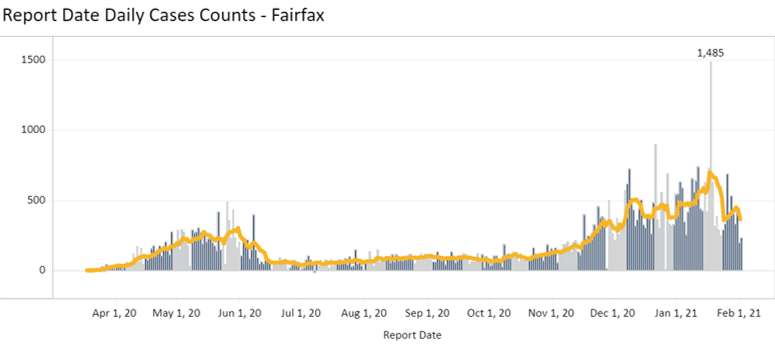
While the number of new cases and hospitalizations appear to be trending downward, Fairfax County has still been averaging 365 COVID-19 cases, eight hospitalizations, and 4.5 deaths per day over the past seven days, according to the Virginia Department of Health’s data.
With 237 new cases today (Monday), the Fairfax Health District has recorded a total of 60,436 COVID-19 cases, and 3,317 people have been hospitalized due to the disease caused by the novel coronavirus.
After a hectic week of mass appointment cancellations and revamped protocols, state and local officials in Virginia hope that an anticipated increase in vaccine supplies, clearer guidance to health providers, and the pending launch of a centralized registration system will result in a more efficient and less confusing COVID-19 vaccination program.
According to a presentation that Fairfax County Health Director Dr. Gloria Addo-Ayensu is scheduled to deliver to county supervisors tomorrow (Tuesday), Virginia is currently receiving about 105,000 doses of the Pfizer and Moderna vaccines per week. The Fairfax Health District has a weekly allocation of 13,600 doses.
Virginia Gov. Ralph Northam announced last week that the federal government is expected to increase its allocation of vaccine to the Commonwealth by 16%. He also told local health districts to split their supplies evenly between older adults and the other eligible populations, including essential workers and people with high-risk medical conditions.
Fairfax County continues to lead Virginia’s vaccination efforts, administering 95,935 total doses and fully vaccinating 15,864 people as of today. However, that is only a fraction of the 223,625 doses that the Fairfax Health District has received, according to a new VDH dashboard.
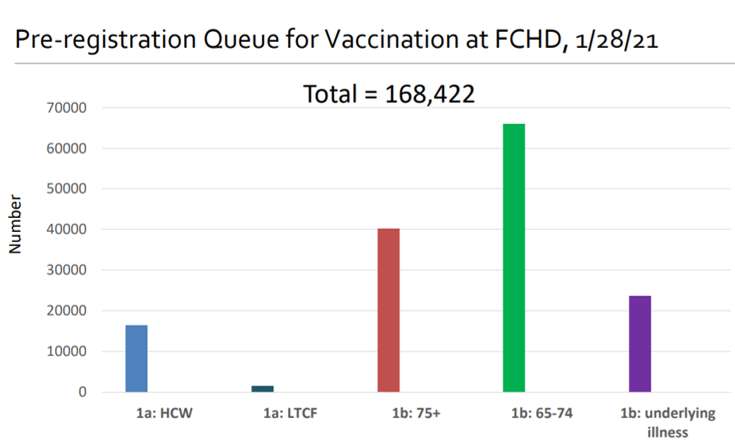
As of Jan. 28, the county had a waitlist of 168,422 people who have pre-registered for an appointment through the Fairfax County Health Department, which has been administering the vaccine to older adults, healthcare workers, long-term care facility employees, and people with underlying medical conditions.
Essential workers, including teachers and first responders, have been getting vaccinated through special clinics from Inova Health Systems, which has reported administering about 75,000 doses. Last week, the nonprofit ceased giving new appointments for people looking to receive their first dose, though Fairfax County Public Schools was able to reschedule appointments for its staff that had been canceled.
Overall, Virginia has received 1.3 million vaccine doses, administered 843,230 doses, and fully vaccinated 124,407 people. The pace of vaccinations has been picking up, with the Commonwealth now averaging 33,675 doses a day, but remains short of Northam’s goal of 50,000 per day.
Images via CDC on Unsplash, VDH, Fairfax County Health Department

Fairfax County should provide hazard pay to all local government workers, a union that represents more than 2,000 general county employees argues.
The county is currently considering a proposal to provide a one-time $1,500 hazard pay bonus to workers who are at high risk of exposure to COVID-19. Staff say about 4,000 employees would be eligible for the benefit.
However, SEIU Virginia 512 — the Fairfax County government employees’ union — says the bonus should be available to all workers, because they have all taken risks and been forced to adapt so the county can keep providing essential services during the pandemic.
As of yesterday (Wednesday), a petition urging Fairfax County supervisors to extend $1,500 hazard pay bonuses to all staff has been signed by nearly 1,000 workers, with more signatures expected to come, according to SEIU Senior Communications Specialist Rachel Mann.
“We’ve all been impacted by what’s going on. Whether we are doing our assigned work or not, we are still working,” SEIU Virginia 512 Executive Board President Tammie Wondong said. “…We are continuing to keep Fairfax County running. Residents are being continually served. So, that’s why everyone needs to have hazard pay.”
The Fairfax County Board of Supervisors was initially scheduled to vote on the proposed plan on Tuesday (Jan. 26), but the decision was postponed after Chairman Jeff McKay asked staff to continue discussions with the union and other workers’ groups.
Under the staff plan, hazard pay would go to workers whose risk of being exposed to COVID-19 is rated “high” or “very high” by the Virginia Occupational Safety and Health (VOSH) risk assessment. It would also be limited to merit or career positions.
Fairfax County intends to pay for the bonuses using CARES Act Coronavirus Relief Funds. Federal guidelines, however, dictate that CARES Act money can only be used for hazard pay if an employee is performing duties that involve physical hardship related to COVID-19 response efforts.
In other words, localities must establish criteria for hazard pay eligibility to use CARES relief funds, Fairfax County Department of Management and Budget Director Christina Jackson told the board on Jan. 12.
The county could use its own funds to extend hazard pay to more workers, but McKay suggests employees should temper their expectations for the upcoming Fiscal Year 2022 budget.
“Based on the economic impacts of the ongoing pandemic, it will be challenging to address many of the Board’s priorities in the FY2022 [budget],” McKay said in a statement to Tysons Reporter. “The budget is still early stages and we are exploring what options are available, but it is unlikely we would have the resources to increase hazard pay funding in the next budget cycle.”
SEIU Virginia 512 supports the amount of the proposed bonus, which came out of talks between workers’ groups and county staff, but the union argues restricting hazard pay to select positions and agencies ignores the risks all employees face when doing their jobs.
For instance, a sanitation worker may not typically come into direct contact with the residents whose trash they collect, but their job still requires them to regularly go out into the community.
“You don’t know who you’re passing, and you don’t know who’s infected. You just don’t know,” Wondong said. “It’s a risk that we take just coming in and out of our homes every day.”
The burden placed on workers who test positive for COVID-19 to prove they contracted the disease through their job could also potentially be a concern.
Further complicating matters, Fairfax County has been reassigning many employees to duties outside their usual purview as some departments have reduced operations and others have ramped up during the pandemic.
Wondong is a social worker for the county’s aging and older adults services division, but she is currently working in a different role for her department, one that allows her to work from home but also normally carries a higher salary than what she’s being paid.
Wondong says hazard pay would not be up for debate if Fairfax County employees had stronger collective bargaining powers to guarantee equitable compensation and working conditions.
“What we believe as a union is that all county workers deserve fairness and equity when it comes to pay and benefits. That’s what we believe,” Wondong said.
Photo via Fairfax County government/Facebook
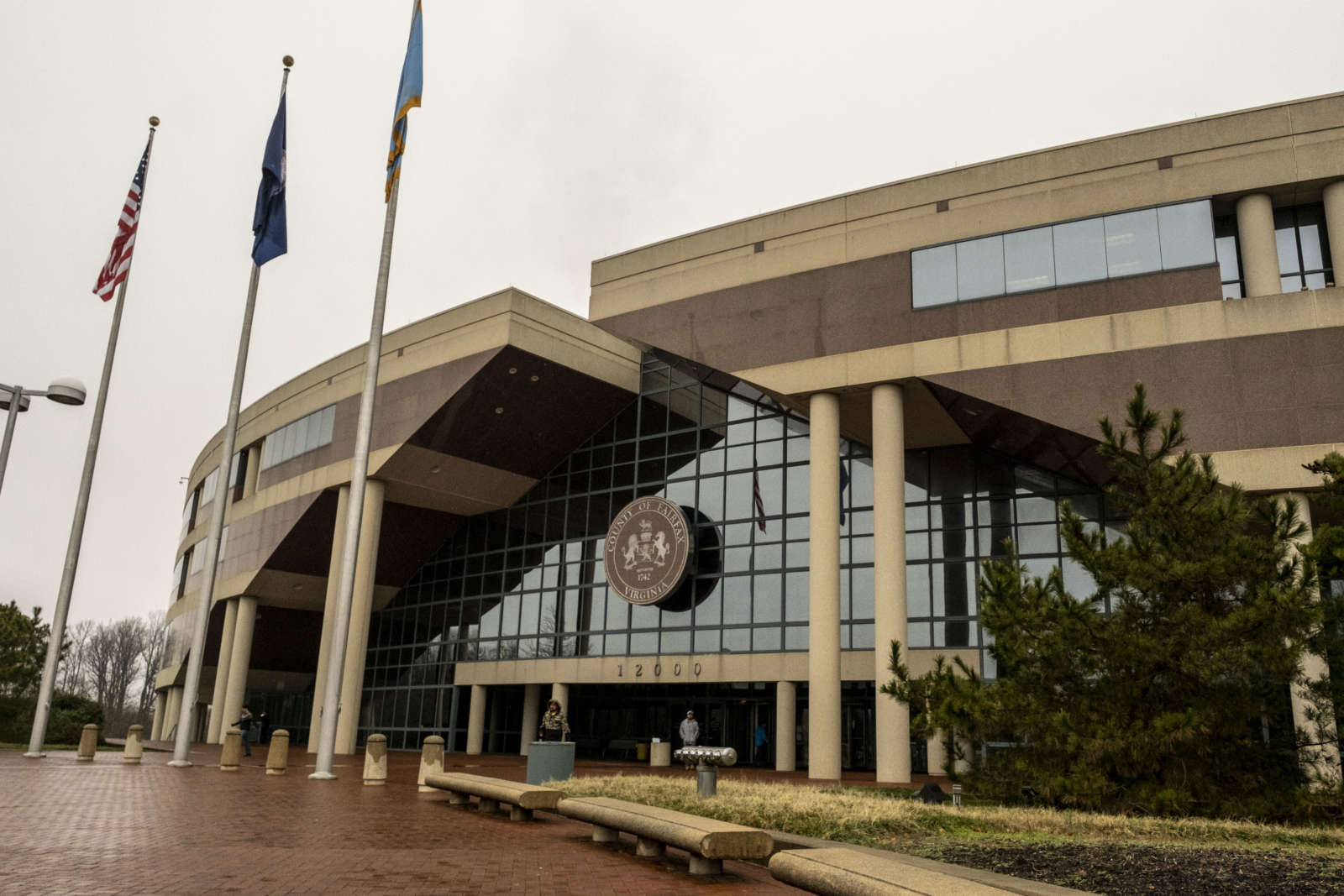
Fairfax County employees are now prohibited from providing information about a person’s immigration or citizenship status to federal immigration authorities unless required by law or court order.
The Fairfax County Board of Supervisors voted 9-1 to adopt the new Public Trust and Confidentiality Policy yesterday (Tuesday) as part of a board matter introduced by Chairman Jeff McKay, Dranesville District Supervisor John Foust, and Providence District Supervisor Dalia Palchik.
While Fairfax County has long maintained that it does not assist Immigration and Customs Enforcement (ICE) unless mandated, McKay, Foust, and Palchik say the need to turn those guidelines into a formal policy has been heightened the COVID-19 pandemic, which has disproportionately affected local Latino communities in particular.
“While there are no known instances of General County employees voluntarily sharing information about a resident’s immigration status, such policies are no doubt critical steps forward in building community trust and transparency,” the board matter said. “They also help quell fear in our community and ensure everyone feels comfortable getting the assistance they need from local government.”
The immigrant rights groups ACLU People Power Fairfax and CASA hailed the trust policy as “a major victory” after a four-year campaign urging Fairfax County to bar agencies from voluntarily disclosing information to ICE.
Advocates have argued that information-sharing with ICE can undermine public safety, as fear of detention or deportation discourages immigrants from reporting crimes, seeking medical attention, going to school, accessing basic needs assistance, and utilizing other critical local government services.
CASA says Fairfax County’s new policy is the first of its kind in Virginia.
“For four years, we have marched, spoken out and stood up for our rights as immigrants, and now we can finally breathe easier,” Luis Aguilar, CASA’s Virginia state director, said. “We are grateful for the leadership of Chairman McKay and Fairfax County Board of Supervisors, who stood strongly in support of immigrant families by voting through this critical county policy change.”
The Board of Supervisors directed staff to draft the new policy last year. McKay credits ACLU People Power Fairfax and CASA with helping develop the policy.
According to the board matter, the trust policy is intended to complement a Fairfax County Police Department general order that established more robust guidelines regarding the FCPD’s role in civil immigration cases and interactions with immigrants.
Implemented on May 6, the general order expanded on an existing directive that instructed officers against taking individuals into custody or reporting them to ICE solely on the basis of an outstanding civil administrative warrant.
Under the new trust policy, Fairfax County employees are now prohibited from:
- Disclosing personal identifying information about individuals, such as their citizenship or immigration status, unless required by law or the individual has given their permission
- Providing access to county facilities, records, or funds not accessible to the public unless mandated by law, court order, or a criminal warrant
- Using county resources to provide information to federal immigration enforcement officials
- Threatening, coercing, or intimidating individuals based on their actual or perceived citizenship or immigration status
- Participating in civil immigration enforcement operations
The policy also directs county agencies to accept driver’s licenses, passports, and other photo documents issued by a state or foreign government or an approved nonprofit as sufficient to verify an individual’s identity or address.
“The Trust Policy breaks new ground in Virginia by prohibiting voluntary cooperation with ICE,” ACLU People Power Fairfax Lead Advocate Diane Burkley Alejandro said. “…ICE has exploited the weaknesses of Virginia privacy laws to obtain contact information to track down its ‘targets.’ Thanks to Chairman McKay and the Board, Fairfax now has guardrails in place to prevent this happening here.”
Staff photo by Jay Westcott
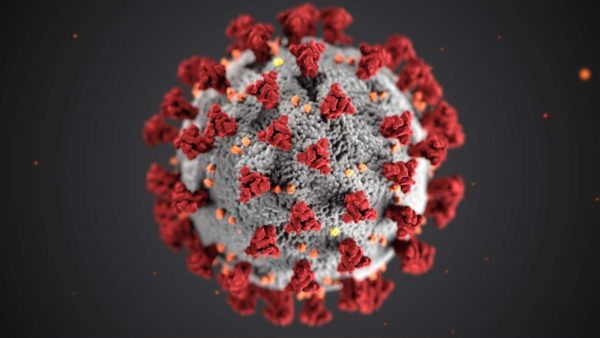
Fairfax County set a new single-day record for new COVID-19 cases over the three-day weekend leading up to Martin Luther King Jr. Day.
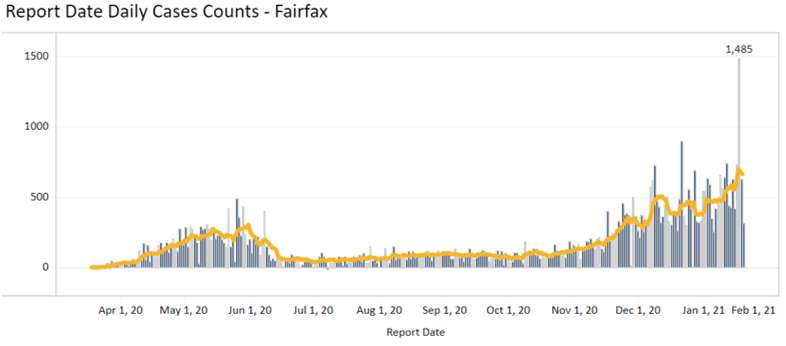
The county’s daily caseload rocketed to 1,485 cases on Sunday (Jan. 17), topping the previous high of 897 cases recorded on Dec. 21 by 588 cases.
The new record was part of a statewide surge that saw Virginia nearly reach 10,000 new cases in one day for the first time since the novel coronavirus was confirmed in the Commonwealth last March. 9,914 cases were reported in the state on Jan. 17, followed by 7,245 cases on Monday, which represented the second-highest daily caseload of the pandemic.
Unlike with previous jumps in new cases, the two-day spike could not be attributed to a lag in reporting.
“This increase is likely due to exposures during the holidays, similar to after Thanksgiving,” the Virginia Department of Health said in a statement reported by Inside NoVA and other news outlets. “VDH reminds Virginians to be vigilant and use the recommended guidance to prevent the spread of COVID-19.”
With an additional 313 cases coming in today (Tuesday), the Fairfax Health District has now recorded a total of 55,534 COVID-19 cases, 749 deaths, and 3,191 hospitalizations.
This weekend’s surge came as Virginia expanded eligibility for the COVID-19 vaccines to new populations, including people who are 65 and older or have high-risk medical conditions or a disability.
Fairfax County continues to outpace other jurisdictions in the state in administering vaccinations, delivering 43,161 doses as of this morning. 4,393 people in the county have been fully vaccinated, meaning they have received the required two shots of either the Pfizer or Moderna vaccine.
However, limited supplies and technical issues have complicated the vaccine distribution process.
In the week since Fairfax County opened appointments to residents in phase 1b, the online pre-screening registration system and phone hotline set up by the county health department have been overwhelmed by demand multiple times.
As of Jan. 16, more than 40,000 people had registered online or by phone to get a vaccination in the past week, but the vaccine supply “remains very limited,” and not everyone who has registered has been able to secure an actual appointment yet, according to the Fairfax County Health Department.
“We ask for your patience as it may take months to get through these priority groups,” the department said. “There are plans to increase options for vaccine in pharmacies and health care provider options, which over time will give people more choices.”
According to the VDH, Virginia has administered 341,388 vaccine doses total and distributed 943,400 doses. The state is administering 17,464 doses every day, still well shy of the 25,000 vaccinations-per-day goal set by Gov. Ralph Northam.
Image via CDC on Unsplash, chart via Virginia Department of Health
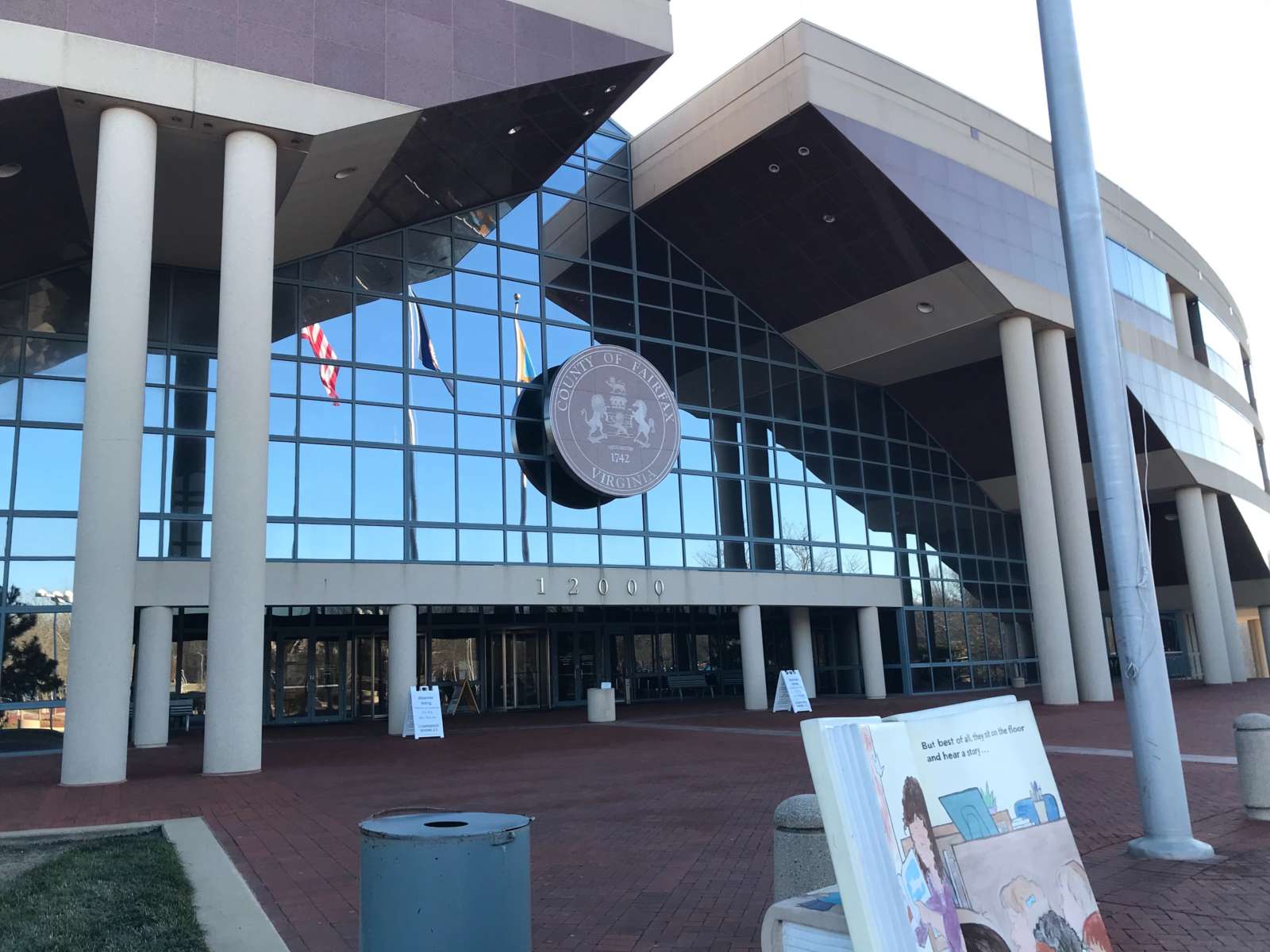
Fairfax County workers whose jobs put them at high risk of exposure to COVID-19 could receive a one-time hazard pay bonus of $1,500 if county leaders approve a proposal put forward on Tuesday (Jan. 12).
Fairfax County Director of Human Resources Cathy Spage told the Board of Supervisors during its budget policy committee meeting that about 4,000 county employees would be eligible for the bonus, giving the proposal an overall estimated cost of $6.5 million.
If approved, the funds would come out of $10 million in CARES Act coronavirus relief money that the county had set aside earlier for hazard pay, according to Fairfax County Department of Management and Budget Director Christina Jackson.
“I think there’s a strong desire on the board to move forward with something,” Fairfax County Board of Supervisors Chairman Jeff McKay said. “I know there’s still some lingering debate on some pieces of this, but I think the principle here is one that is strongly supported.”
Under the county’s proposal, the hazard pay bonus will be available to workers whose exposure risk level is rated high or very high based on Virginia Occupational Safety and Health (VOSH) standards established by the Virginia Department of Labor and Industry.
Adopted on July 15, the VOSH COVID-19 risk assessment puts workers in very high, high, medium, and lower risk categories based on their work environment, their proximity to people known or suspected to be infected, their ability to maintain social distancing, and other factors.
The bonus will only be open to merit employees, because the lack of standard schedules for non-merit employees would make it “problematic” to include them, according to Jackson.
Several board members raised concerns about employees being excluded from getting hazard pay despite risking infection by the novel coronavirus as part of their job. For instance, the VOSH standard classifies school settings, restaurants, and construction sites as medium risk.
“There have been outbreaks on construction sites. We know that it happens,” Braddock District Supervisor James Walkinshaw said. “Based on what I’ve read of the VOSH medium-risk categories, some of them probably make sense. Some of them make me a little bit concerned in terms of how they’re categorizing folks.”
Spage says VOSH generally limits “very high” and “high” risk designations to individuals who are unable to socially distance and work directly with people that have contracted COVID-19 or are highly likely to be positive for the disease.
“Just having contact with the public isn’t going to put you in a high or very high category,” Spage said.
Federal guidelines for using CARES Act funds for hazard pay require localities to establish specific criteria for recipients, so if Fairfax County wants to expand the pool of workers who are eligible for hazard pay, it would likely have to cover those costs on its own, Jackson says.
If the current proposal passes, the county would have about $3.5 million left that it could use for hazard pay or reallocate to other needs related to the COVID-19 pandemic.
McKay acknowledged that there was some pressure for Fairfax County to provide hazard pay early in the pandemic, but county leaders opted to wait until they had more data and a better understanding of COVID-19 transmission.
Some jurisdictions in the Washington, D.C., region that implemented hazard pay, including the District, have since ended their programs, while others are questioning whether they can afford to keep making the payments as the pandemic drags on.
Jackson says the proposed $1,500 bonus is in line with what Loudoun County approved in October and what Virginia Gov. Ralph Northam is suggesting for state employees.
“Taking a benefit like this away from somebody once they’ve gotten used to it is never a position anyone wants to be in,” McKay said. “Given the uncertainty that we were facing this entire past year and really are continuing to face now, I think this is a responsible way to do this.”
The Board of Supervisors will vote on whether to approve hazard pay for county workers on Jan. 26. If approved, the county will complete its verification of eligible employees on Feb. 12, and the bonuses would start being paid on Feb. 26.
Staff photo by Catherine Douglas Moran
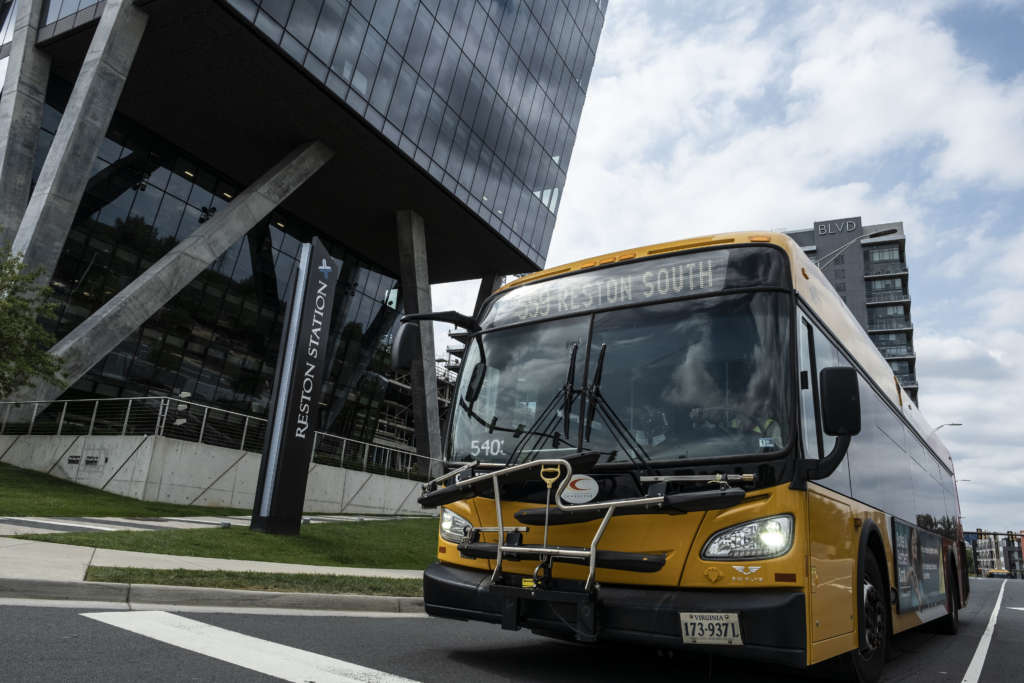
With only a week left until President-elect Joe Biden’s inauguration, Fairfax Connector announced that two bus routes will stop operating today (Wednesday) through Jan. 20 due to planned road closures in Washington, D.C.
Route 699, which normally travels between the Fairfax County Government Center and downtown D.C., will instead serve as a free shuttle to transport riders from the government center park and ride to the south entrance of the Vienna Metro station.
“The shuttles will leave the government center at the time on the schedule,” Fairfax Connector said in a tweet. “The shuttles will leave Vienna about 45 mins after their DC departure time with the goal of getting riders back to the P&R lot near their regularly scheduled arrival time.”
Fairfax Connector suggests Routes 631, 632, and 634 as travel alternatives for passengers on Route 697, which goes from the Stringfellow Road Park and Ride in Centreville to D Street SW in D.C. Routes 631, 632, and 634 all stop at the Stringfellow Park and Ride and the Vienna Metro station.
⚠️ Due to road closures for Inauguration, Route 697 will not operate into DC starting immediately through Wednesday, Jan. 20, 2021. Passengers should use shuttle between Stringfellow P&R and Vienna Metro South. Use alternative Routes 631, 632, & 634. Thanks for your patience.
— Fairfax Connector (@ffxconnector) January 13, 2021
⚠️ Due to road closures, Route 699 will not operate into DC starting immediately through Wednesday, January 20, 2021. Route 699 will shuttle passengers (free of charge) between Government Center Park & Ride and Vienna Metro South. Thanks for your patience.
— Fairfax Connector (@ffxconnector) January 13, 2021
Fears that the violence that embroiled the U.S. Capitol last week could return during the lead-up to Inauguration Day have put the D.C. region on edge, prompting thousands of National Guard troops and federal, state, and local law enforcement officers to mobilize for the National Special Security Event.
Fairfax County Board of Supervisors Chairman Jeff McKay joined other local and state public officials in warning community members against traveling to downtown D.C. on the day of the inauguration and the days preceding it.
“Sadly, the terror that occurred at the U.S. Capitol on January 6, 2021, was not a contained or isolated incident, and there is continued concern that similar violence is an ongoing threat to Americans and our democracy,” McKay said in a statement today.
The chairman says that the Fairfax County Police Department has been in contact with D.C. police about “the evolving situation” and has increased its presence in “key areas” of the county.
McKay advises residents to stay home if possible, avoid downtown D.C., and report any suspicious activity to police at 9-1-1 or the FCPD’s non-emergency line at 703-691-2131.
“Fairfax County will do all we can to help our partners in the region ensure a peaceful and safe transition of power on January 20, 2021 because that is the will of Fairfax County residents and the majority of Americans across the country,” McKay said.
Photo via Fairfax Connector/Facebook
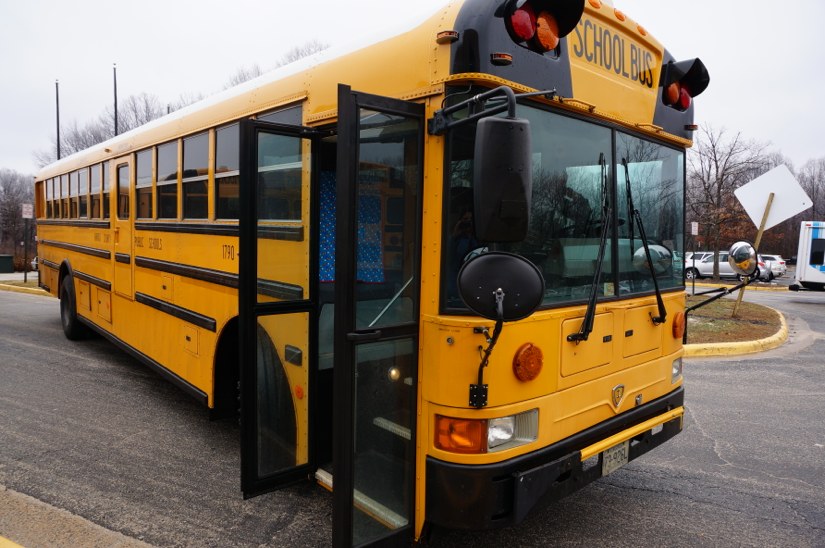
Fairfax County Public Schools is getting its first electric school bus today as part of a statewide initiative led by Dominion Energy.
The bus is expected to arrive at the Stonecroft Transportation Center in Chantilly. It is the first of eight vehicles that FCPS will receive from Dominion in an initial deployment of 50 buses throughout Virginia.
FCPS says it anticipates getting the remaining seven buses by the end of January.
Made by Thomas Built Buses, the new vehicles will join Fairfax County’s fleet of approximately 1,625 diesel-fueled school buses, one of the largest in the country.
“Electric school buses in FCPS will benefit not only the school division and its community, but the entire national capital area,” FCPS says. “…They will help reduce carbon emissions, serve as a resource for national emergency planning efforts, and provide stability and capacity to the grid with meeting increasing energy demands.”
While electric buses are more expensive to purchase than diesel ones, they are cheaper to maintain and operate. FCPS is covering the difference in the initial cost with a grant from Dominion Energy, which also funded the installation of electric charging infrastructure at the Stonecroft facility and is responsible for maintaining the equipment.
FCPS says training for bus drivers, maintenance technicians, and other staff will start once the first bus arrives. The vehicles will undergo testing before being assigned to routes in early to mid-April, though whether there will be any students for them to transport at that time remains to be seen.
The arrival of Fairfax County’s first electric bus is a welcome step forward for community members and public officials who have been advocating for a transition to electric vehicles, citing health and financial benefits as well as environmental ones.
One of the most prominent advocates for electric school buses has been the Fairfax County branch of the national climate advocacy group Mothers Out Front, which launched a campaign in 2019 calling on FCPS to commit to converting its entire fleet to electric power by 2024.
“We are so excited for Fairfax to get its electric school buses on the ground and running,” Mothers Out Front Fairfax co-leader Barbara Monacella said in a statement. “…Every electric school bus we add to our fleet reduces the air pollution from diesel that harms our kids’ health, and brings us closer to our goal of converting every bus in order to reduce emissions and fight climate change.”
The community advocacy group has teamed up again with Del. Mark Keam (D-35th) on legislation that would create a state fund for school districts to purchase electric buses, a move aimed at addressing concerns about the amount of control Dominion has over the current initiative.
Last year, lawmakers opted to pursue the utility company’s pilot program instead, but Monacella says Keam will reintroduce his bill when the Virginia General Assembly convenes for its 2021 session on Wednesday (Jan. 13).
“We applaud the buses Fairfax has added, and we hope to add more through the state grant fund in the future,” Monacella said. “With every electric bus we add, we move the needle for our kids’ health and their future in the face of climate change.”

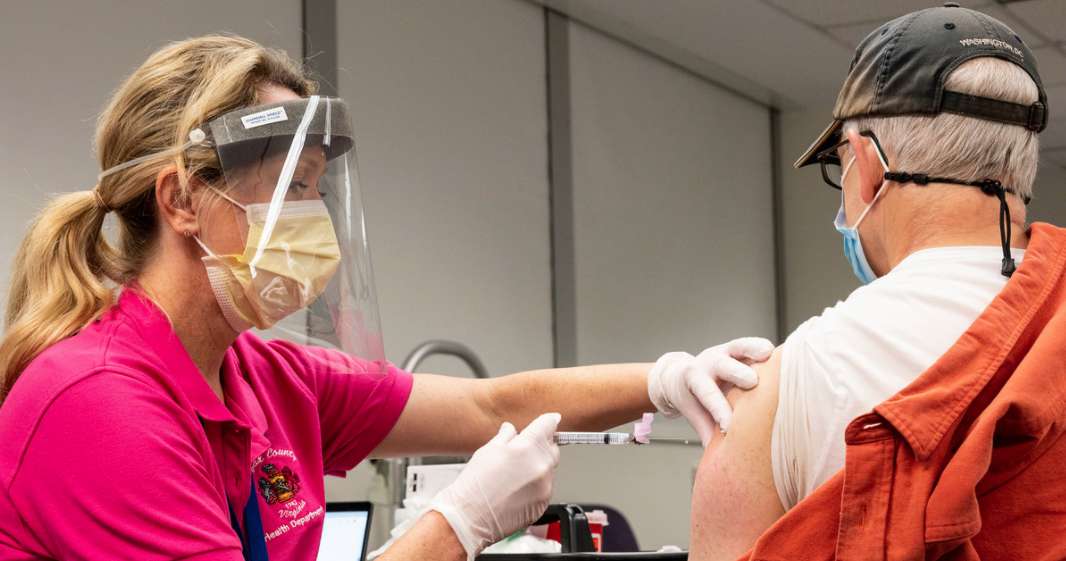
As Virginia continues to roll out the COVID-19 vaccines to healthcare professionals and workers in long-term care facilities, Gov. Ralph Northam provided some clarity regarding the next phase of the state’s vaccination plan during a press conference yesterday (Wednesday).
Phase 1B, the next group to be prioritized for innoculations, will focus on essential workers, people who are at high risk of being exposed to the novel coronavirus, and people who are unable to do their jobs remotely, Northam said.
The largest segment of that group will be teachers, childcare workers, and other school employees. There are roughly 285,000 teachers and childcare workers in Virginia, according to Northam’s presentation.
“They’re high on the list of essential workers, because teachers are critical to getting schools back open, and that’s critical to people getting back to work and literally getting back to normal,” Northam said. “Opening schools doesn’t depend on vaccinating teachers, but that sure will make it a lot easier.”
Phase 1B will also include first responders; grocery, agriculture, and food processing plant workers; manufacturing workers; postal workers; and bus drivers and other transit workers as well as those who are 75 and older.
Virginia is currently in Phase 1A of its vaccination plan, which is limited to healthcare workers and workers in long-term care facilities.
Northam did not provide details on when to expect the state to advance to the next phase, but he hopes the Commonwealth will eventually have the supplies to deliver 25,000 doses per day. Right now, Virginia is getting about 110,000 doses a week, or roughly 14,000 doses per day.
With a population of 8.5 million people, Virginia needs to administer 17 million shots total since the Pfizer and Moderna vaccines that have been authorized for distribution both require two doses. That means the state will need to double its distribution rate in order to vaccinate everyone by the end of this year, Northam says.
To ensure that no doses are wasted, Northam says healthcare providers, health departments, hospitals, and any other organizations responsible for administering the vaccine must utilize their entire supply, or else risk getting fewer doses in subsequent shipments.
“You use it or you lose it,” the governor said. “So, I want you to empty those freezers and get shots in arms. No one wants to see any supplies sitting unused.”
Virginia Department of Health data shows that, as of Jan. 6, Fairfax County has administered 15,391 COVID-19 vaccine doses, more than any other jurisdiction in the Commonwealth.
Demand has “remained high” among healthcare workers since the Fairfax County Health Department received its first shipment of the Moderna vaccine on Dec. 23, according to Tina Dale, the senior communications specialist for the county health department.
Dale says the health department has made the vaccine available by appointment at five different dispensing sites around the county. The locations have not been made public to avoid drawing visitors who are not eligible to be vaccinated yet.
“We are excited by the continued interest we have seen from people who fall into the other priority groups and continue to get questions when others can begin receiving vaccine,” Dale said. “When the Virginia Department of Health expands vaccine availability to other priority groups, vaccine could be available in a variety of ways, including healthcare providers, pharmacies and local health departments.”
In Virginia, CVS and Walgreens are facilitating the distribution of the vaccine to people who live in nursing homes as well as healthcare providers.
At a virtual town hall for the City of Falls Church with State Sen. Richard Saslaw (D-35th), Del. Marcus Simon (D-53rd) acknowledged that the pace and clarity of the vaccine rollout has been frustrating for some community members.
“I don’t think anything is more important than deploying the vaccine as rapidly as humanly possible,” Simon said. “Those of you looking for more information and transparency, I heard you. Those details are coming out soon.”
Saslaw expressed hope that Virginia will reach Phase 1B before February.
“We’re a little behind right now on where we should be, but we’re hoping to catch up quickly,” Saslaw said.
Jo DeVoe contributed to this report.
Photo via Fairfax County Health Department/Twitter
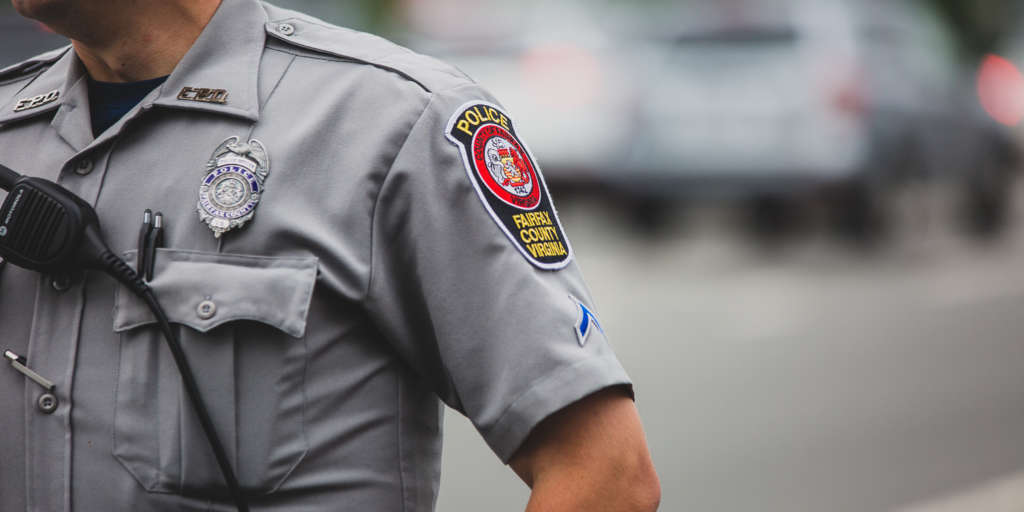
Fairfax County is seeking public input on the characteristics, skills, and values it should prioritize in selecting its next police chief.
Conducted by the search firm Polihire, the community survey asks respondents to share their thoughts on the most important public safety issues facing the county, the police department’s relationship with the citizens it serves, and the experience and skills that they expect from a police chief.
Available in English and Spanish, the survey has been open since mid-December, but this Friday (Jan. 8) is the deadline for contributing. The county is encouraging all residents and businesses to participate.
The survey is part of a nationwide search that Fairfax County hired Polihire to conduct after current Police Chief Edwin Roessler Jr. announced on Nov. 5 that he will retire in February.
The community engagement portion of the search process will also include focus groups with key community organizations, according to the county.
Photo via FCPD
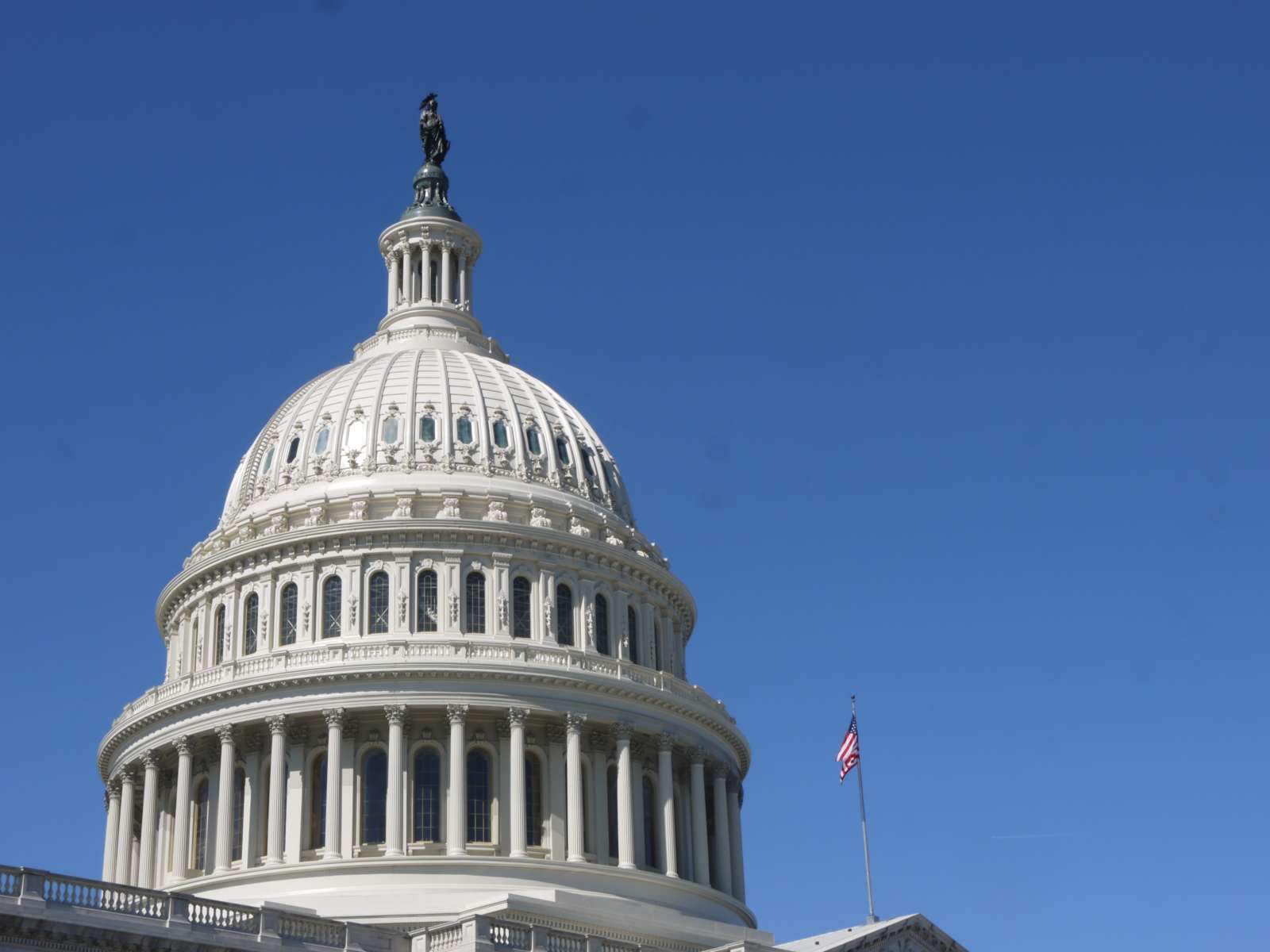
Fairfax County Board of Supervisors Chairman Jeff McKay and other public officials in the Washington, D.C., region are advising local residents to avoid the District’s downtown area over the next few days in anticipation of potentially volatile protests.
Multiple pro-Trump groups, including the far-right extremist Proud Boys, are expected to hold demonstrations in D.C. tomorrow (Wednesday), when Congress is scheduled to certify the Electoral College’s vote cementing President-elect Joe Biden’s victory in the Nov. 3 general election.
Here is the full statement from McKay’s office:
On Wednesday, January 6, demonstrators will be protesting in Washington DC and there are concerns over safety.
While the District will be doing all they can to keep demonstrations peaceful, my regional colleagues and I encourage our residents to stay safe and avoid the downtown area and not to engage with those seeking violence.
We know the election is over, the votes have been cast, states have certified results, lawsuits have been dismissed, and a winner has been named. It is time for our normal, democratic, peaceful transition of power and the will of the electorate to be honored. At this time of unprecedented distrust in the electoral process, despite every assurance otherwise, engagement will only inflame a volatile situation.
Photo via Sherry Xu on Unsplash
10,565 Fairfax County residents have now received a dose of one of the COVID-19 vaccines authorized for distribution as of Sunday (Jan. 3).
That is by far the most vaccine doses that have been administered in a single locality in Virginia, according to a Virginia Department of Health dashboard, which shows that no other locality has administered more than 5,000 doses.
Like the rest of the country, Fairfax County is in the 1A phase of the vaccine distribution process, meaning that vaccinations are limited to health care personnel and long-term care facility residents. Some emergency responders with the Fairfax County Fire and Rescue Department have also gotten vaccinated.
The Pfizer and Moderna vaccines that were granted emergency use authorizations by the federal government both require two doses that are administered three or four weeks apart. No Virginia residents have gotten a second dose of either vaccine yet.
What You Need to Know About the First COVID-19 Vaccinations in Fairfax County: https://t.co/GRN9TDQKng pic.twitter.com/ZmZ63oKdsw
— FairfaxCounty Health (@fairfaxhealth) January 1, 2021
The vaccine rollout has been slower than anticipated. Virginia has distributed 404,675 doses to healthcare providers, but only 87,618 doses have been administered so far, according to the state health department.
Meanwhile, the Fairfax Health District reported 353 new COVID-19 cases today (Monday) for a total of 46,595 cases since the pandemic began. The disease caused by the novel coronavirus has killed 703 people in the district, which includes the Cities of Falls Church and Fairfax as well as the county, and put 3,032 people in the hospital.
Today’s caseload breaks Fairfax County’s streak of four consecutive days with more than 500 new cases that started on New Year’s Eve. The county’s current seven-day average is 472.9 cases.
Virginia recorded more than 5,000 new cases in a single day for the first time on Dec. 31 and has now exceeded that number three times within the past week.
Worse may be to come as the Commonwealth and the U.S. as a whole starts to see the impact of holiday gatherings and travel.
The Transportation Security Administration reported this morning that it screened 1.3 million people at airport checkpoints nationwide on Sunday, the highest volume since the COVID-19 pandemic hit early last year. TSA spokesperson Lisa Farbstein said that yesterday marked the eighth time in the past 12 days that airports recorded more than 1 million travelers.
Photo via Fairfax County Health Department

Using a mobile phone while driving will officially be illegal in Virginia starting on Jan. 1.
Current state law prohibits reading a phone and texting while driving and holding a phone while driving through a work zone, but the Virginia General Assembly adopted legislation barring the use of handheld phones while driving a moving vehicle on state highways in March.
While the law was technically enacted on July 1, its effective date was delayed until the new year so that the public could be educated about its provisions and law enforcement agencies could get training on how to enforce it.
Violations of the new law will be punishable by a fine of $125 for the first offense and $250 fine for any subsequent offenses.
There are a few exceptions to the ban on using a phone while driving, including:
- Emergency vehicle operators who are performing their official duties, including law enforcement and fire and medical responses
- Drivers who are lawfully parked or stopped
- Someone using their phone to report an emergency
- The use of an amateur or citizens’ band radio
- Department of Transportation vehicle operators who are performing traffic incident management services
Virginia’s public information campaign on the new law is being led by Drive Smart Virginia, a nonprofit dedicated to promoting traffic safety.
According to Drive Smart Virginia, the Virginia Department of Motor Vehicles reported that 15% of all fatal crashes in 2018 were related to distracted driving. Fairfax County has the second-most distracted driving fatalities in the state, surpassed only by Prince William County, and the most injuries that result from distraction-related crashes.
The distracted driving ban is perhaps the most significant legal change coming to Virginia on New Year’s Day, but it is not the only new law that will take effect on Jan. 1.
Here are some other measures to be aware of when the new year arrives:
- HB 264: requires in-person training for concealed handgun permits, removing online or electronic courses as an option for demonstrating competence
- HB 1211: enables undocumented immigrants to apply for new driver privilege cards so they can legally drive
- HB 66: prohibits health insurance companies from charging more than $50 per 30-day supply for prescription insulin
- HB 789: sets a 36% annual rate cap on the interest and fees charged for a short-term loan, which can now go up to $2,500
- SB 172: protects people who receive emergency services from an out-of-network healthcare provider from unexpected medical costs
- HB 1407: prohibits employers from misclassifying employees as independent contractors
- HB 742: gives localities the authority to regulate the takeoff and landing of unmanned aircraft on public property
Photo via Alexandre Boucher on Unsplash

An end to 2020 is almost upon us. If ever a year deserved a send-off of champagne and confetti, it was this one, but as they did with many other traditions, concerns about COVID-19 have curtailed or put on hold many of the usual New Year’s Eve parties.
Still, there remain plenty of options for ringing in the new year.
Many local restaurants are offering special meals to eat in or take home as well as festive cocktails created by local bartenders and mixologists that you can order or try to recreate yourself.
For people who like to close out the year with a song, the Times Square Ball Drop will feature singer Andra Day headlining an evening of live performances. The event is closed to the public this year, but it will still be broadcast on TV and online.
The great outdoors also offers a world of possibility.
The Fairfax County Park Authority is turning its annual First Hike Fairfax program into a three-day affair that starts on New Year’s Day. People who send in a photo of their hike by Jan. 3 will be entered into a contest to celebrate the park authority’s 70th anniversary.
How do you plan on ushering in 2021? If you have a special New Year’s tradition that’s not included below, feel free to share in the comments.
Image via Sharon McCutcheon on Unsplash
