
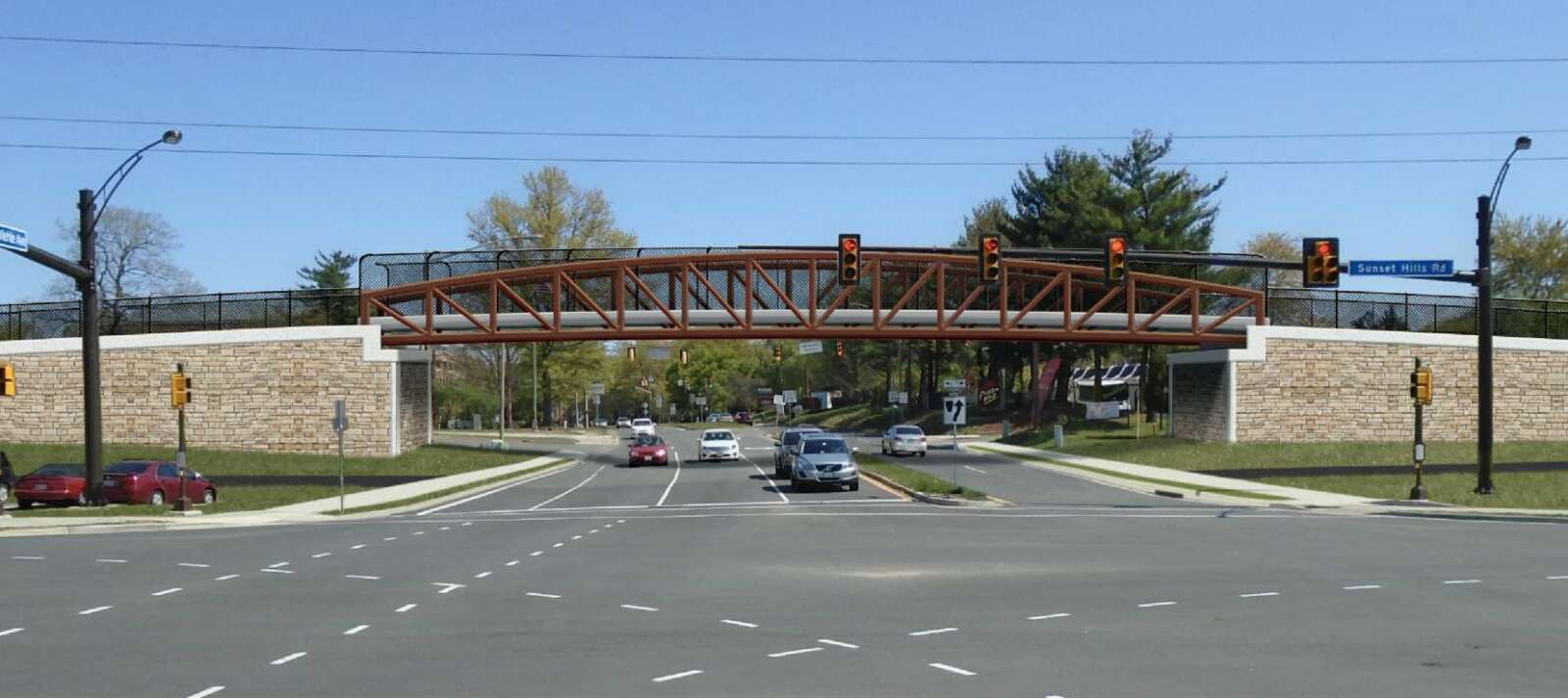
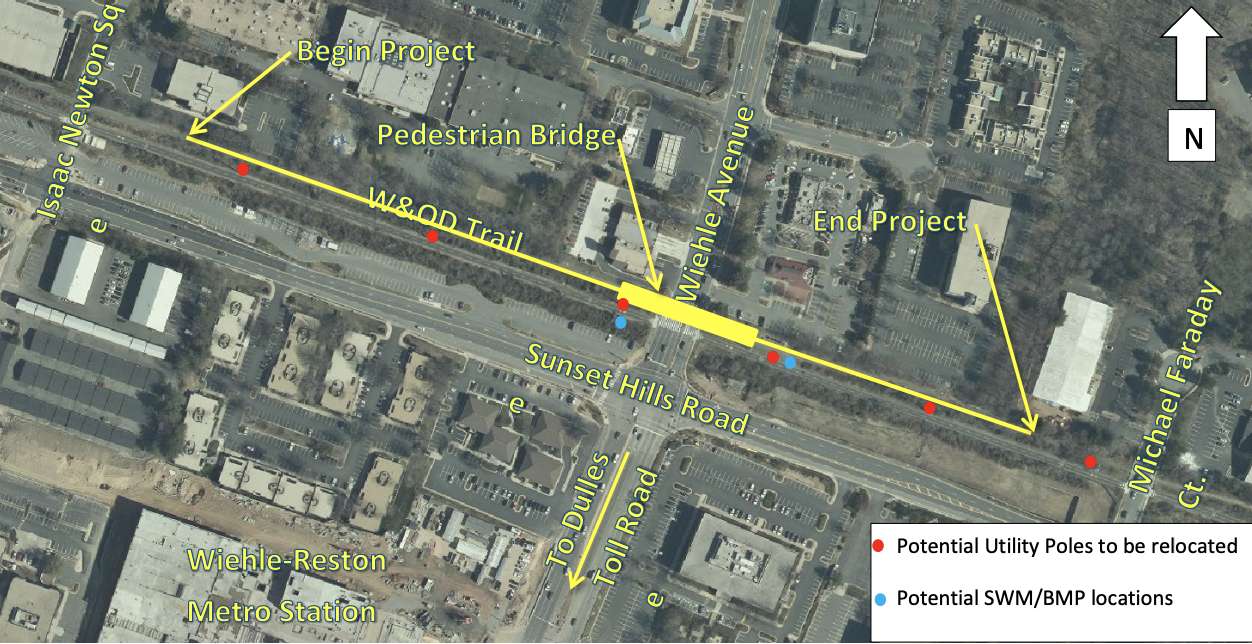
Construction on a new pedestrian bridge over Wiehle Avenue is set to begin sometime next summer.
The bridge, which would connect to the Washington & Old Dominion Trail, is intended to improve access for pedestrians and bicyclists near the Wiehle-Reston East Metro Station.
Once built, the bridge would begin on the trail and extend over Wiehle Avenue, replacing an existing at-grade crossing. The project — which is part of the Reston Metrorail Access Group‘s plan to improve pedestrian and bicyclist connectivity near the metro station – is expected to cost around $12 million.
So far, the county has secured land rights on four of seven properties affected by the project. The Fairfax County Board of Supervisors is expected to hold a public hearing on Nov. 9 at 4 p.m. on the acquisition process.
In a memo, county staff said that the board may have to use eminent domain powers to seize some property.
“Negotiations are in progress with the affected property owners; however, because resolution of these acquisitions is not imminent, it may be necessary for the board to utilize quick-take eminent domain powers to commence construction of this project on schedule,” the memo states.
Minor roadway, sidewalk, and median tweaks are planned to make the bridge possible. The bridge would accommodate the gravel path and the asphalt trail, providing full access to and from Wiehle Avenue. In the future, Wiehle Avenue from Sunset Hills Road to the Reston Fire Station entrance and the entrance to Pupatella would also be widened.
Dominion Energy Virginia recently completed plans to relocate overhead electrical transmission lines. Utility work includes removing existing monopoles and installing new ones, as well as relocating overhead transmission lines.
Construction is expected to begin next summer and last for roughly a year.
The Fairfax County Board of Supervisors is expected to discuss the issue at an Oct. 19 meeting.
Photo via handout/Fairfax County Government
Zoomph, a Reston-based tech company that started in 2016 is continuing to build national partnerships.
Its digital platform provides social media post metrics for sports clients along with detailed demographic information about fans.
Zoomph clients have ranged from the Washington Football Team to the Chicago White Sox and the Golden State Warriors as well as others, including leagues like NASCAR.
The company started as a team within Reston-based MetroStar Systems as a social media monitoring project with the State Department, Zoomph President Amir Zonozi told the Fairfax County Economic Development Authority.
‘We were looking at the reaction in areas of the Arab Spring when people like Secretary Hillary Clinton would make a speech,’ Zonozi explained. ‘But that capability wasn’t really possible in social media. So we had to build things to make that happen. They loved what we built and then they wanted more of it.’
Zoomph eventually pivoted to focusing on partnerships, business intelligence and research around digital marketing at sports, e-sports teams, leagues, brands and agencies. To gather this business intelligence, Zoomph utilizes innovative processes, such as artificial intelligence (AI).
‘We have AI that tracks all of the media content, whether it’s an image, a video, a GIF,’ Zonozi said. ‘We can also capture the assets. So we’re training AI to look at physical objects and understand the value of that physical object digitally.’
The company has around 25 employees.
Zoomph also provided a video interview with the FCEDA in an effort to help highlight the region’s potential for business and jobs.
The company didn’t respond to a media inquiry yesterday by the time this article published.
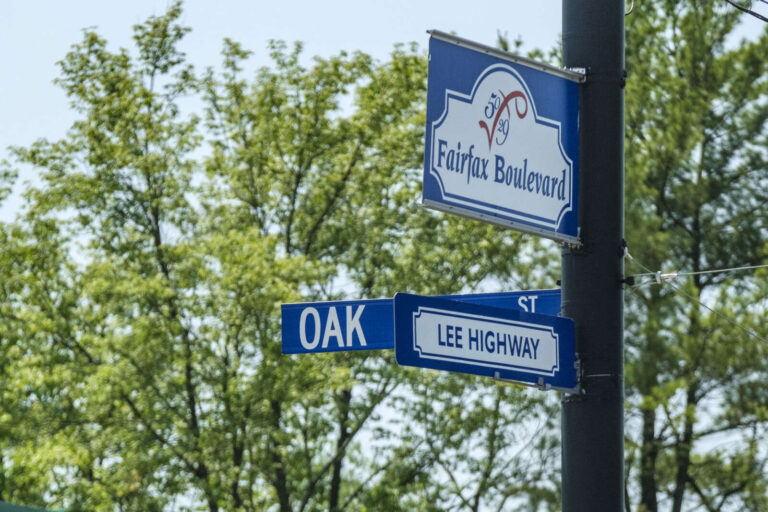
For anyone who feels strongly about whether or not Lee Highway and Lee-Jackson Memorial Highway should continue to bear those names, the time to share that opinion has arrived.
The Fairfax County Confederate Names Task Force launched a survey yesterday (Thursday), kicking off the community engagement phase of its review of whether to rename the highways.
Open until Nov. 12, the survey is available in English, Spanish, Arabic, Farsi, Korean, and Vietnamese. Chinese and Urdu versions will be coming soon, and print copies will be available at county libraries and district supervisor offices starting next Wednesday (Oct. 20), according to the task force’s website.
According to the news release, the task force will send out a countywide mailer to all residents later this month encouraging them to weigh in on the issue, and four public meetings — three in person, one virtual — have been scheduled through early November:
- Thursday, Oct. 28: Providence Community Center, 3001 Vaden Drive, Fairfax, 7-8:30 p.m.
- Saturday, Oct. 30: Fairfax County Government Center, 12000 Government Center Parkway, 10-11:30 a.m.
- Monday, Nov. 1: via WebEx, 7-8:30 p.m.
- Thursday, Nov. 4: Sully District Governmental Center, 4900 Stonecroft Boulevard, Chantilly, 7-8:30 p.m.
Comments can also be sent to the task force by email, phone (703-877-5600), and regular mail (Fairfax County Department of Transportation, 4050 Legato Road, Suite 400, Fairfax, VA 22033).
“Symbols matter and we want our community to feel welcome and reflect our values,” Fairfax County Board of Supervisors Chairman Jeff McKay said. “Community feedback is a key part of the renaming of Lee and Lee Jackson Memorial Highways process and will determine our next steps forward. There are multiple ways to offer feedback including a survey and community listening sessions. I encourage everyone who can to join the discussion.”
The Board of Supervisors appointed the 30-member task force in July after getting a report from the county’s history commission that identified more than 26,000 streets and other local landmarks bearing names associated with the Confederacy.
The Fairfax County History Commission narrowed its inventory down to 150 sites named after well-known Confederate figures, with Lee and Lee-Jackson highways among the most prominent.
The county’s portion of Route 29 spans 14.11 miles from Centreville to Falls Church and was named after Confederate general Robert E. Lee in 1919, according to the task force. Lee and fellow general Stonewall Jackson became the namesakes for the 8.43-mile stretch of Route 50 from Loudoun County to the City of Fairfax in 1922.
While those monikers have stuck for around a century now, nationwide efforts to remove names linked to the Confederacy or slavery from public places have gained momentum in recent years. Fairfax County Public Schools alone has renamed three buildings in the past four years.
Neighboring Arlington County renamed its section of Route 29 this past summer, replacing Lee’s name with that of abolitionist John M. Langston, Virginia’s first Congressional representative of color.
Expected to present a recommendation on whether to rename the roadways to the Board of Supervisors in December, the Confederate Names Task Force has been meeting on a regular basis since Aug. 16. The agenda for its upcoming meeting on Monday (Oct. 18) includes a staff briefing on the cost implications of a name change and a discussion of criteria for street names.
If the task force recommends changing the names, it will then offer up to five possible new names for each road, and after holding a public hearing, the Board of Supervisors will vote on the recommendation, potentially early next year. The name changes would then have to get state approval and go through the county budget process to cover the costs.

Wiehle-Reston East Outage Set for Next Week — A planned shutdown at the Wiehe-Reston East Metro station is on track, a spokesperson for the Washington Metropolitan Area Transit Authority tells Reston Now. The closure is intended to allow crews to connect the first and second phase of the Silver Line. [WMATA]
Reston Association Has Another Key Departure — Human resources director Melissa Kelley is leaving on Oct. 20 for another opportunity. “She will be greatly missed,” president of the board of directors, Caren Anton, said Wednesday. Other recent departures have included the association’s CEO and technology director. [Reston Association]
Reston-based Company Offers Flexible Workweek Policy — IT services firm Science Applications International Corp. is allowing its workers to take part in a flexible, four-day workweek. Employees can work a few extra hours each day to get an extra day off per week. [Technical.ly]
Photo via vantagehill/Flickr
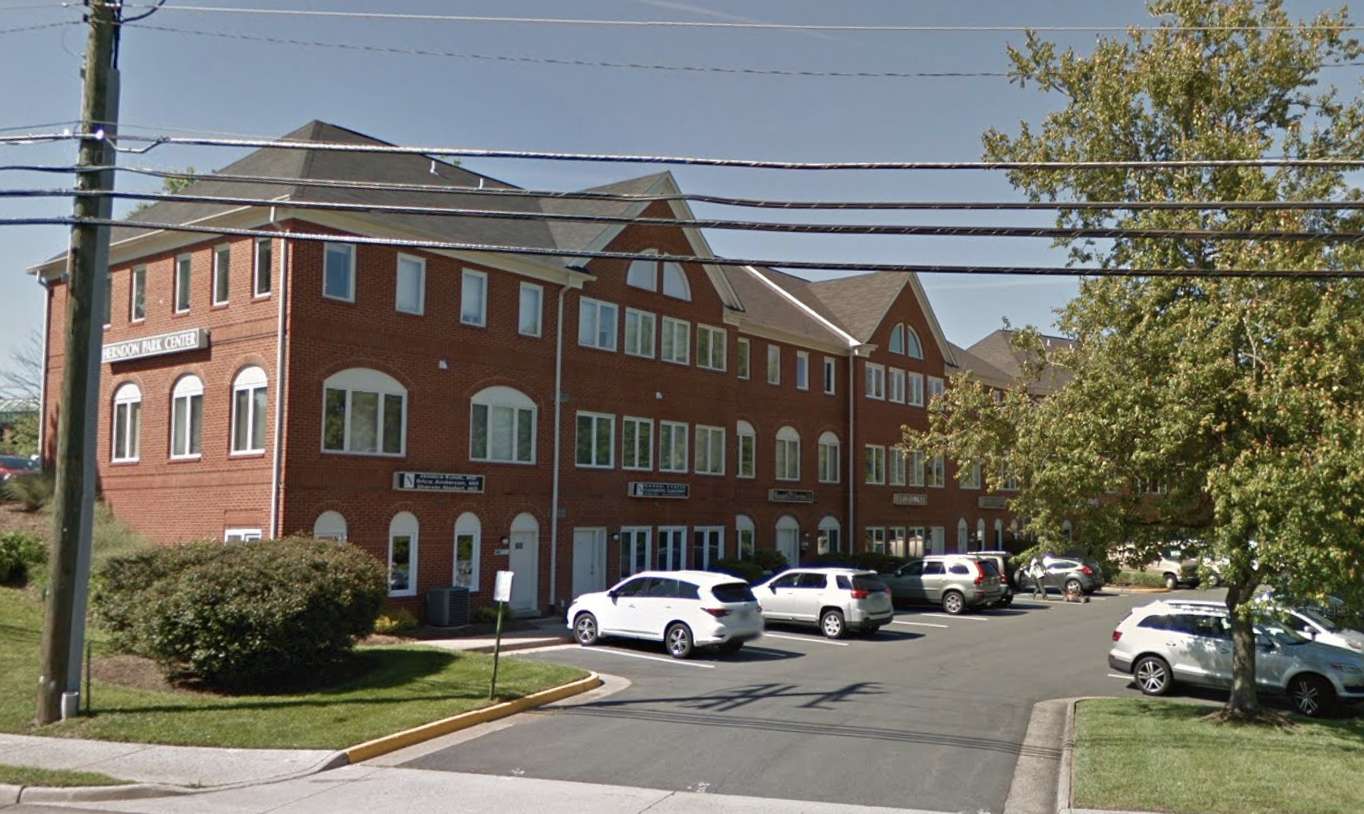
A new cosmetics and personal services business is coming to the Town of Herndon.
Fancy Lashes and Beyond hopes to open a location in the Herndon Park Condominium office building, which is located at 299 Herndon Parkway.
The business would occupy just under 1,000 square feet of space in the multi-unit building. The building is mostly occupied by commercial offices.
The Town of Herndon’s Planning Commission is set to review the application at an Oct. 18 meeting. In order for the plan to move forward, owners Tommy Nguyen and his wife Phuong Le Tran need to secure a special exception to allow a cosmetic services business to open in the building, which is zoned for commercial office use.
“After I had recently made my trip to 777 Lynn Street and witnessed a very tight-knit community, it became an inspiration for both my wife, Phuong Le Tran, and I to become a part of this community in Herndon. As small business owners, we also would like to play our part inside the community and make future contributions to rebuilding this community during this challenging time,’ the owners wrote in an Aug. 17 letter to the town.
The owners said they discovered that the business was not zoned for personal and cosmetic services after they reached an agreement with the property owner on the price of the property.
Planned services include eyelash extensions, lashes lifts, brow lamination, waxing, facials, and makeup. The business currently operates out of Cascades Marketplace in Sterling.
People shared their concerns during a public hearing yesterday with Reston Association’s board of directors.
An initial budget has suggested the annual assessment fee could increase from $718 to $764, a 6% increase, though Board of Directors president Caren Anton noted it’s not yet finalized.
People submitted written comments and provided feedback during the virtual meeting.
Butler said the main changes with the budget currently call for:
- Increased costs due to inflation and insurance,
- A 3% merit increase for staff, who received no merit increase this year,
- Increasing various staff salaries to the bottom of pay ranges,
- Increasing base pay for lifeguards as well as covering certifications and recertifications, and
- Adding a senior environmental staff position but not a registrar position.
Butler said aside from the current CEO search, it takes 50 days to fill a vacancy, and he felt it was important to make the salary changes given the difficult job environment.
Speakers took issue with upgrades to Barton Hill tennis courts due to concerns involving driver visibility at a nearby crosswalk during certain times, environmental impacts due to light pollution as well as cost-benefit issues if the association built a covering above the courts.
Butler said RA is no longer considering a covering at this time. The current proposal is to add lighting, repair cracks and add lines on two courts for pickleball.
Mike Sanio submitted a letter, which Anton read into the record, noting the limited availability of lighted tennis and pickleball courts given usage. Other speakers suggested that the association support tennis facilities but in other ways, such as just by maintaining them or making sure there’s enough support before proceeding with lighting upgrades.
Tammi Petrine recommended the association survey its 21,000-plus households rather than pursue proposals for “small groups of vocal people.” She said it could be a working tool and show usage of recreational facilities such as pools and tennis courts and help show what members want and are willing to pay for.
“Why is this not done … maybe every two years?” she said. “We paid $144,000 for a branding study, but we never did a survey, and that seems to be such a useful tool.”
Jordan Fletcher said the the proposed budget call for an 8% increase in staff compensation, among other jumps in costs.
He said the board should carefully consider adding new positions and suggested the association consider factors such as seeing if a service could be automated through information technology, see if underutilized or part-time staff perform similar functions, or look to see if duties could be shifted when new needs arise.
Fletcher also recommended listing all 100-plus positions and their responsibilities and other details to help make more objective decisions.
The association expects another draft to be presented to its fiscal committee on Oct. 20 with the board addressing the second draft at its Oct. 28 meeting.
A second public hearing will be at 7 p.m. Nov. 10.

Fairfax County officials have a simple message for anyone who spots a spotted lanternfly: kill it immediately.
Native to China, the invasive insect can spread far and wide through its egg masses, making its way to Fairfax County via a recent shipment to a grocery store in Annandale. Loudoun County has also confirmed multiple sightings, but its presence has not reached the level of an infestation — yet.
“This is a relatively new pest in the area and the county is concerned about the potential impact this pest may pose,” Joan Allen, chief of the county’s forest pest management branch, told FFXnow.
Allen says that while the county has not found evidence of an infestation, the county has received several reports of a hitchhiker spotted lanternfly.
The insect can cause serious damage to home and commercial gardens, according to county officials. It thrives on more than 70 plant species, including grapes, apples, stone fruits, and tree-of-heaven. Officials say the state’s peach, apple, grape, and wine industries are most threatened by the insect.
The spotted lanternfly releases a sticky substance called honeydew that attracts wasps and ants. This substance can also encourage mold to grow on plants and trees, which can cover leaves, stunt plant growth, and ruin crops.
Although the insect has been in Virginia since 2018, its recent emergence has prompted the city of Winchester and Frederick, Clarke, and Warren counties to institute a spotted lanternfly quarantine. This effort is intended to slow its spread to un-infested areas of the state.
Businesses must receive a state permit and inspect articles to ensure that they do not contain any life stage of the spotted lanternfly, according to Fairfax County. This quarantine has been in effect since May 2019.
The insect has different colors during four different nymph stages. The county offers the following description of the insect’s changing appearance.
There are black and white nymphs; red, black and white nymphs; and adults. Adult lanternflies have gray-brown forewings, a black head and black spots. When at rest the hind wings, which are crimson in color, can be partially seen through the semi-translucent forewings, which gives the lanternfly a reddish cast. The lanternfly’s abdomen is yellow with black and white bands on the tip and bottom.
October is egg-laying season for most of the insects. Egg masses are typically covered with a light gray wax that looks like mud when it dries.
From this month through July, the county encourages residents to scrape egg masses from trees and trunks with adhesive bands. Scrapings should be discarded in containers of rubbing alcohol or hand sanitizer. Stump treatments, hack and squirt treatments, foliar sprays, and basal bark sprays can help during the other parts of the year.
For now, any spotted lanternfly should be killed immediately.
The first spotted lanternflies in the United States were found in Pennsylvania in 2014, according to the National Capital Partnership for Regional Invasive Species Management.
Four years later, Virginia officials documented the state’s first lanternflies infestation in Winchester. A quarantine was enacted by the Virginia Department of Agriculture and Consumer Services to slow the spread of the infestation.
Photo via Magi Kern/Unsplash
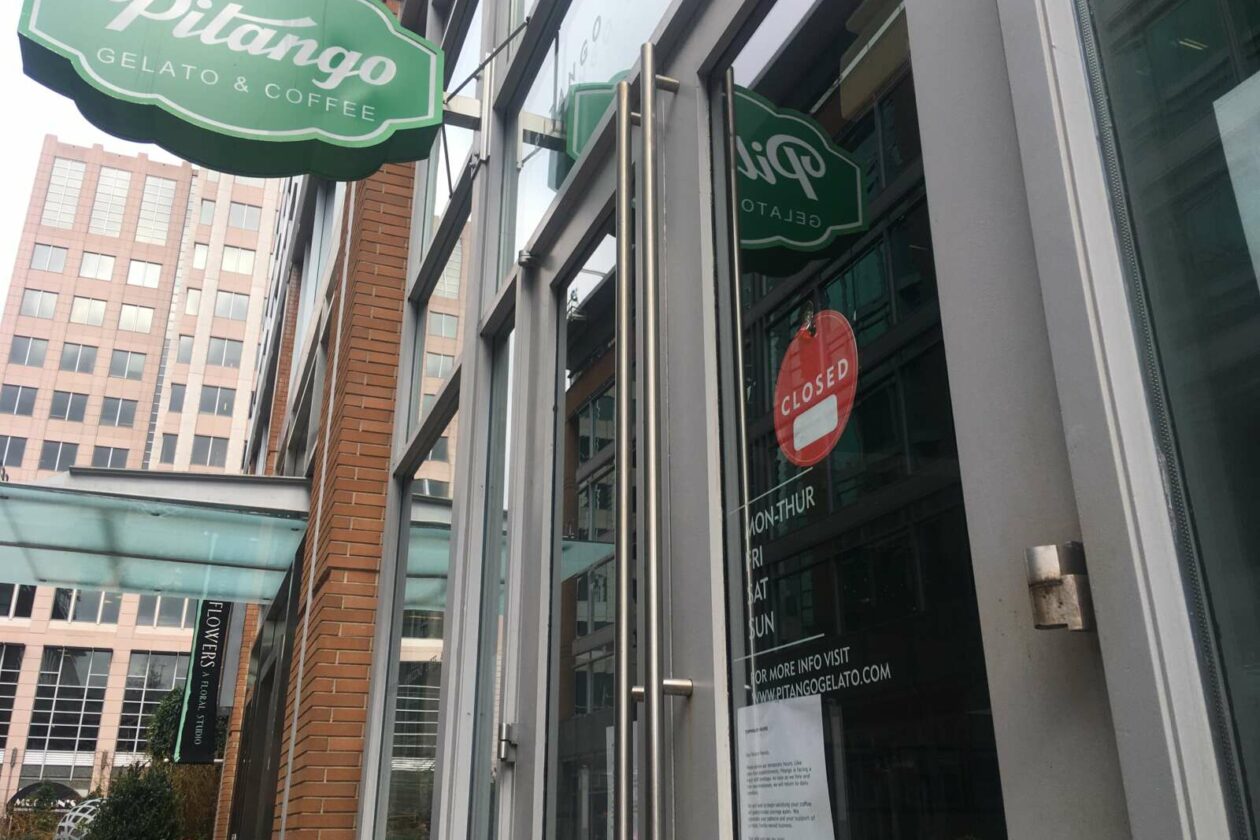
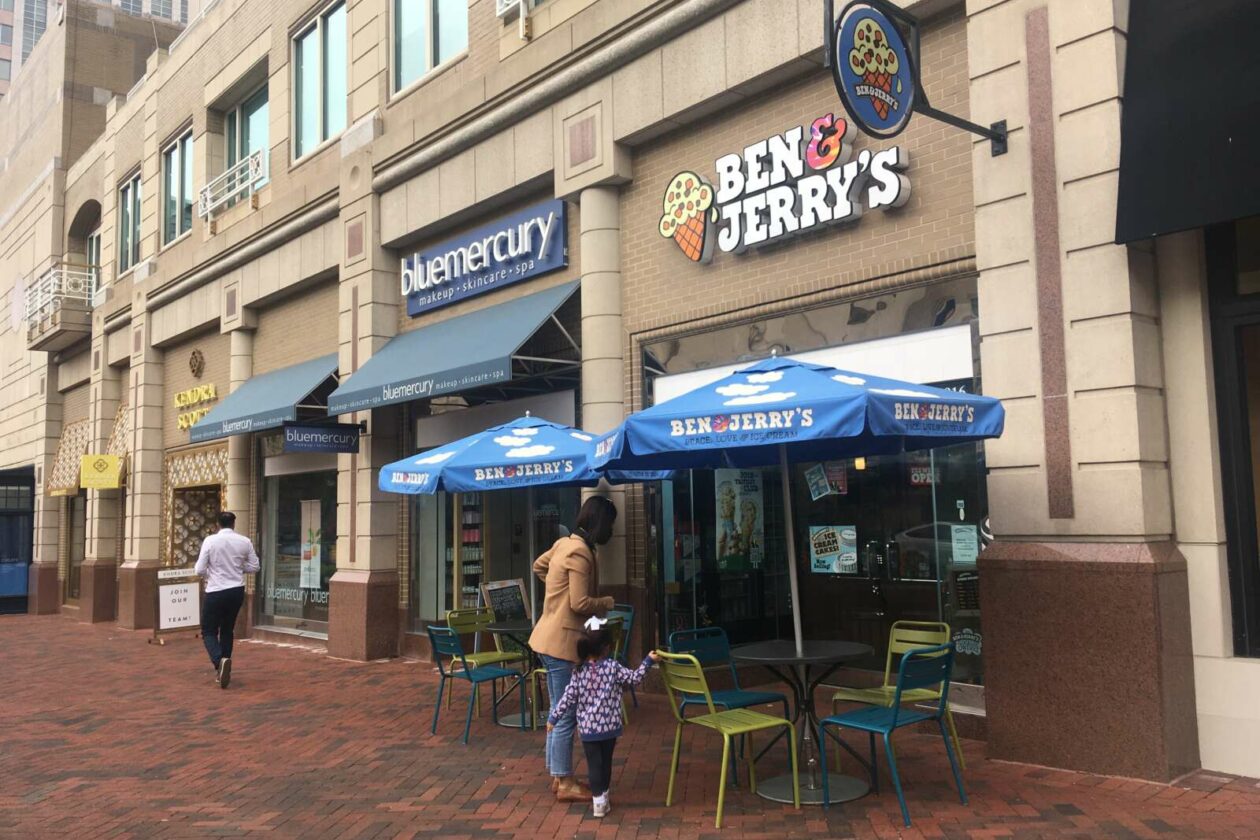
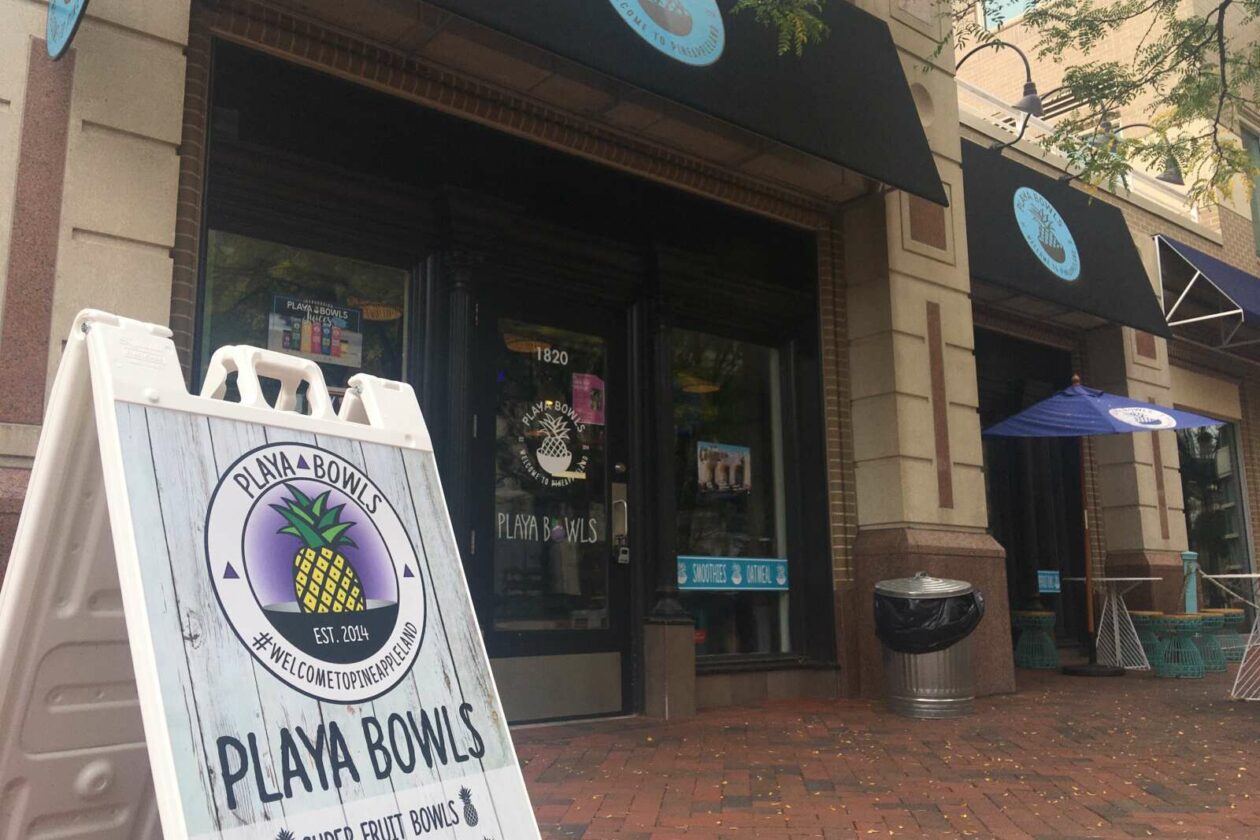
Dessert and smoothie shops in Reston Town Center are in need of workers, with one still keeping hours scaled back due to staffing needs.
One store remains operating at a reduced-hours schedule: Pitango, which makes gelato and sorbets, is open from 4 to 10 p.m. on Saturdays and Sundays.
“We would like to be open daily, from early morning for coffee customers to late evening for gelato,” owner Noah Dan said in an email. “We are actively seeking new employees but it has been very slow-going.”
The family-owned business looks to begin to open daily as soon as possible, it says on its website. A hiring sign and notices to customers are posted on its entrance.
The notices state that it will return to daily operations as soon as it hires and trains new employees, and they thank customers for supporting the business.
Other shops reported similar issues. Ice-cream customers may have noticed Ben and Jerry’s temporarily reduce its schedule, but a manager said a shift lead will bring its hours back to normal. It currently has around six employees, though, which was less than the dozen workers or so it had last year.
At Playa Bowls, store manager Isabella Heffel noted the location’s front door has a sign encouraging people to apply and specifically asks for those with daytime availability.
She said the store has connected with colleges but has found the hiring to be tough. The store has around 30 workers, though, allowing it to maintain a full schedule, Heffel said.
The unemployment rate for 16 and 17-year-olds, seasonally adjusted, had been improving since January, reaching as low as 8.9% as of May 1 before rising to 9.6%, 9.7% and 11.6% in coming months. It eventually landed on 11.4% as of Sept. 1, according to data from the Federal Reserve Bank of St. Louis.
Like the rest of the country and world, teen workers weren’t immune to reductions in the workforce during the pandemic, being especially hit last year starting in March as restaurants and retail stores closed due to state shutdowns.
But it’s still one of the best times in decades to be a teenage worker. Prior to this year, unemployment for the age group hasn’t been this low since 1957.
The restaurant industry has faced a labor shortage that has put pressure on an already strained segment of the economy — not just teenage workers.
A Goldman Sachs survey from last month found that 87% of small businesses are finding it difficult to recruit qualified candidates for open positions, and most say their workforce challenges have worsened since before the pandemic.
The survey, involving 1,145 participants from across the U.S., found Black-owned small businesses have also been slower to recover to pre-pandemic employment levels.
Top Schools Ranking Released — Some elementary and middle schools from Northern Virginia have made it to U.S. News & World Report’s annual ranking of the best schools in the country. Arlington Traditional School has the highest ranking in Virginia among elementary schools while Prince William County’s Mary G. Porter Traditional was ranked the best middle school in the state. [Reston Patch]
County Faces Invasion from Plant — You read that right. The county is facing an invasion from an aggressive plant with an otherwise unthreatening name. The plant wavyleaf basketgrass is spreading through natural areas across the county. The plant even sprouts a sticky substance that can bind itself to cloths, boots and animals, allowing the plant to continue to grow by spreading its seeds. [Fairfax County Government]
First Friends of Reston Fall 5K Set for This Weekend — The inaugural event takes place on Sunday at 8 a.m. at Brown’s Chapel Park. Online registration is open until tomorrow. [Reston Patch]

Some residents at Lake Anne are turning to the county for help sort out its homeowner association’s contentious and divisive elections.
In a Sept. 23 letter to Hunter Mill District Supervisor Walter Alcorn, more than 40 residents urged the county to not allow the property’s landlord to vote in condominium elections. Roughly seven percent of votes in the board election is assigned to the unit occupied by Reston Community Center Lake Anne.
The letter contends that removing the landlord from the process — who holds about seven percent of the entire property — would allow the owners a chance for a “free” election.
“The county allowing the vote to be used in a condo election creates an unequal balance of power and potential conflict of interest,” the letter states. “Using taxpayer money to do so is not in the best interest of our community and especially unfair to our minority commercial owners, burdened with significant assessments; and who will be disproportionately affected by further special assessments to address our infrastructure issues.”
Board politics and infighting — including deep disagreement over the outcome of elections for board president — have mired the board for more than a year. Alcorn has met several times with concerned property owners and the Lake Anne of Reston Condominium Association to allay concerns about property management, lack of hot water, and other issues.
Alcorn told Reston Now that he deferred the proxy matter to RCC’s board for consideration.
“I have full confidence in that board — including the three members that were just re-elected by the community last month — to do the right thing,” he said.
RCC has no immediate plans to change participation in board elections. The center’s executive director Leila Gordon told Reston Now that RCC has had an excellent relationship with its landlord since 1999 when RCC Lake Anne first opened in the historic area.
Here’s more from Gordon on the issue:
The lease stipulates the proxy provision in the context of Section 7, “Leasehold Improvements,” and specifically notes that the Landlord’s proxy isn’t available when the matter is related to “voting on LARCA fees and assessments payable by Landlord.” RCC views the election of LARCA Board officers to be wholly unrelated to any issue of Tenant Improvements and entirely germane to issues of fees and assessments, and would therefore be the sole concern of the Landlord. We remain satisfied with the present arrangement.
Maintenance and infrastructure issues caught statewide attention when residents of the Quayside condominiums went without hot water for several months last winter.
An assessment by architecture firm Samaha Associates found that the property needs more than $37 million in repairs. At a mid-September meeting, Alcorn said the county may explore options to help revitalize the property. No formal plans have been proposed and discussions are ongoing.
Board President Jason Romano did not immediately return a request for comment from Reston Now.
LARCA’s board election for this year takes place on Oct. 27.
After a slight delay, Fairfax County Public Library has come to the same realization as dozens of other library systems in the D.C. area and across the country: that fining patrons for overdue materials doesn’t work.
The library’s Board of Trustees got informal but clear support from the Fairfax County Board of Supervisors at a joint meeting yesterday (Tuesday) to stop FCPL’s practice of charging late fees for unreturned books, DVDs, and other resources.
The trustees must still officially vote to eliminate library fines, but if that happens in November or December as anticipated, the new fine-free policy will take effect on Jan. 1, 2022, FCPL Director Jessica Hudson told the Board of Supervisors, noting that people will still be expected to pay back the cost of lost or damaged items.
“I have not heard anyone on this board that doesn’t wholeheartedly support [the fine-free strategy],” Board of Supervisors Chairman Jeff McKay said. “So, [I] look forward to the library board moving forward with that, and being able to accomplish that would be, I think, a big win for all our users.”
Fines Affect Library Access
Inspired by the One Fairfax policy, which commits the county to considering racial and social equity in its policies and decision-making, the FCPL Board of Trustees started exploring the idea of eliminating fines with the creation of an ad hoc committee in April.
Tasked with reviewing trends and determining the effectiveness of fines, the committee found that fines are not only futile at incentivizing the timely return of materials, but instead, actually discourage people from returning overdue items and utilizing library services.
“If you have a book checked out, and it’s a month late, and you know that you’ve got fines accrued on it, it doesn’t really make you want to run into the library and quickly turn it in and pay your fine,” Hudson said. “Instead, it acts as a punitive measure that ensures that some members of our population are never going to come back to the library.”
The committee recommended that FCPL eliminate fines at a Board of Trustees meeting on July 14, citing the policy’s ineffectiveness, its disproportionate impact on youth and low-income communities, and declining revenue from fines in a statement that the board accepted on Sept. 8.
According to the committee, 17% of the approximately 420,000 library cardholders that FCPL had prior to the pandemic — including 23% of cardholders younger than 18 — had their cards blocked because their accounts carried more than $15 in outstanding fines.
The number of blocked cards correlated closely with neighborhood income, with low-income areas served by the Reston, City of Fairfax, George Mason, Kingstowne, and Sherwood regional libraries having particularly high rates, according to Hudson.
The committee also reported that the revenue FCPL gets from fines, which goes into the county’s general fund, has been decreasing throughout the past decade, dropping from $1.3 million in fiscal year 2010 to just $127,067 in FY 2021.
“Is the effort of collecting those dollars really worth all of the negative impact that’s associated with it?” Hudson said, attributing the decline to the introduction of auto-renewals and an increase in usage of electronic materials that don’t accrue fines.
Better Late Than Never
Assuming the policy change is approved, Fairfax County will be the last jurisdiction in the D.C. region to end the use of library fines, a trend that started with Loudoun County in 2019 and continued most recently the City of Alexandria and Prince William County on July 1.
However, FCPL got some practice in going fine-free last year, when the COVID-19 pandemic closed all 22 branches, prompting the system to suspend fine collections for overdue materials from March through August.
Even before the pandemic, FCPL had implemented initiatives intended to make it easier for people to pay off their fines, partnering with the nonprofit Food for Others on a “Food for Fines” program in 2018 and introducing a “Read Away Your Fines” program in 2019.
It also joined forces with Fairfax County Public Schools on the fine-free Library Equity Access Pass program, which lets all students access public libraries without a library card. The program was piloted at one branch in 2019 before going countywide in October 2020.
The benefits of fully eliminating fines could be realized immediately, according to Sujatha Hampton, who represents Dranesville District on the trustees board and chaired the ad hoc fine review committee.
She noted that other library systems have seen spikes in returns after suspending the use of fines, including one case in San Francisco where a man returned a book that had been overdue for 100 years.
“The lifting of fines is associated with the return of the books,” Hampton said. “So, we could imagine that just putting this in place and strongly advertising it would bring back a flood of books that have been out.”
New art in Reston envisions a scenario in which the U.S. Capitol Grounds is taken over by a swamp and vegetation even entangles the historic building itself.
The exhibit by Andrea Limauro, a D.C. city planner who has worked on flood resilience efforts for the district, is being shown in Reston Town Center at the Signature apartment building (11850 Freedom Drive).
“So much of the work in this show is inspired by my daytime work looking at flood plains and sea level rise in the District and imagining a not so far fetched future scenario where the capital is taken over by water and a new tropical fauna and flora,” he said in an email. “I do not believe these are inevitable outcomes but I like for my paintings to provide the alarm.”
The artwork started being on display earlier this month, and an opening reception will be held at 6 p.m. Oct. 22. An in-person reception and brief artist talk will be held at the outside courtyard, noted Tephra Institute of Contemporary Art, which hosts and selects exhibits in its satellite gallery at Signature.
Tephra described the art with the following:
Through his attentive and laborious process of screen printing and careful painting, Limauro’s works bring into focus the looming nature of disasters due to the effects of climate change. Through the employment of striking color combinations, metal leaf, patterns, and minute details, the illusion to a dystopian future of the DC region entices the eye.
D.C’s Office of Planning further notes that Limauro has served as the point of contact on “sustainability and climate planning for the Neighborhood Planning Division.”
The centerpiece of the show, “A Rising Tide Lifts All Boats,” is a 12-foot-long “dystopian painting about the increased risk of flooding due to climate change in Washington, D.C.,” the artist notes on his website, where rising water affects historic sites from the Washington Monument to the Lincoln Memorial and beyond.
Visitors can view the paintings Tuesday through Saturday from 11 a.m. to 5 p.m. Face masks are required but reservations aren’t.

Fairfax County officials are undertaking a comprehensive review of off-street parking for the first time since the late 1980s.
Conducted by a consultant, the county’s Parking Reimagined project will kick off a community engagement process this month for the public to weigh in on how it could update its approach to parking, such as by revising parking rates or reassessing land-use requirements.
County staff presented their efforts to assess off-street parking yesterday (Tuesday) during a joint meeting between the Board of Supervisors and Planning Commission. The project is expected to last 12-18 months.
“One of the critical elements of this project is community engagement,” said Michael Davis, a county staffer and parking lead. “Our community outreach is intended to encompass all the different areas of the county in the sense of business owners, renters, residents, religious assembly leaders, nonprofits, because parking has an effect on all of these in some form or fashion.”
A white paper on the project notes the “engagement process will be ongoing and interactive with the community as we gain more knowledge of the parking needs…and propose changes to the requirements.”
Options to include the public may include community and town hall meetings, video presentations, surveys and more. Public hearings on proposed changes could occur in late 2022 into early 2023.
Two county departments are part of the project: Fairfax County Land Development Services, which deals with how property construction codes and regulations, and the Department of Land Development, which provides proposals, advice and assistance on land use, development review and zoning issues to decision-makers.
To assist with the review, the county hired Clarion-Nelson\Nygaard, a partnership of two land use and transportation consulting firms, this past spring.
The white paper says equity, affordability, land use, environmental, and economic concerns will all be considered as part of the study.
“Society has changed,” Mason District Supervisor Penny Gross said during the meeting, noting that residents of one townhouse community in Annandale built in 1972 are “screaming they have no place to park.”
Gross said the county needs to look at retrofitting existing townhouse communities to meet current parking needs.
Changes in technology, development, and people’s habits over the past few decades require a reevaluation of how spaces are used and where they’re actually needed. The white paper highlights the rise of electric and autonomous vehicles, ridesharing, remote work, and online retail among the trends that have affected parking needs.
On one end of the spectrum, limited parking spots can mean the difference between whether a business has enough spots and whether vehicles spill over onto nearby residential streets, Land Development Services director Bill Hicks said.
On the other, there are office parks and strip malls with lots that take up half a block but rarely host more than a handful of vehicles. Hunter Mill District Walter Alcorn called some parking situations in the county “bonkers.”
He also forecast that parking needs will continue to change over time, so county officials should examine the situation as it evolves over the coming years.
As the review of off-street parking gets underway, the county is also still considering potentially adding parking meters for certain on-street areas, particularly in Tysons and Reston. Proposals for that could be presented to the Board of Supervisors next year.
Reston Association to Host Budget Hearing — RA is holding a public hearing on its budget today at 7 p.m. The meeting is virtual. So far, the organization’s board is considering an increase in next year’s assessment. Tentatively, the draft budget also includes roughly $1.8 million for the renovation of Lake Thoreau pool. [RA]
Night of Lights Comes to Roer’s Zoofari — The LuminoCity festival brings an array of lights to the zoo from Friday through Jan. 2. This is the organization’s first annual event but this is the first time the show ic coming to a location outside of the New York area. [LuminoCity]
Reston Company Partners with Sports Teams and Leagues — Zoomph, a Reston-based company, is partnering with sports leagues and teams to analyze social media initiatives. The company has clients like NASCAR and the Team Liquid e0sports league. [Fairfax County Economic Development Authority]

Early last month, Larry Butler took over as the acting chief executive operator of the Reston Association (RA) after Hank Lynch resigned from the position.
Butler, a long-time employee of RA, was formerly the chief operating officer nd actually was the acting CEO once before, prior to the hiring of Lynch in 2018.
All of this is to say that Butler understands RA and the challenges that come with running one of the largest community associations in the country.
It’s also a complicated time for RA, with the organization in the midst of budget season, possibly increasing assessments, cutting capital projects, and still dealing with the effects of the pandemic.
Reston Now spoke with Butler via phone last week to discuss assessments, community engagement, pools, budget, and a timeline for hiring a new permanent CEO.
This interview has been edited for brevity and clarity.
Reston Now (RN): Since you took over as acting CEO in early September, what’s been taking most of your time? What have been the challenges so far?
Larry Butler: What’s taking the most time is working through the budget process, which is always time consuming. The key part there is trying to get a [grasp] from the broader community on what the priorities are for the coming year. There’s obviously a lot of opinions on what those priorities should be and how we fund those priorities.
RN: And what have you heard from the community so far?
LB: Not as much as we would have liked. I would have thought we have had more people participating in the September board meeting. We’ve had listening and work sessions… and very, very few members are jumping on that.
We do a pretty good job of getting information out there. One person [told me] maybe that means people are okay with the job that RA is doing in the community. Maybe that leads to some apathy, at least regarding the budget.
RN: In terms of the budget, an assessment increase is being considered. Why is that and is there any way to avoid it?
LB: We are a staff-driven organization, a service organization. Whether that is our central service facility, taking care of all of our myriad facilities throughout the community, or our programing staff and intelligence, we are staff-driven. What I’ve put into the budget draft is a 3% merit pool increase because there was no merit increase in 2021. I feel strongly that’s a very important thing. It’s a very difficult job market right now.
Insurance costs are also going up, that’s something we must absolutely pay for. There’ll be three new positions as well. We’re going to be adding into the next budget draft a senior environmental position at the RA Board’s direction. We are currently operating without three of our senior leadership team. We don’t have a CEO, our IT director resigned, and October 20 is the last day for our director of Human Resources. There’s also inflation.
One of our considerations to help offset these costs and increasing assessments… is looking at our fiscal position in terms of the repair and replacement fund as well as some operating surplus going forward in 2022, as well as possibly 2023.
RN: If assessments do increase, how does that impact the affordability of living in Reston? There’s been some discussion about working with the Friends of Reston on providing help to those who can’t afford the assessments.
LB: We haven’t fully fleshed out how that could work yet. It’s a difficult situation because when one buys into or even rents in Reston, it’s contractual in nature. We don’t have the ability in our governing documents to afford relief. We’ll have more discussion about it, certainly with the Friends of Reston. The difficulty there too is that there’s limited funding there as well. We may be able to assist a handful of people, but not hundreds.
RN: There’s been a lot of talk about capital improvement projects, renovations, and possibly “repurposing” of pools. Where is the discussion currently at with that and how is a decision made on that?
LB: In terms of big projects, we are not in much different position than in years past. But, sure, none have been like Lake Thoreau Pool, which is much more complicated because it’s next to a lake… that will be the biggest capital project we’ve ever done in terms of cost.
In terms of smaller projects on pools and tennis courts, what we are finding now is that it makes more sense if you are going to go spend a [few] hundred thousands of dollars on a pool, that might be a time to rethink the shape. Or could it be something else? I think we’ve done a really good job of managing that and managing the expectations.
Anytime you bring up the notion of closing recreation facilities, whether it’s a pool or a tennis court, you get a lot of input. Those four pools [being considered for repurposing] have historically really low usage, but cost is the same to maintain and repair. We’ve heard a lot from those [communities] around those four pools. It’s really about starting a conversation about what’s possible.
In the end, if that conversation leads to we would like our pool exactly the way it is, so be it. That’s what we will program for and budget for. It was really just to get that conversation on the table.
RN: What’s the status update on the process of finding a new permanent CEO?
We are finalizing the contract with the search firm. Hopefully, that will be done [soon]. The search firm will be putting together a profile based upon input from the RA board… like what skill sets, traits, and experiences are wanted. Then, we will kick it off in earnest.
There’s not an established timeline, at least not until the board meets with the search firm. Typically, a search like this could take four to five months.
RN: Any last thoughts you’d like to share?
LB: We have public hearings on the budget coming up on October 13 and November 10. It would be great to have people come out and share their thoughts.
We know people are so busy and they get most engaged when something impacts them really close to their homes, like the pool discussion, but talking about the more nebulous things that don’t impact them exactly where they live, it’s harder for them to get excited about that.