

 Ken Plum represents Reston in Virginia’s House of Delegates. His opinion does not reflect Reston Now’s.
Most professions have opportunities or requirements to ensure that members of the profession stay current in their knowledge. Some of these requirements are established by professional associations for their members, and others are required by law as a protection for consumers.
While I consider public service to be a profession, there are no preservice or in-service requirements to serve in office. Getting elected is the only prerequisite to being a member of the legislature other than being a citizen and voter of the required age. Once elected, public officials vote on numerous bills that establish continuing education requirements for other professions.
As an educator for nearly 30 years, I was required to have completed certain courses before becoming a teacher and to take a given number of courses every few years. There were no such requirements for my becoming and remaining a legislator. Upon my first election, I was given a few hours of orientation and that was it.
While I do not propose continuing education requirements for legislators, an argument could be made that it might improve the process as well as the product. I have sought continuing education opportunities on my own that might help me serve my constituents more effectively.
My experience is that the annual summit of the National Conference of State Legislatures (NCSL) provides the best continuing education I can get as a legislator. In NCSL, states are referred to as “laboratories of democracy” as the states face most of the same challenges but often take different approaches to meet them. As lawmakers come together from throughout the country, there are numerous opportunities to share experiences and to learn from each other.
I attended the NCSL Summit last week and heard presentations on topics as diverse as cloud computing security and liability, effectiveness of tax incentives to attract economic growth, alternative funding mechanisms for higher education, steps to ending economic inequality of women, and common sense measures to end gun violence. While the challenges across the country are essentially the same, the approaches taken by the states are very different based on their traditions and partisan control among other factors.
NCSL’s emphasis is on research and background information on issues unlike its counterpart the American Legislative Exchange Council (ALEC) that provides legislators with the actual text of conservative legislation. Many of ALEC’s proposals have become very controversial because they are so extreme and because they have been written to satisfy certain business interests.
At NCSL, there are presentations by stakeholders, but they are balanced with opposing points of view. Researchers are part of the discussions as are subject area experts. I have found most sessions to be thought-provoking, and over the years I have found many ideas to improve my constituent services. Some of what I learned may lead to legislation that I will have drafted and introduce; all the discussions make me better informed to debate the issues when they come before the House of Delegates. Certainly the experience helps me keep up to date.
Del. Ken Plum represents Reston in Virginia’s House of Delegates. His opinion does not reflect that of Reston Now.
In 1982, my then-legislative assistant came to me distressed that her father had been found to have Alzheimer’s disease.
My response was similar to that of many at the time to say, “What is that?” Not much was known about Alzheimer’s before the 1980s. Old people were called senile; some had dementia. If testing to determine the reason for memory loss was negative, the patient was declared to have Alzheimer’s disease — whatever that was.
Soon after I became aware of Alzheimer’s Disease, national news stories started to break about the number of people suffering severe memory loss and the rapid rate at which that number was growing.
After consulting with researchers at the Medical College of Virginia (now the Virginia Commonwealth University School of Medicine), who were doing work in the areas of dementia and Alzheimer’s, I introduced legislation establishing the Alzheimer’s Disease and Related Disorders Research Award Fund to provide seed money for larger federal and foundation grants.
The Fund continues to today and has shown a 10-to-1 return on money invested by the state in the first state-level research fund. I also introduced legislation establishing the Alzheimer’s and Related Disorders Commission that continues to do studies and make recommendations on policies related to Alzheimer’s. Its work can be reviewed at Alzpossible.org, including the Dementia State Plan along with lists and descriptions of resources on the subject.
What I never realized when I was first introduced to this subject was the extensive nature of it. The Alzheimer’s Association estimates that 5.3 million have the disease with women almost twice as likely as men to get it. The direct costs associated with the care of Alzheimer’s sufferers are estimated to be $221 billion. Projected to the year 2050, the number of people with the disease is likely to be 13.8 million Americans with a cost of care of $1.1 trillion.
The effect of the disease on the individuals is devastating; the loss of memory for some can be gradual over many years and for others can be rapid.
In my experience from chairing the Alzheimer’s Study Commission for several years, I found that the effects on family caregivers can be devastating as well. While some resist institutional care, the 24/7 responsibility of caring for someone can take its toll. The number of day programs that can accommodate individuals with Alzheimer’s Disease has expanded as have other opportunities for respite care.
According to the CDC, Alzheimer’s is the sixth-leading cause of death in the United States and the only one in the top 10 for which there is no prevention, cure or effective treatment.
Congress has been slow to appropriate increased monies for expanded medical research. Although there continues to be some hopeful work going on, research and educational programming is highly dependent on individuals contributing through such organizations as the Alzheimer’s Association.
With the projected increase in the number of people affected by Alzheimer’s and the promising effects of genome research, funding should be a priority.
Del. Ken Plum represents Reston in Virginia’s House of Delegates. His opinion does not reflect that of Reston Now.
With the federal Clean Air Act requiring higher air quality standards, many fossil-fuel power plants will be closing or converting to other fuel sources.
On trips to the western part of our country and abroad, especially to Germany, I am reminded of the significant role that wind plays in being used to generate clean and sustainable electricity. In 2014, wind power added significantly more new electricity for consumers than any other source in the United States, according to the U.S. Department of Energy.
According to an American Wind Energy Association announcement last year, the United States has more wind energy supplying its grid than any other country, enough to power 15.5 million American homes. Wind is the fifth-largest electricity source in the U.S., generating 4.4 percent of all the electricity in this country.
In Denmark, wind-produced electricity provides just under 40 percent of the nation’s power. Scotland has enough wind-produced electricity to supply all its homes. Wind power is the leading source of Spain’s electricity and is the largest component of Germany’s renewable sources that now constitute a quarter of its power. China leads the world in investments in wind power.
Among the states Texas, Iowa, California, and Oklahoma, each generated enough electricity from wind to power more than a million homes. Other states with significant wind capacity include Kansas, Illinois, Minnesota, Oregon, Colorado, and Washington.
Virginia and other eastern states do not make the list because they do not have as significant a wind resource. For Virginia, only off-shore and in the mountains mostly in the southwest is there wind sufficient to site a wind turbine farm.
Dominion, the largest power provider in the Commonwealth, has invested in wind-powered electricity generation in West Virginia, Indiana, Illinois, and in Virginia where it holds a lease from the federal government for off-shore wind development.
The success of wind-produced electricity in Europe has been realized from a feed-in tariff system that has effectively subsidized investments. In the United States, the Production Tax Credit has been the primary federal tax incentive for wind energy. As all countries look for ways to save money these incentives are in danger at a time when wind energy is beginning to demonstrate its value.
Virginia is the first state to secure a wind energy research lease to build and operate turbines in federal waters. Dominion’s plan to build a pair of 6-megawatt test turbines about 24 nautical miles off-shore from Virginia Beach seems to be in trouble as bids to build the turbines are about twice that projected. The expectation has been that eventually there would be 300 turbines in the off-shore area. Stakeholders are currently at work to identify options to salvage the project.
Wind energy needs to be a part of the renewable mix of energy sources in Virginia and the nation. Congress needs to extend the federal tax credit that keeps our development of wind energy competitive with the rest of the world. Consumers need to be open to buying wind and other renewable energies even if there is a cost premium. Our air quality depends on it.
Del. Ken Plum represents Reston in Virginia’s House of Delegates. His opinion does not represent Reston Now.
Happy first birthday to Metro’s Silver Line, which transported its first passengers on July 26, 2014.
Since then, Wiehle-Reston East has become the most popular station on the young line, spurring development — as well as a few traffic headaches — nearby. Metro, meanwhile, is about to start airing TV commercial (see above) starring “Alan,” whose life was changed by rail service here.
Take our poll and tell us whether rail in Reston has impacted you a little, a lot or not at all.
While I am far from a world traveler, I find the trips I take to other countries to be relaxing, fun and educational. I agree with those who stress the value of traveling abroad to a complete education. An increasing number of colleges and universities have made study in other countries available and sometimes required of their students.
I seem to be happiest when I am learning, and a couple of weeks immersed in another land and culture brings new discoveries, challenges to my own paradigms, and the excitement of seeing and doing.
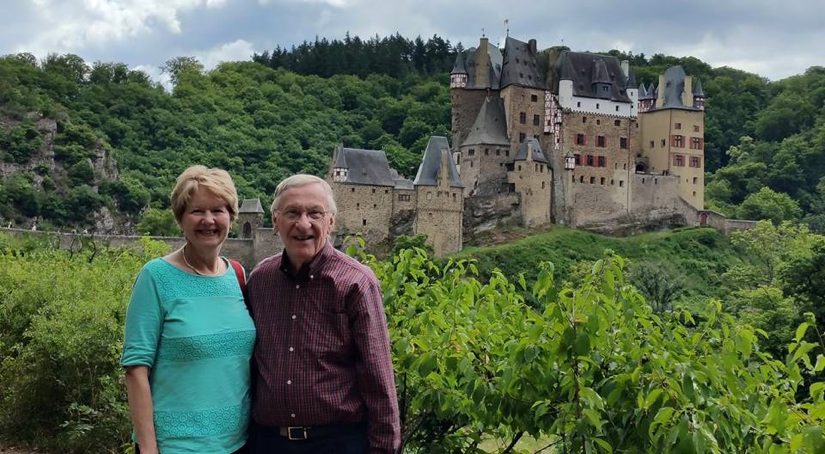
The recent vacation Jane and I took to the Netherlands, Belgium, and the Mosel Valley in Germany was no exception. While it can be questionable to draw too many conclusions after being in a place for only hours or days, curiosity can be aroused that can be verified with some research when you get home.
I always pay close attention to how other countries deal with their transportation needs. Never have I seen as many bicycles as there are in Amsterdam. Multiple levels of covered parking for bicycles at the airport and train station accommodate thousands of bicycles. Most every lamp post, park bench, and railing had bicycles chained to it.
 Checking on my observations when I returned home I found that Amsterdam and other Dutch cities are the most bicycle-friendly in the world. There are more than 22,000 miles of bicycle lanes in the Netherlands with more than a quarter of all trips made by bicycle. That number is 38 percent in Amsterdam, a city of about a million people, and in the university city of Groningen 59 percent of all trips are by bicycle.
A typical street scape in Amsterdam would include a narrow lane for automobiles, bicycle lanes in both directions, trolley rails, and a sidewalk for pedestrians. Men and women dressed for work were among those on bicycles as were many seniors. Spending a couple of days there makes it obvious why it is considered one of the best cities in the world in which to live.
Brussels is likewise a beautiful city to visit, but I think it is especially noteworthy as the center for the cooperative efforts that are going on in Europe with the European Union and the European Parliament. At a time when there is so much strife among countries, it is reassuring to see the progress being made in mutual support and cooperation in Europe even if it is slow given the strong sense of nationalism and history that exists among the countries.
Of course I pay attention to things that relate to issues I deal with as a delegate, but do not let me mislead you about our vacations. I also give equal or more time to enjoying the flowers and foliage of the region, the local foods, and the people we meet. That’s what is great about traveling abroad: you learn a lot while you are relaxing and having a good time.
Ken Plum represents Reston in Virginia’s House of Delegates. His opinion does not represent Reston Now.
The recent tension between the Fairfax County Board of Supervisors and the School Board over approval of the budget for the public schools left one big factor out of the equation for funding schools — the role of state government in financing public education in the Commonwealth.
Public education as defined in the state constitution is a partnership between state and local governments. For some years, the state funded on average statewide more than half the cost of public education. In recent years there has been steady slippage in state support, and local governments have had to pick up the difference.
Virginia Issues and Answers, an excellent publication of the Virginia Tech School of Public and International Affairs, took a look at the issue of financing K-12 education in Virginia in its spring 2015 issue. While the national average of state funding for public education has been around 50 percent, “Virginia, however, has provided a smaller fraction of funding with its contributions typically 10 percentage points below the national average.”
With the Great Recession, funding for education dropped nationally while in Virginia in 2010 it dropped to 37 percent to be in the lowest quartile among the states.
As would be expected, in a look at local funding the opposite is true. In Virginia, localities have been asked to pick up a greater share of education costs. The study found that on average local governments in Virginia have to put in about ten percent more for education than their counterparts in other states.
“Whereas most other states rely more heavily on state revenue to fund their schools, Virginia relies more heavily on local revenues from local property and sales taxes,” the report stated.
Federal funds typically provide 10 percent or less to the revenues of schools in the states. Interestingly, in 2009 the federal share of funding schools in Virginia increased by four percent as Virginia accepted without fanfare or objection American Recovery and Reinvestment Act monies that otherwise Virginia politicians like to rage against. The Virginia Tech study found that during the Great Recession other states cut their per pupil spending less than cuts in Virginia.
The funding for schools is complicated by the necessity under the federal Constitution to ensure that children throughout the state are equally protected to have access to public education. The equalization aspect of the state funding formula for schools results in a higher percentage of state dollars going to the poorest communities over the more prosperous ones. While the success of the formula is open to debate on equalizing access to education, reductions in the amount of dollars available disadvantage all school divisions.
Local governments in Virginia can pass only those taxes that are permitted by state government. Fairfax County cannot pass a meals tax, for example, without state authorization and approval in a local referendum.
Fairfax County residents expect the best schools and under current laws and practices have to shoulder most costs through the property tax. As the debate goes on in Fairfax City about funding our schools, we need to have a discussion about the state’s shrinking role.
I continue to celebrate the human rights victories we have had recently in marriage equality, health care and housing.
I voted against Virginia’s marriage amendment defining marriage as being between a man and a woman when it came before the General Assembly and campaigned against it in the referendum; voters in my district voted against it. Now it is history! All Virginians can marry. Now we need to work against LGBT discrimination in other parts of our society.
With the Affordable Care Act being found constitutional, we need to move forward in fully implementing it in Virginia by expanding Medicaid coverage to the working poor. A key benefit of accepting federal Medicaid dollars is that it would free up state funds for programs we currently are unable to fund adequately like mental health and education. As many as 400,000 Virginians could be helped as we accept back into the state tax monies Virginians have paid into the system.
The Supreme Court’s ruling interpreting the Fair Housing Act of 1968 that housing discrimination doesn’t have to be intentional to be illegal protects vulnerable populations. These advances remind us that we need to stay the course on other issues like gun violence and the Second Amendment.
A study recently released by the Harvard School of Public Health found that between 1982 and late 2011 mass shootings occurred about every 200 days. After Sept. 2011, however, the rate of mass shootings increased to one every 64 days.
Prior to the 1980s mass murders had rarely occurred. Since Columbine and Virginia Tech, the rate of terrorism by mass murderers using guns has accelerated.
A timeline in a recent issue of Mother Jones dramatically shows the increased frequency of mass shootings. (Mass Shootings) Since the shootings at Virginia Tech in 2007, there have been more than two dozen slaughters using guns. I join President Obama in wondering what kind of nation we have become and when we are going to insist that political leaders do something about gun violence.
Recent Supreme Court rulings in other areas convince me that commonsense gun safety measures can be enacted into law and pass any constitutional challenge. As Thomas Jefferson once wrote in words that are inscribed on the Jefferson Memorial, “institutions must advance also to keep pace with the time.” A militia of armed citizens is not required for our times.
Trying to enact legislation to keep guns out of the hands of violent or mentally ill people is not an attack on the Second Amendment rights of law-abiding gun owners. Bills are being introduced in the Congress and in the General Assembly that would put the Second Amendment freedom in perspective with the public’s safety.
I will continue introducing bills for universal background checks. Insist that your elected representatives support these bills. If there are those who would want to take the resulting laws to the Supreme Court, let’s go. Our recent victories call for another!
Ken Plum represents Reston in Virginia’s House of Delegates. His opinion does not represent Reston Now.
Our national holiday the Fourth of July, or Independence Day, is known for fireworks, parades, picnics, concerts, baseball games, family reunions and of course retail sales.
In the midst of all of our “Red, White, and Blue” festivities, we need to remind ourselves that the Fourth is about the celebration of freedom as expressed in the Declaration of Independence.
While we tend to forget the list of grievances we as colonists had against the Mother Country that are enumerated in the Declaration, almost everyone remembers its most significant message: all men are created equal and have certain rights that can’t be taken away–life, liberty, and the pursuit of happiness.
Everyone recognizes that the statement was aspirational; specifically it did not include women or slaves who made up a significant percentage of the population in the South.
The history of our country has been a movement towards realizing the liberties that are associated with the Fourth of July. The great compromisers who put together the Constitution and its Bill of Rights could not resolve the contradictions in our stated goal and the practices of society. It took a civil war and hundreds of thousands of deaths to free the slaves and another century of struggle to extend civil rights to persons of color.
Recently, we were starkly reminded of how far we still need to go to expunge racism from our society. The horrific massacre of nine people at a Bible study in Charleston, South Carolina, puts into focus the extent to which some people are willing to go with their Confederate flag and symbols to glorify a conflict that was about a segment of society that was willing to go to war.
They fought to keep their ability to take away life, liberty, and the pursuit of happiness as well as the property of others. The Civil War was not about states’ rights; it was about people who wanted to continue a lifestyle and economy on the backs of their slaves which the southern states were willing to allow. If any “rights” were lost in the Civil War, it was a mistaken notion that one should have a right to discriminate against others. The Confederate battle flags need to go down, and our work to end racism needs to intensify.
The Fourth of July was followed in our history by a long list of men and women who worked hard to extend the promises of the Declaration of Independence to everyone. Their work is paying off with the results we saw last week in the Supreme Court decisions on marriage, health care and housing.
Our celebration of the event that happened a long time ago needs this year as much as ever to include a commitment to work for freedom for all, to reject hate and divisions, and to ensure that the inalienable rights of all men and women to life, liberty and the pursuit of happiness are enjoyed in this country.
Ken Plum represents Reston in Virginia’s House of Delegates. His opinion does not reflect that of Reston Now.
 This is an op-ed by Eric Mogensen, CEO and Corporate Director of the Reston Zoo. It does not represent the opinion of Reston Now.
There continue to be misperceptions about Reston Zoo and past events. The recent report of USDA filing charges against us, all of which are being refuted, has made it an appropriate time to clarify.
Meghan Mogensen was an employee of the zoo in 2012. She has never been an owner of any of the facilities, as has been repeatedly listed incorrectly. She was the Zoo Director and not involved with daily animal care; that person was the Animal Curator. The curator was directly involved with both the [euthanized] wallaby and the [injured] spider monkey. She was under company investigation for the spider monkey when the wallaby was injured. This was not made public. Corroborating materials will be presented in court. Meghan’s role begins and ends with the wallaby. All other issues for which Reston Zoo has been cited concern other employees.
As reported, Meghan was charged with animal cruelty. Her intent was to ease the suffering of a gravely injured animal as quickly as possible because her curator failed to do her job. The intent was admirable, the process wrong. However, the official necropsy report showed no signs of drowning, i.e. the animal was already deceased. Meghan is a vocal animal rights advocate when it comes to their care; her intent was never to cause any suffering. There was no cruel intent. This is a woman who hand-reared porcupines and pot-belly pigs in our house when she was a girl; a parrot from the day it hatched; helped raise multiple baby kangaroos on bottles.
There have been mistakes made at the zoo, but they were made by animal staff which sincerely cared for their animals, and were inadvertent. As in every zoo in this country, including our very well respected National Zoo, animals die through mistakes and keeper error. No animal cruelty is involved; there is no vicious intent.
Our staff loves their animals; most [staffers] young and want to save the world. For many, this is their first paying job out of college. It’s hard, gritty and many times Read More
I recently received a “Dear Mr. Plum” letter from the Executive Vice President of the National Rifle Association of America (NRA). Had it not been for the obvious marketing design of the envelope, I may have thought that he was writing to me about my monthly appearance outside his office as part of our End Gun Violence Vigil.
No, he was writing to invite me to become a member of the NRA! The mass marketing firm responsible for the mailing may have lost their contract after sending a letter to me.
I get many solicitations for membership and contributions in the mail, but I found this one to be particularly alarming. While it promised me an “NRA rugged duffel bag” for joining, its main pitch was to scare me and the thousands of other persons receiving it into signing a “National Petition to Protect Our Rights to Keep and Bear Arms” and joining the NRA. Signing the petition was important the letter explained because “the Obama-Biden-Bloomberg gun ban machine and their anti-gun media allies are waging all-out war on our gun rights!”
And if that was not enough, the letter went on to explain in bold type with underlining and capitalization that “They’ve vowed to fight on and never surrender…Not until they BAN tens of millions of commonly owned firearms…SHUT DOWN gun shops and shows…Impose crippling TAXES and FEES on firearms and ammunition…REGISTER gun owners…and DESTROY your right to defend yourself, your home and your loved ones.”
The tone of the letter was disturbing with its repeated references to “fight, defend, destroy, war, muscle, defeat.” All the bluster and loud noises are attempts to distract from the efforts on the part of many organizations to have common sense gun safety measures passed that leaves the Second Amendment in place but enhances safety in our homes and community. I continue to introduce a bill to close the gun show loophole as a way to keep guns out of the hands of criminals and persons who are violent.
The purpose of the signed petition is explained later in the letter again in bold type: “When NRA is fighting gun control legislation and regulations, we can point to these signed petitions and tell your Virginia politicians that there are thousands of gun owners standing ready to elect the Second Amendment’s allies and defeat her enemies!” Unfortunately this fear tactic works with too many elected officials.
The theme of our monthly vigil at NRA on the 14th of each month is “We will not forget,” and it started after the massacre at Sandy Hook Elementary in 2012. We will not forget, for unfortunately we are reminded too often about gun violence — last week it was the pastor and eight members of a church in Charleston, SC, who died from gun violence.
Not to adopt the tactics of others, but I do fear for the future of our free society if violence like this continues.
Ken Plum represents Reston in Virginia’s House of Delegates. His opinion does not necessarily reflect that of Reston Now.
 This is an op-ed by Reston resident Bill Woloch. It does not reflect Reston Now’s opinion.
Reston founder Robert Simon envisioned Reston as being a place where people could walk to work and shopping, walk to recreation and nature without using a car. He designed a number of Village Centers that were actually within walking distance of most of the residents homes in Reston.
One of those Village Centers is located at the corner of Wiehle Avenue and North Shore Drive. It is called the Tall Oaks Village Center. It has been in disrepair for a number of years, a decade, and no one in Reston cared. It was sold a few times, most recently to another developer.
Village Centers are more than just shopping and retail. They are gathering places for people who see each other occasionally from nearby neighborhoods. Where parents and kids could easily walk after hitting the RA pool and maybe have a coke or ice cream. Where dog walkers could sit and chat.
Architecturally, Village Centers made people feel like they could stop by no reason other than to hang out a while, with inviting open spaces, sitting areas (covered) and up till now, maybe a county or RA office or branch library.
The developer’s current plans allow for none of these. Worse yet, I believe the Reston Association and Fairfax County don’t seem to think it is important. Actions speak louder than words.
Who is responsible for ensuring the principles of Robert Simon’s vision and association bylaws are adhered to? Not an easy answer. There is the Fairfax County Planning Commission, the Reston Association (RA) Board of Directors, along with the RA Planning and Zoning Committee and the RA Design Review Board. That’s a lot of oversight. So what have they been doing during the last 10 years of the Tall Oaks Village Center’s decline? Ask them yourself. Send an email. Read More
Virginia voters in areas with contested primaries went to the polls last week to select their candidates for the Nov. 3 general election, when all seats in the General Assembly are up for election as are many local offices.
Primary elections attract mostly party faithfuls in small numbers and are not clear barometers of the mood of voters generally on issues. Some of the results in General Assembly primaries merit attention.
In the Republican-dominated Shenandoah Valley, senior Sen. Emmett Hanger, one of the three Republicans in the General Assembly who supported Medicaid expansion, had two more conservative challengers who made Medicaid expansion an issue in the primary with both of them opposing expansion. Hanger won easily.
In Hampton Roads, the lone Democratic incumbent who opposed Medicaid expansion lost to his primary challenger who supported it.
Before jumping to the conclusion that Medicaid expansion has suddenly become popular in the Commonwealth, there is the primary involving the William Howell, Speaker of the House of Delegates.
The Speaker was reported as campaigning in part on his being able to keep Virginia from expanding Medicaid. Of course, his Tea Party opponent opposed Medicaid and suggested that the Speaker’s opposition had not been strong enough. After campaigning hard and out-spending his challenger, the Howell won easily.
Across the state, a senate incumbent and a delegate incumbent, both Republican who opposed Medicaid expansion, beat their challengers who also opposed Medicaid expansion.
The election results do not give a clear indication of the outcome of what will be a critically important issue for the 2016 General Assembly session. The Governor remains committed to Medicaid expansion, but his having any chance of success is dependent upon the outcome of the Senate races.
There will be several key contests in the November state senate races. At a 21-19 advantage for Republicans, Democrats need to pick up at least one seat to give Democratic Lt. Gov. Ralph Northam the opportunity to break ties.
The seats being vacated by the two other moderate Republicans who supported Medicaid expansion offer hope for Democrats, but Democrats need also to hang on to the seat vacated with the retirement of Democratic State Sen. Chuck Colgan, the only Democratic state senator in western Virginia is in a three-way race.
If elections were based purely on facts, Medicaid expansion would be a sure winner. The White House Council of Economic Advisors issued a report recently that said expansion would reach an additional 179,000 Virginia residents with lifesaving care. The report also said Virginia will miss out on $1.24 billion in federal funding in 2016 by not expanding Medicaid. That is billions of Virginia taxpayer dollars that could come back to the Commonwealth, freeing up state funds for crucial under-funded programs.
Go to the polls this November, and in the meantime, let friends and family members know the importance of Medicaid expansion and that their votes will matter in making it happen.
Ken Plum represents Reston in Virginia’s House of Delegates. His opinion does not reflect that of Reston Now.
 Fairfax County Public Schools are facing a potential $100 million shortfall for 2016-17, and Superintendent Karen Garza has organized a Budget Task Force to look at cost-cutting measures.
FCPS is also seeking citizen input. Citizen suggestions have ranged from cutting varsity sports to paying for Advanced Placement tests to doing away with center-based Advanced Academics.
Reston Now organized some suggestions based on general themes from citizen input (and not due to any scientific examination of FCPS’ financial statements).
Which areas do you think could be better financially managed? Cast a vote and tell us in the comments.
I am an elected public official by career choice. I can continue to serve in my professional occupation only with the concurrence of the voters every two years.
Most people refer to me as a “politician” for short. The word politician brings with it negative connotations, and I understand why. I would never defend the actions of some in my chosen profession. I just hope that we will not throw out the whole bushel because of some rotten apples. Some of the most honest and decent people I have known have been dedicated public servants in elective office.
Recently, the public perception by some of our political system was brought clearly to my attention. I was invited to George Mason University by a group of students concerned about corruption in government who had organized themselves as part of a national group, Represent.Us.
I was impressed by the sincerity of the group and their desire to make a positive difference. Initially I was taken back by the headline on their handout: “Uniting to Fix Our Corrupt Political System.” It sounded as if they thought everyone involved was corrupt, but then I realized they were talking about the system as a whole.
As explained in their literature, “The system has been corrupted by money. Instead of solving our nation’s problems, our politicians raise money for reelection; instead of listening to the American people, they listen to lobbyists and big donors. Citizens who can’t afford to buy access are cut out of the democratic process.”
The strategy of these GMU students and Represent.Us is to pass a new anti-corruption law that would impose strict lobbying and conflict of interest laws and end secret political money by mandating full transparency and disclosure of all political money and “bundlers” who gather contributions for politicians. A copy of the model bill is available for review or download at AntiCorruptionAct.org.
While the ultimate goal is to pass a federal law, the immediate strategy is to pass anti-corruption laws at the city/county and state levels first to build momentum for federal action.
Too many activities the bill would outlaw have unfortunately become the way of doing business in legislative halls. Overturning the decision in Citizens United would be an important first step. In Virginia, filling in the cracks in the recently passed ethics law is important. The obvious loophole of gifts simply becoming campaign contributions must be closed. Auditing of legislative and campaign accounts is critical.
I have met with a couple of the students a second time. It is refreshing to be around young people who have a strong sense of right and wrong and who want to make a difference. To call them idealistic would be to miss the importance of what they are doing. I have agreed to work with them to help fix the system that allows corruption to flourish in my chosen profession.
Ken Plum represents Reston in Virginia’s House of Delegates. His opinion does not represent Reston Now.
 The Fairfax County Board of Supervisors approved changes to the Reston Master Plan on Tuesday. The changes will help guide growth at Reston’s village centers and neighborhoods going forward.
One of the new rules: Reston’s village centers will not have to get a comprehensive plan amendment should they want to drastically change.
When founder Bob Simon envisioned Reston in the 1960s, all the village centers were going to be like Lake Anne Village Center — high density (townhouses, apartments) housing, a plaza, central gathering place, walking access and parking on the perimeter.
But as Reston developed (Simon was no longer part of the project by the time the rest of the village centers were built), what was put in place was essentially strip mall shopping. Those plans deviated from the vision, but also provided convenience for residents who just wanted to park the car and easily grocery shop or pick up dry cleaning.
Other than a proposal for the ailing Tall Oaks Village Center and the plan for the area near, but not in, Lake Anne Plaza, there are no current plans to redevelop Reston’s village centers. So it is status quo for now — but what do you think should happen in the future? Stay the same or get back to the original plan? Take our poll and tell us in the comments.
Photo Courtesy North Point Village Center
