

 This is a commentary from Del. Ken Plum (D-Fairfax), who represents Reston in Virginia’s House of Delegates. It does not reflect the opinion of Reston Now.
During the primary election season when both parties in Virginia were making their selection of a candidate for governor, one candidate who went on to get his party’s nomination proposed the clincher of a policy proposal to secure his success in the election: a billion-dollar tax cut!
For those who have been around the state for some time it may sound familiar; the successful car tax cutting proposal that elected a previous governor is still costing the state about a billion dollars each year. That cut was particularly ironic in that it had the state cutting a local tax by reimbursing the localities for taxpayers. It was great for Northern Virginians as less wealthy downstate taxpayers reimburse the wealthiest jurisdictions in a reverse “Robin Hood” plan.
Before voters jump at a promise of reduced taxes, I hope there will be a serious consideration of the consequences. Virginia prides itself on being a “balanced budget” state; its revenues cover its operational expenses. Borrowing is permitted under the State Constitution for capital projects when approved by voters unless the project raises enough revenue to pay for itself. All that is good with a major exception. At no time does the state quantify its needs in order to determine what the cost of government would be if the state met its responsibility in providing funding. Two examples are offered below to make my point.
The first example is the state’s refusal to fund education at the level it has in the past and that is required by the Constitution. A report by the Commonwealth Institute, “State Cuts Mean Fewer Staff and Resources for Virginia Students,” in April 2017 makes the point.
“Statewide, state support has fallen 11 percent per student since 2009 in real dollars. This has impacted the ability of schools to maintain staffing and facilities. Across the state, school divisions have about 2,800 fewer staff than they had in 2009, despite growing enrollment. If they had kept pace with enrollment growth, Virginia’s schools would have 10,400 more staff instructing students and making sure the schools run smoothly.”
The other example is in health care. The Remote Area Medical (RAM) clinic in Wise County is well known having been featured on an edition of 60 Minutes. There, thousands of Virginians receive their health care for the year in a weekend clinic held on the local fair grounds. The federal Affordable Care Act did not help as the legislature would not take federal monies to expand Medicaid that would have helped these people in need. The state turned its back on nearly $5 billion paid into the federal system by Virginia taxpayers because it did not want to have anything to do with what it termed Obamacare. What has happened in the meantime? A second RAM weekend clinic has been opened in Lee County nearby to Wise in Southwest Virginia, and a new clinic has been started in Emporia in Greensville County in Southside Virginia.
We definitely need to balance our budget, but we need to balance it against our needs. How could we seriously propose to cut our income when there continues to be such extensive unmet needs in the Commonwealth?
This is a commentary from Del. Ken Plum (D-Fairfax), who represents Reston in Virginia’s House of Delegates. It does not reflect the opinion of Reston Now.
Proposals are now before the Congress to change the Affordable Care Act. While there have been years of rhetoric on changing the plan that got dubbed “Obamacare,” changing it in a way that would continue to extend care to the most vulnerable people in our country has proven elusive. The proposals that have come forward look more like tax cuts for the very rich than health care for the very poor.
Recently, the Board of Medical Assistance Services that provides oversight for the various health care programs in Virginia wrote to Gov. Terry McAuliffe with their concerns about the new federal proposals. Their letter (available here) was very frank in its assessment.
The proposals before Congress they wrote “will inflict a serious cost burden to the Commonwealth, will expose Virginia taxpayers to an increased tax burden, will significantly harm Virginia’s Medicaid program, will derail important medical innovation, and will hobble Virginia’s ability to care for our citizens most in need.”
Most of the letter is devoted to the technical changes proposed in the new legislation that would reduce coverage to Virginia residents while increasing costs to the state. Most of the potential damage stems from the proposed shift to per capita block grant funding, but other technical changes will cost the Commonwealth citizens in services and in money. Using 2016 as a baseline would be especially costly to Virginia.
That provision alone would exclude the new Addiction Recovery and Treatment Services (ARTS) program designed to address Virginia’s opioid epidemic, declared a public health emergency by Virginia’s Health Commissioner Marissa Levine, MD, MPH. Another example is that the per capita cap baseline would exclude Virginia’s $46 million developmental disability system investment that also begins this year.
In a tone that is unusual for a Board made up of professionals and citizens, the letter went on to conclude, “We have attempted to provide some high level examples of the financial damage that the AHCA would inflict on Virginia, but cannot lose sight of the reality of what that means. It is not just the impact on Virginia’s fiscal health, it is also the impact on the health of individual Virginians. That, in the end, is the purpose of Medicaid and of all the other health measures we take as citizens. One of our Board members provides a striking example. She would have to choose between no nursing care for her daughter who receives 12-16 hours per day via Medicaid (their primary insurance nursing benefit is only $500 per year) or pay more than $86,000 per year out of pocket for nursing care, in addition to having to pay for items such as durable medical equipment and medical enteral formula that would no longer be covered by Medicaid. There are thousands of such examples within our Commonwealth.
Finally, we wish to emphasize one more issue: providing help to our fellow Virginians in need, who cannot help themselves, is a moral imperative, a moral test that we cannot and should not fail. We, as the Board of Medical Assistance Services, strenuously and unanimously urge you to oppose the AHCA or any similar bill that inflicts such undeniable damage to our Commonwealth and her citizens.”
Thank you Board for telling it like it is. Hopefully members of Congress, especially members from Virginia, will hear your plea and respond appropriately!
This is a commentary from Del. Ken Plum (D-Fairfax), who represents Reston in Virginia’s House of Delegates. It does not reflect the opinion of Reston Now.Among the many actions of the new federal administration in Washington, few have drawn sharper disagreement around the world as has the unfortunate decision to withdraw from the Paris Climate Agreement. Only two nations of the world did not join, with the United States being the first and only to withdraw. The Agreement was difficult to reach and showed real promise to bring nations together to curtail climate change.
The response has been swift and determined among those concerned with climate change as to what can be done to stay the course on dealing with the issue. Recently, I joined with more than 550 legislators from throughout the country, including 11 from Virginia, organized by the National Caucus of Environmental Legislators (NCEL, ncel.net) in sending a letter to the administration indicating our opposition to withdrawal from the Paris Agreement. Following is the text of that letter:
We are state legislators representing 45 states with a total population of over 298 million United States citizens and we stand united in opposition to the president’s decision to withdraw the United States from the Paris Climate Agreement.
We are committed to continuing the United States’ leadership in working toward a clean energy economy and reducing greenhouse gas emissions. Now more than ever, in the wake of this short-sighted decision by the Federal Administration, it is important that state and local governments come together to strengthen our resolve to meet our regional goals to reduce carbon pollution and our national goals to achieve the reductions agreed to in Paris in 2015.
We stand with the 292 United States mayors representing more than 60 million Americans, the governors of 12 states with a total population of over 102 million, and 194 countries committed to upholding the ambitious goals adopted in the Paris Agreement. At the same time, we explicitly refuse to stand with President Donald Trump in his repudiation of the agreement.
Climate change is not a conspiracy, a hoax, or a partisan cause. Climate change will not affect just a few low-lying countries and the polar regions. Climate change is real and caused by human activity. People around the world and here in our own country, in our own states, in our own communities have already experienced the impacts and will see significantly increased impacts in the coming decades.
As state legislators, we declare our commitment to work with our legislative colleagues, our governors, and our constituents to ensure that we continue this country’s leadership role to build a 21st Century clean energy economy and that we meet or exceed all of the deliverables in the Paris Agreement. To this end, we will reach out across local, state, and federal borders to work together for our future. These ties will strengthen our economy as we build upon American ingenuity, entrepreneurship, productivity, and scientific and technological know-how to reduce carbon pollution while producing the next generation of clean transportation, clean power and energy-efficient devices and strategies.
With or without the president’s leadership, our country must continue to lead the fight for climate action. Working together across multiple states, we will ensure our great nation does not go backward and meets or exceeds the Paris Agreement.
If you decide to write a letter as well, please feel free to borrow any or all of the text of this letter.
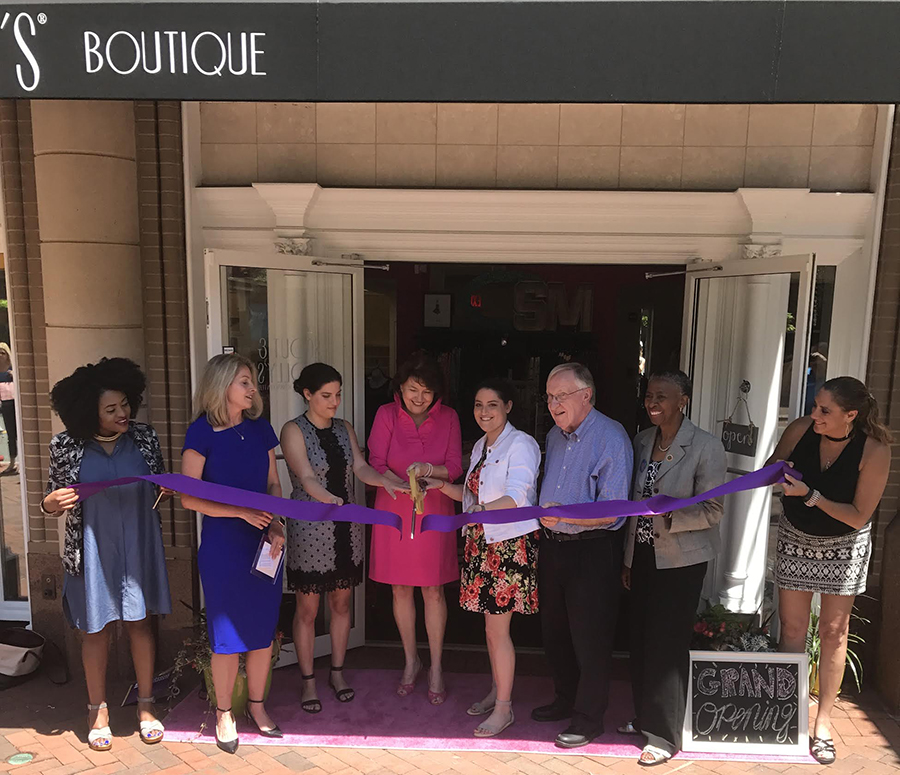
Ribbon Cutting for Clothing Store — Scout & Molly’s (11944 Market St.) hosted its official ribbon-cutting ceremony Saturday morning. Among attendees were Rep. Barbara Comstock (R-Va.), Del. Ken Plum (D-Fairfax), Fairfax County Supervisor Cathy Hudgins, representatives of the Greater Reston Chamber of Commerce and more.
Summer Meals Program Starts Today — The Free Summer Meals for Kids Program provides free, healthy meals to children ages 5 to 18 at designated meal sites in Fairfax County. [Fairfax County]
Officials Talk Metro, Fields, More — Fairfax County Board of Supervisors Chair Sharon Bulova, Supervisor Cathy Hudgins and more addressed the Vienna Town Council recently to give updates on the Silver Line, placement of athletic fields and more. [The Connection]
Kids Can Earn Prizes for Reading — Kids who complete the summer reading adventure at any Fairfax County library by Sept. 2 can win a coupon book with dozens of free and discounted fun treats like ice cream and miniature golf. [Fairfax County]
Image courtesy Powers Brand Communications LLC
This is a commentary from Del. Ken Plum (D-Fairfax), who represents Reston in Virginia’s House of Delegates. It does not reflect the opinion of Reston Now.
With the conclusion of the political party primaries last week, the general election is now teed up for Nov. 7.
There were some surprises coming out of the Democratic and Republican primaries. Lt. Gov. Ralph Northam easily won the Democratic primary to be the nominee for governor, even though there was discussion beforehand that polls indicated a tight race. Polling for primaries is notorious for being inaccurate because with a typically light turnout, the universe of potential voters is almost impossible to determine. Former one-term Congressman Tom Perriello has a great deal to offer and will hopefully stay on the scene for future opportunities. Although the term “establishment” was grossly overused in describing Ralph Northam, his service in the state Senate plus his active role as lieutenant governor made him well known and greatly admired throughout the state.
Justin Fairfax gained everyone’s admiration after a primary loss to Attorney General Mark Herring four years ago led to his active campaigning during the interim time, making him well known for this primary. He was also well known for his work as an attorney. If you review the areas where Ralph Northam did well and compare them with where Justin Fairfax was strongest, you create a strong statewide team that will be nearly impossible to defeat. Attorney General Mark Herring was not challenged in a primary and will be on the ballot to succeed himself in November. There is no one-term limitation with the attorney general and the lieutenant governor as there is with the governor.
The greatest surprise of the primaries may have been on the Republican side to pick a candidate for governor. Ed Gillespie who has been mentioned for years as the next Republican governor of Virginia barely got through the primary with a shockingly strong showing by Corey Stewart, who is known for his anti-immigrant work in Prince William County and for campaigning with a Confederate flag. He has the distinction of being so over the top that he was fired by the Trump campaign. Turnout was especially low in the Republican primary, and Stewart was just over a percentage point from taking out Gillespie. It will be interesting to see if the folks who voted for Stewart will vote in the general election or decide to stay home.
The Republican primary for lieutenant governor was a slugfest between two state senators, with Sen. Jill Vogel winning after a mud-slinging campaign that left neither candidate looking good.
All 100 seats for the House of Delegates are up for election this fall with a record number of contested elections. Historically, it has been difficult to recruit candidates to run for the House of Delegates, but events of the past year have brought forth more candidates than ever before. There was a record number 27 seats where the candidates were determined by the primary because there was so much interest in running. Democrats will certainly pick up seats in the House of Delegates getting closer to shifting or sharing power in that legislative body.
While I am uncontested in my race for the House of Delegates, you can still expect to see me campaigning. It is a good way to stay in touch with constituents and to increase turn-out for the statewide elections. Expect a busy fall of campaigning leading up to the fall elections in Virginia that will send a signal to the nation as to the public’s reaction to national events.
This is a commentary from Del. Ken Plum (D-Fairfax), who represents Reston in Virginia’s House of Delegates. It does not reflect the opinion of Reston Now.
One of my favorite classes to teach in the Osher Lifelong Learning Institute (OLLI) at George Mason University is a course I have entitled “A New Look at the Old Dominion.”
It came out of my experiences growing up in Virginia and attending public schools from elementary through graduate school and using state-approved textbooks, at least in the early years. A persistent problem I had was matching up the romanticized version of Virginia’s history with realities I read about in source materials. This problem is not unique to Virginia or its history; every state and every culture always attempts to put its best foot forward. It skews our view of events and may lead us to believe that America was at its greatest in some bygone era. The fact of the matter is that our greatness has been evolving.
Reading early Virginia textbooks could lead one to believe that slavery was good for all, until what some termed the “War of Northern Aggression,” and then there was the Lost Cause movement that restored faith that Virginia was right all along. We still hear remnants of that line of thinking as the debate on Confederate monuments is going on.
I was reminded of this background as I recently visited a new exhibition at Montpelier, James Madison’s home in Orange County. Through extensive archaeological work there is an attempt to tell “a more complete American story.” The title of the exhibition, “A Mere Distinction of Colour,” is a phrase from Madison’s writings: “We have seen the mere distinction of colour made in the most enlightened period of time, a ground of the most oppressive dominion ever exercised by man over man.”
Despite that observation, the Father of Our Constitution was the owner of hundreds of slaves who worked his farms and did his labor allowing him time to be a statesman. He did not free his slaves at his death. Enslaved families were split up and sold to retire the debt he left behind.
Visiting Montpelier today, you can see the mansion beautifully restored, including the upstairs room where Madison probably did his writing about the Constitution. Thanks to important archaeological work, you can visit the area around the mansion where the slave quarters were located, with several reproductions having been added in recent years. A tour of Montpelier can be eye-opening for your children, to contrast the home of the owner with the quarters of the enslaved.
Nearby at Thomas Jefferson’s home Monticello, there is an expansion of the tours to include a slave tour. The tour guide says very clearly what was denied for generations, that Jefferson fathered several children by Sally Hemings. Of the more than a hundred slaves owned by the writer of the Declaration of Independence who said “all men are created equal,” on his death only those slaves that he had fathered were freed.
The historians at Montpelier call it “a more complete American story.” It is being written way past time. While we need to acknowledge and embrace a history that is inclusive of the men and women who did the work in founding our country, acknowledging the arbitrary distinctions of the past will make us stronger as a nation.
This is a commentary from Del. Ken Plum (D-Fairfax), who represents Reston in Virginia’s House of Delegates. It does not reflect the opinion of Reston Now.
The Virginia General Assembly will celebrate its 400th anniversary in a couple of years, making it the longest-running representative legislative body in this hemisphere.
Although not much has changed in the basic procedures of lawmaking with committees and structured floor debate, over the centuries there have been adaptations to the times as the Legislature has sought to best serve those it represents. Most recently, the biggest changes have been to the housing of the legislative functions.
For those interested in details, here is a summary of the major changes — past and present. The General Assembly in 2004 abandoned Mr. Jefferson’s Capitol for the first time since the Civil War to give the place a major renovation that would keep it standing and expand its size underground so as to not take away from its iconic exterior. For that renovation, the Legislature moved to the former state library, whose upstairs had been renovated to be the Governor’s Office but whose reading rooms downstairs had been left intact and became very efficiently the House of Delegates and Senate chambers for several sessions.
Meanwhile, the offices of legislators in the General Assembly Building (GAB) have been crumbling asbestos, explaining the white dust that periodically appeared on the furniture. Legislating should not be considered hazardous duty, at least in a physical sense, nor should failing plumbing and heating and cooling systems cause delays in the work of the Legislature.
For decades, the Life Insurance Company of Virginia had occupied the building before it moved to an office park in the suburbs and sold its aging building to the Commonwealth. The building is currently being demolished, and a new office building will be constructed in its place with a parking garage across the street. That will be good news for those who want to participate in the legislative process but have been prevented from doing so because they simply could not find a place to park.
The last act of legislators this past session was to pack ourselves up for a move down Richmond’s Capitol Hill to the Pocahontas Building, formerly in private hands as the State Planters Bank of Commerce and Trust Building, where we will have temporary but nice and asbestos-free offices for several years while the new building will be constructed. The Pocahontas Building was available to us as the Attorney General and his staff, who had offices there, have recently relocated to the Barbara Johns Building, formerly the Hotel Richmond and later state offices, just across the street from where the new General Assembly Building will be.
Regardless of whether you chose to follow all that, the good news is that when you come to Richmond you will be much more likely to find a convenient place to park, and you will be in a safer setting.
With our physical surroundings taken care of, now we need to go to work on bringing the legislative process up to date by making it more transparent and responsive. Maybe a significant anniversary and a change in working environment should be viewed as a time to start anew.
This is a commentary from Del. Ken Plum (D-Fairfax), who represents Reston in Virginia’s House of Delegates. It does not reflect the opinion of Reston Now.
My credentials as a progressive Democrat (capital D) are well established; sometimes missed in the political back and forth of an election year might be my earnest effort to be a democratic (small d) advocate.
The outcomes of elections can be no more reflective of the public mood and aspirations than substantial participation by voters in the electoral process. That observation has been made over and over, yet elections occur with only a small fraction of eligible voters taking part.
Voting does take some time and effort. To vote one must register, but registration is active as long as you have not moved. Even though elections take place on a weekday when many people work, it should be possible to find some time between 6 a.m. and 7 p.m. in order to vote. If not, absentee voting is an alternative. There has been much legislation over the years designed to suppress the vote, but I and others have spent a lifetime working to get it defeated in the courts or in the Legislature.
Although candidates spend huge amounts of money and time selling themselves to voters, there are many voters who consider themselves too ill-informed to vote. Bringing a realistic vision of a candidate to a voter is not an easy task. Candidates need to keep trying, and voters need to step up the effort to find out information on candidates for themselves. The recent growth of interest groups registering voters and informing people on the issues is a very hopeful sign. I believe it will help change the outcome of some elections, and for sure it is likely to increase participation.
Virginia has an election every year. While most states skip the odd-numbered years for elections, Virginia — along with New Jersey — will elect a governor, lieutenant governor, attorney general and all members of the House of Delegates this year. That election will be on Nov. 7. But even before we get to those campaigns, there are many more primary elections in both parties this year than I can ever remember.
June 13 is a most important date when primary elections will take place. Voters do not register by political party in Virginia. To vote in the Democratic or Republican primary on June 13, you need to declare your political party at that time. You cannot vote in more than one primary.
Of course, I am voting in the Democratic primary and will be voting for current Lieutenant Governor Ralph Northam for the Democratic nomination for governor and Justin Fairfax as the Democratic nominee for lieutenant governor. Attorney General Mark Herring will be the Democratic nominee for re-election, as he is not being challenged in the primary.
If you are voting in the Republican primary on June 13, you have a choice of three candidates for the nomination for governor, and three for lieutenant governor.
I am not being challenged in the primary but several delegate districts have primaries in Northern Virginia. To look at a sample ballot for each party, go to www.fairfaxcounty.gov/elections/upcoming.htm.
However you choose to vote, do get out and vote and encourage your neighbors to do the same.
This is a commentary from Del. Ken Plum (D-Fairfax), who represents Reston in Virginia’s House of Delegates. It does not reflect the opinion of Reston Now.
For more than a half century, signs along the roadsides and ads in local newspapers featured Smokey the Bear with a message “Keep Virginia Green.” His reference was to forest fire prevention, for which he said 9 out of 10 could be prevented. Forest fires were a big concern because wood products were big business in Virginia.
A campaign continues today with a “Keep Virginia Green” theme as part of the “Keep Virginia Beautiful” effort. It has a broader meaning, as it now includes stopping littering and other actions consumers can take as part of caring for the environment in the Commonwealth.
Maybe the most meaningful effort ever taken to protect Virginia’s environment was announced last week by Gov. Terry McAuliffe — that he had signed an Executive Directive ordering the Department of Environmental Quality to begin the process of establishing regulations in Virginia that will reduce carbon emission from power plants. As the Governor explained, “As the federal government abdicates its role on this important issue, it is critical for states to fill the void. … Virginia will lead the way to cut carbon and lean in on the clean energy future.” The current federal administration has moved to rescind actions of the Environmental Protection Agency to reduce carbon in the atmosphere and to act on climate change.
While proponents of states’ rights may applaud the shift from the federal to the state governments, wind currents from power plants and airborne pollutants do not recognize state boundaries. It is critically important that other states follow the actions of Gov. McAuliffe.
According to the press release announcing the Governor’s Executive Directive, the Commonwealth has seen an increase from just 17 megawatts of solar installed to more than 1,800 megawatts in service or under development. Revenues in the rapidly growing clean energy sector have risen from $300 million to $1.5 billion between 2014 and 2016. In the last year alone, solar installations have risen nearly 1,200 percent. The number of Virginians employed by the solar industry rose 65 percent to 3,236 — twice the number of jobs supported by coal. An analysis by The Solar Foundation quoted in the release said that Virginia is now second in the Southeast and ninth in the nation for year-over-year solar growth. As of 2017, Virginia is first in the Southeast for corporate clean energy procurement.
Dominion Energy, the Commonwealth’s largest electricity producer, announced earlier that it intends to follow the federal Clean Power Plant regulations even if they are rescinded by the current administration. Older coal-powered plants are being converted to natural gas or closed. The company will be subject to any additional regulations that result from the Governor’s Executive Directive.
It is heartening to see the number of citizens who have expressed a greater interest in environmental matters as they realize the threat to current protections under the new administration. We need to thank and applaud the Governor for his action and at the same time keep the pressure on federal and state elected officials to see that our air is kept clean and safe. I am pleased that both the Sierra Club and the League of Conservation Voters have recognized my efforts in this regard.
Several weeks ago, at the invitation of their leader, I spoke to a group of Boy Scouts about government and the responsibilities of citizenship. Talking with me helped the Scouts meet one of their requirements for a merit badge.
One of the Scouts asked me about the most important legislation I had ever gotten passed. I told him about multiple issues on which I had worked, but I focused on one that I thought he might know little about but would show the range of issues with which legislators deal. I told him about my work to expand infant screening in the Commonwealth.
Prior to my election to office, I served on the Fairfax-Falls Church Community Services Board. A member of that Board whose adult son was a resident at the Northern Virginia Training Center told me of the great hope there was in detecting health issues in infants at the time of their birth with blood screening. At the time Virginia had only three tests, one of which was PKU testing. I remembered our conversation after I was elected, and I got new tests added as scientists developed them.
Metabolic disorders that can be discovered from a pinprick of an infant’s heel can generate early and sometimes simple treatments that can lead to a healthy child and adult. Without treatment, numerous medical conditions can develop including severe developmental delays and chronic illnesses. Metabolic disorders affect the chemical processes in your body that must work together correctly for you to stay healthy.
I was honored to work on legislation that added most of the 30 tests that are done in Virginia on that same spot of blood from an infant to detect these disorders. Last week, I was reminded of the experience that I had working with Dr. Barry Wolf of the then-Medical College of Virginia, who had discovered that the disorder in which the body is unable to recycle the vitamin biotin can lead to developmental delays in children, hearing and vision loss, breathing problems, and problems with balance and movement. When discovered early such as through a screening test, the disorder can be treated with nutritional supplements that can result in a normal life for the person.
With Dr. Wolf’s research and my legislative proposal, in 1984 Virginia became the first state in this country to begin infant screening for biotinidase deficiency. Since that time, every state and many foreign countries have started the screening. The March of Dimes recognized us for that accomplishment.
The reminder of this story came from a local doctor in Reston who was a medical student at MCV at the time and knew of Dr. Wolf’s research and my bill. She wrote to us both, telling us of a teenage patient she had just met who at birth had been found to have the deficiency but, with treatment, was living a normal life. She wrote to both of us that “because of researchers like you and advocates like you… our world is made a little better for all, and lives are saved for some precious few. That’s something to be proud of.”
I hope the Boy Scouts understood why I consider the work on infant screening to be among the most important I have done.
This is a commentary from Del. Ken Plum (D-Fairfax), who represents Reston in Virginia’s House of Delegates. It does not reflect the opinion of Reston Now.
Virginia has the distinction of having had the first mental health hospital in the country, although it was called an insane asylum, which more correctly described the work it did.
From colonial days to the present, the role of the state in providing treatment and services for those with mental illness has been widely debated, filled with different theories and approaches, and always critically underfunded. It took a massacre of students at Virginia Tech and a state senator’s son attacking his father with a butcher knife, then shooting himself, to bring a higher level of urgency and seriousness to the discussion. A commission has been meeting the past couple of years and will continue to meet for at least a couple more to develop recommendations on what the state should do.
In the meantime, some hopeful progress is being made. After the Virginia Tech shootings, state appropriations for mental health programs were increased dramatically, only to be reduced again after the onset of the recession. Funding for programs for those with mental illness has been slowly increasing again but still does not come close to the levels requested by professionals in the field. Additional funding was provided in the most recent General Assembly session to allow for transitional housing. Statewide, there has been more clarification of the role of the Community Services Boards for the treatment of mental illness.
The practice of “streeting” persons, by putting them back on the street when there was no treatment option available to them, has largely been stopped. Emergency and temporary custody orders can be issued to ensure that those needing emergency care will receive it. Crisis treatment centers are being opened around the state.
We are blessed in Fairfax County that local government has for decades been offering mental health treatment and services well beyond that provided in most parts of the state. The most recent example is the Diversion First program, which just issued its first annual report. The program came about from the recognition that more than a quarter of the inmates in local jails have mental illness. They came into contact with law enforcement because of a behavior that needed treatment, not incarceration.
Sheriff Stacey Kincaid, the Fairfax County Police Department and the Community Services Board cooperatively put together a program that offers alternatives to incarceration for people with mental illness or developmental disabilities who come into contact with the criminal justice system for low-level offenses. As stated in their annual report, the goal is to intercede whenever possible to provide assessment, treatment or needed support in an appropriate setting for those who struggle with mental illness, developmental delays or substance abuse, instead of jail being the default solution. In its first year of work, the program diverted 375 persons from jail into treatment programs. Both money and lives are saved with the shift of emphasis.
More about this important new service made possible by Fairfax County government officials working together is available at www.fairfaxcounty.gov/DiversionFirst.

Reston Dad’s Idea Selling Around the World — Swipe and Feed is an attachment parents can put on their smartphone, allowing them to feed their babies at night while still comfortably holding the phone. Its creator, Reston’s Tim Causa, says he is selling to customers in multiple countries. [Northern Virginia Magazine]
Howell, Plum to Meet with Constituents — Sen. Janet Howell (D-Fairfax) will host a town-hall meeting tonight from 7:30-9 p.m. at Reston Community Center at Lake Anne (1609 Washington Plaza N.) along with Del. Ken Plum (D-Fairfax). [Sen. Janet Howell]
Campaign Starts for County Residents to Go Solar — The Solarize Fairfax County campaign begins tomorrow and goes through June 30. Fairfax County citizens are invited to sign up for a free solar assessment and to attend an information session to better understand pricing and financing options, as well as meet contractors. [Fairfax County]
Book-Signing Luncheon Slated — The Reston-Herndon Area Branch of American Association of University Women (AAUW) and the Reston/Herndon Section of the National Council of Negro Women (NCNW) are sponsoring a Mother-Daughter and Friends book-signing luncheon. The guest speaker will be Paula Young Shelton, author and daughter of civil rights activist, congressman and United Nations ambassador Andrew Young. The event takes place Saturday at Mon Ami Gabi (11950 Democracy Drive) in Reston Town Center. For more details, call 703-620-9873. [Reston-Herndon AAUW]
This is a commentary from Del. Ken Plum (D-Fairfax), who represents Reston in Virginia’s House of Delegates. It does not reflect the opinion of Reston Now.
Nearly two hours of the eight-and-a-half-hour reconvened session of the House of Delegates of the General Assembly were taken up last week by speeches from retiring members and acknowledgement speeches by others about their service and achievement.
The length of the tribute time was driven in large part by the fact that eight members, all of whom are Republicans, are retiring. Heading the list is the Speaker of the House, followed by a senior member who chairs the important Courts Committee. For some, like the Speaker, the longevity of service was a key factor. Others cited family and financial concerns. Another one or two may re-appear running for another office. Legislative service that is considered part-time with a low level of remuneration but takes full-time commitment always has some turnover, but the number this year is significant.
Another factor that may have influenced some decisions is the sense of changing political winds in the Commonwealth. Never in my years of service have I gotten as many phone calls, postcards and emails as I have this year. Traditional groups have gotten re-energized, and many new groups have formed. Activism is in the air.
For me, it has been reassuring. As a progressive, I feel less like I am speaking into the wind and more like there is a force of people behind me. For years I worked on the redistricting issue almost alone and now thousands of people are contacting their legislators asking that they support redistricting reform. The public has become keenly aware of the adverse impact that gerrymandering has had on the Legislature.
The signs of change were evident in the reconvened session last week. While the House of Delegates did not respond favorably to my plea that we approve an amendment by the Governor to expand Medicaid, there was discussion by majority party leaders in the House and Senate that a new group is going to be looking at how medical services can be expanded to the poorest in our state. I continue to be amazed at the argument that leaving $40 billion on the table in federal dollars could somehow be considered “fiscally responsible.”
The majority party may have felt somewhat humbled by the fact that the Legislature upheld 40 vetoes of bills by the Governor, extending the record of his administration to 111 with none being over-ridden. Of course, a two-thirds vote is required, but in the House only a couple of deflections by Democrats would have made an over-ride possible. The vetoes by Gov. Terry McAuliffe have kept Virginia out of the news with crazy legislation that has passed in other states.
Certainly there is also an eye to November, with 77 Democrats lining up to challenge 49 Republican incumbents. As that number is reduced by primaries and conventions, it leaves hotly contested races that could dramatically change who is in charge in the House, and/or the attitude of those left in charge. Democrats have challengers to incumbents in the 17 districts held by Republicans that were won by Hillary Clinton. For those who continue to ask what they can do, there is a clear sense emerging that much can be done this year to put Virginia on a more progressive track.
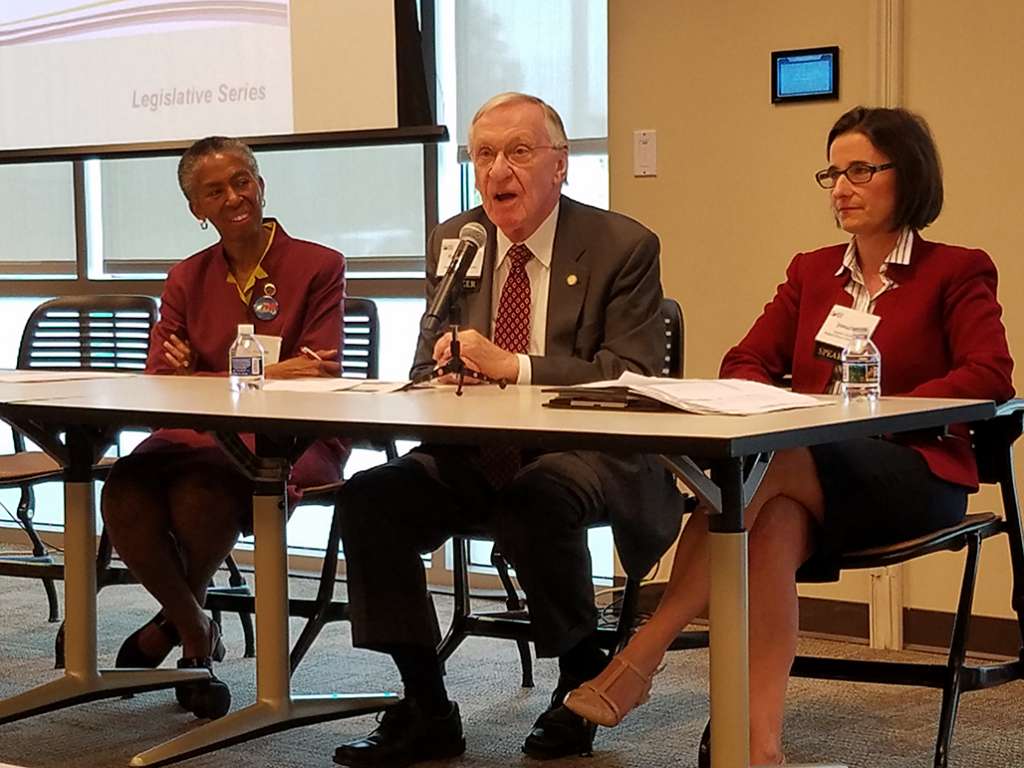
There may be a sense of frustration and concern regarding ongoing construction of Metro’s Silver Line, area elected officials said Thursday, but its great potential must be remembered.
Fairfax County Supervisor Cathy Hudgins and state delegates Ken Plum (D-Fairfax) and Jennifer Boysko (D-Fairfax/Loudoun) talked about Metro and the surrounding future development during a legislative panel discussion sponsored by the Greater Reston Chamber of Commerce and hosted by Dominion Virginia Power in Herndon. Plum, the former state chair of the Dulles Corridor Rail Association, said it is important to put the status of Metro’s Silver Line in perspective.
“We really ought to stop for a moment and celebrate where we are,” Plum said. “For 25 years of my life I worked on that project, and it was announced to be dead half a dozen times, at least. … Now, by 2020, we’re going to have it all the way out into Loudoun County. And we have an incredible opportunity with that.”
A large amount of development has happened or is in the works in the area of the Wiehle-Reston East Metro station, the current western terminus of the Silver Line. Other projects are also springing up near the line’s future stations in Fairfax and Loudoun counties.
The Metro Washington Airport Authority’s Dulles Corridor Metrorail Project, which is overseeing construction, announced recently that Phase 2 work to extend Metro through Reston into Dulles Airport and onward to Ashburn is more than 56 percent complete. However, deficiencies in Metro’s budget and decreasing ridership have raised a number of questions in recent months about the future viability of the transit system.
Boysko, whose district includes Herndon, praised the state’s creation of the Metrorail Safety Commission to examine how Metro is being organized and managed. She said as Phase 2 of the project continues, it is imperative that safety issues as well as financial and operational performance are properly monitored and addressed.
“People say this is the least functional transit system in the country,” she said. “We have such a great opportunity as we are expanding into Phase 2, [but] it has to be a success. We have really focused our economic development around Phase 2 being successful.”
Hudgins, who is also a member of Metro’s Board of Directors, said this is a conversation she “live[s] every day.” She said Metro is unique in many ways, most notably in its partnership between multiple jurisdictions as well as in its infrastructure itself.
“I think people need to understand, it is a different kind of railroad,” she said. “That system is one of the most difficult systems [to maintain] of all those in the country.”
Plum said Metro needs to be revitalized, and in order for that to happen, it needs to continue to receive the support of the surrounding community.
“Please, don’t wash your hands of Metro,” Plum said. “It’s vital to the economic development of our region and I think we all recognize [that].”
The legislative recap event sponsored by the Greater Reston Chamber of Commerce is a chance for local businesspeople to keep abreast of important issues in the community, said Mark Ingrao, GRCC president and CEO.
“We’re a catalyst for business growth and entrepreneurship in this area of Fairfax County,” he said. “We think that we have the type of programming our members are looking for to connect them with other businesses [and] to educate them on legislative things like this.”
This is a commentary from Del. Ken Plum (D-Fairfax), who represents Reston in Virginia’s House of Delegates. It does not reflect the opinion of Reston Now.
While a governor is the chief executive of a state responsible for seeing that the laws are carried out, the governor plays a crucial role in the legislative process with the requirement that all passed bills must be signed before they become law or not signed and vetoed to keep such bills from becoming law. There is no better example of the significance of the governor’s power to veto laws than in Virginia.
Next week, on Wednesday, April 5, which is the required sixth Wednesday after the adjournment of the regular session of the General Assembly, the Constitution requires a reconvened or commonly called “veto session” to consider only vetoes or amendments made by the governor to bills that had been passed in both houses of the General Assembly earlier in the regular session. The requirement for the reconvened session was added to the Constitution in 1981 because without it, the governor was able to veto bills after legislators went home without any opportunity for them to override the veto.
With the fast pace of nearly a thousand bills being passed in a session of 45 to 60 days, the reconvened session provides an opportunity for the governor to send down amendments that are found to be needed that might clarify or correct language in bills.
Most importantly, a governor can play a role in the legislative process by vetoing some really bad bills that may have narrowly passed the legislature but are not in the best interest of the state. Gov. Terry McAuliffe has used his veto pen very effectively in vetoing bills that respond to special interests but do not serve the public good of the Commonwealth. By the end of the reconvened session next week he will have set a record of vetoing more than 90 bills without legislators being able to get a two-thirds vote in both houses for the bills to become law without his signature. I am especially pleased that he has never vetoed a bill that I had not already voted against in the regular session.
As in previous years, he has vetoed bills that would legalize discrimination against LGBT citizens. He has regularly vetoed bills similar to HB2 in North Carolina, which has brought such bad publicity to that state for upholding discrimination and that resulted in the state losing businesses and major sports events. Without Gov. McAuliffe’s courageous veto, Virginia would be in the same category of discrimination as North Carolina.
Gov. McAuliffe has once again vetoed a bill that would deny public funding to Planned Parenthood, which provides critically important health services to women over an ideological dispute as to who should make reproductive health decisions for women. He is again vetoing a series of bills that would make guns and switch-blades more accessible to persons in emergency shelters including children. He vetoed a bill that would have expanded eligibility for concealed handgun permits.
What a difference Gov. Terry McAuliffe has made with his veto pen in keeping some really bad bills from becoming law.
