

The Fairfax County Board of Supervisors has endorsed county efforts to expand food scrap drop-offs to more farmers markets and evaluate a possible curbside collection pilot program.
Such collection opportunities would mark a step toward the county’s ambitious goal of making schools and government operations zero waste by 2030 and carbon neutral by 2040.
The board asked the Department of Public Works and Environmental Services last summer to research and report options for bringing an internal compost pilot — an employee-led food scrap recycling program called the Fairfax Employees for Environmental Excellence — to the public.
Fairfax County Director of Engineering and Environment Compliance Eric Forbes told the board during its environmental committee meeting yesterday (Tuesday) that DPWES has “a number of pilot programs” and the county “has been discussing working toward organics diversion for quite a while.”
Food scraps, which can be composted and converted into nutrient-dense soil, make up 30% of what gets thrown away in the county. Diverting this potential resource represents “the next rung on the ladder for our community,” Forbes said.
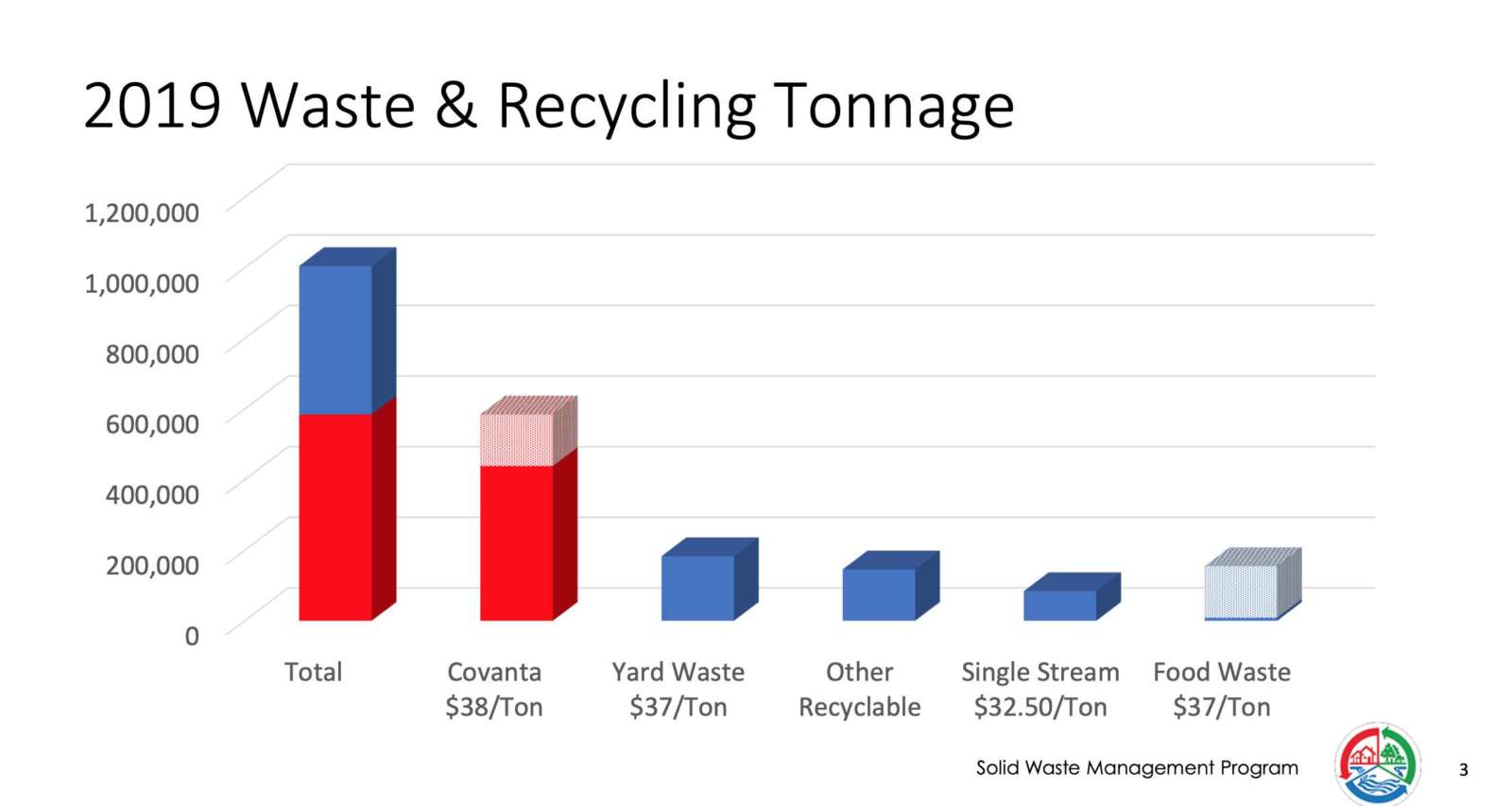
The county unveiled composting drop-off sites at the I-95 Landfill Complex & I-66 Transfer Station in November. He said these sites have rescued about 4,500 pounds of food scraps so far. People can also bring food scraps to farmers’ markets or hire one of four vendors in the county that offer curbside organics collection services.
In the near future, the county is looking to expand collection opportunities at farmers’ markets run by the Fairfax County Park Authority, FRESHFARM, and Central Farm Markets. These three organizations have expressed interested in working with the county, according to Forbes.
The county is also mulling over a curbside collection program, which would let residents mingle food scraps and yard waste in their green bins. Through an inter-county agreement, the food scraps could be taken to a facility in Prince William County.
“I like the idea of regional players taking the responsibility,” Mount Vernon District Supervisor Dan Storck said. “I appreciate Prince William stepping up to build their own food scrap recycling.”
Still, Braddock District Supervisor James R. Walkinshaw told Forbes the county should “aggressively” promote backyard composting. He said doing so is especially important if the county finds that a curbside collection program would increase emissions.
“I want to make sure we do that analysis before moving forward with expansion of curbside,” he said.
Likewise, Board of Supervisors Chairman Jeffrey McKay said he appreciates the pilot programs and partnerships, but there needs to be more communication with the “average Joe homeowner.”
Forbes said his staff is looking to purchase electric vehicles for trash collection. As for educational opportunities, he said the county publishes lots of educational material and presents ways to eliminate food waste at homeowners’ association meetings.
Providence District Supervisor Dalia Palchik encouraged the county to look for year-round and seasonal farmers’ markets near apartment buildings.
“I want to make sure we are looking at equity through this issue,” she said. “Families will be happy to participate as long as we look at some of the barriers that exist.”
Photo via Seth Cottle on Unsplash
Fairfax County has made progress in its efforts to vaccinate priority groups for COVID-19, but challenges remain as officials contend with still-limited supplies while attempting to improve communications and outreach, particularly to minority and disadvantaged communities.
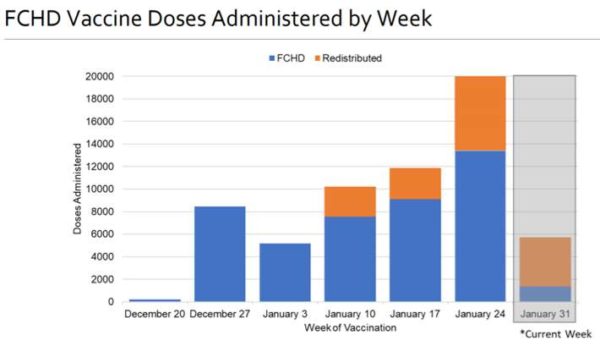
According to a presentation delivered to the Fairfax County Board of Supervisors Tuesday morning, 53,731 of the 58,825 first doses that the Fairfax County Health Department has received since late December have been administered by either the health department or its partners, which include Emergency Medical Services, the Fairfax County Adult Detention Center, pharmacies, and other healthcare providers.
The county health department has also received 25,800 second doses of the Moderna vaccine. 7,875 of those doses have been administered.
With its weekly allocation from Virginia currently limited to 13,600 doses, Fairfax County has scaled back the number of available vaccination sites. The health department is now only providing first doses at the county government center, reserving local health district offices for second doses.
However, the county has also started working with more partners over the past week, including Kaiser, the first private healthcare provider to get the COVID-19 vaccine, and George Mason University’s Mason and Partners (MAP) clinics.
Fairfax County Health Director Dr. Gloria Addo-Ayensu says partnerships like those will be critical to getting the vaccine to more people in Fairfax County, since not everyone can easily travel to the Fairfax County Government Center and other established vaccination sites.
“The ideal thing would be for us to be able to engage clinicians, private providers when we have sufficient vaccine,” Addo-Ayensu said. “…We do know for sure that more vaccine is coming our way, but we just don’t have dates and timelines. All we’re doing right now is building that capacity by engaging with our partners.”
While acknowledging that supply constraints remain the biggest challenge facing the county’s vaccine program, several supervisors shared frustrations that they have heard from constituents who have registered for a vaccination but have no clear sense of when it will actually be their turn to get an appointment. Read More
Fairfax County’s Zoning Ordinance Modernization Project (zMOD) remains a point of discussion among members of Reston’s community as the heft project moves forward.
The project, which was launched in 2017, is aimed at modernizing the county’s zoning ordinance that was established in 1978. It has been the subject of debate in recent months, but the project’s progress was authorized by the Fairfax County Board of Directors on Dec. 1 to be advertised for public hearings.
The board’s decision to move forward with the project in December was billed as an opportunity to “provide sufficient time to advertise” today’s 7:30 p.m. planning commission public hearing on zMOD and a public hearing with the county’s board of supervisors on March 9.
While the project has moved forward, it has come under scrutiny by various community members and organizations.
The Reston Association (RA) issued a letter to Hunter Mill district Supervisor Walter Alcorn in November wherein RA President Julie Bitzer outlined a number of concerns regarding zMOD. In Bitzer’s letter on behalf of RA, the listed concerns outlined issue with proposed changes for accessory living units (ALU), home-based businesses, parking, and traffic.
RA and Reston Citizens Association (RCA) have discussed those initial concerns and more over the last week. Each organization has taken umbrage with the zMOD proposal to remove a 55-and-over age requirement for ALUs due to a belief that the change will create a strain on the local infrastructure and population density.
Both organizations also have opposed proposed changes to home-based businesses due to concerns about traffic congestion and losing the character of single-family residential neighborhoods.
RCA adopted a set of resolutions to outline community concerns with the latest zMOD draft on Jan. 21 while RA held a special Board of Directors meeting to discuss a resolution on the project to be presented to the county. RCA offered a measure of support in its resolutions to defer a detailed review of these points for future study.
“RCA has carefully followed the progress of the county staff’s proposals in the zMOD project,” Reston Citizens Association president Dennis Hays said in a release. “We believe the staff has gone far beyond the intended purpose of zMOD, proposing far-reaching changes with little to no consideration as to the impact such changes would have on established communities.”
Among the primary concerns that RA and RCA have raised is the amount of time to suitably address the zMOD changes as a whole when there is not a sufficient redline version or chart to identify potential changes in the zoning ordinance. The current executive summary of the zMOD project was released Nov. 24 is 741 pages.
“Our goal is to slow this down and give us a bit more time to participate and drill down into some of the details,” Bitzer said during RA’s Board of Directors meeting.
Image courtesy Fairfax County
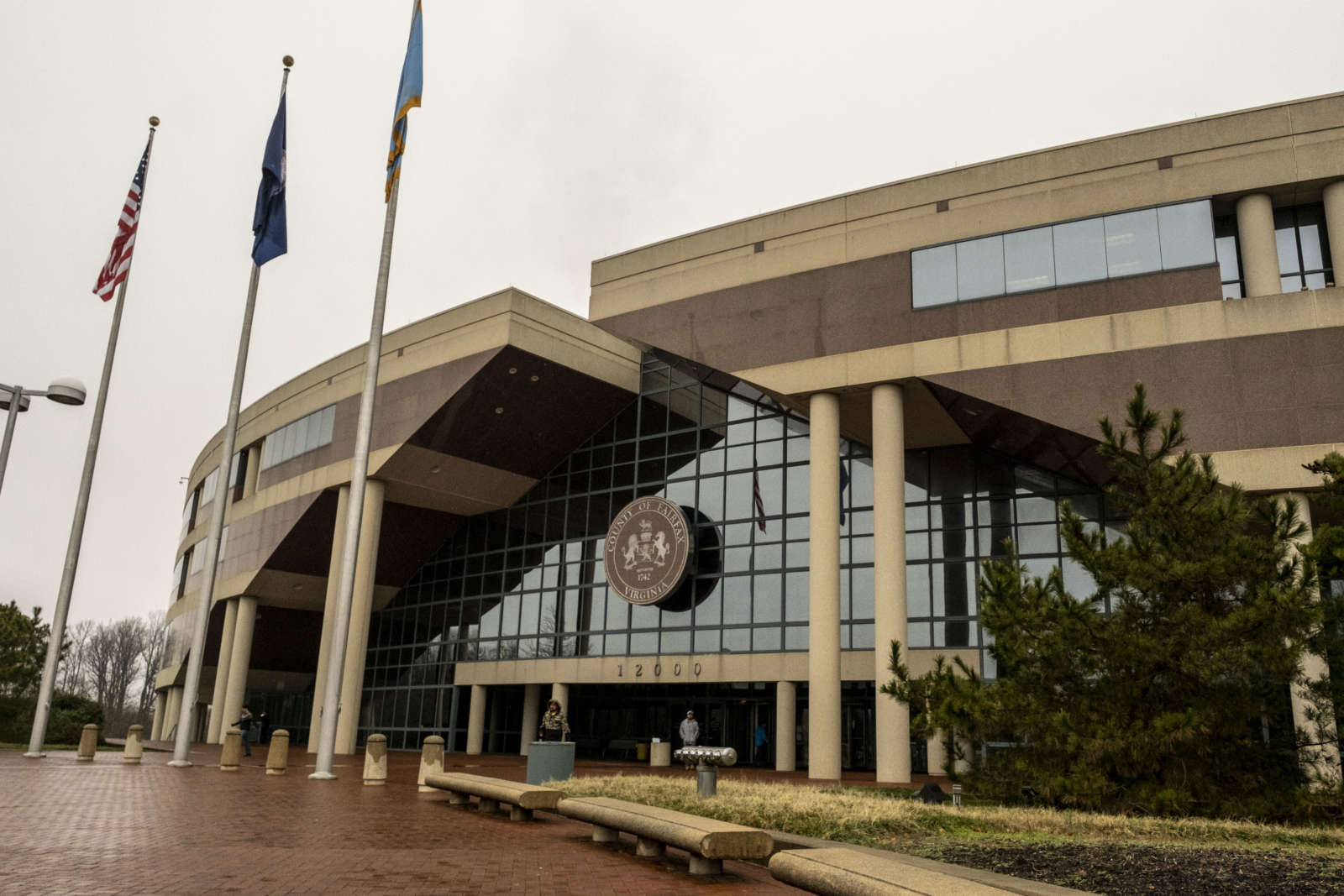
Fairfax County employees are now prohibited from providing information about a person’s immigration or citizenship status to federal immigration authorities unless required by law or court order.
The Fairfax County Board of Supervisors voted 9-1 to adopt the new Public Trust and Confidentiality Policy yesterday (Tuesday) as part of a board matter introduced by Chairman Jeff McKay, Dranesville District Supervisor John Foust, and Providence District Supervisor Dalia Palchik.
While Fairfax County has long maintained that it does not assist Immigration and Customs Enforcement (ICE) unless mandated, McKay, Foust, and Palchik say the need to turn those guidelines into a formal policy has been heightened the COVID-19 pandemic, which has disproportionately affected local Latino communities in particular.
“While there are no known instances of General County employees voluntarily sharing information about a resident’s immigration status, such policies are no doubt critical steps forward in building community trust and transparency,” the board matter said. “They also help quell fear in our community and ensure everyone feels comfortable getting the assistance they need from local government.”
The immigrant rights groups ACLU People Power Fairfax and CASA hailed the trust policy as “a major victory” after a four-year campaign urging Fairfax County to bar agencies from voluntarily disclosing information to ICE.
Advocates have argued that information-sharing with ICE can undermine public safety, as fear of detention or deportation discourages immigrants from reporting crimes, seeking medical attention, going to school, accessing basic needs assistance, and utilizing other critical local government services.
CASA says Fairfax County’s new policy is the first of its kind in Virginia.
“For four years, we have marched, spoken out and stood up for our rights as immigrants, and now we can finally breathe easier,” Luis Aguilar, CASA’s Virginia state director, said. “We are grateful for the leadership of Chairman McKay and Fairfax County Board of Supervisors, who stood strongly in support of immigrant families by voting through this critical county policy change.”
The Board of Supervisors directed staff to draft the new policy last year. McKay credits ACLU People Power Fairfax and CASA with helping develop the policy.
According to the board matter, the trust policy is intended to complement a Fairfax County Police Department general order that established more robust guidelines regarding the FCPD’s role in civil immigration cases and interactions with immigrants.
Implemented on May 6, the general order expanded on an existing directive that instructed officers against taking individuals into custody or reporting them to ICE solely on the basis of an outstanding civil administrative warrant.
Under the new trust policy, Fairfax County employees are now prohibited from:
- Disclosing personal identifying information about individuals, such as their citizenship or immigration status, unless required by law or the individual has given their permission
- Providing access to county facilities, records, or funds not accessible to the public unless mandated by law, court order, or a criminal warrant
- Using county resources to provide information to federal immigration enforcement officials
- Threatening, coercing, or intimidating individuals based on their actual or perceived citizenship or immigration status
- Participating in civil immigration enforcement operations
The policy also directs county agencies to accept driver’s licenses, passports, and other photo documents issued by a state or foreign government or an approved nonprofit as sufficient to verify an individual’s identity or address.
“The Trust Policy breaks new ground in Virginia by prohibiting voluntary cooperation with ICE,” ACLU People Power Fairfax Lead Advocate Diane Burkley Alejandro said. “…ICE has exploited the weaknesses of Virginia privacy laws to obtain contact information to track down its ‘targets.’ Thanks to Chairman McKay and the Board, Fairfax now has guardrails in place to prevent this happening here.”
Staff photo by Jay Westcott

David Rohrer, deputy county executive for public safety, will take over as interim police chief for the Fairfax County Police Chief on Feb. 1.
The appointment was made by the Fairfax County Board of Supervisors at a meeting yesterday as Edwin Roessler, the current police chief, retires next month.
It isn’t the first time Rohrer has worked for FCPD. From July 2004 to October 2012, Rohrer was appointed as the first-ever deputy county executive for public safety. He jumpstarted his career in 1980 as a patrol officer in Fairfax County. During his 32-year tenure, he worked his way up to several ranks of the department as captain, major and deputy police chief.
In a statement, Fairfax County Executive Bryan Hill said he expects the transition to be “seamless.“
“I work closely with Deputy County Executive Rohrer on a daily basis and I could not be more confident in his ability to see the Police Department through this period while we search for a new chief,” he said.
Rohrer currently. oversees the Police and Fire and Rescue Departments, the Department of Public Safety Communications, the Office of Emergency Management, the Department of Animal Sheltering and the McConnell Public Safety and Transportation Operations Center.
Meanwhile, a nationwide search is underway to select the next new police chief. The county is working with POLIHIRE to conduct the search. A community survey to identify key skills, characteristics, and traits for the new hire is open through Saturday.
Photo via Fairfax County Government

With only a week left until President-elect Joe Biden’s inauguration, Fairfax Connector announced that two bus routes will stop operating today (Wednesday) through Jan. 20 due to planned road closures in Washington, D.C.
Route 699, which normally travels between the Fairfax County Government Center and downtown D.C., will instead serve as a free shuttle to transport riders from the government center park and ride to the south entrance of the Vienna Metro station.
“The shuttles will leave the government center at the time on the schedule,” Fairfax Connector said in a tweet. “The shuttles will leave Vienna about 45 mins after their DC departure time with the goal of getting riders back to the P&R lot near their regularly scheduled arrival time.”
Fairfax Connector suggests Routes 631, 632, and 634 as travel alternatives for passengers on Route 697, which goes from the Stringfellow Road Park and Ride in Centreville to D Street SW in D.C. Routes 631, 632, and 634 all stop at the Stringfellow Park and Ride and the Vienna Metro station.
⚠️ Due to road closures for Inauguration, Route 697 will not operate into DC starting immediately through Wednesday, Jan. 20, 2021. Passengers should use shuttle between Stringfellow P&R and Vienna Metro South. Use alternative Routes 631, 632, & 634. Thanks for your patience.
— Fairfax Connector (@ffxconnector) January 13, 2021
⚠️ Due to road closures, Route 699 will not operate into DC starting immediately through Wednesday, January 20, 2021. Route 699 will shuttle passengers (free of charge) between Government Center Park & Ride and Vienna Metro South. Thanks for your patience.
— Fairfax Connector (@ffxconnector) January 13, 2021
Fears that the violence that embroiled the U.S. Capitol last week could return during the lead-up to Inauguration Day have put the D.C. region on edge, prompting thousands of National Guard troops and federal, state, and local law enforcement officers to mobilize for the National Special Security Event.
Fairfax County Board of Supervisors Chairman Jeff McKay joined other local and state public officials in warning community members against traveling to downtown D.C. on the day of the inauguration and the days preceding it.
“Sadly, the terror that occurred at the U.S. Capitol on January 6, 2021, was not a contained or isolated incident, and there is continued concern that similar violence is an ongoing threat to Americans and our democracy,” McKay said in a statement today.
The chairman says that the Fairfax County Police Department has been in contact with D.C. police about “the evolving situation” and has increased its presence in “key areas” of the county.
McKay advises residents to stay home if possible, avoid downtown D.C., and report any suspicious activity to police at 9-1-1 or the FCPD’s non-emergency line at 703-691-2131.
“Fairfax County will do all we can to help our partners in the region ensure a peaceful and safe transition of power on January 20, 2021 because that is the will of Fairfax County residents and the majority of Americans across the country,” McKay said.
Photo via Fairfax Connector/Facebook
Updated at 11:45 — The fatality and crash numbers in this article from the DMV reflect statistics for Northern Virginia, not just Fairfax County as previously stated. The Fairfax County Police Department says that the county’s fatality and crash rates are much lower.
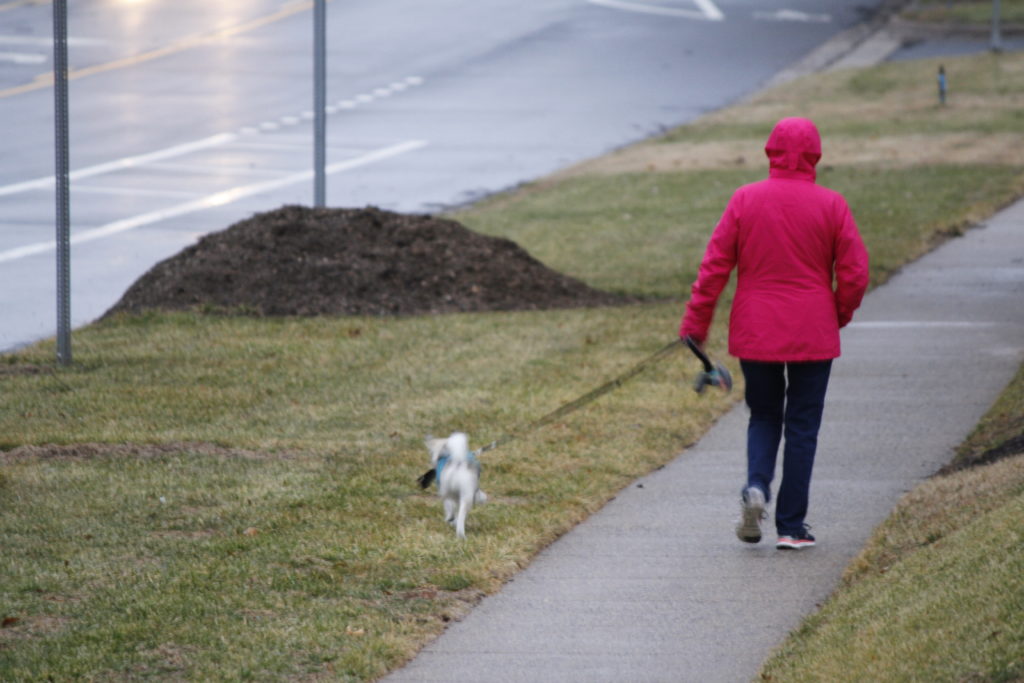
With 38 pedestrian fatalities, 2019 was the deadliest year in the last decade to walk in Northern Virginia, according to Virginia DMV data.
The number of deaths dropped to 29 in 2020, but the Fairfax County Board of Supervisors and county transportation officials are still working on strategies to improve pedestrian and bicyclist safety with a countywide initiative.
“Unfortunately our incidents of pedestrian fatalities and crashes continue to be at unacceptable levels,” FCDOT bicycle and pedestrian program manager Chris Wells said during a transportation committee meeting yesterday (Tuesday). “Due to a number of factors, those numbers are trending up — not just in Fairfax, but in Virginia and across the United States.”
Bicycling is safer, but crash rates are still high: 216 crashes in 2019, and 157 in 2020.

Wells added that certain portions of Fairfax County’s population are disproportionately affected by pedestrian crashes, a trend that has been documented nationwide.
The county hopes to reverse these statistics. Wells told supervisors that FCDOT and VDOT have recently improved walking and cycling conditions by programming head starts into signals for pedestrians, re-striping four-lane roads as two-lane roads, and installing rapid-flashing beacons for crosswalks without lights.
VDOT awarded FCDOT $1.2 million last year to install nine more flashing beacons, bringing the county’s total to 17, Wells said.
VDOT also has a pedestrian safety action plan for improving safety along particularly dangerous corridors. In Fairfax County, the highest-priority roads are Columbia Pike, Little River Turnpike, Richmond Highway, Lee Highway, Lee-Jackson Memorial Highway, Braddock Road, and Ox Road.
Officials said that work on roads in Fairfax County is a lengthy process compared to other jurisdictions, because VDOT owns the roads.
“They’ve really stepped up this year to help us to advance pedestrian safety in a way that we have not seen in years past,” FCDOT Director Tom Biesiadny said.
Looking ahead, supervisors suggested introducing better lighting and longer crossing times at mid-block crosswalks. They are also still interested in reducing speeds in the county.
FCDOT officials said a multiagency group, including transportation officials and attorneys, is working through the logistics of speed cameras. Meanwhile, VDOT is preparing to examine where speed limits can be lowered.
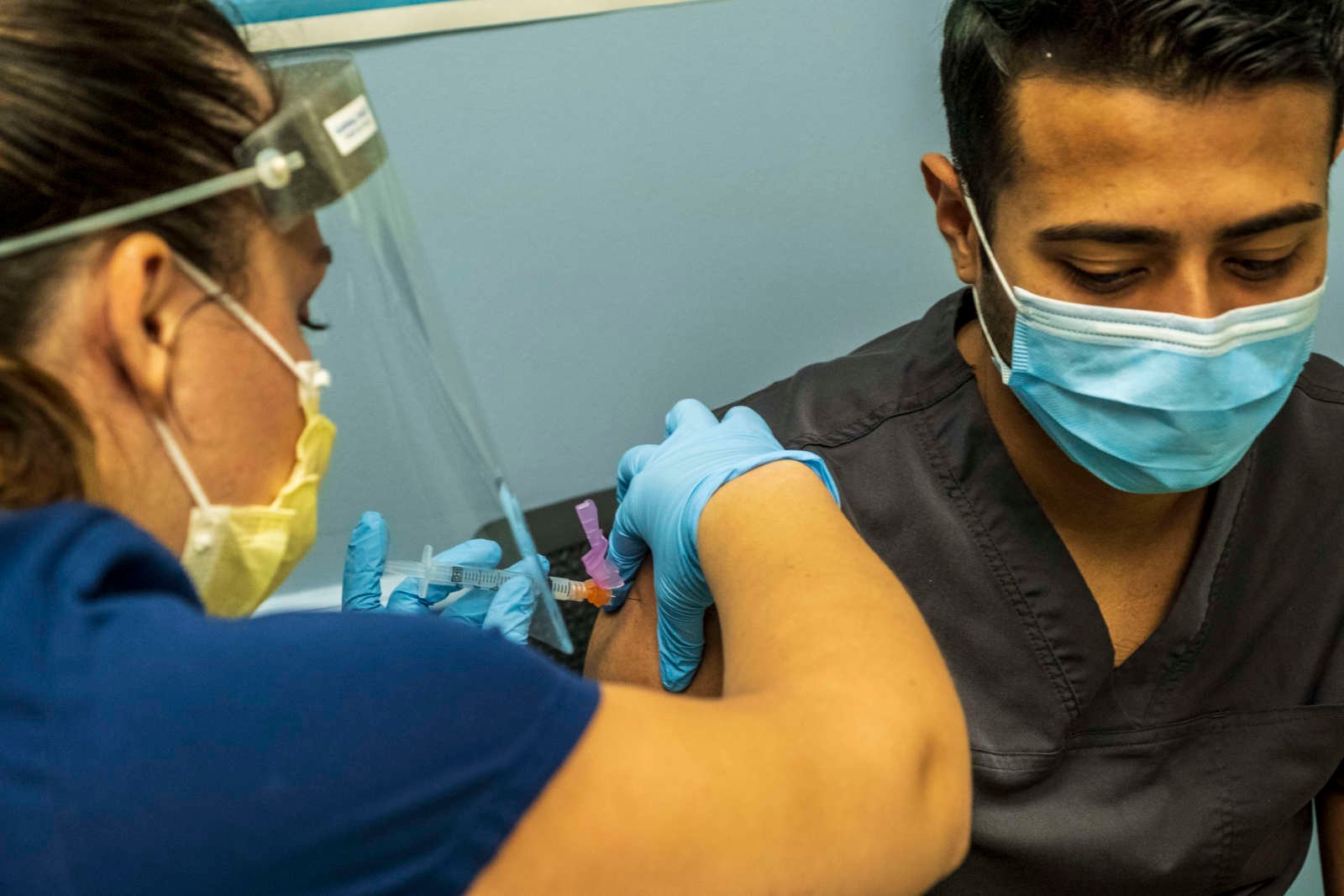
Following a flood of demand yesterday, Fairfax County plans to launch a new online vaccine registration system as early as tomorrow that will allow residents to schedule an appointment according to the county’s Information Technology Department.
On Friday, Gov. Ralph Northam announced that the Fairfax Health District is one of several districts in the state to jumpstart the next phase of vaccinations — phase 1b. The first priority group in this phase is adults age 75 and older, followed by priority groups like police and grocery store workers.
The new system, which is currently under development, follows a pre-registration tool that was launched by the county on Monday after overwhelming demand for scheduling jammed county phone lines and flooded the overall system. The pre-registration form, which is currently open, includes pre-screening questions and was launched earlier than originally anticipated in order to shift demand from the county’s phone line to the online system. Pre-registered residents will likely be contacted via email by the county to complete the registration process.
At an IT committee meeting today, some members of the Fairfax County Board of Supervisors were dismayed by the initial rollout of the registration system and phone line. Overall, the county received nearly 1.2 million calls on its vaccine hotline yesterday. Within the first hour that the phone line went up, the system was jammed.
Jeff McKay, the board’s chairman, said that he was concerned the board did not receive information about the issues facing the county until around 6 p.m. yesterday.
“I know it is disappointing that we weren’t better prepared for this,” McKay said. “I will say that we need to be a lot quicker.”
He also noted that residents should be aware that phase 1b is not a first-come, first-serve system. Frontline essential workers will be vaccinated in a pre-determined order, with police, fire and hazmat workers on the top of the list.
The county is testing out the new system today in cooperation with the Fairfax County Health Department, according to Gregory Scott, director of the county’s Department of Information Technology.
His office also plans to implement a virtual system with automated chatbots and work with external vendors to help manage call volume. The county also routed some calls to a voice message that said to call back later due to busy phone lines.
“Everybody was in this predicament yesterday morning,” Scott said.
Staff noted that additional manpower may be needed to manage call volume and respond to registration forms to sort out missing or conflicting information.
For example, more than 286,000 voicemails were left on the county’s vaccination line yesterday alone. So far, the county hopes to automate as much of the registration process — including administration of the vaccine’s second dose — as much as possible.
Residents will likely receive an email about registering for the second dose, according to the county’s health department.
Hunter Mill District Supervisor Walter Alcorn, who chairs the IT committee, also encouraged the county to ensure the registration form is friendly for seniors. The first version of the preregistration form sent yesterday made providing a cell phone a required field, for example.
The new registration form is expected to be available as early as tomorrow, pending final testing and revisions.
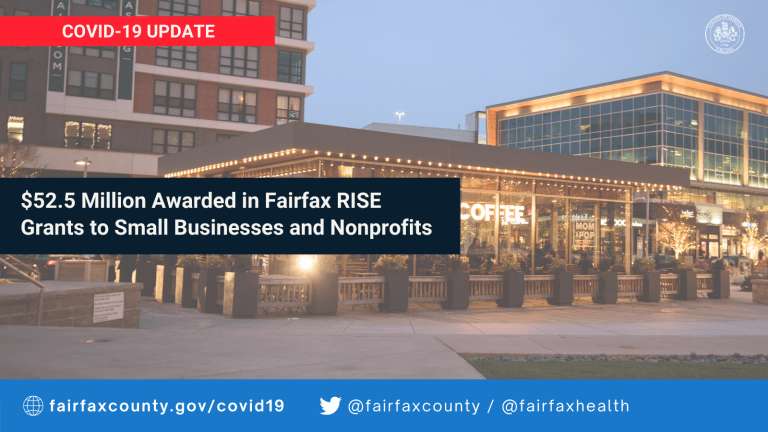
Fairfax County’s relief fund for small businesses and nonprofits affected by the COVID-19 pandemic has come to an end, the county announced on Dec. 11.
Established by the Fairfax County Board of Supervisors in May, the Fairfax Relief Initiative to Support Employers (RISE) assisted 4,809 local businesses and nonprofits by awarding $52.57 million in grants.
According to the county, RISE received 6,280 total requests for aid during the application period from June 8 through June 15. 95% of the grants went to local businesses, while the remaining 5% supported nonprofits.
More than 72% of the grant recipients identified as organizations owned by women, minorities, and/or veterans. That surpasses the county’s goal of allocating at least one-third of the available funds to businesses owned by those historically disadvantaged groups, which account for a third of the jobs in Fairfax County.
The Board of Supervisors praised the county staff and employees of the nonprofit Community Business Partnership who ran the program during an Economic Initiatives Committee meeting on Nov. 10.
“I think each of us have heard from recipients what a difference this has made,” Board of Supervisors Chairman Jeff McKay said. “We’ll be paying close attention to what we hope will be future federal stimulus that will help us do even more going forward. 4,800-plus businesses is not insignificant.”
Fairfax County created RISE using money that it had been allocated by the federal CARES Act. As of November, the county had received $340.5 million in federal aid, including $200.2 million from the CARES Act Coronavirus Relief Fund, whose eligibility period ends on Dec. 30.
RISE grant funds were intended to assist with wages, rent, employee health insurance, and other fixed operating costs critical to keeping businesses alive.
Recipients needed to have a principal place of business located in Fairfax County, including the Towns of Vienna, Herndon, and Clifton, and no more than 50 full-time employees in order to be eligible for the program.
Almost 40% of the grants went to businesses in the accommodation and food services, healthcare and social assistance, and professional services sectors. 8% of recipients were in retail trade, which joins food services and hospitality as industries hit especially hard by job losses and the pandemic’s other economic impacts.
More information about RISE and the grant recipients can be found on Fairfax County’s website and its RISE dashboard.
Image via Fairfax County government
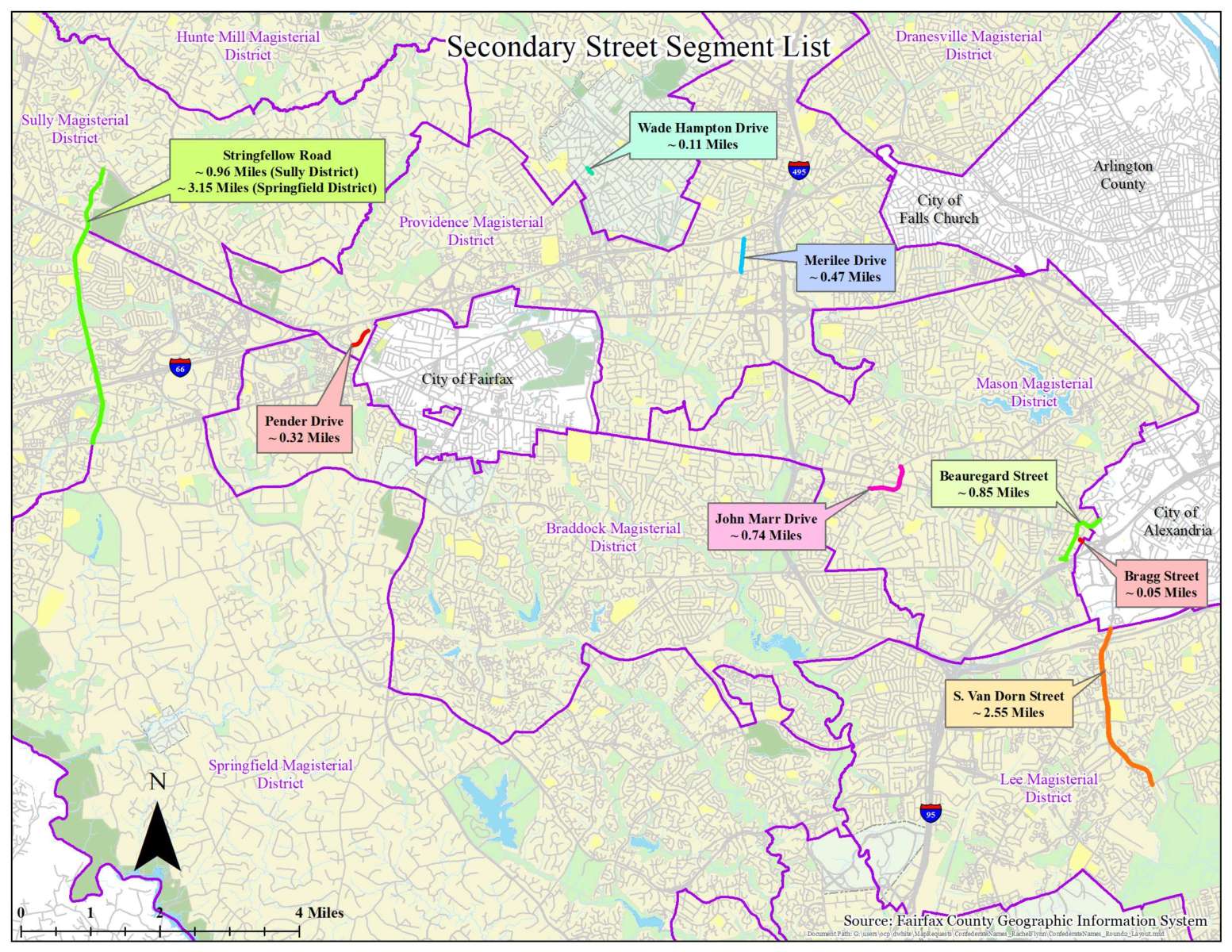
The Fairfax County Board of Supervisors met with the Fairfax County History Commission on Tuesday to discuss Confederate associated street and place names across the county.
This project began after the June 23 and July 7 board meetings, where the commission set out to create an inventory of Confederate places and structures within the county following the Black Lives Matter movement and the death of George Floyd.
After identifying more than 26,000 streets and places in a report, the board narrowed the focus list to 650 well-known Confederate Officers and locally-known Confederates. After researching those names, the Commission found 150 assets to have confirmed Confederate associated names, according to the presentation by Anne Stuntz, the chairwoman of the History Commission.
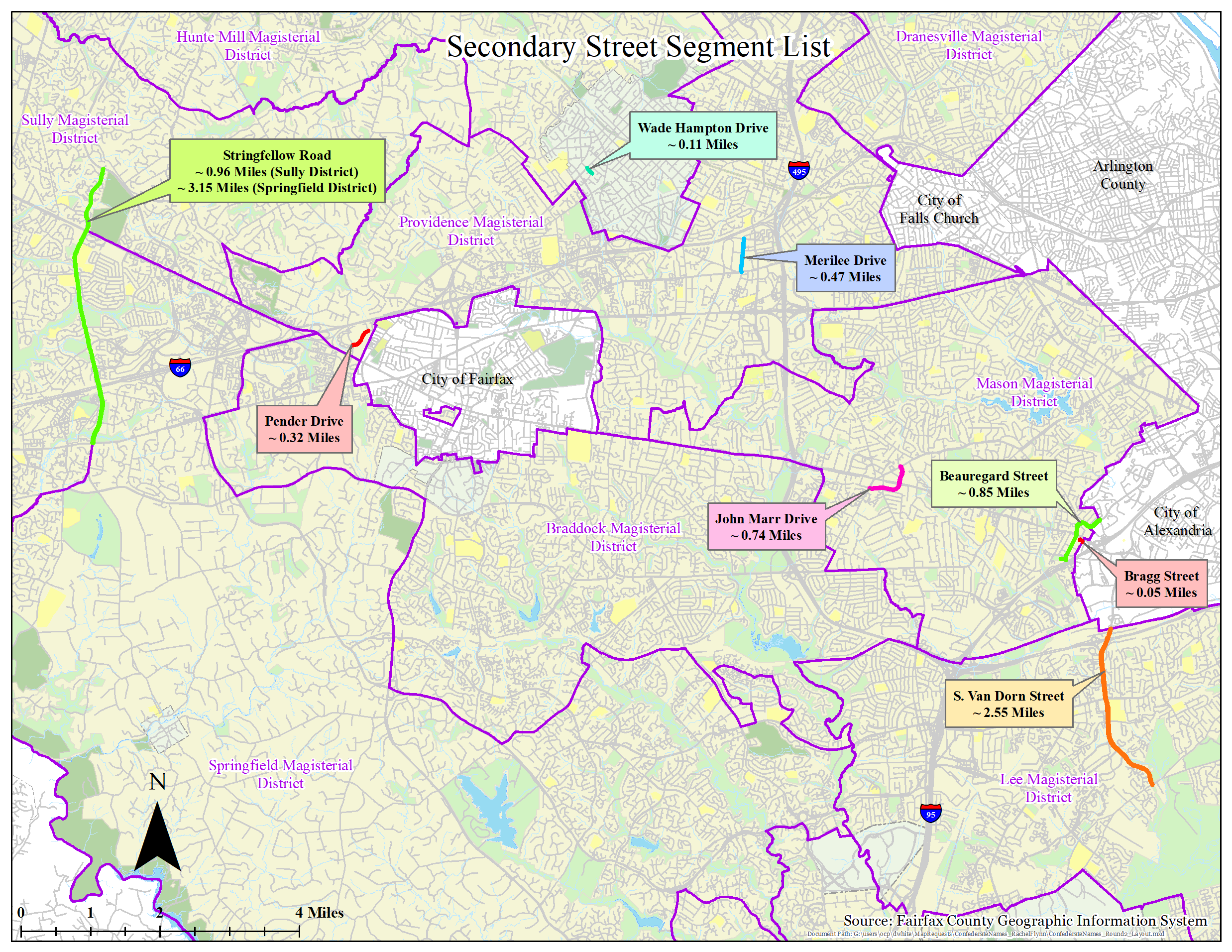
Names identified in the Hunter Mill District include the Lee Manor Subdivision, Fort Lee Street, Mosby’s Landing Condominium Complex, and Wade Hampton Drive.
The commission recommended that the Board of Supervisors create a public dialogue regarding the issue through public meetings and community gatherings, and follow those discussions with deliberation and definitive action on the Confederate names. The Commission also recommended that all project research is archived in the Virginia Room in the City of Fairfax Regional Library because of the extensive project research.
Tom Biesiadney, director of Fairfax County’s Department of Transportation, discussed the process of petitioning the Commonwealth Transportation Board to change the name of Lee Highway and Lee-Jackson Memorial Highway. The commonwealth says there needs to be public input, as well as a request from the Board of Supervisors to change the name.
The Commission created a 2021 initiative in response to the Confederate listing, aiming to develop an inventory of research materials on African American communities in Fairfax County in collaboration with African American organizations including churches, social and community groups.
The Commission is using a model identified by the city of Alexandria. Additionally, this summer, the City of Fairfax developed a framework process for identifying Confederate-associated names throughout this city and is partnering with George Mason University to provide community learning sessions on the issue, according to the presentation.
The board shared their appreciation for the extensive and intricate research by the History Commission. Additionally, Board members mostly agreed that the first priority should be the renaming of the highways, and from there, move forward with a community. process for renaming the secondary and neighborhood streets.
One concern came from Lee District Supervisor Rodney Lusk regarding the history of the district’s name.
“I was hoping that there’d be something more definitive about Lee District, in terms of where its name originated, but it appears that we still have the same set of ambiguity,” said Lusk. “We will have to have a community conversation about this name of this district.”
Additionally, Springfield District Supervisor Pat Herrity expressed concern in rushing into the name change process in the midst of the pandemic and emphasized the need for “robust community participation” before moving forward.
Image via the Fairfax County History Commission
 Hunter Mill District Supervisor Walter Alcorn has experienced some unexpected challenges during his first year on the Fairfax County Board of Supervisors. But he says he has striven to meet each challenge by abiding by the chief principles he ran his election campaign on: community engagement and transparency.
In a recent interview with Reston Now, Alcorn said he knows it’s “going to be a tough early 2021” as the area deals with the ongoing COVID-19 pandemic, but he remains hopeful of a productive future.
Among his agenda items is the progression of the community task force analyzing potential changes to the Reston Comprehensive Plan, which guides planning and land use decisions for the area. Alcorn’s agenda includes looking forward to the task force advancing and “wrapping up in 2021.”
“I know saying ‘wrapping up’ is kind of funny right now because we’re really just getting into some of the meatier issues,” Alcorn said Monday. “But I think we will get there and see that happen some point next year. Moving forward with that is definitely a priority.”
Alcorn said the task force represents an opportunity to continue an open dialogue with the public moving forward. Alcorn believes that the task force and county have structured the public meetings as close to having “real face-to-face meetings” to allow opportunities for questions or comments.
His plan for 2021 also includes revisiting efforts of revitalization at Lake Anne and looking at what needs to happen to maintain progress in the area. He is also planning to continue community engagement for the Wiehle Avenue crossing and the construction of a pedestrian and bicycle bridge over the avenue that is planned to begin in the summer of 2022.
He is also looking to move forward with public facilities in Reston Town Center North, including the rebuild of the Reston Regional Library, the Embry Rucker Shelter, plans for a civic space for all of Reston, and additional public facilities in Reston.
Through 2020, the pandemic has created various issues including face-to-face public engagement opportunities and budget issues. A portion of those issues has been the county’s inability to proceed with some of the affordable housing financings that were initially expected this year.
“That’s been a disappointment to me. We’ve had to put off some of the financing, but that doesn’t mean that we aren’t putting off moving forward with plans where we can,” Alcorn said.
Alcorn was able to host a couple of town halls early in the year before the COVID-19 outbreak, and he has been able to host more on virtual platforms. Those virtual town halls have included a meeting with Fairfax County Police Chief Edwin Roessler, as well as a recent meeting to discuss proposed updates to zMOD, the county’s zoning modernization process.
Alcorn listed the size of the change included in zMOD as one of the primary challenges that is being faced. However, through the Hunter Mill district town hall, Alcorn heard a number of comments and suggestions that he says he’s following up on with the county staff.
Proposed changes Alcorn says he’s reviewing include potential changes to the zoning ordinances for accessory living units and concerns that a potential increase could destabilize neighborhoods by exacerbating “localized issues” like parking and other concerns.
“That’s something I’m going to be focusing on more through January, and basically working with different stakeholders, some of the folks who showed up and testified at the town hall, and others,” Alcorn said of the zMOD proposals. “We’ll have another opportunity, one more for sure, over the next few months to try and parse that out a little bit more.”
With an eye on the future, Alcorn can look back on successful enterprises during 2020.
He has seen an encouraging re-engagement with the comprehensive plan in Reston and participation with it. He also touts an increase in transparency and accessibility with the public.
“I think it’s important to bring people together to think about some of these issues a little more broadly and consider them from different perspectives. I think in doing that, it opens up new doors and possibilities for action to move forward.”
Another success for Alcorn is getting design approval for the replacement of the Hunter Mill Bridge, including designs for anticipated future pedestrian improvements in the area.
Alcorn also points to a strengthened relationship with the town of Vienna as a success. As part of the relationship, Alcorn received approval from the county Board of Supervisors for a waiver of all county building and inspection fees applicable to the Vienna Police Facility Construction Project, which saved the town more than $400,000.
Another notable moment for Alcorn came in October, as he did not offer support for the comprehensive plan for the redevelopment of Hidden Creek Country Club based on feedback.
Through a reflection of 2020, Alcorn gives credit for aiding progress in the county and the district to the involvement of the community and its feedback. He particularly expressed his pride in the community stepping up to help others in the area as issues have mounted during the pandemic.
“Some of our needs continue to be very high. We have food insecurity. We have a lot of people that are facing eviction,” Alcorn said. “We’ve really seen a lot of folks step up and be very generous with their time, with their money and their energy to help address some of these real community problems.”
Photo via Walter Alcorn/Facebook

The Fairfax County Office of Environmental and Energy Coordination has proposed a process of drafting a five-cent plastic bag tax ordinance in Tuesday’s Fairfax County Board of Supervisors Environmental Committee meeting.
According to Susan Hafeli, the Deputy Director of OEEC, Fairfax County legislation allows the county to adopt an ordinance imposing a five-cent tax on most disposable plastic bags provided by grocery stores, convenience stores and drugstores.
As of right now, there are no guidelines from the state regarding the creation of a plastic bag ordinance, rather, the state intends to wait until a locality adopts an ordinance to consider guidelines, according to the presentation.
The revenues are to be appropriated for environmental clean-up, mitigation of pollution and litter, education and the provision of reusable bags to recipients of a federal food support program, according to Hafeli.
The proposed plastic bag tax could generate annual aggregate local revenues of between $20.8 to $24.9 million statewide, although, the tax may be more of an “impetus to behavior change rather than a revenue generator,” said Hafeli.
Across the region, the Northern Virginia Regional Commission Waste Management Board has begun exploring the issues laid out in the legislation, according to Hafeli. Additionally, Arlington County is planning to convene a public workgroup in early 2021 to discuss the adoption of a plastic bag tax, with the discussion of issues regarding equity in the county.
OEEC anticipates that action for this process will occur in two phases. The first phase will focus on public engagement, from developing an informative website, to holding one or more workshops for input, to releasing an electronic survey.
The second phase will focus on the development of the ordinance, including updating the webpage with the proposed ordinance and requests for comments, presentations to the Board’s Environmental Committee, and requests to advertise and hold a public hearing, according to Hafeli.
Concerns from several supervisors regarding the ordinance included confusion regarding state guidelines, equity issues within the community, and ensuring there is good research on the issue, especially in the midst of the pandemic.
However, most supervisors agreed that the environmental issue with plastic bags is significant, and that data from other major water sources, including the Anacostia River, has shown a plastic bag tax to have positive environmental effects.
Moving forward, the Board is looking to clarify the state’s policies while working in conjunction with regional partners and plan for further conversation on how to create the ordinance.
The next Environmental Committee Meeting will take place on Tuesday, Feb. 2 at 11 a.m.
Photo by Brian Yurasits/Unsplash

Fairfax County officials are in the early phases of considering the implementation of a five-cent tax on plastic bags.
In March, the Virginia General Assembly passed a state bill that allows municipalities to collect taxes on disposable bags. Gov. Ralph Northam signed the bill on April 10.
Jurisdictions can levy taxes on disposable plastic bags given by grocery stores, convenience stores, and drugstores. Tax revenues are allocated for environmental cleanup, pollution and litter management, providing educational programs to reduce environmental waste, and the funding of reusable bags to recipients of federal food support programs.
The Virginia Department of Taxation estimates the tax could generate between $20.8 million to $24.9 million in annual aggregate local revenues across the state.
A board matter approved by the Fairfax County Board of Supervisors in late July also directs the Office of Environmental and Energy Coordination to create a plan to implement the plastic bag fee next year.
In a Nov. 30 memo to the Fairfax County Board of Supervisors, Fairfax County Executive Bryan Hill said county departments are currently “exploring the issues associated with development and implementation of a plastic bag tax ordinance.” Other jurisdictions like Arlington County have cited concerns about adopting the tax amid a pandemic due to equity-related dissues.
Hill noted that several ambiguities in the state’s ordinance need to be addressed. For example, the ordinance does not explicitly define what constitutes a convenience store and offers scant information on how tax commissioners will enforce the tax and issue penalties for non-compliance.
“At least at this time, there appears to be no mechanism to contest a retailer’s categorization short of a court challenge and sufficient facts to support a locality’s different categorization,” Hill wrote.
The county anticipates launching a public engagement process, including public meetings and an online survey, to gauge input on the move.
If the Board of Supervisors directs staff to create a plastic bag ordinance, county departments would launch a second public engagement process and consult with county entities like the Environmental Quality Advisory Council prior to consideration by the board.
The board will discuss the issue at an Environmental Committee meeting tomorrow (Dec. 8).
Photo by Griffin Wooldridge/Unsplash

Abandoned shopping carts are likely to stay put in Fairfax County.
County staff is recommending against adopting any legislation that would allow the county to remove abandoned shopping carts and charge a maximum $300 fine to the owner.
The Virginia General Assembly enacted legislation this year enabling jurisdictions to adopt stricter legal measures to contain the spread of carts in the area.
If the Fairfax County Board of Supervisors approves the legislation, the county can warn the owner of a cart to remove it after fifteen days. The owner would be charged a fee of up to $300 per cart. If someone is using a cart outside the premises of the cart owner, the county could collect a fine of up to $500.
It’s unclear how pervasive the abandoned shopping cart problem is in the county.
County staff noted the legislation could help reduce the “visual clutter” of unused and neglected shopping carts in the area, especially if they’re in the way of roads and sidewalks.
But county staff noted that it would be incredibly challenging to enforce the legislation and keep shopping carts at bay.
“Enabling legislation falls short of that needed to establish an effective shopping cart ordinance for the county,” according to meeting materials.
Staff suggested that the county consider new legislation that would require businesses to monitor, control, and prevent cart removal.
More outreach and education about the issue, along with the voluntary implementation of an “abandoned cart prevention plan,” was also suggested.
The board’s Land Use Policy Committee is expecting to take up the issue at a Dec. 8 meeting.
Photo via David Clarke/Unsplash
The Fairfax County Board of Directors authorized the advertisement of the Zoning Ordinance Modernization (zMOD) project as recommended by the county’s staff during its meeting Tuesday.
This move will allow sufficient time to advertise the project before a planning commission public hearing on Jan. 28, 2021, and a Board of Supervisors public hearing on March 9, 2021, according to the authorized administrative request.
The zMOD project has been included on the Zoning Ordinance Amendment Work Program since 2016. The goals of the project “are to modernize the county’s zoning ordinance, to make the regulations easier for all stakeholders to understand, and to remove inconsistencies, gaps, and ambiguities” that have been incorporated into the current ordinance since its adoption in 1978, according to an executive summary of the project.
During a Hunter Mill district town hall on Monday, Department of Planning and Development planners Carmen Bishop and Casey Judge provided four reasons behind the update of the zoning ordinance:
- Unintuitive format and structure
- Outdated land uses and regulations
- Legal jargon and antiquated language
- Inconvenient on cellphones, tablets and other devices
The current zoning ordinance encompasses more than 1,200 pages. The project proposal includes streamlining the different regulations to make it user friendly, complete with hyperlinks throughout the document as well as tables and graphics that consolidate information.
The language within the current zoning ordinance may also convert to a “plain English effort,” according to Judge.
Though the board authorized the progression of the project, citizens are asking about the language and stipulations in the latest draft of the project.
On Nov. 25, a letter from Reston Association President Julie Bitzer to Hunter Mill district Supervisor Walter Alcorn listed areas of concern “that directly affect the Association and the larger Reston community.”
Among the areas of concern Bitzer listed is the timing of review and approval of the project. Bitzer raised issue with the “inadequate” amount of time to review and comment on the 741-page draft of the new ordinance before the planning commission hearings in January.
During the town hall Monday, similar concerns were heard about the speed in which the project is moving. Bishop and Judge assured the project has been discussed with people from all Fairfax County districts over the last two years.
During the town hall, which marked the 89th meeting about zMOD in the county, it was also explained that the project has been released in installments for over a year while some adjustments were made based on feedback from community engagement.
However, it was reiterated that the county is willing to continue meeting with the public to address concerns or continue to make adjustments based on feedback.
“We want the community engagement. The project has benefitted so much from the input that we have gotten, and so I don’t want to minimize the impact that citizens have already had on this project,” Bishop said.
“But we’re happy to continue the meetings and to continue to fine tune the document.”
Among the other concerns heard during the town hall and expressed in Bitzer’s letter were adjustments to accessory living units (ALU) and home based businesses.
The concerns specifically revolved around potential parking and traffic issues, and how proposed changes to ALUs and home based businesses may coexist with the rules set by homeowner’s associations (HOA) in the area.
Through the zMOD proposal, Judge assured that the project works to recognize “the residential character of these neighborhoods and making sure we don’t have people coming and going all day long.”
The proposed standards for the home based businesses include limiting each to two customers or clients at a time and six per day. The businesses will still require appointments only, each spaced 15 minutes apart. Each home based business will also be required to designate one parking space.
In Bitzer’s letter, she communicated specific concern about the option to remove the requirement that a person with a disability or a person 55 years or older live on the property to obtain a permit for an ALU. Bitzer expressed a belief that this adjustment may have “drastic unintended consequences,” including increased density and conflicts over parking and access.
During the town hall, it was clarified that dwellings with ALUs will be required to provide one additional off-street parking space for an interior unit approved with an administrative permit in addition to the off-street spaces already designated for the dwelling.
Another proposal stipulates that ALUs must meet health department approval and applicable regulations for building, safety, health and sanitation.
It was also clarified that each HOA will retain its covenants that will take precedent over the county’s regulations.
The final area Bitzer addressed in her letter was a point of support on behalf of the Reston Association for the proposed change requiring “the disclosure and showing of all easements on properties, regardless of easement width, on rezoning and entitlement plans being submitted for review.”
Image courtesy Fairfax County