


County remains among the richest — the U.S. Census Bureau estimates that Fairfax County ranks second as the richest county from 2013 to 2017, following Loudoun County. [U.S. Census Bureau]
It’s snow joke — With snow predictions looming, the Virginia Department of Transportation wants residents to stay safe by looking over its 2018-2019 “snow facts.” [VDOT]
Fine arts photography collection — The “La Lumiere DuBois VII” exhibit by Michael DuBois, who highlights his love of nature, opens today at the Reston Community Center Hunters Woods. The exhibit is open until Jan. 6. [Reston Community Center]
“She Kills Monsters: Young Adventurers Edition” — Watch students from the Herndon High School perform a contemporary dramatic comedy tonight at 7 p.m. Parental guidance is recommended. [Herndon High School Theatre]
Photo by Susan Berger
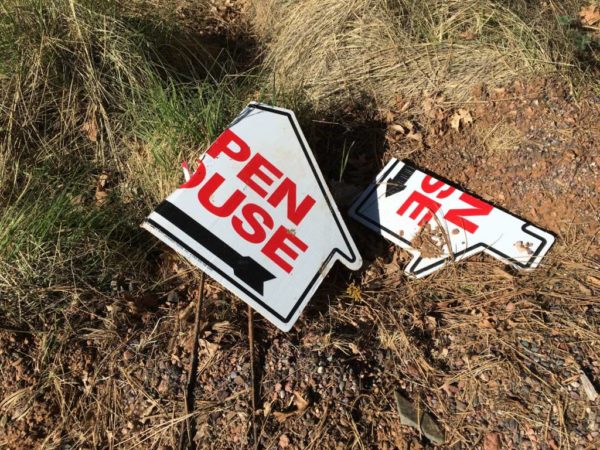
Fairfax County Government is currently mulling over changes to its sign ordinance that has everyone from schools and parks to local realtors concerned.
At a Planning Commission meeting last night (Wednesday), the commission deferred a decision on the new sign regulations until Jan. 16 to allow for more discussion on the impact of the ordinance.
Currently, county staff are reviewing changes to the zoning ordinance to make the language content-neutral. The change is in response to the United States Supreme Court’s 2015 ruling in Reed vs. Town of Gilbert, which ruled that localities that define sign categories based on the message expressed, or content-based, is unconstitutional unless it furthers a compelling governmental interest.
Rather than allow free reign for Fairfax residents of businesses to erect signs regardless of content, a proposed amendment would clamp down on sign regulations across the board.
Changes to the sign ordinance are widespread but often minor corrections. One of the biggest changes is that one freestanding building identification sign is permitted for each detached building and such signs must be limited to identifying the name of the building or the individual enterprises located therein, the address, trademark or identifying symbol of the building occupant.
According to county staff, minor signs (formerly referred to as temporary signs) were the largest challenge in the zoning ordinance rewrite.
“While staff acknowledges that the proposed language could negatively affect some developments that are currently exempt from regulation, we continue to recommend the language found in the draft text as it provides the closest level of regulation as the current provision.”
A representative from real estate investment company Macerich said at the meeting said the company had a laundry list of concerns but has been working with county staff to whittle those issues down. Another local realtor at the meeting said the new ordinance could push the open house signs and corner signs off of local lawns and into the already crowded right-of-way spaces.
The sign ordinance changes sparked concern with the inclusion of language that would remove government exemptions from sign ordinances.
“Staff has received comments from both Fairfax County Public Schools (FCPS) and the Fairfax County Park Authority (FCPA), neither of which is in favor of eliminating the current exemption status. Of particular concern to the Park Authority is the limitation on the size, number and location of minor signs permitted for non-residential uses in a residential district. These signs are used to announce summer concert series, camps and other activities at the parks. The schools have raised concerns with the proposed height of permitted freestanding signs for non-residential uses in residential districts which is proposed to be limited to 8 feet in height.”
As a result, staff said at the Planning Commission meeting that there would be modifications to the ordinance allowing some exceptions for schools and parks.
Planning Commissioner Phillip Niedzielski-Eichner said at the meeting he was generally in favor of holding Fairfax County government accountable to many of the same sign regulations as the public.
“There’s something to be said with us being able to model our behavior consistent with what we expect from the private sector,” said Niedzielski-Eichner. “There is a different benefit to be realized to the public with the park authority and public school [having] latitude with signs, but frankly I’m comfortable with them doing it within a regulatory context… not unfettered.”
Photo via Flickr/Alan Levine

Fairfax County’s Board of Supervisors Chairman Sharon Bulova announced today (Dec. 6) her plans to retire after her term ends Dec. 31, 2019. Her departure adds to the list of supervisors who have also decided to retire.
Supervisors Linda Smyth, for the Providence District, and John Cook, for the Braddock District, recently said that they won’t seek reelection.
Lee District Supervisor Jeff McKay plans to run for the top seat, as well as Springfield District Supervisor Pat Herrity, who faces a Democratic challenger for his district seat, The Washington Post reported. The upcoming election for the county’s Board of Supervisors will take place on Nov. 5, 2019.
Bulova, who hits the 10-year mark in February for leading the board, joined the board in 1988 as the Braddock District Supervisor.
The announcement arrived in her monthly newsletter. In one section, she wrote:
Local government is an awesome place to be. It’s the level of government closest to the people you represent. It’s the place where you can truly make a tangible difference, touch lives, and engage with the community in a personal, positive way. Deciding when to stop is just as hard as making the decision to start down the road of elective office. For me, however, that time has come.
When questioned by Tony Olivo of the Washington Post about my plans for running, I told him I was going to use the Thanksgiving holiday to think about it, and to talk to my family and friends. On Thanksgiving Day my son David arrived for dinner equipped with a large flip chart and colored stickies for voting. He titled the Chart “Family Decision Making Matrix” and separated it into “Pros” and “Cons.” It was a fun, light-hearted after dinner activity. Many of the items listed on the “Pro” side of the chart were some of the reasons that had already persuaded me to not seek another four-year term. More time with family and grandchildren, time for travel, to entertain, to smell the roses. It has been an honor to serve the Fairfax County community on the Board of Supervisors. During these past thirty years, I have been privileged to work alongside dedicated elected officials at every level of government, with talented, caring county staff and a county full of enthusiastic community volunteers. While I will not be running for re-election in 2019 I sure do have a lot to look back on with satisfaction.
Congress members representing Virginia have applauded Bulova’s leadership style and accomplishments.
“As former mayor to a city of 200,000 people, I have enormous respect for Sharon Bulova’s leadership of a county of 1.1 million,” Sen. Tim Kaine (D-Va.) said in a statement. “Over the past 30 years, Fairfax County’s population has grown by nearly half, and Sharon’s service during that time has played a major role in ensuring the prosperity and quality of life accompanying that growth.”
 U.S. Rep. Gerry Connolly (D-Va.), who was the chairman before Bulova, said in a statement that Bulova “is a true community treasure,” whose time on the board will be remembered for decency and commitment to improving Fairfax County.
“Under her leadership, she turned the idea of the Virginia Railway Express into a reality,” Connolly said. “As Chairman, she guided the county through the worst of the Great Recession, while still maintaining the critical investments and services that Fairfax residents have come to expect.”
Reston Now reached out to Hunter Mill District Supervisor Cathy Hudgins for a comment and has not heard back.
Pat Hynes, the Hunter Mill District representative for Fairfax County Public Schools, board supervisors and Eileen Filler-Corn, a member of the Virginia House of Delegates representing Fairfax County, took to Twitter this afternoon:
https://twitter.com/VotePatHynes/status/1070702751565443073
Congratulations to Supervisor Linda Smyth (Providence District) on announcing her retirement at today’s Board meeting. Thank you for your years of dedication and service to Fairfax County.
— Supervisor Pat Herrity (@PatHerrity) December 4, 2018
.@SharonBulova is a great example of collaborative leadership. No one has been better at pulling together disparate views and finding consensus on difficult issues. 2/3
— John Cook (@JohnCookVA) December 6, 2018
We didn’t always agree, but @SharonBulova was a fair leader who gave everyone a fair shot. Can’t ask for more from a Board Chair. The people of @fairfaxcounty have been well served. 3/3
— John Cook (@JohnCookVA) December 6, 2018
Thank you Chairman @SharonBulova for your tireless work, first as Braddock Supervisor and then as Chairman of the @fairfaxcounty Board of Supervisors. You have been an incredible advocate for our county and an incredible mentor to me and so many women and men. (1/2) pic.twitter.com/etFn46MB54
— Eileen Filler-Corn (@EFillerCorn) December 6, 2018
Photo via Fairfax County. Second photo via Evan Michio Cantwell.

Cloud computing company Appian Corporation will receive $4 million from Fairfax County for the company’s expansion and new headquarters in Tysons Corner.
The Fairfax County’s Board of Supervisors approved the Development Opportunity Fund grant from the Commonwealth at its meeting on Tuesday (Dec. 4).
The funds will pay for the leasing, improvements, equipment and operation of Appian’s Tysons Corner facility (7950 Jones Branch Drive), which is expected to lead to 600 new jobs there.
News of the company’s move from Reston to Tysons first broke in April.
Currently, Appian is headquartered at 11955 Democracy Drive, Suite 1700 in Reston Town Center.
Fairfax County competed with another jurisdiction for the expansion of Appian’s headquarters, according to county documents.
As part of the grant, Fairfax County must provide a local match which will be in the form of the Lincoln Street project, a roadway improvement which is already planned and funded in the county budget. The road improvement was identified by coordinating with the Fairfax County Department of Transportation.
Additionally, the county will provide an estimated funding of $288,000 from the Virginia Jobs Investment Program.
The Fairfax County Economic Development Authority will monitor Appian’s performance metrics agreed upon for the grant funding, updating the Office of the County Executive annually on the number of jobs and capital investment achieved during that time.
Photo via Appian/Facebook
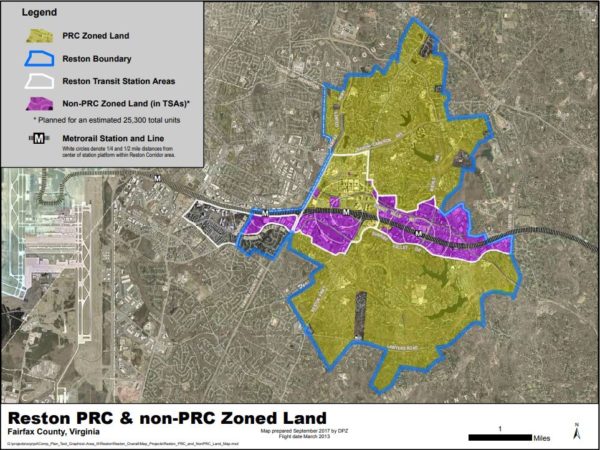
As Reston is projected to continue growing at a dramatic pace, Fairfax County is moving forward with a proposed zoning amendment to allow for greater density. But a group of Reston citizens are protesting the move, saying the proposed amendment is rushed through and under-explained.
The zoning amendment would increase the maximum population per acre in the Planned Residential Community (PRC) district from 13 persons to 15. Dwelling units per acre would increase from 50 units to 70 near Metro stations.
The Board of Supervisors is anticipated to authorize public hearings on the zoning changes at its upcoming Tuesday (Dec. 4) meeting. Public comment will not be heard at the meeting.
A group of citizens calling themselves the Coalition for a Planned Reston wrote a letter to Supervisor Cathy Hudgins saying that approval of the zoning amendment would be premature.
“The Coalition for a Planned Reston (CPR) is deeply concerned and dismayed by the announcement that you have requested County staff to move forward with the proposed PRC Zoning Ordinance Amendment,” the CPR wrote in the letter. “We strongly urge you to withdraw your request immediately and to complete the community dialogue to which you committed.”
The letter included a list of 23 areas where the groups say Fairfax County officials have supplied inadequate information. Among the criticisms of the zoning amendment are exemptions given to developers with proposals that do not conform with the Reston Master Plan.
Some of the topics of the letter involve the minutiae of zoning amendments but others — like what the CPR calls a lack of clarity over the expected number of students the added density would have on the school systems — could shape Reston for years to come.
This isn’t the first letter from the CPR over the issue. The group had previously sent a letter on Aug. 1 urging Hudgins to suspend action on the amendment. The Reston Association has also expressed concern about the impact of the zoning amendment.
Photo via Fairfax County
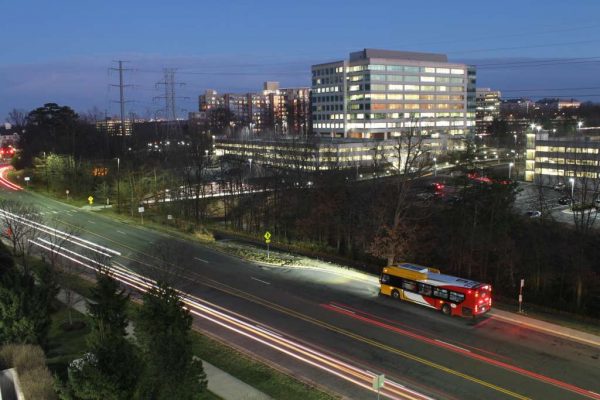
(Updated at 10:05 a.m.) Don’t expect Reston’s recent population boom to slow anytime soon.
Fairfax County’s Demographic Reports 2018 project high levels of residential growth throughout Reston over the next 27 years and the Hunter Mill District leads the county in new housing in development to match.
Reston, divided across the 20190, 20191, and 20194 zip codes, currently has a total population of 64,546 people. By 2045, the population is anticipated to reach 103,989.
To the south, 20191 is projected to increase to a population of 30,512 by 2020 and 31,995 by 2025. The 20190 zip code north of the Toll Road is also expected to grow and, by 2045, will start to close the population gap with its southern neighbor. Much of the growth in Reston’s core is likely spurred by plans to continue expansion on the Silver Line.
Further to the north though, the more suburban 20194 area code shows very little growth.

The demographics report also breaks down the type of housing throughout Reston. The 20191 area code south of the Toll Road leads in single family homes and townhomes, with 3,694 and 4,225 respectively. However, Reston north of the Toll Road contains most of the area’s multifamily housing, with 7,701 multifamily apartment units. Both sides of the road are expected to continue adding housing at about the same rate for the foreseeable future.
To deal with the increasing development, Hunter Mill also leads the county in housing development. Of the 4,354 housing projects in the county currently under construction, 3,052 are in Hunter Mill.
The Hunter Mill District overall is among the County’s most affluent areas. Income in Hunter Mill is more concentrated at the higher end than income range than the Fairfax average. The unemployment rate in Hunter Mill is approximately half a percent lower in Reston than in the rest of Fairfax County.
The cost of living is also higher in the Hunter Mill District. The median market value of an owned home throughout Fairfax County is $519,560. In Hunter Mill, it’s $584,094. Average housing rent in the County is $1,789. In Hunter Mill, it’s $1,907.
Hunter Mill also has higher levels of education than the Fairfax County average, with 73.9 percent of men and 67.4 percent of women having a bachelor’s degree or higher, as compared to the countywide average of 62.9 percent of men and 57.8 percent of women with college degrees.
Photo courtesy Lauren Pinkston
Chart via Demographics Report 2018
This story has been updated
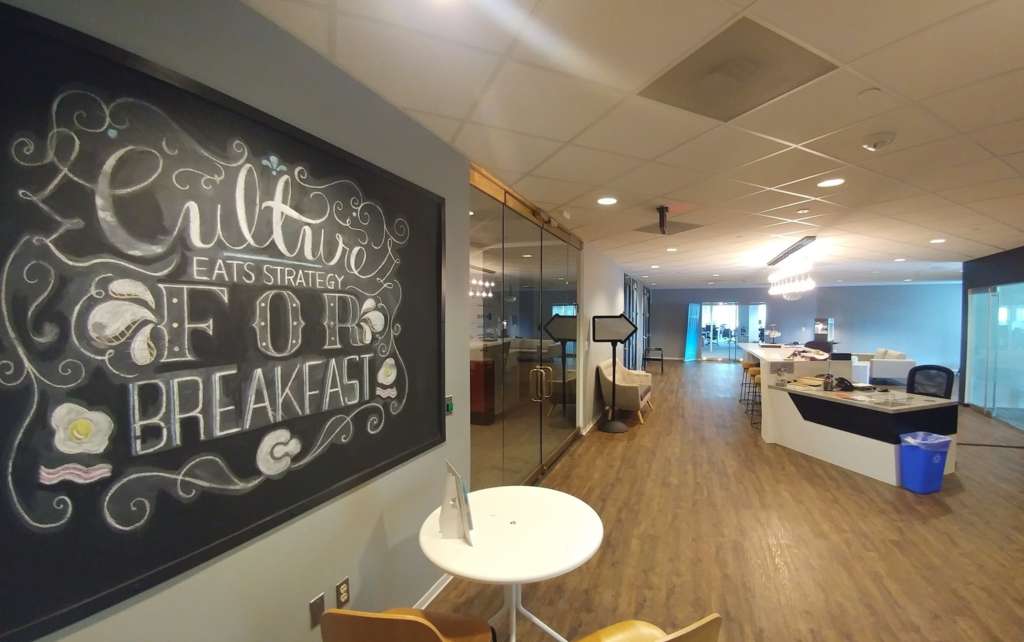
Reston-based Refraction is eyeing larger office space in the area in preparation for an expansion that will add 800 jobs in the next five years.
Currently located in Reston Town Center, Refraction plans to use a portion of the recent $1 million investment from Fairfax County toward securing new office space.
The county’s Board of Supervisors approved the use of the economic development funds yesterday (Nov. 20) for the company’s expansion.
Founded in 2014, Refraction (11911 Freedom Drive, Suite 850) is a coworking community for startups and high-growth companies. The “innovation hub” provides educational programs, along with networking and mentoring events. Currently, more than 55 companies are a part of the Refraction community.
Esther Lee, CEO of Refraction, said conversations about the move started a few months ago. Refraction wants to keep its Reston roots in order to strengthen the area’s “innovation ecosystem” by encouraging companies in its coworking space to stay and add new jobs.
A report by the Brookings Institution last year found that the D.C.-area has had the biggest loss of digital tech jobs in a five-year span compared to 50 other cities with large digital employment.
Lee called the report “alarming” and said she wants to see Refraction take an active role in boosting job growth in the region. “We want to grow the future Googles and Amazons of the world,” Lee said.
Refraction is looking to move to an office space in Reston that it roughly 25,000 square-feet in the next three to six months, she said, adding that finding a new location, receiving tenant approval and signing the lease all take time.
Refraction is working with Boston Properties to find another space in Reston Town Center.
The move to the larger space affects the launch of the Refraction’s apprenticeship program it is currently developing with the Northern Virginia Community College.
The apprenticeship, which is supported by the funding from the county, train workers for startups and high-growth companies. The goal is to launch the program early next year, Lee said.
“Lots of companies have a hard time hiring people with the right skill sets,” she said. “Many kids coming right out of college haven’t had startup experience.”
Photo via Refraction/Facebook
Fairfax County’s Board of Supervisors approved today a $1 million investment in Reston-based Refraction’s expansion, which plans to add 800 jobs in the next five years.
In addition to the new tech jobs, the investment is anticipated to go toward training 2,500 workers and eventually lead to $200 million in new capital investment over the next five years.
The funding will also support Refraction’s apprenticeship program under development with the Northern Virginia Community College to train workers for startups and high-growth companies, along with assisting Refraction’s move to a larger space in Reston.
The board approved the use of the economic development funds at its Nov. 20 meeting. Under its agreement with the county, Refraction must report its financial results and success metrics annually.
Founded in 2014, Refraction (11911 Freedom Drive, Suite 850) is a coworking community for startups and high-growth companies. Located at Reston Town Center, the “innovation hub” provides educational programs, along with networking and mentoring events.
The Refraction community has had more than 100 companies who have collectively raised $126 million in capital, according to a Refraction press release.
Fairfax County Chairman Sharon Bulova said the expansion will stimulate the local economy.
“As a county, we’re making strategic investments that help to support and grow our region’s innovation ecosystem, such as offering tech startups access to entrepreneurial expertise so they can scale their businesses,” she said.
Refraction will also partner with the county’s chief equity officer and public schools to train girls and students from underrepresented and economically disadvantaged communities on entrepreneurship skills — a partnership that supports the social and racial equity policy, One Fairfax.
County officials have said that a focus on women and minorities is especially important as the tech industry increases diversity in its workforce.
Last week, another Reston-based company announced an expansion that will create more jobs, just days after Amazon’s decision to bring its second headquarters to Crystal City.
IT services firm 1901 Group announced last Thursday (Nov. 15) that it will bring 225 more jobs to Reston in the next three years as part of a $4 million expansion.
Photo via Refraction/Facebook
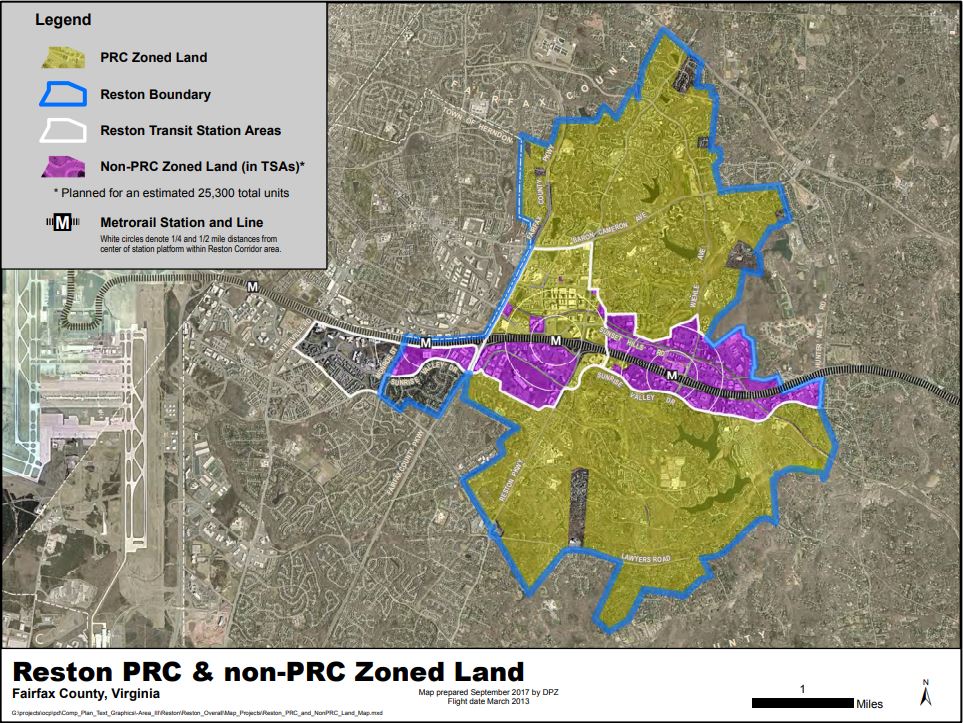
Fairfax County is expected to move forward with proposed zoning changes for Reston that would increase the population density.
After 17 months of public engagement, the county’s Board of Supervisors is anticipated to authorize public hearings on the zoning changes for early next year at its Dec. 4 meeting, the county announced Monday (Nov. 19). The meeting will not be an opportunity for public input, the statement said.
The proposal would increase the maximum allowed population per acre in the Planned Residential Community (PRC) district — Reston’s primary zoning district — from 13 persons up to 15. The current density is roughly 12.46 people per acre.
“This 13-persons per acre limit has remained unchanged for several decades and does not accommodate the future residential growth anticipated in the Reston PRC near the future Silver Line Metrorail stations,” the statement said.
The proposal would also up the limit of 50 dwelling units per acre to 70 in the transit station areas planned for mixed-use development. This would mainly affect the Reston Town Center Transit Station Area, according to the statement.
County officials began small workgroup sessions hosted by the Coalition for a Planned Reston, a grassroots organization and Reston Association in July to discuss the controversial plan.
County planning officials have argued that the Reston PRC zoning change is needed to put into action Reston’s Master Plan, which allows for future growth over the next 40 years, especially around the Silver Line Metrorail stations.
Last September, Reston 20/20, Reclaim Reston and the Reston Citizens Association encouraged Restonians to fight the County’s proposal, which then had the bump on the people per acre in the PRC District from 13 to 16.
Coalition for a Planned Reston sent a letter Aug. 1 to Hunter Mill District Supervisor Cathy Hudgins to urge her to continue suspending further action on the zoning amendment while discussions were ongoing between the Reston community and Fairfax County staff.
Reston Association sent two letters last year to Hudgins. The first one expressed opposition to the amendment as currently proposed, and the second letter included a list of actions that should be undertaken before the amendment is considered any further by the county.
“Many believe that such increases would create an unsustainable burden on Reston’s infrastructure,” the Reston Association said in an April 11 statement. “Simply, we want to ensure adequate infrastructure to account for the increased growth, including, but not limited to, adequate schools, roads, parks, athletic fields, and natural areas, while protecting the Reston vision.”
Photo via Fairfax County
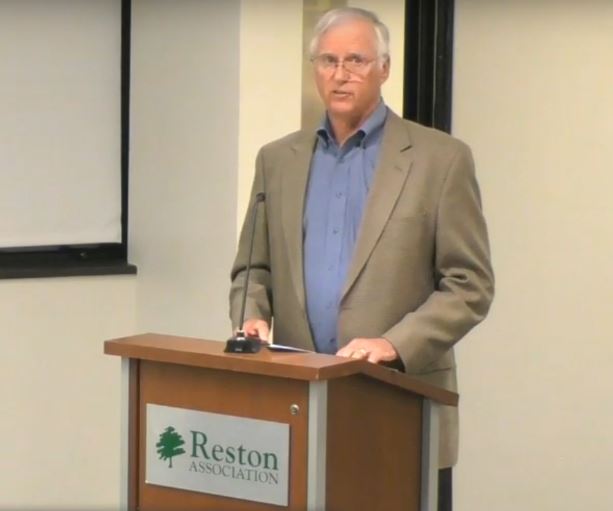
The Reston Association’s Board of Directors received a summary last week of the second annual report about the state of the environment in Reston.
Doug Britt, a Virginia Master Naturalist and the director of Reston Association’s first Reston Annual State of the Environment Report, gave an overview of the 2018 Annual State of the Environment Report (RASER) at a Reston Association meeting on Thursday (Nov. 15).
The study is intended to give readers a better understanding of Reston’s current environmental conditions in order to provide a baseline against which future changes to the environment can be measured.
The second RASER updates all of the topics addressed in the first one, along with adding new topics and recommendations. The results of the first RASER arrived in January after it was published last July.
The report has 11 new recommendations, which include the following:
- Schedule dredging when nuisance aquatic weeds are dormant
- Enforce shoreline distribution regulations for cluster shoreline properties
- Create a plan to alert residents about lake safety issues
- Assess whether de-icing salts are affecting water quality
- Partner with organizations to conduct native plant education programs, to use edible plants in landscaping and to distribute leftover food
- Determine baseline noise levels throughout parts of Reston
The report also has an analysis of 19 environmental attributes — rating them on a scale of green (good), yellow (fair), red (poor) and undetermined — and adds in excerpts from Fairfax County’s Environmental Vision Document. “I feel confident as a community that we are way ahead of a lot of other county committees in meeting the revised vision document of the county,” Britt said.
Attributes that got a “green” rating include air quality, drinking water, wastewater treatment, hazardous and toxic waste and environmental education.
Streams received a bump from “red” to “yellow” status this year after more diversity than expected was found in them over the summer, Britt said, adding that almost half of Reston’s streams have been restored. Lakes and ponds, urban forests, landscaping, wildlife management and light pollution also got bucketed in the “yellow” rating.
Attributes that lacked enough data for an adequate rating included wetlands, mammals, reptiles and amphibians, invertebrates and noise pollution.
Only one received the “red” designation: stormwater management. “When Reston first developed in the early 60’s and 70’s, the stormwater was typically shunted from development sites into nearby receiving sites as quickly as possible trough impervious surfaces,” Britt said. “This resulted in the streams not being able to handle the capacity of storm surges.”
South Lakes District Director Julie Bitzer said at the meeting that she has had a lot of residents talk to her about erosion and stormwater management, because of the amount of rain this year. “I think that is something we need to look at,” she said.
Britt encouraged the board to move away from the “band-aid approach” of expensive lake dredging to remove sediment and instead focus on soil erosion prevention, which he said will be a more cost-efficient choice for improving streams and water quality issues. He also suggested that the board empower residents to help by using low-technology solutions like rain gardens and also set higher standards for developers.
Britt also provided a breakdown of the progress of the 61 recommendations made in last year’s report. Two have been completed, while the rest include 14 lacking progress, 20 with limited work done and 25 with “substantial” progress.
“I don’t want anybody to get the idea that because only two were fully completed, that this designates some ignoring of these recommendations, because very few of the recommendations were what I would call ‘one and done,'” he said.
The three highest priorities should be protecting Reston’s urban forests, improving surface water quality and maintaining “robust” education and outreach programs, Britt said.
RASER recommendations will continue annually, while updates will come every other year, Britt said. The next updated text is expected to be released in 2020.
Photo via Reston Association/YouTube

IT services firm 1901 Group (2003 Edmund Halley Drive) will bring more than 200 jobs to Reston in the next three years as part of a $4 million expansion.
The Reston-based company, which provides internet technology services for the public and private sectors, plans to bring 225 more jobs to Reston, along with 580 new jobs to Montgomery County by 2021, according to an announcement released today (Nov. 15). The additional 805 jobs across both counties are part of the company’s expansion of its corporate footprint in Reston and IT operations center in Blacksburg, the press release said.
1901 Group’s growth in the two counties will result in “tremendous” opportunity for the state’s citizens, State Gov. Ralph Northam said.
“With one of the largest technology talent pools in the nation, Virginia’s thriving IT industry promises high anticipated growth and upward mobility for employees,” Northam said, adding the decision reflects Virginia’s ability to compete for major projects.
The Fairfax County Economic Development Authority worked with the Virginia Economic Development Partnership to secure the project for Virginia, according to the press release. VEDP will support 1901 Group’s recruitment activities through the state-funded Virginia Jobs Investment Program, which provides consultative services and funding to companies creating new jobs.
Founded in 2009, the company provides internet technology services for public and private sectors, offering infrastructure, applications management and security services through the IT-as-a-service delivery model. The Virginia Chamber of Commerce recognized the company as one of its “Fantastic 50” in 2016.
1901 Group anticipates future growth after experiencing a substantial increase in the federal government’s use of its services, according to the press release.
“1901 Group’s revenue in the federal market has increased thirty-fold in the last six years,” said Sonu Singh, CEO of 1901 Group. “Much of this growth can be attributed to operating in the Fairfax region, which has a strong technology focus and great access to talent.”
The announcement comes days after Amazon chose to locate its second headquarters to Crystal City — a decision that business leaders in the area said will transform communities including Reston into a technology corridor. Secondary and tertiary businesses lured by Amazon’s Arlington presence may entice new and emerging developments in Reston around the Silver Line, Mark Ingrao, CEO and president of the Greater Reston Chamber of Commerce, previously told Reston Now.
Photo courtesy 1901 Group
Local police and law enforcement officials are advising commuters to exercise caution as they head out today. A winter weather advisory, which was initially in effect until 1 p.m. today, has been extended to 4 p.m.
Two roads in Reston, Fox Mill Road at Folkstone Drive and Wiehle Avenue at Inlet Court, which were closed earlier this morning, are now open, according to the Fairfax County Police Department. FCPD is maintaining a list of all closures in the county online.
Here’s more from social media:
Broken down bus on Reston Station Blvd. Clearing out now. @wtop pic.twitter.com/QJxOrpZtHL
— GrantG (@OnTopOfIndy) November 15, 2018
@capitalweather Alexandria-Reston commute was genuinely harrowing. I would not recommend going out if people can avoid it. pic.twitter.com/CMiinu0xTA
— Robyn (@Luxnoctis) November 15, 2018
This story has been updated.

Let the skating begin — The Reston Town Center ice skating pavilion reopens today, just in time for colder temperatures that are expected to befall the region this week. [Reston Town Center]
Getting a little trashy — In Fairfax County, nearly 30 percent of all recycling material received was actually trash. Here’s what you need to know to reduce the amount of contaminated materials placed in recycling bins. [Fairfax County Government]
841 stronger — The Fairfax County Economic Development Authority worked with 21 businesses in the third quarter of the year to bring in 841 jobs to Fairfax County. Bechtel, a leading engineering and construction firm, consolidated its company headquarters in Reston, adding 150 jobs as a result. [Fairfax News]
Veterans Day Closures Next Week — Fairfax County Government offices will be closed Monday for the observance of Veterans Day, but county schools will remain open. [Fairfax County Government]
Shedding light on Diwali — South Lakes High School’s International Club learned about Diwali, the Hindu festival of lights recently. [Fairfax County Public Schools]
Flickr pool photo by vantagehill
A glitchy laptop caught fire on Monday and caused $93,750 in damages to a Herndon home, according to the Fairfax County Fire and Rescue Department.
The fire happened on Monday (Oct. 15) just before 1 p.m. on the 13100 block of Weather Vane Way in Herndon. Fire and rescue crews extinguished the fire, which started in a bedroom on the second floor of the two-story, single-family home. Damages were limited to the bedroom and no one was injured, according to the department.
One adult was home at the time of the fire. When she smelled smoke and heard crackling noises, she discovered a fire on the top of the bedroom’s bed.
Fire department officials said the fire was “accidental in nature.” Three adults were displaced because of the incident. Red Cross assistance was declined.
Photos via Fairfax County Fire and Rescue Department
A new study says that Fairfax County is one of the best places in Virginia to retire.
The rankings were compiled by financial website Smartasset.com, which used factors like healthcare access, the number of retirement-focused recreational centers and overall tax burden, to determine the best places to retire in Virginia.
The website wrote the following description about Fairfax County’s retirement-friendliness:
If you’re looking to retire in the great outdoors, Fairfax County may be the perfect place for you. The region houses many national parks, including Great Falls National Park and Mason Neck National Wildlife Refuge, the nation’s first sanctuary for bald eagles. You can also visit the Smithsonian Air and Space Museum.
You’d also have more than 300 miles of hiking trails to tackle as you stay active. In fact, the Fairfax County Park Authority runs more than 400 parks among more than 20,000 acres. Some feature wildlife preserves and working farms. But nature isn’t Fairfax’s only perk. You also have more than 200 regional shopping centers. And don’t worry too much about your wallet. The region’s mid-range 16.7% tax burden falls well below that of major cities. So it would behoove you to invest in tax-advantaged savings vehicles like a 401(k) or individual retirement account (IRA). And where can you use your hard earned savings? At tons of recreation centers, including an ice-skating rink and Wolf Trap National Park for the Performing Arts. You also have more than 800 playgrounds you can bring the grandkids to. And if you need it, Fairfax has more than 13 medical centers per 1,000 people. Overall, Fairfax County is definitely the place to retire in if you love the outdoors and still want some action in your life
Other areas that made the list include Falls Church (#2), which was described as a welcome sport for outdoor enthusiasts, and Vienna (#7), which was described as a place best-suited for art lovers.


