


The Town of Herndon is considering a plan to allow Peppertree Montessori School to open at 400 Herndon Parkway.
An application asking for a special exception that would permit the opening of a private school or daycare at Sugarland West Business Center is slated to be discussed at today’s Planning Commission work session.
A special exception is needed since the school would lie in the Office & Light Industrial zoning district. The other occupant of 400 Herndon Parkway is Honeywell, an aircraft parts manufacturer.
According to the staff report, a recommendation from staff not been made yet to the Planning Commission.
This is due to a revised plan from the school detailing parking location, logistics of child pick-up/drop-off, and the size/location of the fenced play area still being needed. It is expected to be provided prior to the public hearing, which is set to take place on March 22.
The Peppertree Montessori school would use the existing building and no construction would be needed at this time, a Montessori school official confirmed. It’s simply an “occupancy change.”
Because of this, if approval happens soon, the school could start accepting students and open as soon as May, a Peppertree Montessori representative told Reston Now. Everything is currently “on track” for this to happen. The school is also currently scheduling site visits and tours.
Montessori learning is one that’s focused on individualized, personalized, student-led learning based on principles developed by Italian physician Maria Montessori in the early 20th century.
The proposed 4,951-square-foot school would hold up to 50 students, ranging in ages of newborns at 6 weeks of age to eight-year-old third graders. An outdoor fenced-in play area is also expected to be added.
Screenshot via Herndon Planning Commission Staff Report
Monday, March 8
- Living in Reston A Long Time Ago (6 p.m.) – Join the Reston Historic Trust and Museum for a trivia night put on by a South Lakes High School student who wanted to learn more about the town she grew up in. It will focus on Reston’s history and what it was like living in Reston in the 1960s, 1970s, and 1980s.
Tuesday March 9
- Simon B. Rhymin’ (2 p.m.) – Dwayne Reed, America’s favorite rapping teacher, introduces Simon B. Rhymin’ who is a fourth grader with a heart full of lyrics. Join Reed as he reads from his debut book.
Wednesday, March 10
- Paint like Van Gogh (6:30 p.m to 8:30 p.m.) – Create your own Vincent Van Gogh-inspired masterpieces. Join the Fairfax County Public Library staff in using the technique called “impasto,” meaning to lay paint on thickly to make it stand out from the canvas. All art materials will be provided and available for pick-up.
Thursday, March 11
- Cains Branch (11 a.m.) – Hike the trails in Chantilly and learn the hidden history of this Fairfax County park. Follow the waterway to discover more about the life of early inhabitants who made this area their home.
Friday, March 12
- Eye of an Eagle (7 p.m.) – Be it date night or family night, see if you can spot the animal by its anatomy at this virtual trivia night hosted by the Reston Association.
Saturday, March 13
- Drive-Up Movie Night (6 p.m.) – Take a trip to Tysons for a baseball-themed drive-up movie night. Entry cost supports the Crohn’s & Colitis Foundation and DC Take Steps Program. It’s a double family-friendly feature of “Field of Dreams” & “42: The Jackie Robinson Story.”
Sunday, March 14
- Birding for Beginners (9 a.m.) – 2021’s hottest new hobby… is birding? As the spring migration season takes flight, join fellow birders at Lake Fairfax to learn how to spot feathered flyers.
- Founder’s Day (2 p.m.) – A new exhibit at Lake Anne’s Jo Ann Rose Gallery imagines the beginnings of Reston. The art focuses on the seven principles outlined by Reston founder Robert E. Simon. On Sunday, there’s also a reception celebrating the exhibit which will be on display until April 30.
Photo via vantagehill/Flickr
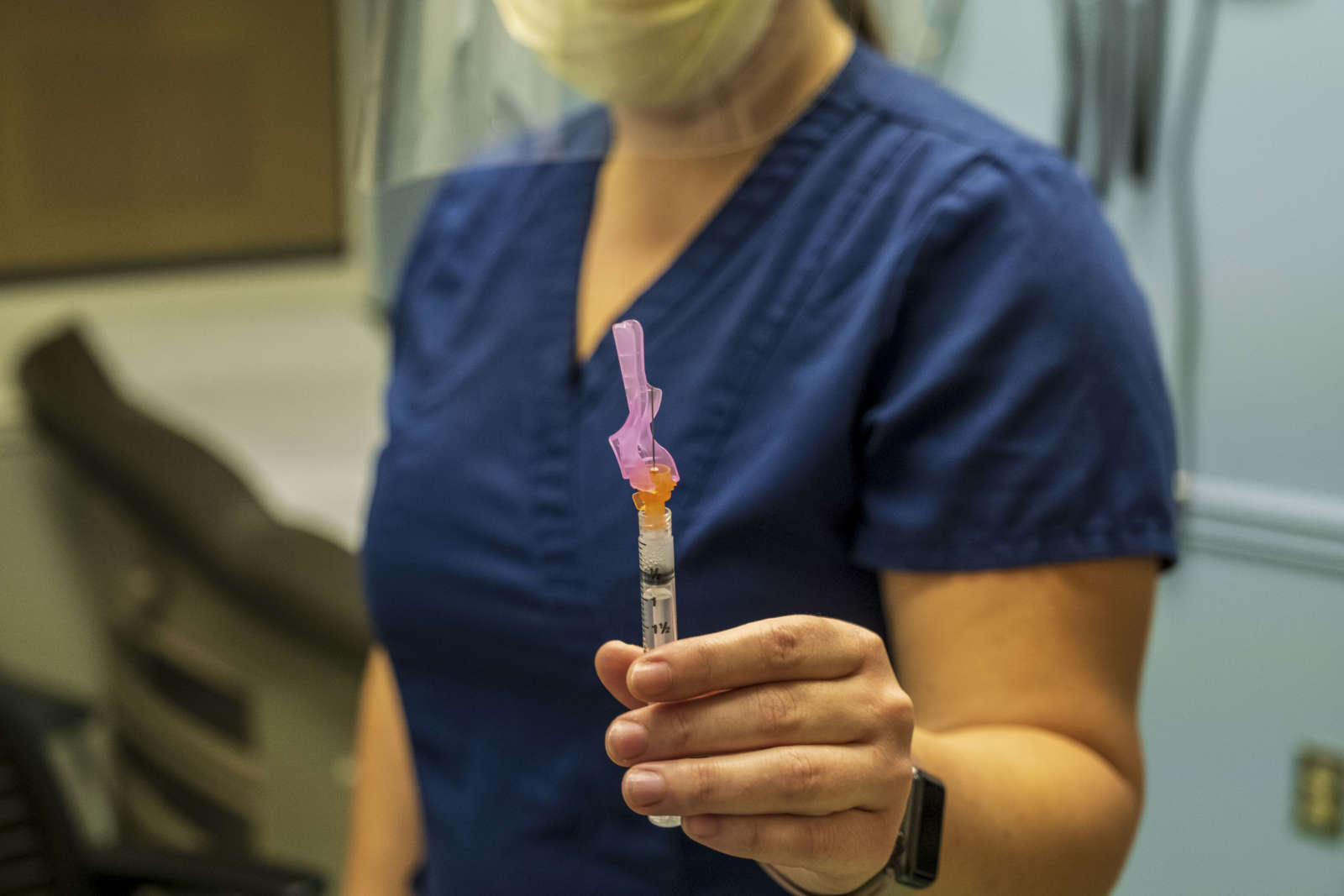
(Update: 10:45 a.m.) Thanks to federal and state partnerships, some local retail locations of CVS, Walgreens, Safeway, and Harris Teeter are all offering no-cost vaccine appointments separate from the county.
But appointments remain extremely hard to come by even as the one-dose Johnson & Johnson begins to roll out. Demand far exceeds supply.
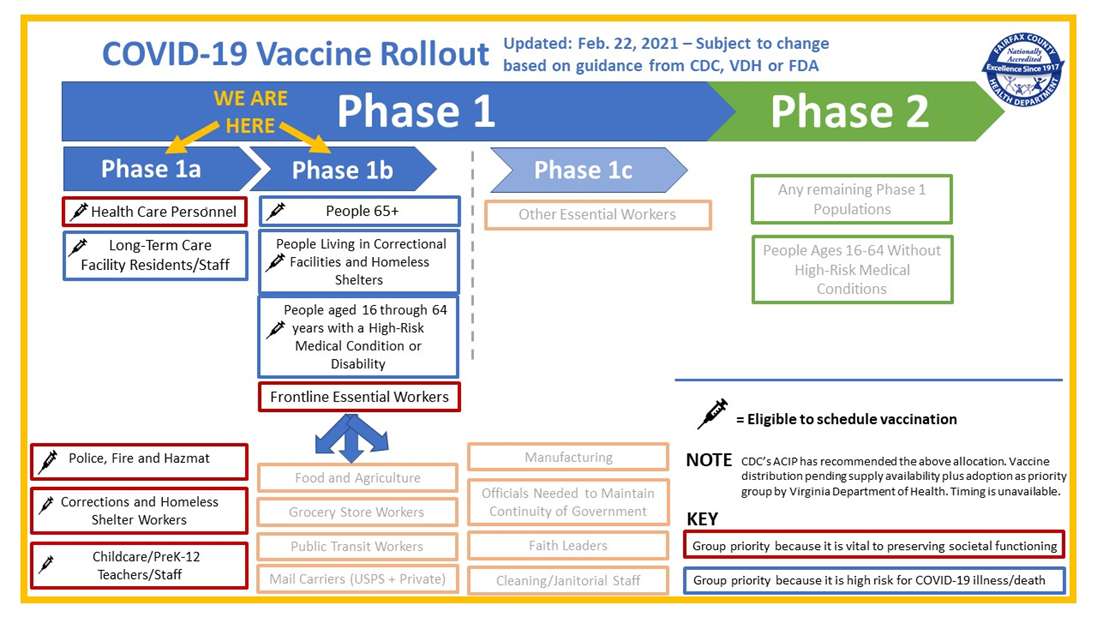
Virginia is currently in Phase 1b, meaning those 65 or over and those with 16 to 64 with underlying medical conditions are eligible to receive the vaccine.
The Virginia Health Department tells Reston Now that more than 80,000 doses are being given to retail pharmacies state-wide for distribution, an increase from last month.
The 69,000 J&J vaccine doses announced last week started coming in yesterday, VDH confirms, and clinics across the state are expecting to start using it today (March 5).
VDH also says that they’ve directed retail pharmacies to “prioritize” those 65 and over to “make significant progress in vaccinating that vulnerable population.” All of this provides hope that more vaccines and more appointments will soon become available for those that are eligible.
Early last month, CVS began offering vaccine appointments at its local stores.
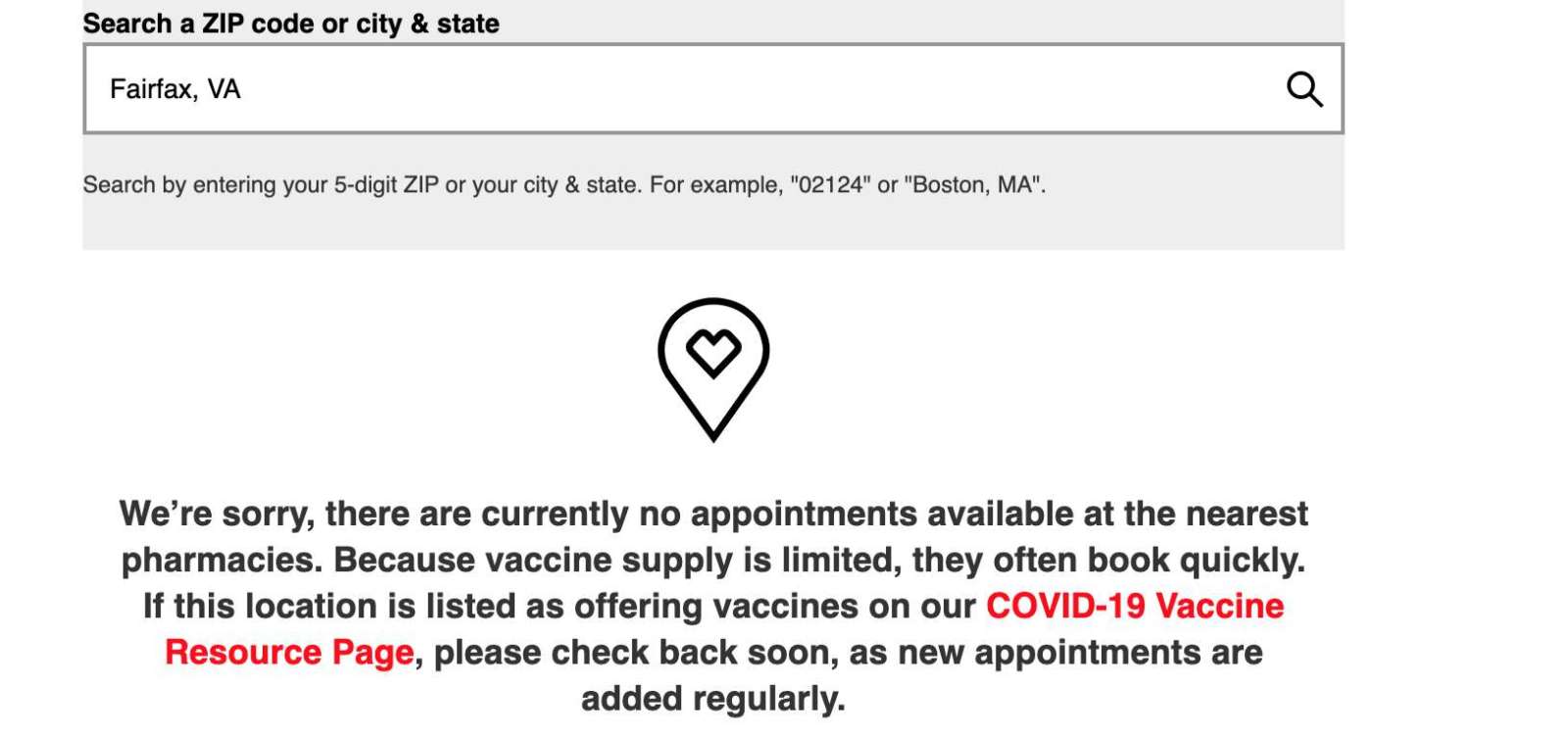
Currently, 41 CVS pharmacies are offering the vaccine in Virginia with appointments booked through their website. But that includes only one location in Fairfax County. The location is in Fairfax, but is listed with no exact address.
CVS spokesperson Amy Thibault tells Reston Now there are roughly 41,580 appointments per week available at the 41 locations statewide. Most of them are using the Moderna vaccine. Basic math says that’s about 1,000 appointments per store per week.
However, as of March 4, all appointments are booked at that one Fairfax location.
“In most (if not all) states, the number of individuals who are eligible to receive the vaccine under the state’s rules far outnumber the state’s available doses,” she says.
Currently, in Fairfax County, more than 100,000 people remain on the county’s waitlist. About 183,000 county residents have already been vaccinated.
Thibault confirmed that CVS is receiving a “one-time allocation” of 212,000 doses of the Johnson & Johnson vaccine this week which will be spread across their stores in 17 states. Scheduling for that began yesterday (March 4) on the CVS website and administrating begins today (March 5).
She says that CVS has the capacity to administer 20 to 25 million doses a month nationwide, assuming there’s an adequate supply of not only the vaccine but also supplies.
At the other retail pharmacies offering vaccines in Fairfax County, challenges are similar.
Safeway, and its parent company Albertsons, are also offering appointments to those 65 and over. According to their online scheduler, the one-dose Johnson & Johnson vaccine is also now being offered.
Locations in the county include one on Elden Street in Herndon, South Lakes Drive in Reston, Georgetown Pike in Great Falls, and West Ox Road in Fairfax.
So far, no appointments are currently available at least through March 13 at any locations.
“Store supply is based on allocations from state and local health departments. New appointments are added to the online scheduler as more vaccine become available,” writes Andrew Whelan, Albertsons spokesperson, to Reston Now. “Demand is high and appointments are often claimed very quickly. As dose allocations increase, so too will the opportunity to secure an appointment.”
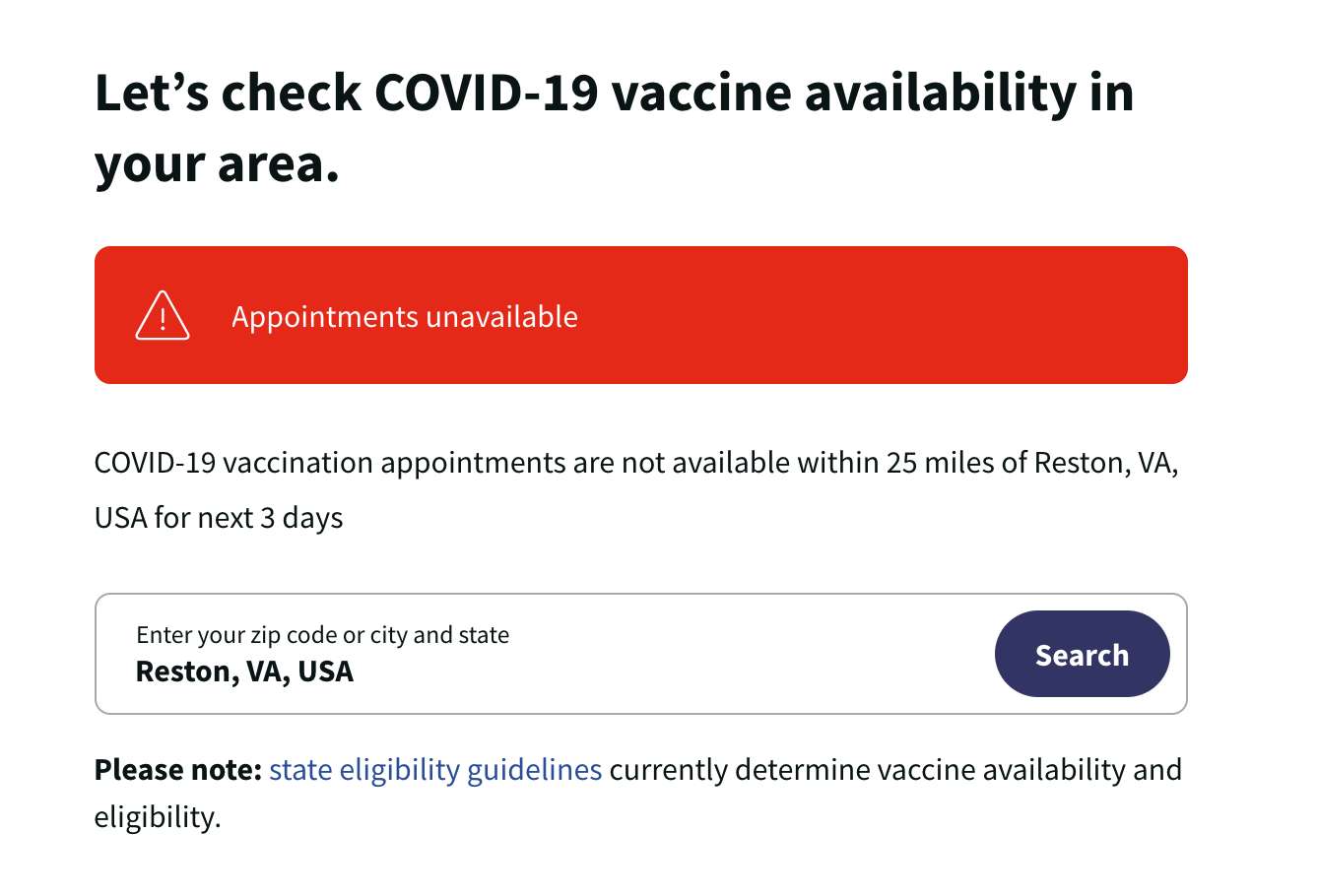
Walgreens announced their participation in the federal partnership and started administering vaccines in Virginia. But, at least as of March 4, there are no appointments available within 25 miles of Reston, Fairfax, or Tysons.
Harris Teeter’s website notes that they were to start distributing vaccines this week in Virginia, but a company spokesperson writes to Reston Now that this hasn’t happened yet.
“Harris Teeter is expected to receive limited quantities of the vaccines soon at nine pharmacies in and around Northern Virginia… appointments will be released as vaccine allocations arrive.”
Giant has taken another approach. Instead of creating its own appointment system, the grocery chain is using the vaccine supply allocated to them by the federal government to help the Fairfax County Health Department vaccinate their waitlist.
“People invited from the queue will be able to select from several Giant locations within the Fairfax Health District,” reads the health department’s blog. “Locations and details will be included in the appointment scheduler email.”
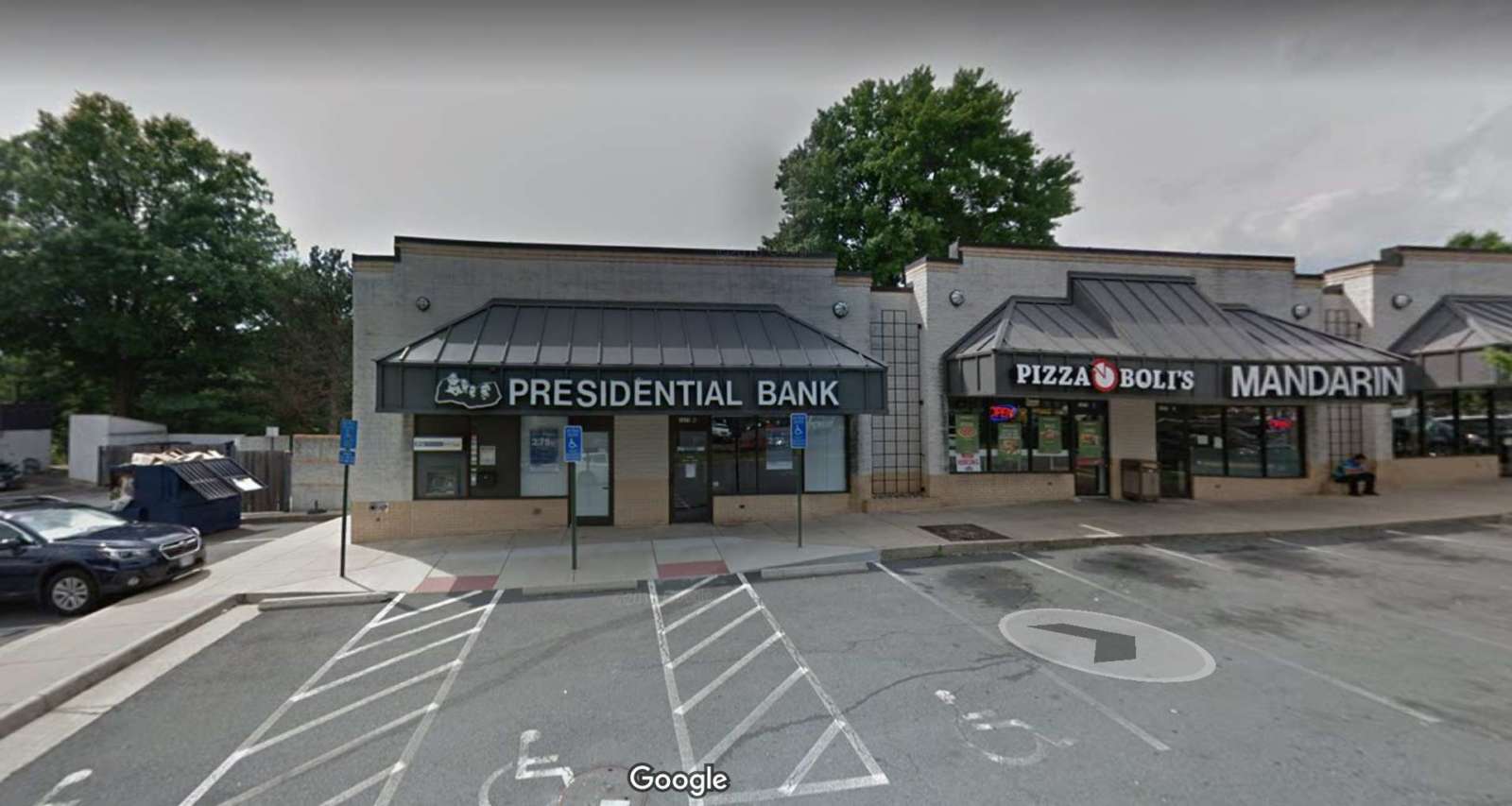
Presidential Bank is moving its Reston branch to across the street from the Reston-Wiehle Metro Station.
The new location will open on Monday, March 29 at 11211 Reston Station Blvd.
“You will see the same familiar faces at this new location while enjoying more convenience in an upgraded environment,” notes the bank’s news release about the move.
Until then, the old branch about two and a half miles away at 1675-N Reston Parkway will remain open. That branch’s final day of service will be Friday, March 26 and will close at 4 p.m.
Reston Station Blvd., particularly near the Reston-Wiehle Metro Station, has had many new additions in recent months despite the pandemic.
Luxury apartments, an indoor baseball training facility, and a virtual shark tank are just a few of the recent comers.
Photo via Google Maps
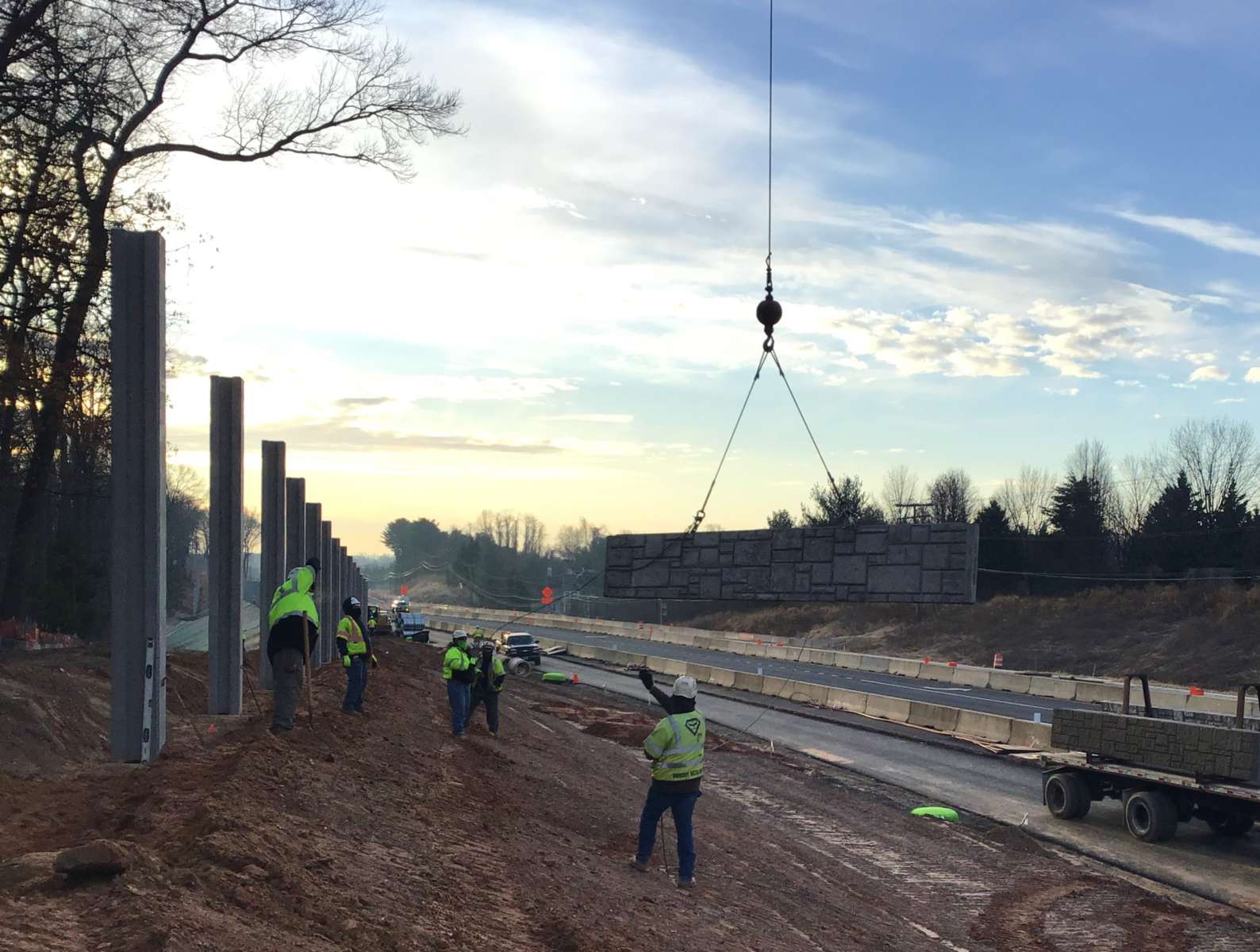
(Update 3/3) A major project to widen nearly seven miles of Route 7 between Reston Avenue and Jarrett Valley Drive remains on track for completion by July 31, 2024.
It is also expected to be completed within its $314 million budget, confirms Jennifer McCord, a Virginia Department of Transportation spokeswoman.
The improvements include widening the heavily-trafficked road – also known as Leesburg Pike – from four to six lanes, adding shared-use paths for pedestrians and bikers, and making major design changes to intersections.
It’s all being done within the guidelines of the Fairfax County Comprehensive Plan.
The project was first discussed nearly a decade ago, approved in 2017 with construction beginning two years ago, in the spring of 2019. It’s expected to take just over five years to complete.
Over the last two months, construction has continued at different sections of the road.
Between Reston Avenue and Utterback Store Road, a noise barrier is currently being added as well as the installation of a storm sewer between Reston Avenue and Baron Cameron Avenue.
From Baron Cameron Avenue to Colvin Run Road, existing asphalt was removed.
In the Difficult Run Area, work has continued on the new Colvin Run as well as excavation for the pedestrian tunnel that will run under Route 7.
Between Faulkner Drive to Jarrett Valley Drive, water main relocations and traffic shifts are taking place.
Landscaping work and third-party utility relocations are underway throughout the roadway.
This construction has also resulted in a number of traffic changes and lane closures that are constantly shifting.
In the upcoming months, crews will begin removing the Route 7 bridge over Difficult Run and will eventually complete a higher, longer bridge to replace it.
Colvin Run will also be diverted to a new stream channel. Small weirs (barriers) are being placed in the stream bed to encourage a meandering flow pattern and vegetation growth.
Construction will also continue on the pedestrian tunnel underneath Route 7 connecting the north and south sections of Colvin Run Mill Park.
Despite the ongoing work, public access to the Gerry Connolly Cross County Trail will be maintained.
While crews continue to work with COVID-19 safety protocols in effect, the decreased traffic volume in the earlier part of the pandemic has allowed VDOT to extend work hours in certain cases.
Photo courtesy of VDOT
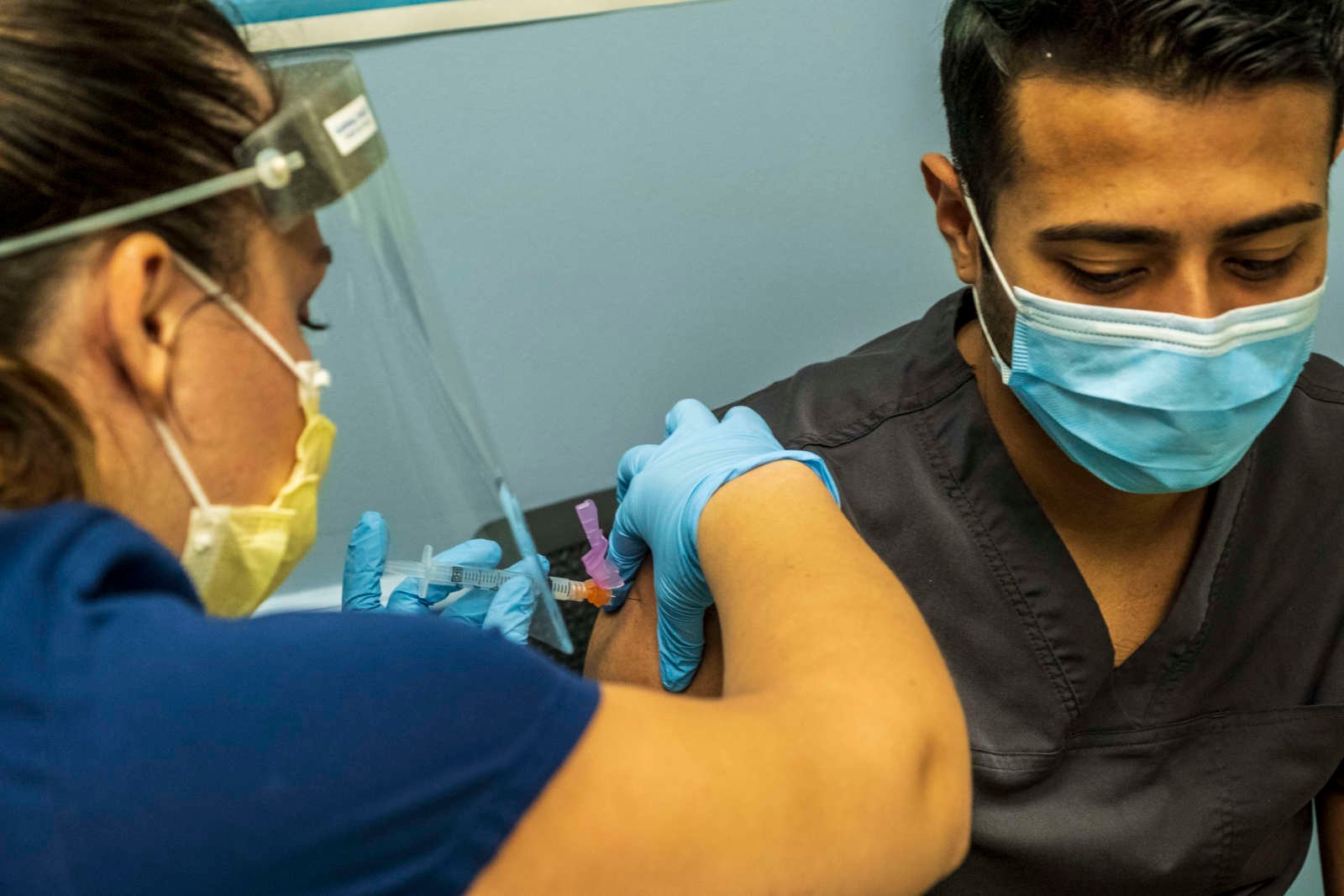
The Fairfax County Health Department has completed sending out vaccine appointment invitations to 42,000 eligible residents who signed up on Jan. 18 and are now hopeful they’ll be able set up appointments at a faster clip.
“Now that we have got thru [Jan. 18 registrations], we anticipate that we will move more quickly through the other dates,” Tina Dale, a spokesperson for the Fairfax County Health Department, writes Reston Now. “In addition, we are working with more vaccination partners, so this, too, will assist us in moving through our registration list faster.”
If residents registered on Jan. 18 or before and have not received an invite, Dale says they should check their spam folder. If there’s no email with the subject line “Schedule Appointment,” residents should call the COVID-19 Vaccine hotline at 703-324-7404 and a call taker should be able to assist.
The county’s dashboard now says they are currently making appointments for those who registered on Jan. 19.
Six weeks ago, the county first allowed residents who qualified for Phase 1b to register for COVID-19 vaccine appointments. Phase 1b includes residents 65 years old and over and those 16 to 64 with underlying medical conditions.
On that first day when vaccine appointments opened to those in Phase 1b, Jan. 18, more than 42,000 eligible signed up and registered – far exceeding another other day.
In fact, as the dashboard shows, the 42,000 registrations on Jan. 18 alone were approximately the same number of combined registrations over the next four days.
The county acknowledged that sending everyone an invitation to schedule a vaccine appointment who signed up on Jan. 18 would take “several weeks.”
Nearly 94,000 residents remain on the waitlist, which means they are awaiting an invitation to schedule an appointment.
The county says they don’t have an estimated timeline for when those remaining 94,000 people will be sent an invitation to sign up for a vaccine appointment or when the county will move to sign up those in Phase 1c for appointments.
However, the Virginia Department of Health expects the vaccine supply to increase over the next two months, says Dale, and the Commonwealth has said they expect to get through all of those who are eligible and want the vaccine in Phase 1b by mid to late April.
Essentially, demand still far outweighs supply – a continued issue since the vaccine first started being distributed in December.
Overall, about 176,700 residents have been vaccinated in Fairfax County, which represents just over 15% of the total population in the county.
That’s comparable to Virginia and the country as a whole, which has vaccinated about 16% and 15% (respectively) of the population according to the Washington Post.
Additionally, on Friday, the county acknowledged that there issues with about 2,800 registrations “not being correctly captured in the system due to technical errors.”
Dale says that these registrations have been corrected and were a result of a combination of issues, including both “user error and system error.”
Since then, the county has added new features to the registration to reduce the possibility of user error, like providing two fields for email addresses and limiting the number of characters for phone number and zip code.
The county is also asking people to review the spelling of their names and email addresses as well as ensure their date of birth is accurate to make sure there are no errors.

Monday, March 1
- Reston Association Board Election (5 p.m.) – Month-long voting begins at 5 p.m., with residents able to vote online or via their mailed ballot (which is being sent out on March 1). Five candidates are certified for three open seats on the 2021 Board of Directors. Results will be announced in April at the Annual Members’ Meeting.
Tuesday March 2
- Suburban Space to Natural Oasis (7–8 p.m.) – Kim Young, a naturalist at Annandale’s Hidden Oaks Nature Center, is teaching how to turn a “typical suburban yard into a native plant wildlife habitat.” She’ll go over processes and what plants are right for your suburban space. This is a two part virtual program.
Wednesday, March 3
- Home Fermenting (1–2 p.m.) – Fermenting vegetables at home have become somewhat of a fad during the pandemic. Join Kathryn Strong from the Virginia Cooperative Extension to learn how to properly do it and the equipment needed.
Thursday, March 4
- Tom Stoppard (5 p.m.) – Join Smithsonian Associates as they talk with author Hermione Lee about her new biography about one of the greatest living playwrights, Tom Stoppard. He’s the author of Rosencrantz and Guildenstern are Dead and co-writer of the 1998 Oscar winner Shakespeare in Love.
Friday, March 5
- Drawing Comics (4–5:30 p.m.) – Let the creative juices follow as cartoonist Bud Little guides students through a four-week comic strip class. Students will learn how to create and illustrate basic cartoons using their own characters and settings. The class is intended for kids. It’s being put on by the Arts of Great Falls, it is in-person, and there’s a 7-student maximum.
Saturday, March 6
- American Girl (11 a.m.) – Authors Erin Teagan and Terry Catasus Jenning are talking girl power with the introduction of their new books. Jennings is introducing her new series Definitely Dominguita and Teagan is talking about her new series about the American Girl Doll of the Year Kira’s adventures. During this Zoom event, four American Girl dolls are being raffled off, including 2018’s American Girl of the year Luciana.
- Cider Tasting (5 p.m.) – Drink up with a virtual apple cider tasting. Join authors Dan Pucci & Craig Cavallo of the book American Cider: A Modern Guide To A Historic Beverage as they talk and walk through a virtual cider tasting featuring ciders from D.C.’s ANXO.
Sunday, March 7
- Challah Challah (11 a.m.) – Hannah Wolfman-Arent, baker for popular Sonny’s Pizza in D.C., leads a challah workshop. She’ll teach how to make the classic egg loaf as well as variations like one with garlic jam. A full recipe, an ingredient list, and a step-by-step guide will also be provided prior to the online class.
Photo via Pixabay/dinar_aulia
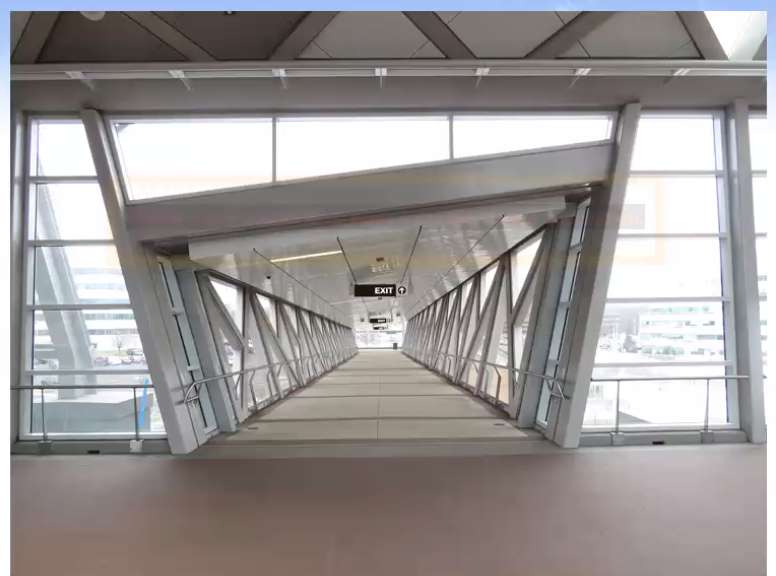
Metro’s Board of Directors is still proceeding as if the Silver Line Phase II will open this year, but a public survey is asking riders to weigh in on drastic service cuts, including closing the newly-opened Phase II stations in Janurary 22.
Last week, Metro announced that the public comment period for its 2022 fiscal year budget has officially opened.
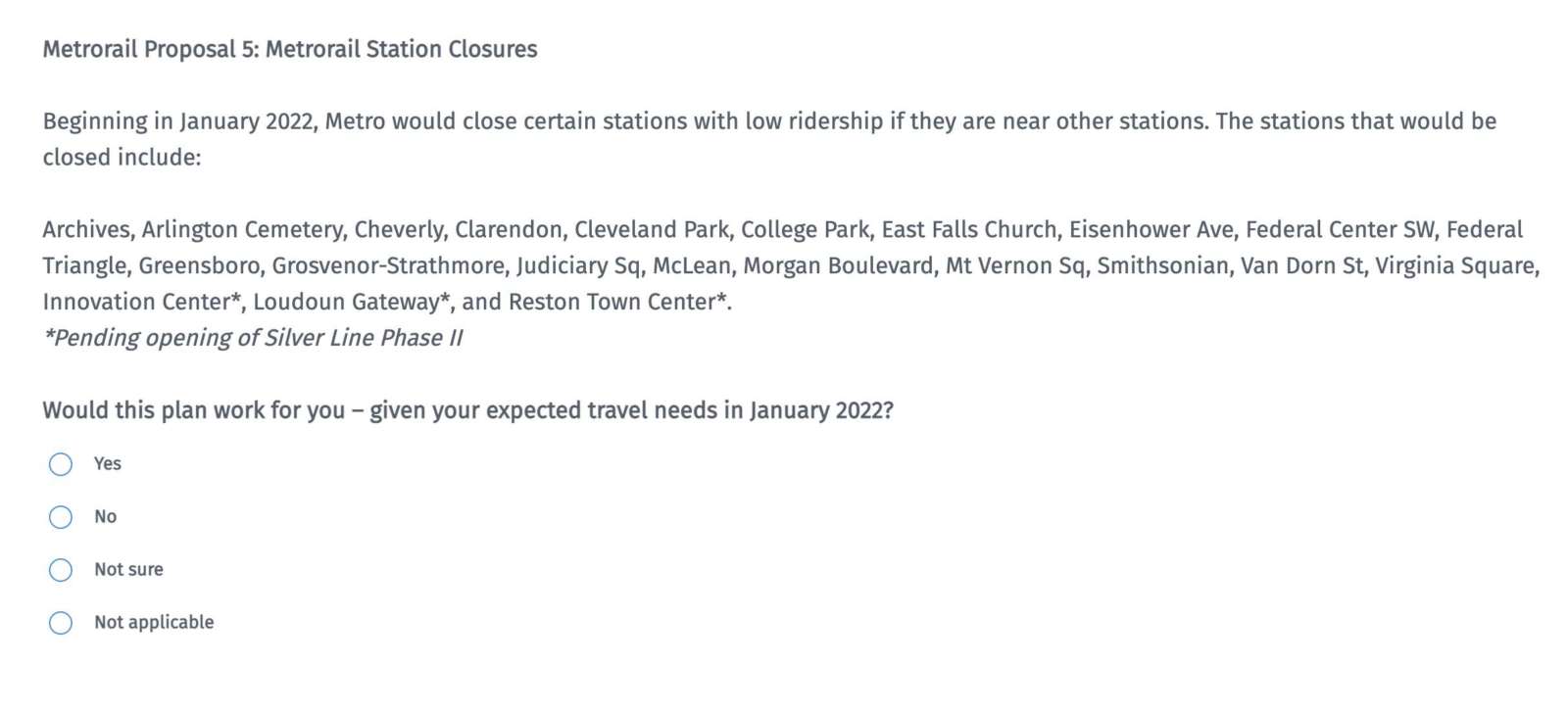
As part of that, they’re asking riders to fill out a survey about what extreme service cuts they’d be willing to tolerate beginning on Jan. 1, 2022 if additional federal money is not available.
In these options is a question about the closing of 22 stations across the entire system, including two Silver Line stations – McLean and Greensboro – and three potentially newly-opened Silver Line Phase II stations – Innovation Station, Loudoun Gateway, and Reston Town Center.
Although the 2021 budget says that Phase II could open July 1, 2021, it could be delayed until, at the earliest, the fall.
At last week’s budget work session, an tentative estimate was noted as early November.
A Metro spokesperson tells Reston Now there’s “no clear answer yet” about an opening date, however the Metro Board has to proceed as if it will open in 2021 in order to pass the 2022 budget.
“The Board will take all public feedback into consideration before approving a final budget for FY22,” writes the spokesperson.
So, it is possible that the Silver Line Phase II could open this year, only for the stations to close a few months later due to the budget shortfall.
Complicating the situation is that Silver Line Phase II and the proposed drastic service cuts are essentially on two different timelines.
Earlier this month, Metro’s staff presented an update on 18 different safety and operational issues previously noted in December.
Of those 18, 17 were still in the midst of being resolved or remained unresolved. They range from maintenance issues with the station platform pavers to several thousand damaged track fasteners that need replacing to cracked third rail insulators.
The Metro spokesperson confirms that resolving these safety and operational issues have a greater impact on the timeline for the opening of the Silver Line Phase II than the budget shortfall in 2022.
In fact, Metro’s funding for Phase II construction hasn’t really been impacted by Metro’s overall financial woes.
“The Metro board has not done anything to delay the opening of Phase II as a matter of Metro policy or budget policy,”Metro Board of Supervisors member Matt Letourneau told Reston Now in January. “Thus far the position of the Metro board has been whenever the project is…. deemed acceptable and safe, and gone through testing, we should open it.”
That’s not to say that the Silver Line Phase II won’t cost Metro money that needs to be accounted for in the 2022 budget.
At last week’s work session, it was noted that operating costs for Phase II are about $120 million annually, or $10 million a month.
If it is delayed to November 2021 due to safety and operational issues, that would save Metro about $40 million.
However, retention costs like security and ongoing maintenance are $28.5 million annually or about $2.38 million a month — even if the stations and trains are not running and operational.
In the end, if Silver Line Phase II does not open in early November and gets delayed until additional federal funding does come through, it could save Metro about $7.5 million a month.
Metro is continuing to plan the 2022 budget under the prospect that they will not receive additional federal funding, though.
The most recent coronavirus relief package provided Metro more than $600 million in federal funds. That funding, notes Metro, helped avoid layoffs and provide essential services.
But even with that funding and other austerity measures, “there is not enough money to fill the entire budget gap for the fiscal year that begins July 1, 2021,” Metro’s press release reads.
Hence, the potential need to close 22 stations, including the possibly-just-opened Silver Line Phase II stations.
Among the other options for service cuts asked in the survey is closing Metrorail every day at 9 p.m. and trains arriving only every 30 minutes at most stations.
Metro is asking riders to fill out the survey by Tuesday, March 16 at 5 p.m.
There’s a decent chance, however, that these worries over closing stations on Jan 1, 2022 could become moot.
President Biden’s $1.9 trillion stimulus plan has $20 billion earmarked for public transit agencies.
At this time, however, it remains unclear how much would go to Metro if the plan does pass in Congress.
Photo courtesy Metropolitan Washington Airports Authority
(Update 3/1/21) The public hearing regarding leasing Frying Pan Farm Park’s Ellmore Farmhouse to ServiceSource will take now place on May 4 as opposed to March.
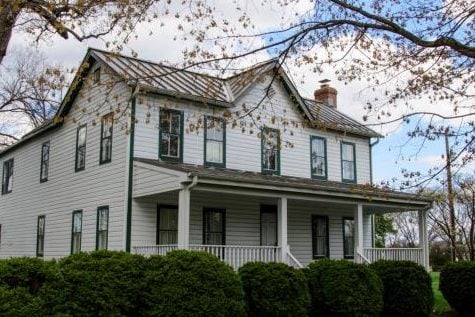
Earlier: Earlier this week, the Fairfax County Board of Supervisors approved a hearing in March to discuss allowing Fairfax County Park Authority to sublease the 130-year-old, two-story, 3,300 square foot house at 2739 West Ox Road to ServiceSource as part of the county’s “Resident Curator Program.”
The terms of the lease allows the organization to transform the house into a “Community Integration Center” that would provide employment to its clients through an onsite café and handicrafts specialty store.
ServiceSource has programs across the country including theirs in Northern Virginia for more than 40 years, according to its website.
It was back in July 2019 when ServiceSource was first identified as a candidate to take over Ellmore Farmhouse.
The sublease would be for 29 years.
The ServiceSource – the “resident curator” – has proposed rehabilitating “by making ADA-compliant improvements and incorporating green-building designs in a manner that respects the heritage, historic features and appearance of the property,” reads the board agenda.
Under the lease, the resident curator also agrees to provide ongoing maintenance and property upkeep for the next nearly three decades in exchange for rent-free use.
The Resident Curator Program is managed by the Fairfax County Park Authority (FCPA). There are four properties in the program: Lahey Lost Valley in Vienna, Ash Grove also in Vienna, Hannah P. Clark House in Lorton, and Ellmore Farmhouse in Herndon.
In 2001, FCPA acquired Ellmore Farmhouse for inclusion in Frying Pan Park.
The house was first constructed in 1891 as a family home. William Ellmore, a prominent local politician who served on the Fairfax County Board of Supervisor, operated a dairy farm on the property as well until it was sold in 1945. It continued as a dairy farm for another decade before shutting down operations.
It went through several different owners, including a church, prior to being sold to FCPA.
Photo via Fairfax County Government
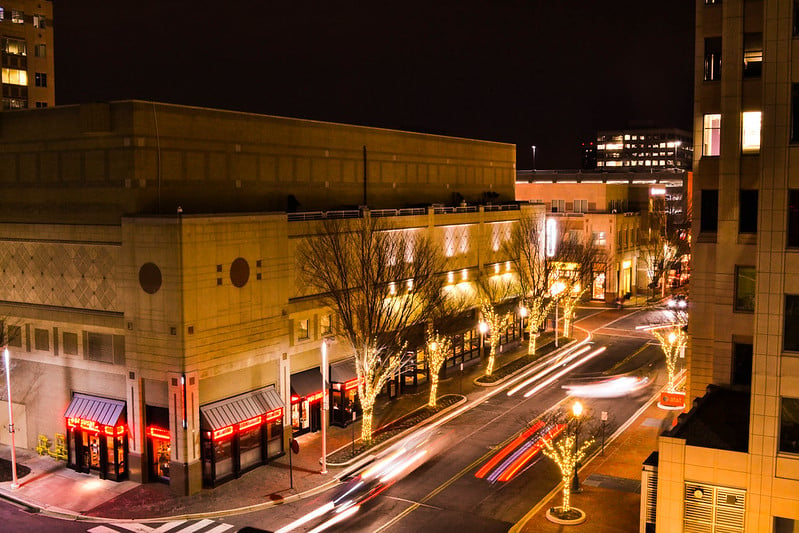
Reston Town Center manager Boston Properties and security contractor MaxSent may have to face trial over a women’s 2018 lawsuit alleging she tripped, fell, and got hurt walking from the parking garage to the shopping center.
Camille Sedar fell down a short flight of stairs, landed face first, and lost consciousness. She was later diagnosed to have a concussion. The suit alleges she tripped due to loose, uneven bricks and “sagging” caulk at the top of the stairs causing the fall.
Sedar says she doesn’t remember the fall. Though witnesses didn’t actually see her fall, they saw her on the ground, hurt, and called for help, according to court documents.
Sedar won the appeal in the U.S. Court of Appeals for the Fourth Circuit earlier this week, as first reported by Bloomberg Law.
The appeal centered on if there was enough “material” facts and evidence that lack of upkeep and maintenance could have caused the loose bricks and her fall.
Sedar provided photographic evidence, scuffed shoes, and an expert engineer witness saying large gaps due to loose bricks create tripping hazards.
The defense argued that it wasn’t on their clients to fix small “sidewalk irregularities,” which are visible to all and known to be avoided. Plus, it was “mere speculation” that these irregularities caused her fall in the first place.
However, a loose brick may not be immediately obvious and visible, argued the plaintiff, and therefore created a hazard.
Sedar also offered evidence that the shopping owners and property manager had knowledge of the hazard.
The court agreed there was enough evidence that the loose brick and sagging caulk could have created a tripping hazard and, therefore, the case could go to trial.
“We make no comment on which parties’ evidence is more persuasive. We only ask whether Sedar has provided ‘evidence beyond speculation’ that provides a sufficient basis for a reasonable inference of causation,” reads the court’s opinion. “We conclude that she has.”
Reston Now has reached out to each side’s attorneys but have yet to hear back as of publication.
Photo by R. Dawson/Flickr
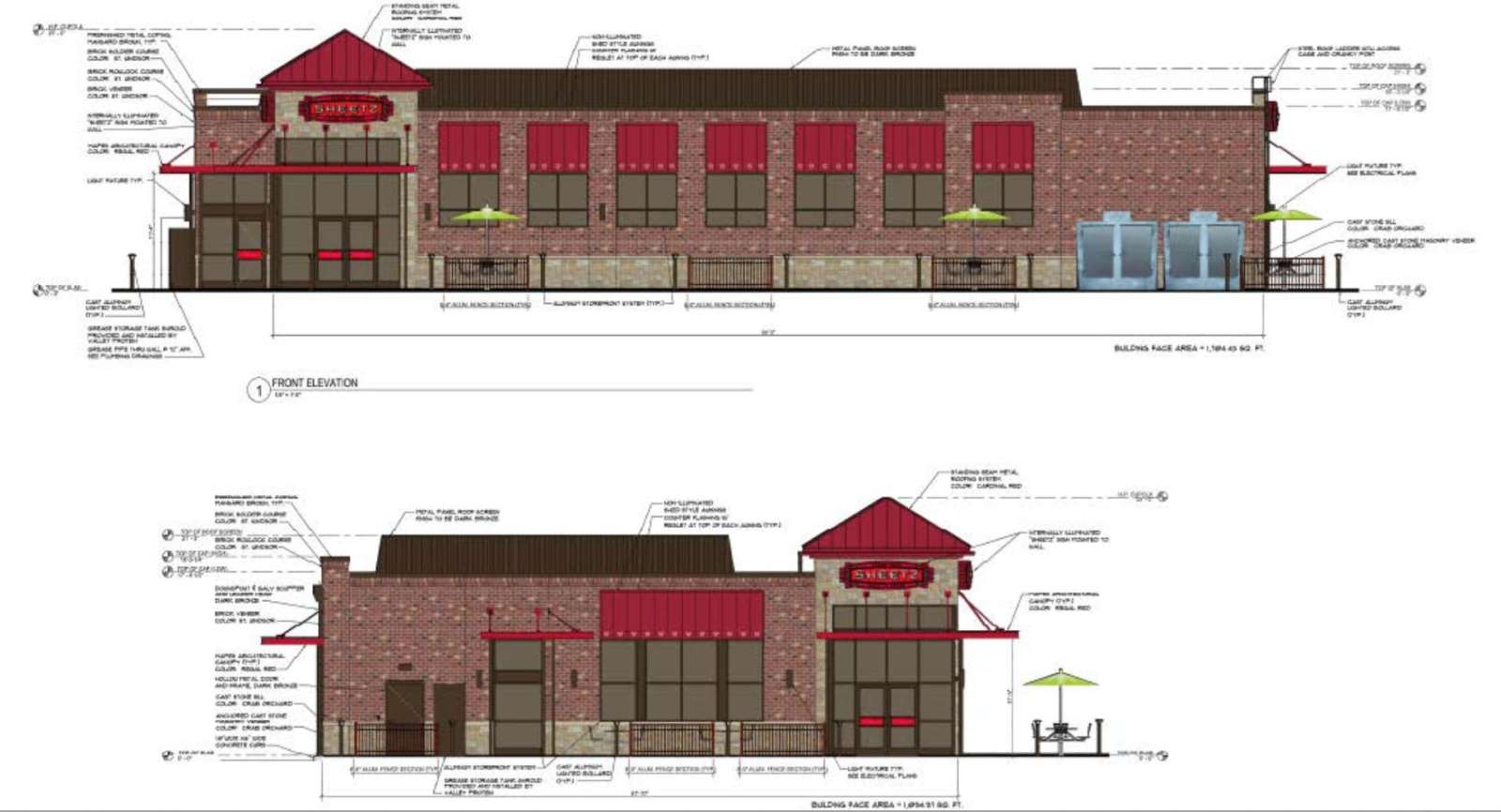
(Update 2:45 p.m.) A Sheetz is soon coming to Herndon.
On March 3, the Fairfax County Planning Commission is holding a public hearing and a vote to approve a Sheetz gas station, a quick-service food store, and drive-thru restaurant at 13850 McLearen Road. The staff has recommended approval.
After that, the proposal will move to the Fairfax County Board of Supervisors where there will be another public hearing if needed and, potentially, a Board of Supervisors vote on March 23.
First reported a year ago, the 6,07-square-foot Sheetz will occupy a roughly 2.7-acre parcel of land. It will take the place of a set-to-be-demolished 1977 two-story office building and surface parking lot, per the staff report, at the intersection of McLearen Road and Towerview Road.
It remains unclear when construction will begin nor when the Sheetz is expected to open.
“Since this project is in the very early stages, it is too soon to provide additional details,” Nick Ruffner, Public Relations Manager for Sheetz, wrote in a statement to Reston Now.
The family-owned popular gas, convenience, and restaurant chain has more than 600 stores across the Mid-Atlantic including a number of locations in Fairfax County.
The Sheetz is planning to operate 24 hours a day, seven days a week with a maximum of nine employees on-site at any one time. It also will have 49-car parking spots (five of which are reserved as electric vehicle charging stations) plus bicycle parking in accordance with county guidelines.
The “architecture character” of the building will include materials such as a brick veneer facade with cast stone masonry. Staff is recommending “high quality landscaping” so the development is “attractive” in its “highly visible site” along McLearen Road.
The new development is also required to incorporate green building practices and the staff prefers that Sheetz makes the building LEED-certified (or an equivalent program).
Fairfax County – as well as other Northern Virginia jurisdictions – have prioritized LEED-certification as a means of meeting long-term goals of cutting carbon emissions.
Photo via handout/Fairfax County Planning Commission

The Fairfax County Board of Supervisors is aiming to formally update its Workforce Dwelling Unit (WDU) policy to provide affordable rents for those in need as rents continue to increase across the region.
However, these policy changes would not apply to Reston, which is currently undergoing its own separate study to update its WDU policy. The proposal heads to the board for a public hearing and a vote today.
The main update is lowering the household income levels served under the county’s rental WDU program from a maximum of 120% of the Area Median Income (AMI) in the Washington D.C. Metro Area to 80% of AMI. It also now includes those at 70% and 60% of AMI in the program. The changes are based on a comprehensive staff report released last month.
The area median income (AMI) is the household income for the median household in a region. Currently, in the D.C. region, the AMI is $126,000 for a household of four.
“We conducted a housing strategic plan process over the last two or three years, which identified, sort of these lower incomes as being in the greatest need,” says Tom Fleetwood, Director of Fairfax County Housing and Development. “While at the same time, the higher income tiers that were served under the original version of the WDU program really were closer to the prevailing market rents here in Fairfax County.”
The updates would also lower the minimum percentage of rental units offered as WDUs from 12% to 8%. According to the plan, 4% of those units would need to be offered to those at 80% AMI, 2% to those at 70% AMI, and 2% to those at 60% AMI.
However, these numbers are different and are specifically revised for the Tysons Urban Center.
Fleetwood says the policy is “similar in intent” but the specific numbers are more in context with the realities of Tysons’ rental market.
In Tysons, developers would have the ability to choose between two different options for their affordable rental units. Either they can offer 2% of the units at 60% AMI, 3% at 70% AMI, and 8% at 80% AMI, which brings their WDU commitment to 13% in total, or they can simply offer 10% of their units at 60% of AMI.
The county’s planning commission voted unanimously to make these changes.
Reston is working on their own separate WDU study as part of the Reston Comprehensive Plan Study. That study is being initiated by a task force led by Hunter Mill District Supervisor Walter Alcorn.
Alcorn’s communication director Lisa Connors, tells Reston Now that Reston has a “separate formula for WDUs.” Similar to the policy updates that the county is voting on, WDUs will be discussed at the study’s task force meeting on March 8.
Affordable housing continues to be a challenge for Reston.
The Board of Supervisors is also voting to update, revise, and rewrite editorial elements of the policy that was first established in 2015. The revisions would update data, rework outdated terminology, and remove references to programs that no longer exist.
Photo by Mike Reyes/Flickr

Monday, Feb. 22
- Undefeated (2:30-3:15 p.m.) – Meet Kwame Alexander, one of the hottest young adult book authors writing today. The New York Times best selling and Caldecott Medal-winning author (for his 2019 book “The Undefeated“) will talk about his writing process and give a short reading.
- Brothers Gupta (6:30-7:30 p.m.) – After being rejected many times, Suneel Gupta dives into the question of if “charisma”can be learned. He gets into a conversation with his brother Sanjay Gupta, and famed CNN medical correspondent, about his new book focusing on this topic. This virtual event is hosted by Politics and Prose.
Tuesday Feb. 23
- Burn (6-7 p.m.) – In October 1933, George Armwood of Princess Anne, Maryland was lynched. It was the last known lynching in a state with a horrific history of the crime. Join filmmaker Will Schwarz – and founder of the Maryland Lynching Memorial Project – as he virtually screens and discusses his documentary film, “Burn: The Lynching of George Armwood.” This event is for adults.
Wednesday, Feb. 24
- Backyard Bats (7-8 p.m.) – Learn about the enchanting life of the world’s only flying mammal from Leslie Sturges, President of the Save Lucy Campaign. She’s teaching participants about the seven bat species that call this region home and how to spot the animals in your own backyard. This event is virtual.
Thursday, Feb. 25
- A Reckoning (Noon to 1 p.m.) – This virtual event from Woodlawn & Pope-Leighey House in Alexandria features four poets giving voices to the erased lives of those who were enslaved at Woodlawn. Readings are accompanied by music from harmonica player Cliff Bernier.
Friday, Feb. 26
- Asteroid (3 p.m.) – Last October, a NASA spacecraft touched down on Bennu, an asteroid, and collected samples of the rock. Hear from Dr. Ben Ashman, a member of the mission’s navigation team, about how they did it.
Saturday, Feb. 27
- Geocaching (2 p.m.) – Go on a Global Positioning System-led treasure hunt at Lake Fairfax. Geocaching continues a much-beloved activity, especially during the pandemic since it’s almost entirely done outdoors. Bring your own GPS and learn how to find your own treasure.
Photo via alobenda/Pixabay
(Update 2:05 p.m.) Fairfax County opted out of Virginia’s new COVID-19 vaccine pre-registration system, but the decision seems to be causing confusion among some county residents.
The Virginia Department of Health tells Reston Now, the day after the launch (Wednesday), 542 calls from Fairfax County zip codes to the statewide COVID information line asking questions about vaccines were rerouted back to Fairfax County’s call center.
When asked about this, the Fairfax County Health Department admits that they understand the confusion.
“We understand that it could still be confusing that there are two systems,” wrote Jeremy Lasich, spokesperson for the Fairfax County Health Department. “We are happy that we have a strong partnership with VDH and that their call center is appropriately routing questions about Fairfax County back to our local call center.”
As recently as Wednesday, Fairfax County Board of Supervisors Chairman Jeff McKay told Reston Now that forgoing the Virginia appointment system to continue with the county-only system would help out in this regard.
“I am glad we can maintain our system that residents are familiar with to cut down on confusion,” he said.
Reston Now has reached out to the Chairman’s office with this new information but has yet to hear back as of publication.
Fairfax County is the only jurisdiction to opt-out of Virginia’s COVID-19 vaccine pre- registration system.
The county maintains that they are “consistently” communicating the need to register through their system through their website, blog, social media, and other avenues.
This includes translating COVID-related materials into Spanish and sharing information via text messages from the Health Department’s outreach team.
VDH has also added language to their website directing Fairfax County residents back to the appropriate portal.
If Fairfax County residents do end up registering through the state system, the information does end up eventually going back to the county. But those residents will be added to the end of the waitlist, notes the county.
If residents register in both the state and county systems, the first registration will be honored and the second one will be removed.
Over the last several weeks, the vaccine rollout across Fairfax County, the Commonwealth, and the region has continued to be plagued with technical issues, equity concerns, and challenges.
The county is currently in “Phase 1b”, meaning they are offering vaccine registration for all residents age 65 years or older and those between 16 to 64 years old with underlying medical conditions.
This is in addition to those in previous groups, including health care personnel, childcare workers, and K-12 teachers or staff members living or working in the county.
Check your eligibility status here and to register, visit the county’s vaccine registration page. Fairfax County residents can also call 703-324-7404 for more information.
According to the county’s new data dashboard, those who registered on January 18 – the first day it was open to those in Phase 1b – are now being scheduled for appointments.
More than 42,000 people signed up that day. That’s nearly four times as many people that signed up on Jan. 11, the next busiest day for registrations, the county health department says.
The county expects it will take “several weeks” for all those that registered on Jan. 18 to get a scheduled appointment.
It may appear as if progress isn’t being made when the appointment date on the dashboard isn’t changing, Lasich writes, but the health department is moving through registrations.
“We continue to ask for your patience,” the county spokesperson writes. “We promise you will get an appointment if you are on our list.”
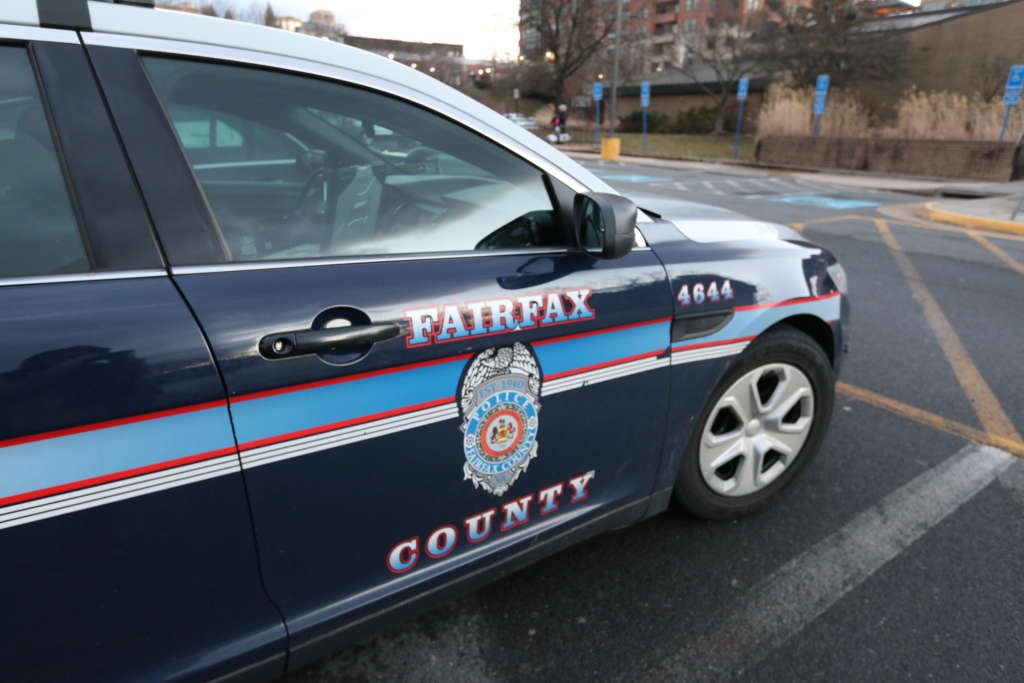
A new bill could potentially significantly limit how long the Fairfax County Police Department and other state police departments can store data obtained through automated license plate readers (ALPRs).
As originally written, SB 1198 would bar police from storing data obtained by ALPRs for more than 30 days without a warrant or ongoing active investigation.
ALPRs have the ability to collect data and information like photos of license plates as well as a driver’s location at a particular date and time. They are often mounted on street poles, overpasses, or police square cars while a central server houses the data.
A number of civil liberty organizations like the ACLU have come out against the use of ALPRs as an invasion of privacy and chilling First Amendment protected activity.
The Virginia State Supreme Court ruled late last year that police departments are allowed to keep this data “indefinitely,” no warrant or investigation needed. This came after a Fairfax County judge ruled otherwise in 2019, saying that it was in violation of Virginia’s “Data Act.”
While some jurisdictions do purge this data relatively quickly, the Fairfax County Police Department does not.
Reston Now has confirmed that FCPD stores information collected by ALPRs for up to a year.
Their reasoning is that the information helps protect the community and locate missing persons.
“Using technology such as license plate recognition has improved our ability to safeguard Fairfax County,” Anthony Guglielmi, FCPD spokesperson, told Reston Now in a statement. “With that, we have stringent systems in place to protect the information privacy and constitutional rights of those we serve. We appreciate efforts to further study this important issue because it’s paramount that we strike an equitable balance between data retention and investigational integrity.”
The state bill was introduced by State Senator Chap Petersen who represents the 34th district, which covers Fairfax, Vienna, Oakton, and parts of Chantilly.
He introduced a similar bill back in 2014 and 2015, which limited storage of data to only seven days. That 2015 bill, which did have bipartisan support, was vetoed by Governor Terry McAuliffe.
“License plate readers… capture the movement of vehicles. They track who’s attending a church service, who’s attending a political rally, a gun show,” Petersen tells Reston Now. “It can be very arbitrary and very dangerous in that… it’s used to essentially put a layer of surveillance over citizens who are exercising their constitutional rights.”
The bill also notes that opportunities to secure employment, insurance, credit, and the right to due process could be “endangered by the misuse of certain of these personal information systems.”
That being said, Petersen notes his bill does not stop the collecting of this information but rather simply adds a “limitation” – 30 days – on how long information of this nature can be stored.
Additionally, the 30-day limitation is dropped if a warrant is obtained or there’s active criminal or missing person investigation.
“Frankly, it’s a pretty modest requirement,” he says.
Petersen says it’s this lack of “guardrails” that worry him and why he’s continued to propose bills of this nature.
“They say they have all types of internal controls. But who’s the judge of that?,” he says. “Who the heck knows who has access and who doesn’t. It’s the ability to use this [information] arbitrability or prejudicially that we have no control over.”
Besides police departments, information collected by ALPRs have also been used by revenue commissioners to confirm payment of property taxes (as is the case in Arlington County).
A slightly altered version of the bill did pass the Senate, but the House amended the bill to “establish a stakeholder workgroup to review the use of license plate readers” as a substitute for the 30-day limitation of storage.
“When my bill came out of the Senate, it was going to be an actual law. The House turned it into a study,” says Petersen. “Which basically kinda neuters it.”
The ACLU of Virginia agrees, with Executive Director Claire Guthrie Gastañaga writing Reston Now in an email that the organization “strongly supports SB1198 as introduced.”
“A requirement that government have a reason for collecting information about you and limiting the retention periods on data collected for no reason is reasonable,” she writes.
However, Petersen admits that it seems like he’s “hit a wall” in terms of getting his version of the bill passed. He doesn’t see a ton of value in a study, so he’s not going to accept the House amendment.
However, it does not alter his long-term goals that this bill could assist with.
“That’s limiting the amount of information the government can collect on its citizens,” he says. “We live in a free society… the government should not be tracking its own citizens.”
